



A kitchen deep clean means working through the places a daily wipe-down never reaches: inside the oven, behind and under the fridge, in the range hood filter, the dishwasher filter, the drain and the cabinet fronts. Do it top to bottom, clean before you sanitize, and plan on a few hours for a typical kitchen. This guide gives you the order, the tools, the safe ratios and a checklist you can work from. It also covers when it makes sense to hand the job to a team.
TL;DR
- Work top to bottom and inside out: range hood and cabinets first, appliances next, counters and floor last, so debris falls onto surfaces you haven’t cleaned yet.
- Clean first, then sanitize. Grease and soil shield bacteria from sanitizers, so spraying a disinfectant on a dirty counter does very little.
- Range hood filters and stove grease are a safety issue, not only a cosmetic one. Grease is a fuel source in cooking fires.
- Most households do a full kitchen deep clean a few times a year, with a lighter monthly pass on the appliances.
- If you would rather not spend a Saturday on it, our teams in Vancouver, WA and the Portland metro area handle kitchen-focused deep cleans.
Table of Contents
- What a kitchen deep clean actually includes
- Before you start: tools, supplies and the right order
- Step by step: how to deep clean a kitchen
- Clean first, then sanitize: the step most people get backwards
- The safety side of a kitchen deep clean: grease and fire
- How often should you deep clean your kitchen?
- Don’t forget what’s around the kitchen
- Our perspective: why kitchens are where a deep clean pays off most
- When it makes sense to hire the job out
- FAQ
- Sources
What a kitchen deep clean actually includes
A regular clean keeps the kitchen presentable: dishes, counters, stovetop surface, sink, floor. A deep clean goes after the buildup that accumulates slowly and out of sight. Think of it as the difference between tidying a room and removing the layer of film that has settled on everything in it over months.
Here is what sits on a thorough kitchen deep clean list:
- Range hood and filters: the grease catchers above your stove.
- Cabinet fronts, handles and the tops of upper cabinets: where cooking residue and dust combine into a sticky layer.
- Oven interior, racks and door glass.
- Stovetop, burner grates, drip pans and the gap beside the stove.
- Refrigerator and freezer interior, shelves, drawers and door gaskets, plus the coils and the floor underneath.
- Dishwasher filter, door seal and spray arms.
- Microwave interior and the turntable.
- Sink, faucet base and drain, plus the garbage disposal if you have one.
- Small appliances: toaster crumb trays, coffee maker, air fryer basket.
- Pantry shelves and drawers, wiped and checked for expired food.
- Backsplash, countertops, light switches, appliance handles.
- Baseboards and floor, including edges and under the toe-kick.
If you want to see how the kitchen fits into the rest of the house, our room-by-room deep cleaning guide and deep clean house checklist cover every other room. For the difference between the two levels of service, see deep clean vs regular clean.
Before you start: tools, supplies and the right order
Most of the work is friction and time, not strong chemistry. You need:
- A bucket of hot water with dish soap
- Several microfiber cloths and a few old rags
- A non-scratch scrub pad and a soft-bristle brush (an old toothbrush works for crevices)
- A degreaser, or a paste of baking soda and water for baked-on spots
- Distilled white vinegar for mineral deposits (not on natural stone)
- Rubber gloves, a vacuum with a crevice tool, trash bags and a step stool
- Unscented household bleach only if you plan to sanitize (details below)
The order that saves you work
- Clear the room. Remove dishes, small appliances and anything on the counters. Take out the trash.
- Start the slow jobs. Put range hood filters and oven racks to soak in hot, soapy water. Start the self-clean cycle only if your oven manual recommends it and you can ventilate well.
- Work top to bottom. Upper cabinets, hood, backsplash, then appliances, then counters, then floor.
- Clean, rinse, then sanitize the surfaces that touch food.
- Finish with the floor, because everything you dislodged ends up there.
This order is practical rather than scientific: gravity moves dirt downward, and it is far easier to mop once at the end than to re-mop after wiping a cabinet.
Step by step: how to deep clean a kitchen
1. Range hood and cabinet tops
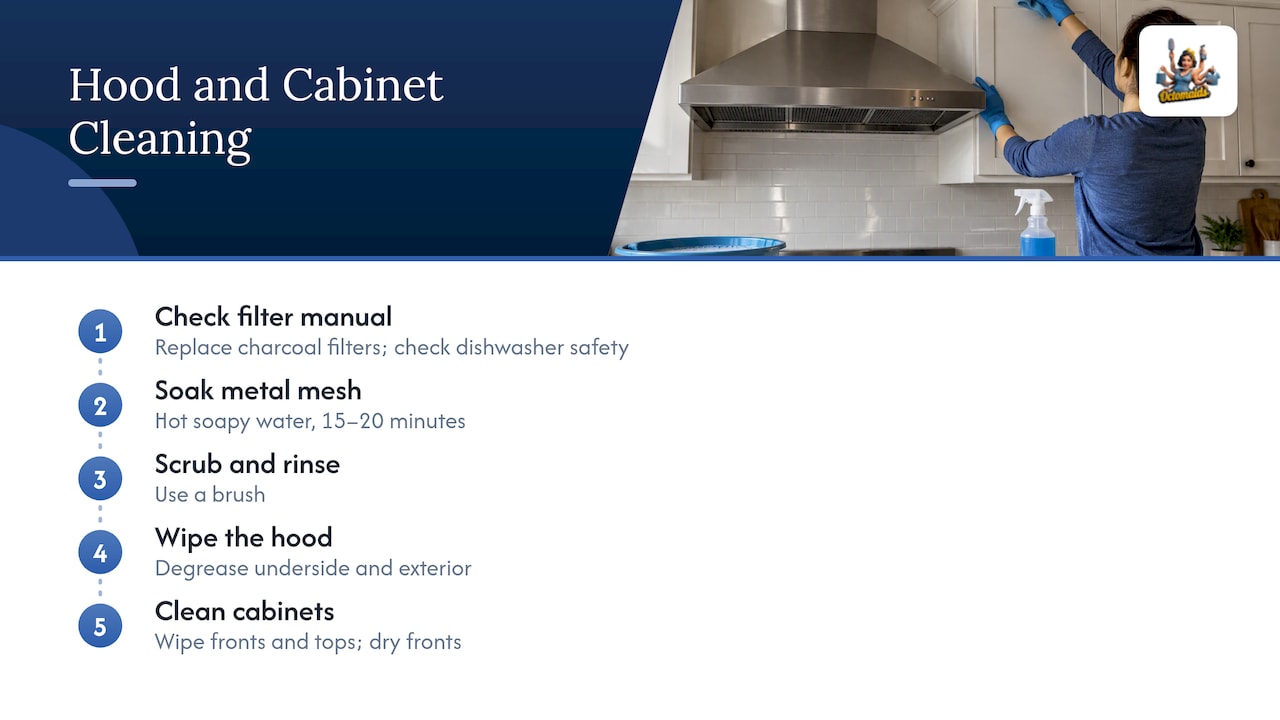
Metal mesh filters can usually be soaked in hot water with dish soap for 15 to 20 minutes, then scrubbed with a brush and rinsed. Check your hood’s manual first, since some filters are dishwasher-safe and charcoal filters in ductless hoods typically cannot be washed at all and have to be replaced.
Wipe the underside and exterior of the hood with a degreaser. Then do the cabinet fronts: a cloth wrung out in hot, soapy water, followed by a dry cloth, because leftover moisture and soap film attract more dust. Don’t skip the cabinet tops if you can reach them. They collect a dusty, greasy layer that most people forget exists.
2. Oven and stovetop
Remove the racks and let them soak. For the oven interior, spread a paste of baking soda and water over the baked-on areas, leave it for several hours or overnight, then wipe it out with a damp cloth and a plastic scraper. For the glass, a baking soda paste and a soft cloth works without scratching.
On the stovetop, lift off the grates and burner caps and wash them in the sink. Clean under them, along the sides of the range, and in the gap between the stove and the counter, where spills tend to collect. Gas burner ports can clog with food, so clear them with a soft brush or a pin, with the burners off and cool.
3. Refrigerator and freezer
Pull everything out and check dates. Wash removable shelves and drawers in warm, soapy water, and let glass come to room temperature first so it doesn’t crack. Martha Stewart’s kitchen guide suggests a spray of equal parts water and distilled white vinegar plus a little dish soap for the interior. Wipe the door gaskets, where food residue and mold like to hide, with a toothbrush.
Once a year or so, unplug the fridge and vacuum the coils and the floor underneath. Dust on coils makes the compressor work harder, and it is a job that rarely makes anyone’s regular list.
4. Dishwasher, sink and drain
Remove and rinse the dishwasher filter, wipe the door seal and check the spray arm holes for food bits. In the sink, scrub the basin and the base of the faucet, where limescale and soap film build up. For the drain, remove the stopper and clean it by hand. Pour in hot water afterward to flush loosened debris. Sponges and dishcloths are among the dirtiest items in the room, so replace or launder them as part of the job.
5. Microwave and small appliances
Heat a bowl of water with a splash of vinegar for a few minutes, let it sit with the door closed, then wipe down the steamed-on food. Wash the turntable by hand. Empty toaster crumb trays, descale the coffee maker according to the manufacturer’s directions, and wash air fryer baskets and blender gaskets.
6. Pantry and drawers
Take everything out, vacuum crumbs, and wipe shelves with warm, soapy water. Group like items as you restock and toss anything expired. Drawers get the same treatment: empty, vacuum, wipe, dry.
7. Counters, backsplash and high-touch spots
Wash with hot, soapy water first and rinse. Then deal with the places hands touch most: cabinet pulls, the fridge handle, light switches, the faucet. Use a product that is safe for your countertop material. Natural stone like granite or marble can be damaged by vinegar and other acids, so a pH-neutral cleaner is safer.
8. Floor
Vacuum or sweep including the edges, move the trash can and any rugs, then mop with a cleaner suited to your flooring. Do this last.
Clean first, then sanitize: the step most people get backwards
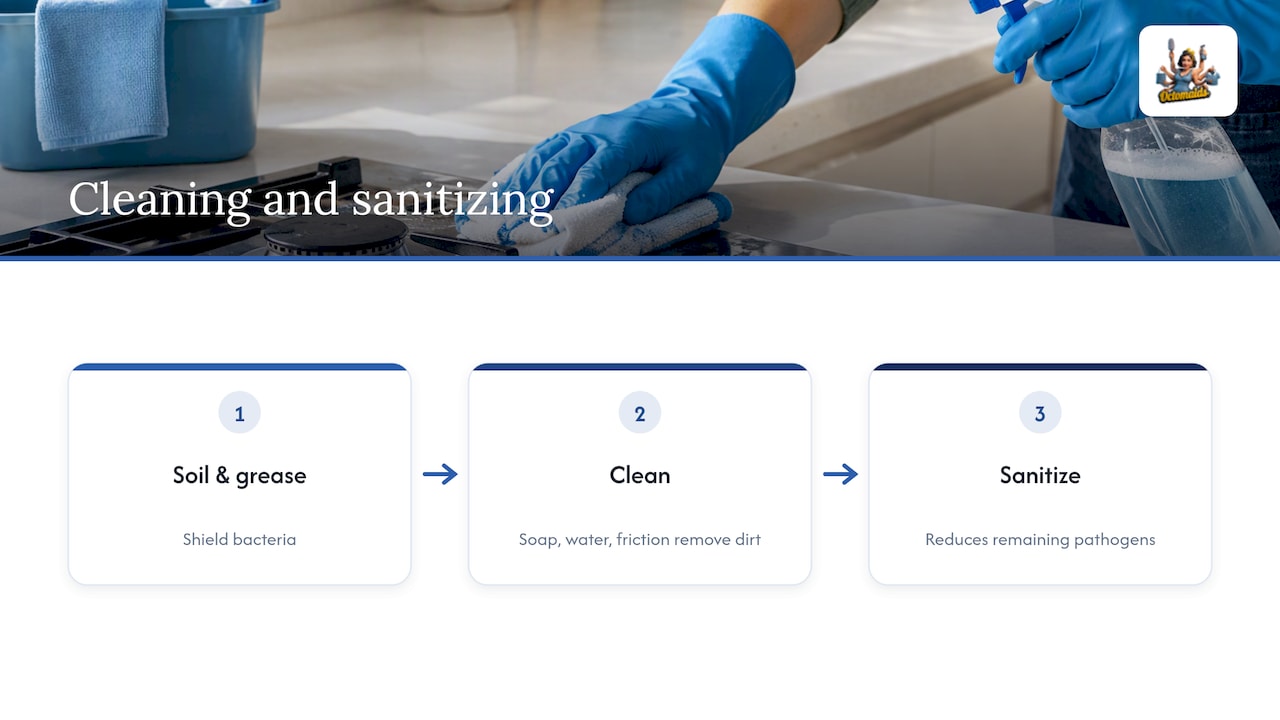
Cleaning and sanitizing are different jobs. According to the USDA, cleaning uses soap, water and friction to remove dirt, while sanitizing reduces the pathogens that remain on food-contact surfaces. Sanitizing only works after cleaning, because soil and grease act as a shield for bacteria.
The EPA also draws the same line: cleaning removes dirt and organic matter, while sanitizing and disinfecting are separate claims for products it regulates.
When you need to sanitize at all
You don’t need to disinfect your kitchen every day. The CDC says that in most situations cleaning with soap and water removes germs, and disinfection is mainly for times when someone has been sick. In a kitchen, the clearest case for sanitizing is after contact with raw meat, poultry or their juices, on cutting boards, counters and the sink.
A simple bleach sanitizer, if you want one
| Purpose | Mix | Contact time |
|---|---|---|
| Food-contact surfaces (counters, cutting boards) | 1 tablespoon unscented liquid bleach per 1 gallon of water | Keep wet for at least 1 minute |
| Non-food surfaces needing disinfection | 5 tablespoons (1/3 cup) bleach per gallon of water | Keep wet for at least 1 minute |
Check the label: the CDC guidance calls for unscented bleach with 5% to 9% sodium hypochlorite, and warns that splashless or scented formulas may not work. Mix a fresh batch each time, use it in a ventilated room, wear gloves, and never combine bleach with other cleaning products. Follow the product label for rinsing food-contact surfaces. If anyone in your household has asthma or sensitive airways, talk to your doctor before using bleach indoors.
The University of Minnesota Extension lays out a five-step routine for food-contact surfaces if you want the full sequence.
The safety side of a kitchen deep clean: grease and fire
Most people think of deep cleaning as a hygiene or appearance task. It is also fire prevention. NFPA data on home cooking fires shows that unattended cooking is the leading factor, and the same research notes that cooking oils, fat and grease are responsible for 51% of home cooking fires that start with the ignition of materials. Ranges and cooktops are involved in 53% of reported home cooking fires.
What that means in practice:
- Clean hood filters on a regular schedule. Grease that builds up in a filter is fuel, and a clogged filter is a hazard rather than a safeguard.
- Remove baked-on grease around burners and under drip pans before the next high-heat meal.
- Keep towels, packaging and wooden utensils away from the burners. NFPA’s educational messages recommend a 3-foot safety zone around the stove and staying present while you cook.
- After any cooking fire, even a small one that you put out, have the appliance checked by a qualified technician before you use it again. Damage inside can leave it unsafe even if it looks clean.
How often should you deep clean your kitchen?
There is no single rule, and it depends on how much you cook. A household that fries food several times a week builds grease faster than one that mostly reheats. A workable rhythm looks like this:
| Frequency | Tasks |
|---|---|
| After every meal | Wipe spills, wash cooking utensils, put food away, wipe the stovetop |
| Weekly | Clean out the fridge, wipe the microwave, wash the sink and mop the floor |
| Monthly | Hood filter, dishwasher filter, cabinet fronts, small appliances |
| Quarterly or twice a year | Oven interior, fridge and freezer deep clean, pantry reset, drawers |
| Yearly | Fridge coils, cabinet tops, behind and beside appliances |
Our own home cleaning frequency guide goes into the whole house, and how to maintain a clean home between visits helps you keep the results.
Don’t forget what’s around the kitchen
Kitchens usually come with upholstered pieces: bar stools, a breakfast-nook bench, dining chairs. Spills and cooking odors settle into the fabric. If your seating is microfiber, this gentle microfiber upholstery cleaning guide (written in Hungarian) shows the basic approach, and you can follow the images even if you don’t read the language. Always test any cleaner on a hidden spot first.
Our perspective: why kitchens are where a deep clean pays off most
We have been cleaning homes in Vancouver, WA and the Portland area since 2006, and the kitchen is the room where the gap between “looks clean” and “is clean” is widest. Counters can be spotless while the hood filter, the oven door seal and the dishwasher gasket tell a different story.
Two things we would tell any homeowner. First, don’t judge yourself if the kitchen has gotten away from you. Busy schedules, new babies, a long work stretch or a hard season of life all do this, and a kitchen that hasn’t had a deep clean in a year is far more common than people admit. Second, the order matters more than the product. Clean, rinse, then sanitize only where it counts, and you will get better results with a bucket of soapy water than with a cabinet full of sprays.
Because we send the same dedicated, background-checked team each visit, the people who clean your kitchen learn how your home works: which cabinet sticks, which cooktop needs extra time, which spots build up quickest. That consistency is what makes a recurring routine easier, and it keeps the deep clean from becoming a yearly emergency.
— Steven
When it makes sense to hire the job out
A DIY kitchen deep clean takes most people four to six hours if everything is cooperating, and longer when there is heavy buildup. Hiring help makes sense when:
- You are preparing for guests, a listing photo shoot or a sale.
- The oven or range hood has years of baked-on grease.
- Mobility, health or time make ladders, scrubbing and bending difficult.
- You are moving out and need to meet the landlord’s expectations. Our moving-out cleaning checklist for renters and guide to what appliance cleaning includes at move-out show what is usually expected.
- You manage a rental or office kitchen, where our audit-ready office kitchen checklist and rental appliance cleaning guide may help.
Let us handle the heavy lifting
Our one-time deep cleaning service covers kitchens in homes across Clark County and the Portland metro area, delivered by trained, background-checked and insured teams, with a satisfaction guarantee. If you would like a regular rhythm afterward, ask about recurring home cleaning. We don’t publish flat rates because the work depends on the size of the kitchen and the condition it’s in, so contact us through our site for a quote that fits your home.
FAQ
What does a kitchen deep clean consist of?
It covers the places daily cleaning skips: the range hood and its filter, the inside of the oven, the fridge and freezer interiors, the dishwasher filter, the sink and drain, cabinet fronts, small appliances, the pantry and the floor edges. The goal is to remove built-up grease, food residue and film, not just to make surfaces look tidy.
What is the best way to deep clean my kitchen?
Work from top to bottom and inside out. Start with the range hood and cabinets, then appliances, then counters, and finish with the floor. Wash with hot, soapy water first, and sanitize only the food-contact surfaces afterward if needed.
How much does a kitchen deep clean cost?
The price depends on the size of the kitchen, how long it has been since the last deep clean, and which appliances are included. Octomaids does not publish set prices for this service, so we give a quote after learning about your home. Reach out through our website to get one.
Do I need to disinfect my kitchen every day?
No. The CDC says that in most situations, cleaning with soap and water is enough to remove germs. Sanitize food-contact surfaces after raw meat or poultry touches them, and disinfect when someone in the home has been sick.
How often should I clean the range hood filter?
Monthly is a common rule of thumb for households that cook often, and less often if you cook lightly. Grease is a fire fuel, so don’t let it build up. Check your hood’s manual for the right way to wash or replace your filter type.
Sources
- Clean THEN Sanitize: A One-Two Punch to Stop Foodborne Illness in the Kitchen (USDA)
- What’s the difference between products that disinfect, sanitize, and clean surfaces? (US EPA)
- Cleaning and Disinfecting (CDC)
- Cleaning and Disinfecting with Bleach (CDC)
- Washing Food: Does it Promote Food Safety? (USDA FSIS)
- Sanitizing equipment and food contact surfaces (UMN Extension)
- Cleaning for a healthy home (UMN Extension)
- Home Cooking Fires (NFPA)
- NFPA Educational Messages 2026 Edition
- How to Deep Clean Your Kitchen From Top to Bottom (Martha Stewart)
Recommended
- Bathroom Deep Cleaning: 8 Safe Steps and When to Hire
- What Does Deep Cleaning Include? a Room-by-Room Guide
- Home Cleaning Best Practices for a Spotless Home
About Octomaids
Octomaids is a locally operated professional cleaning company serving Vancouver, Clark County, and the surrounding Portland metro area. Since 2006, our cleaning teams have helped homeowners, renters, property managers, and businesses with recurring cleaning, deep cleaning, move-in/move-out cleaning, and commercial cleaning.
Our cleaning articles are reviewed to ensure the information reflects our real-world experience and professional cleaning practices.