


Insurance and a bond are not the same thing. Insurance pays for accidents: a broken vase, a flooded bathroom, a cleaner who slips on your stairs. A bond is a financial guarantee that applies when an employee commits a dishonest act, such as theft. Most homeowners need both from the company they hire, and the only way to know a company has them is to ask for proof and check it.
This guide explains what each term means, what each one does and does not cover, what the law requires, and how to verify a company in about ten minutes. We have cleaned homes and offices in Vancouver, WA and the Portland metro area since 2006, so we have answered these questions at the front door many times.
TL;DR
- Insured means the company carries insurance, usually general liability for damage to your property and workers’ compensation for injured staff. It covers accidents.
- Bonded means the company bought a surety bond, often a janitorial bond, that can reimburse you if an employee steals from you. It covers dishonesty, not accidents.
- A bond is not insurance. It generally does not pay for accidental damage, and an insurance policy is not a theft guarantee in the way a bond is.
- Ask for the paperwork, call the insurance agent, and check that the coverage limits are high enough for your home.
- Pair credentials with good screening: a background-checked, trained, consistent team lowers the odds you ever need to file a claim.
Table of Contents
- What “bonded and insured” means in plain language
- Insured: the accident side
- Bonded: the dishonesty side
- Bonded vs. insured at a glance
- Which one matters more?
- Do cleaners legally need insurance or a bond?
- How to verify a cleaning company in ten minutes
- What good coverage looks like at your front door
- Our perspective
- Which situations raise the stakes
- Questions to ask before you book
- Working with Octomaids
- FAQ
- Sources
What “bonded and insured” means in plain language
The two words get stuck together so often that people assume they describe one thing. They describe two separate financial protections, bought from different kinds of companies, covering different risks.
The Better Business Bureau explains it this way: a bond protects you against dishonest or criminal acts by cleaners, while insurance addresses accidental incidents caused by the cleaning workers. Think of insurance as the answer to “what if something goes wrong by mistake?” and a bond as the answer to “what if someone I let into my home does something wrong on purpose?”
A useful mental image: insurance is the safety net under a trapeze, and a bond is the written promise that the performer is who they say they are. One catches falls. The other gives you recourse when trust is broken.
Insured: the accident side
When a cleaning company says it is insured, two policies matter most to you.
General liability insurance
General liability covers damage a cleaner causes to your property. Accidental breakage, water damage, or incorrect chemical use are typical examples. An expensive vase knocked over while dusting is the classic one.
In practice, that can mean a hardwood floor stained by the wrong product, a cracked tile from a dropped bucket, or a laptop pushed off a desk while wiping it down. The policy pays the claim instead of the cleaner or you having to cover it out of pocket.
Workers’ compensation
Workers’ compensation covers medical bills and lost wages when a cleaner is hurt on the job. This matters in your home because without proper coverage, you may face personal liability for a cleaner’s injuries, and that can mean a claim against your own homeowner’s policy.
Cleaning is physical work. Reaching, bending, lifting, climbing a step stool to reach a ceiling fan, and handling wet floors all carry injury risk. A company with employees and real workers’ compensation coverage has already planned for that risk. A person who pays a friend of a friend cash to clean may be carrying it without knowing.
Bonded: the dishonesty side
A bond is a different instrument. In cleaning, it is usually a janitorial service bond, and it is a three-party contract among the cleaning company, the customer, and the surety that issues the bond. If an employee steals from you, you can file a claim and, if it is valid, recover the value of the stolen items.
There are limits you should know about before you rely on one:
- A cap. Claims for employee theft are payable only up to the bond amount. Losses above that may require separate legal action.
- A conviction condition. One major surety explains that a business services bond can protect against a customer’s loss of money, securities, or personal property from an employee’s dishonest act, but the employee generally must be convicted before coverage applies. That condition also protects honest workers from unfounded accusations.
- No accident coverage. A janitorial bond covers the value of stolen items but is not an insurance policy and does not cover accidental property damage. Accidents belong under insurance.
The bond also does not make theft impossible. It gives you a route to be made whole, which is valuable, but the better outcome is that the theft never happens. That is why screening matters as much as paper.
Bonded vs. insured at a glance
| Insured | Bonded | |
|---|---|---|
| Covers | Accidents: property damage, bodily injury, worker injuries | Dishonest acts such as employee theft |
| Typical form | General liability and workers’ compensation policies | Janitorial or surety bond |
| Who gets paid | The injured party or the owner of damaged property, through the insurer | The customer who suffered the theft, up to the bond amount |
| Example | A cleaner breaks a mirror or slips on a wet floor | An employee takes jewelry or cash |
| Limits to check | Per-occurrence and aggregate limits | Total bond amount |
| Can substitute for the other? | No | No |
The difference in one sentence: insurance covers accidents, while a bond safeguards against dishonest criminal acts.
If you want a second explanation of the distinction from the business side, this piece on what bonded vs. insured means for businesses walks through the same two protections.
Which one matters more?
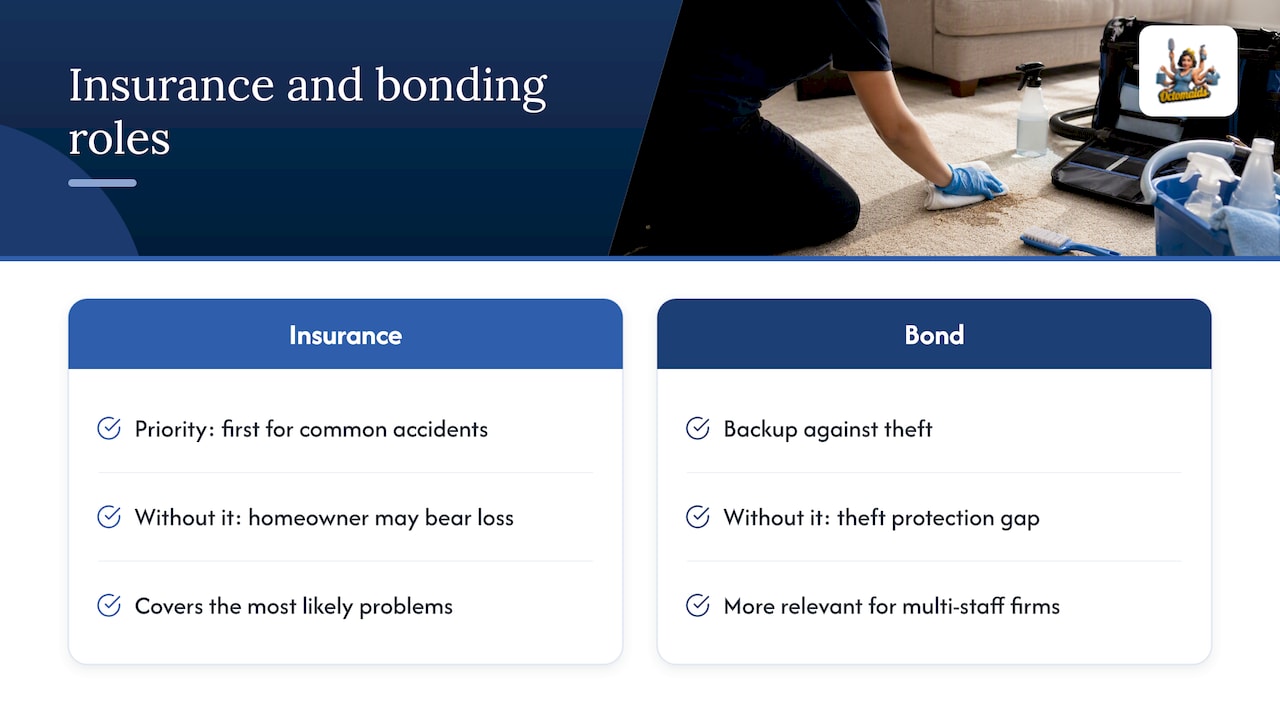
If you must rank them, insurance comes first. Accidents are far more common than theft, and an uninsured accident can land on you. A cleaner who is hurt in your house, with no workers’ compensation behind them, is the scenario that most often turns into a homeowner’s problem.
But “which is better” is the wrong frame. They cover different failures. A company with insurance and no bond leaves you thinly protected against theft. A company with a bond and no insurance leaves a large gap for the most likely problems. You want both, plus a screening process that makes the bond a backup rather than a plan.
Bonding is also more relevant to some businesses than others. It is generally more relevant for companies with multiple staff members than for solo operators, because the theft risk profile differs when several people have access to client homes.
Do cleaners legally need insurance or a bond?
The honest answer is that it depends on the state and on whether the cleaner has employees.
- Sole operators. Guidance for cleaning business owners says those without employees or company vehicles are not required to carry insurance to start, though it is strongly recommended. A consumer-facing explainer says a house cleaner generally is not legally required to be insured, but liability insurance is a good idea.
- Businesses with employees. Workers’ compensation is legally required for cleaning businesses with employees in 49 of 50 states, Texas being the exception.
- Washington. Employers must provide workers’ compensation for any worker who does not qualify for an exemption, and coverage is mandatory and purchased through the state Department of Labor & Industries. If you hire a company in Clark County, a legitimate employer should have this in place.
- Bonds. Nothing in the research we reviewed makes a janitorial bond a universal legal requirement for house cleaning. It is typically a voluntary protection a company buys to earn customer trust, or a requirement some commercial clients write into contracts.
If you employ a cleaner directly, as a household employee, different rules apply, including state workers’ compensation rules and tax obligations. Our guide to housekeepers vs. house cleaners and U.S. tax rules covers that decision. For your specific situation, your state’s labor agency or a licensed insurance agent is the right person to ask.
How to verify a cleaning company in ten minutes
A claim of “bonded and insured” on a website is a statement, not proof. Here is a short process.
- Ask for the documents. The BBB advises requesting a copy of the company’s bond and the name of its insurance agent. A real company has these on hand.
- Call the agent or carrier. Confirm the policies and the bond are active today, not just that they existed when the certificate was printed. This step matters because some business owners have been caught using fraudulent insurance certificates to win contracts. That case was in California, but the lesson is general: verify with the carrier, not the paper.
- Read the limits. Check whether the dollar value on the bond or policy is high enough to cover your house. A policy that tops out below the value of what you own does less than it seems to.
- Match the coverage to the job. If you want windows, post-construction work or a rental turnover, confirm the policy fits that work.
- Ask about employees. Are the people who show up employees of the company, or independent contractors? The answer changes who carries workers’ compensation.
- Get it in writing. A service agreement should spell out how damage is reported and handled. Ours is on the service agreement page.
Red flags are simple: a company that is vague about its carrier, will not name an agent, quotes far below everyone else, or gets irritated when you ask. Legitimate businesses expect the question.
What good coverage looks like at your front door
Paper is one layer. The other is how the company behaves in your home.
- Screening. Ask what the background check includes. We explain what it should mean in what background-checked cleaners should actually mean.
- Consistency. The same people each visit means you know who has access, and they know your home. Fewer surprises means fewer accidents.
- Key and access handling. How a company stores and tracks your entry codes is part of the same safety picture. See how cleaning services handle home access safely.
- Training. Using the wrong product on stone or hardwood is a leading cause of damage claims. Trained cleaners avoid that mistake.
- A clear scope. Knowing what cleaners will not do keeps risky jobs, like high ladders or biohazards, out of a standard visit.
For a wider look at vetting, our guide to vetting trustworthy home cleaners puts all of this into one checklist.
Our perspective
We get asked about this most when someone is about to hand over a key for the first time. That moment is nervous for good reason. You are not buying a mop and a bucket. You are letting people into the place where your family sleeps and keeps its valuables.
Here is how we think about it. Insurance and bonds are the floor, not the ceiling. They tell you what happens after a problem. Our goal is to make problems rare. That is why we send the same dedicated team to your home, rather than whoever is available that day. A cleaner who knows your house knows which shelf has the fragile pieces and which counter is natural stone. All of our staff are background-checked, professionally trained and insured.
We are family-owned and local, not a franchise, which means the person answering your questions is accountable to the same community you live in. When you ask any cleaning company about coverage, including us, we would encourage you to ask about the specifics: what the policy covers, what the limits are, and who the carrier is. A good answer is calm and specific. If you hear defensiveness, that tells you something too.
One more thing we say often: no credential replaces a conversation. Tell your cleaning company what is valuable, what is fragile and what is off-limits. It protects your belongings and it protects the people doing the work.
— Steven
Which situations raise the stakes
Some jobs deserve extra care about coverage.
- One-time deep cleans. A deep clean touches more: inside appliances, baseboards, light fixtures, cabinet interiors. More handling means more chances for breakage. See what deep cleaning includes.
- Move-in and move-out cleans. Homes are often empty or in disarray, access is by lockbox or code, and property managers may require proof of insurance. Landlords can read more in cleaning services for landlords.
- Short-term rentals. Cleaners work alone, between guests, often with a smart lock. Make sure the company’s coverage fits turnover work.
- Post-construction cleaning. Dust, adhesives and fixtures raise the risk of damage to new finishes.
- Offices. Many commercial leases and building managers ask for a certificate of insurance and sometimes a janitorial bond. The difference between service types is covered in our janitorial vs. commercial cleaning article.
A worked example
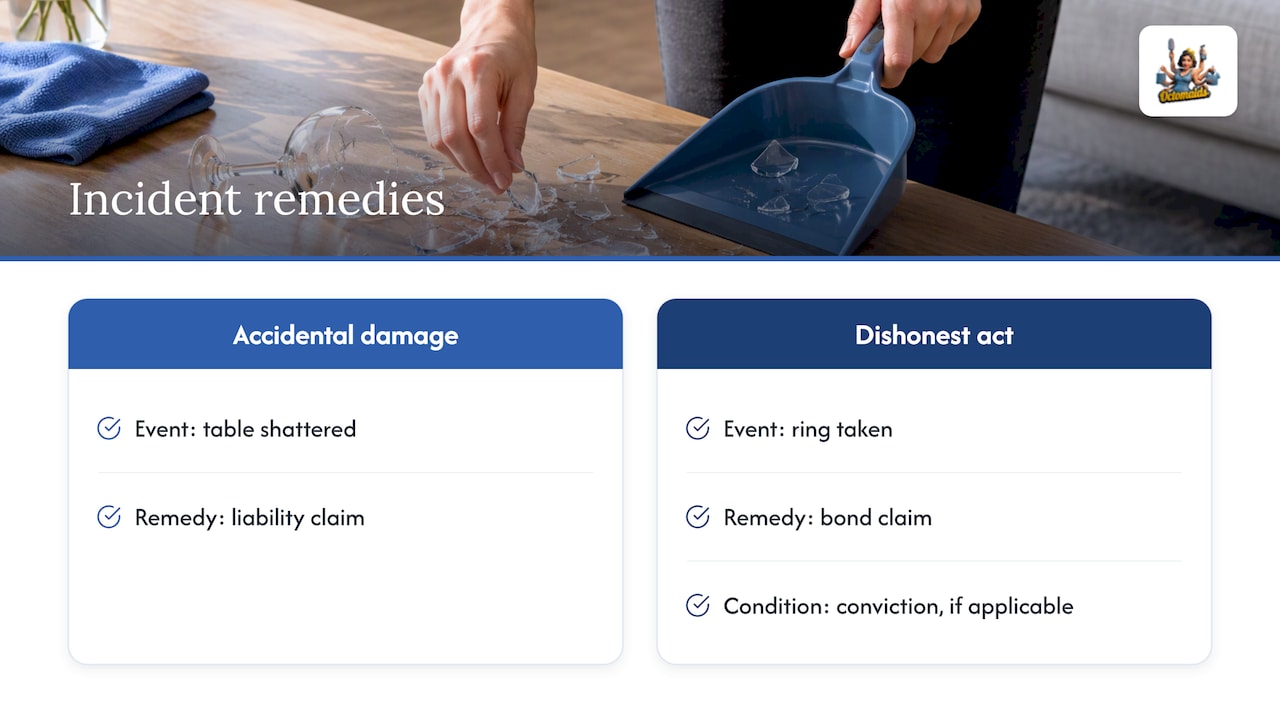
Suppose a cleaner knocks a glass-top side table off its base, shattering it, and later that month a different employee is found to have taken a ring. These are two events with two different remedies. The table is an accident, so a general liability claim is the route. The ring is a dishonest act, so a bond claim (after the conviction condition is met, if applicable) is the route. A company with only one of the two protections leaves you to absorb the other loss. That is the practical case for asking about both.
Questions to ask before you book
Use these on any company. Write the answers down.
- What kinds of insurance do you carry, and with which carrier?
- What are the coverage limits per incident?
- Are you bonded, and for what amount?
- Are your cleaners employees, and do you carry workers’ compensation?
- How do you handle a damage report, and how fast?
- What does your background check cover?
- Will the same team come each time?
If you also want to understand what is included in the visit, our post on whether cleaners bring supplies lists three booking questions worth adding.
Working with Octomaids
We provide recurring home cleaning, one-time deep cleaning and move-in/move-out cleaning in Vancouver, WA, Portland, OR and the surrounding area, along with commercial, office, post-construction, short-term rental and janitorial work. Our teams are background-checked, trained and insured, and our work is satisfaction guaranteed. Ask us anything on the list above when you request a quote. You can also start from our services page or our homepage.
FAQ
Is it better to be bonded or insured?
Insurance is the more important of the two, because accidents and injuries are more common than theft. But they cover different risks and neither replaces the other. The best choice is a company that has both and will show you proof.
Should my cleaner be bonded and insured?
Yes. The BBB advises hiring a cleaner who is bonded and insured so that you are protected if something is broken, stolen or someone is hurt. A cleaner who works alone may not have employees, so ask what coverage they do carry.
Do cleaners need insurance?
Not always by law. Sole operators generally are not required to carry it, but a business with employees must carry workers’ compensation in nearly every state, including Washington. Even where it is optional, it is a sensible protection for you.
What happens if an uninsured cleaner is injured in my home?
You may be exposed to personal liability, which can lead to a claim against your homeowner’s policy. Check with your insurance agent about how your policy treats household workers, and consider hiring only companies that can prove workers’ compensation coverage.
How much coverage should I look for?
There is no universal number. The BBB suggests checking that the dollar value on the policy or bond is high enough to cover your house. Your own insurance agent can help you judge what that figure should be for the contents and finishes in your home.
Sources
- BBB Tips: 7 tips for hiring a house cleaning service
- Steps to Get Your Cleaning Business Bonded and Insured (Insureon)
- Janitorial Bond (NFP)
- Business Services Bonds (Old Republic Surety)
- Bonded and Insured: What These Terms Actually Mean (Salt & Slate Cleaning)
- Cleaning Business Insurance: Costs, Types, and How to Get It (Jobber)
- Should hired household help be bonded and insured? (Insurance.com)
- Employers’ Guide to Workers’ Compensation Insurance in Washington State (L&I)
- California Department of Insurance press release on fraudulent insurance certificates
- Bonded vs. Insured: What Business Owners Need to Know
Recommended
- What “Background Checked Cleaners” Should Actually Mean to You
- 9 Jobs House Cleaners Refuse, Who to Call and How to Prepare
- Do Cleaners Bring Supplies? Ask 3 Booking Questions Backed by CDC/EPA
- Vetting Trustworthy Home Cleaners: Your 2026 Guide
About Octomaids
Octomaids is a locally operated professional cleaning company serving Vancouver, Clark County, and the surrounding Portland metro area. Since 2006, our cleaning teams have helped homeowners, renters, property managers, and businesses with recurring cleaning, deep cleaning, move-in/move-out cleaning, and commercial cleaning.
Our cleaning articles are reviewed to ensure the information reflects our real-world experience and professional cleaning practices.