


Most established cleaning companies bring their own supplies and equipment, from all-purpose cleaners to commercial vacuums, as part of their standard service. The main exception involves independent cleaners or some platform workers, who occasionally ask clients to provide a vacuum or a specific product. Before your first appointment, confirm the supply policy by asking three quick questions, which we cover below.
TL;DR:
- Most cleaning companies supply their own supplies and equipment, with exceptions mainly involving independent cleaners and platform workers who may ask clients to provide items.
- Vacuum use is the most common supply exception, as many cleaners prefer to use household models unless the client requests or brands HEPA filtration for allergy concerns.
- Asking about supply policies, vacuum requirements, and product preferences at booking prevents most service surprises and should be documented in confirmation notes.
- Clients should provide their own products when cleaning delicate surfaces or if they have allergies, and companies may charge extra or decline unsafe or unfamiliar chemicals.
- Standardized kits, commercial vacuums, and clear policies on special requests ensure a worry-free cleaning experience, regardless of service frequency or surface sensitivities.
Table of Contents
- Typical supply models: company crews, independent cleaners, and platform workers
- Common exceptions and equipment logistics
- Exactly what to ask when booking
- When you should supply your own products
- Basic safety rules and labels worth knowing
- Octomaids perspective: how we handle supplies and special requests
- Book a clean without worrying about supplies
- FAQ
- Sources
Typical supply models: company crews, independent cleaners, and platform workers
Who shows up with what depends heavily on the business structure behind your cleaner. Company-employed crews almost always bring standardized kits. This keeps quality consistent from one visit to the next and protects the business from liability if a client’s equipment is faulty or a client’s product causes damage.
Independent cleaners fall somewhere in the middle. Some arrive with a full trunk of supplies, much like a company crew would. Others ask you to provide a vacuum or basic products, often because carrying heavy equipment between jobs on foot or by bus is impractical. According to industry guidance on supply practices, companies generally prefer supplying their own tools because low-quality or poorly maintained client equipment can slow down a job and hurt results.
Platform workers, the cleaners you book through an app or marketplace, are the least predictable group. Policy depends on both the platform’s rules and the individual worker’s personal setup, so it is worth checking before you schedule anything.
These differences affect your wallet, too. A crew that brings everything typically builds that cost into the service price, while a worker who expects you to supply items may charge less but shift the burden back to you.
- Company crews: standardized kits, consistent results, cost built into the price.
- Independent cleaners: supply habits vary, often tied to transportation logistics.
- Platform workers: policy depends on the platform and the individual.
Common exceptions and equipment logistics
Vacuums are the single most common exception. They are bulky, heavy, and awkward to transport, so many independent cleaners prefer to use the one already in your closet rather than haul their own from job to job.
Specialized equipment works differently. Carpet shampooers, steam cleaners, and similar machines are usually something the professional brings, often for an added fee, since these tools require training and are not standard in most homes.
Cross-contamination is a quieter but real concern. A commercial vacuum with HEPA filtration traps fine particles that a household model lets escape back into the air, which matters if anyone in your home has allergies or respiratory sensitivities.
- A worn or dusty household vacuum may get used anyway unless you ask about HEPA filtration specifically.
- A cleaner may decline to use equipment that looks damaged, unsafe, or poorly maintained, and that refusal is reasonable, not a red flag on your end.
Exactly what to ask when booking
A short conversation at booking prevents almost every supply-related surprise. Ask these three questions before you confirm an appointment, and write the answers into your booking notes or confirmation message so both sides remember the agreement.
- Do you bring all supplies, or is there anything you expect me to provide?
- Do you bring a vacuum, or will you need to use mine?
- Can you use my preferred products, and is there a fee if I ask for that?
From there, a few follow-up questions help avoid friction later. Ask whether fragrance-free or Safer Choice-labeled products are available if scent sensitivity is a concern, and ask how cleaning cloths are laundered between jobs to avoid cross-contamination between homes.
Pro Tip: Save the booking confirmation that lists supply responsibilities. It takes thirty seconds and settles any disagreement before it starts.
When you should supply your own products
Sometimes it makes sense to hand over your own products rather than rely on a standard kit. Delicate surfaces like natural stone, antique wood, or specialty flooring often need a specific formula, and a generic all-purpose cleaner can do real damage. Strict allergy or chemical sensitivity needs are another reason to bring your own, since even a mild fragrance can trigger a reaction in some households.
If you want a cleaner to use a specialized chemical you provide, hand over the safety data sheet along with clear instructions. As one client-education resource notes, providing an SDS speeds up approval and reduces liability concerns for the person doing the work.
- Bring your own product for delicate surfaces or documented sensitivities.
- Expect a company to review the product and possibly ask for a signed waiver.
- Some companies charge a small premium for using client-supplied specialty products, and some decline products they consider unsafe or unfamiliar.
Basic safety rules and labels worth knowing
Professional cleaners follow safety practices for good reason, and a few of them are worth understanding even if you never pick up a mop yourself. The CDC warns against mixing bleach and ammonia, since combining the two releases toxic gas. This is one reason trained technicians stick to known products rather than improvising with whatever is under your sink.
The EPA’s Safer Choice label identifies cleaning products that meet federal standards for both human health and environmental safety while still performing effectively. Looking for that label is a simple way to choose a product that cleans well without unnecessary chemical risk.
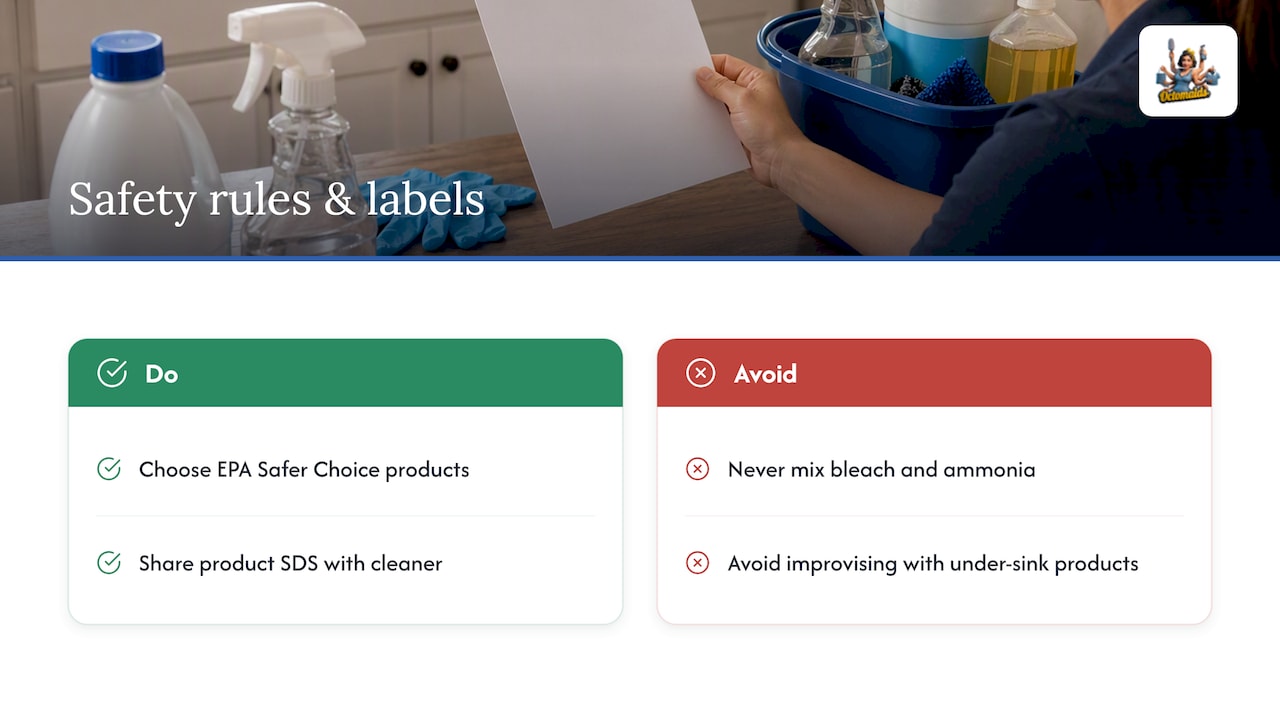
Trained technicians also follow OSHA-informed handling practices, which is part of why they generally prefer products they already know. If you insist on your own product, sharing the SDS gives them the information they need to use it safely.
Octomaids perspective: how we handle supplies and special requests
We supply standardized kits and bring trained teams to every recurring and one-time clean, so you never need to stock products or hand over your own vacuum. When a client asks for fragrance-free or pet-safe cleaning, we accommodate it, and we welcome client-supplied products when accompanied by clear instructions and an SDS. Our teams also travel with commercial vacuums, so equipment logistics are one less thing to plan around.
— Steven
Book a clean without worrying about supplies
Whether you need a weekly visit or a single deep clean, our recurring home cleaning and one-time deep cleaning both include a full kit and a commercial vacuum, so there is nothing for you to buy or set out beforehand. The same goes for move-in and move-out cleaning, where clients often ask about supplies and find we handle everything from start to finish.
If you have a fragrance-free household, pets, or a specialty surface that needs particular care, just mention it when you request a quote and share any product instructions or safety sheets in advance.
- Recurring and one-time cleans include all standard products and a commercial vacuum.
- Fragrance-free and pet-safe requests are accommodated with advance notice.
- Move-in and move-out cleans follow the same supply-included approach.
Ready to stop wondering what to stock before your cleaner arrives? Check availability for your area and ask about your preferences when you book.
FAQ
Do cleaners usually bring their own supplies?
Yes, most established cleaning companies supply their own products and equipment as part of the service. Independent cleaners and some platform workers are the exception, and they sometimes ask clients to provide a vacuum, so it is worth confirming at booking.
Is $20 an hour good for house cleaning?
The U.S. Bureau of Labor Statistics reports a median hourly wage of $16.08 for maids and housekeeping cleaners, with the 90th percentile earning $21.96 as of May 2023, though actual pricing also reflects supplies, equipment, and company overhead.
What is the 20 minute rule in cleaning?
This phrase is not a standardized industry term, and definitions vary depending on who uses it. In general use, it refers to tackling a cleaning task in a focused short block of time rather than letting it stretch indefinitely, a method sometimes used for quick tidying between professional visits.
Do cleaning services pick up clutter?
Policies vary by company, but many cleaning services focus on cleaning surfaces rather than organizing or putting away personal belongings. Clearing visible clutter before your appointment typically helps the team spend their time on the cleaning tasks you are paying for rather than tidying first.
What should I do if supplies run out mid-job?
If a cleaner runs out of a product during your appointment, most companies will note it and either finish with an alternative or follow up about the gap. Mentioning any known stock issues or special requests at booking, along with documenting the agreement in your confirmation message, helps prevent this from happening in the first place.
Sources
- How to safely clean and sanitize with bleach | CDC
- Learn about the Safer Choice label | US EPA
- BLS: Maids and housekeeping cleaners — May 2023
- Do Cleaners Bring Their Own Supplies? | CleanersLink
Recommended
- Office Cleaning Supplies Managers Need: Zone Par Levels & EPA Signals
- Shared Workspace Sanitation Best Practices Managers Can Use Today
- Ask These 6 Laundry Questions Before You Book a Cleaner
- Facility Manager: Turn CDC Rules into Office Cleaning vs Disinfection
About Octomaids
Octomaids is a locally operated professional cleaning company serving Vancouver, Clark County, and the surrounding Portland metro area. Since 2006, our cleaning teams have helped homeowners, renters, property managers, and businesses with recurring cleaning, deep cleaning, move-in/move-out cleaning, and commercial cleaning.
Our cleaning articles are reviewed to ensure the information reflects our real-world experience and professional cleaning practices.