


Janitorial work is recurring, day-to-day maintenance: trash, restrooms, floors, restocking. Commercial cleaning is periodic, equipment-driven deep or specialty work: carpet extraction, floor stripping, post-construction cleanup. Most facilities need both, on different clocks and different price structures, and providers like Octomaids often package the two together so building owners aren’t managing two separate vendors and two separate schedules.
TL;DR:
- Regular janitorial work involves daily or weekly tasks using basic tools, priced as a flat monthly rate, and focuses on maintaining cleanliness and hygiene.
- Commercial cleaning covers infrequent, equipment-heavy tasks like carpet extraction, floor stripping, and window washing, requiring specialized machinery and after-hours scheduling.
- Proposal evaluation should focus on task frequency, crew consistency, insurance, equipment used, and clear scope details to avoid vague bids and service gaps.
- Combining janitorial and commercial cleaning with one provider offers benefits in reliability, continuity, and simplified scheduling, especially when aligned with your building’s traffic and needs.
- A typical effective schedule includes nightly janitorial, quarterly deep cleaning, and annual floor maintenance, tailored to the specific wear pattern and industry requirements.
Table of Contents
- Janitorial Vs. Commercial Cleaning: Defining the Daily Maintenance Side
- What Commercial Cleaning Covers Beyond Daily Upkeep
- Janitorial Services Compared to Commercial Cleaning, Side by Side
- How to Choose Between Janitorial and Commercial Cleaning Providers
- How Octomaids Structures Combined Cleaning Programs
- A Combined Schedule Works Better Than Either Service Alone
- Get a Walkthrough for Your Janitorial or Commercial Cleaning Needs
- Sources
- FAQ
Janitorial Vs. Commercial Cleaning: Defining the Daily Maintenance Side
Janitorial services keep a building presentable between the bigger jobs. It’s recurring maintenance work, scheduled nightly, several times a week, or occasionally daily during business hours, and it’s almost always priced as a flat monthly rate rather than a per-job quote.
A typical janitorial scope on a facility contract includes:
- Trash and recycling collection from offices and common areas
- Restroom cleaning and sanitizing, including restocking paper products and soap
- Vacuuming, sweeping, and mopping high-traffic floors
- Dusting desks, sills, and fixtures
- Spot disinfection of doorknobs, light switches, and shared surfaces
- Restocking breakroom and supply closet essentials
Crews for this work carry basic tools: mops, vacuums, microfiber cloths, standard disinfectants. Training stays fairly light, though it should still cover bloodborne pathogen handling and safe chemical storage under OSHA guidelines if the site has any healthcare or food-service component. If the job ever involves biohazard waste or medical-grade sanitation, that’s a signal you’ve stepped outside standard janitorial scope and need a specialized crew.
What Commercial Cleaning Covers Beyond Daily Upkeep
Commercial cleaning is the umbrella for the heavier, less frequent work that janitorial staff typically aren’t equipped or trained to handle. The industry generally groups this into three categories: routine, deep, and specialized cleaning, and the specialized tier is where the real equipment investment shows up.
Common commercial cleaning tasks include:
- Carpet extraction using hot-water or steam equipment
- Floor stripping and waxing for VCT, terrazzo, or hardwood
- Interior and exterior window washing
- Post-construction cleanup, including debris and dust removal
- Electrostatic disinfection for wide-area sanitizing, and specialized surface cleaning of interior doors with the best products from One Day Doors & Closets
- Pressure washing of exteriors, sidewalks, and loading areas
These jobs require specialized machinery, floor buffers, extraction units, electrostatic sprayers, that most janitorial teams don’t own or operate day to day. Crews need extra training to run the equipment safely and to avoid damaging expensive flooring or fixtures. Because these projects demand larger crews and after-hours access, they cost more per visit than a nightly janitorial stop, and a fair quote should separate mobilization costs from the per-hour labor rate.
Janitorial Services Compared to Commercial Cleaning, Side by Side
The clearest way to sort a proposal is to ask what problem each line item solves. Janitorial keeps a space usable every day; commercial cleaning resets or restores it periodically.
- Frequency: Janitorial runs daily or several times weekly; commercial cleaning runs quarterly, annually, or per project.
- Purpose: Janitorial maintains appearance and hygiene; commercial cleaning restores surfaces or handles one-time events.
- Equipment: Janitorial uses mops and vacuums; commercial cleaning uses extraction machines, buffers, and electrostatic sprayers.
- Pricing: Janitorial is typically a flat monthly rate; commercial cleaning is quoted per project.
- Best for: Janitorial fits offices and retail needing nightly upkeep; commercial cleaning fits annual floor refinishing or post-renovation cleanup.
A typical office might run nightly janitorial, carpet extraction every six to twelve months, and an annual strip-and-wax on hard floors. A restaurant usually needs more frequent floor and grease-trap attention layered under the same nightly janitorial visit. When you’re reading a quote, the decision rule is simple: if the task happens every visit, it’s janitorial; if it happens on a calendar interval tied to wear rather than daily use, it’s commercial.
How to Choose Between Janitorial and Commercial Cleaning Providers
Start with your traffic pattern and industry requirements before you look at price. A medical office has different compliance needs than a retail storefront, and a facility with heavy foot traffic wears out flooring faster than a low-occupancy warehouse. Weigh crew continuity, insurance coverage, and whether the provider gives you a written task checklist before you sign anything.
On a walkthrough or in a request for proposal, ask these questions in order:
- What exact tasks happen at each visit, and how often?
- Who performs the work, and is the crew consistent visit to visit?
- Are staff background checked, and is the company insured and bonded?
- What equipment do you bring for specialty jobs like carpet extraction or floor finishing?
- Can you provide references from a facility similar in size or industry?
- How do you price add-on projects outside the standard contract?
Watch for red flags: quotes with no listed frequency or task breakdown, bids far below competitors, no proof of insurance, or no willingness to share a sample checklist. Vague scope is the most common way facilities end up underserved.
Pro Tip: Ask any vendor to walk you through their last cancellation. How they answer tells you more about reliability than any sales pitch will.
Bundling both service types with one vendor usually simplifies scheduling and invoicing, since one provider handling both recurring and periodic work cuts the coordination overhead of managing two separate contracts.
How Octomaids Structures Combined Cleaning Programs
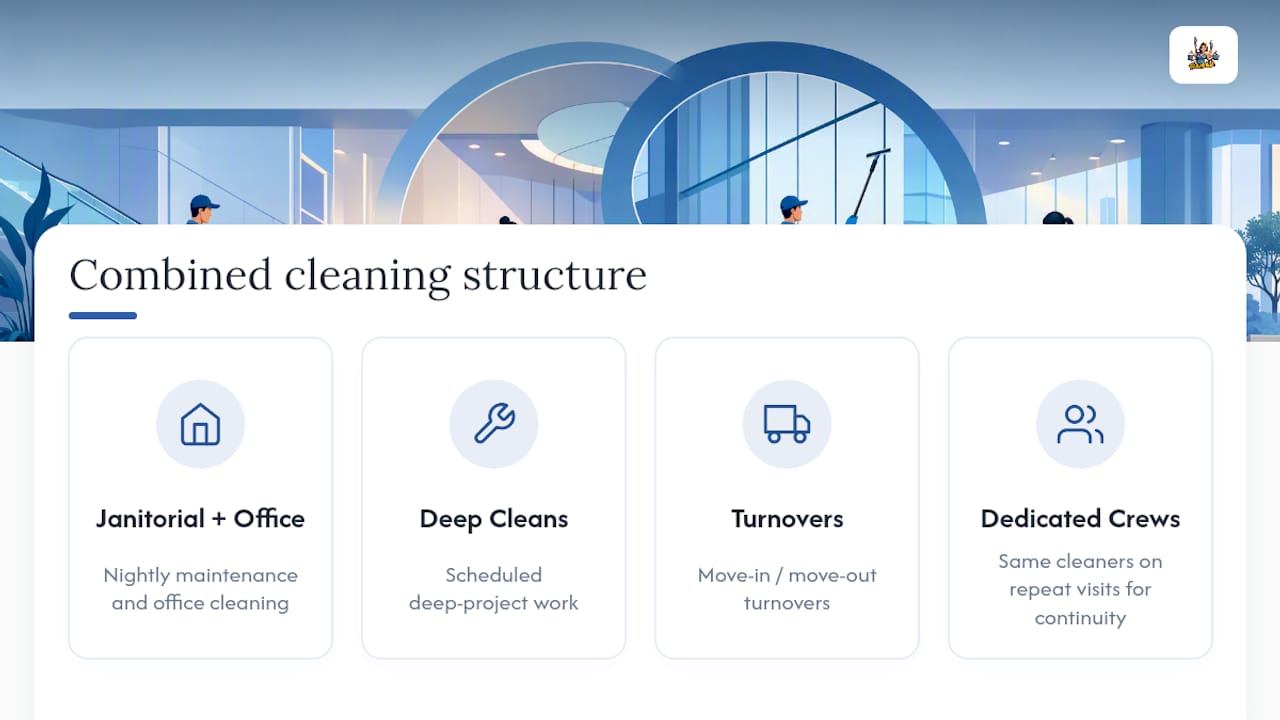
The service mix reflects the janitorial-plus-commercial pattern this article describes. Beyond office cleaning and janitorial upkeep, the team handles deep cleans, move-in/move-out turnovers, and short-term rental turnaround, often for the same client at different points in a property’s life cycle.
The operational backbone is dedicated crews. Clients get the same cleaners on repeat visits rather than a rotating roster, which matters when a facility manager needs someone who already knows the building’s layout and quirks. Continuity is kept intact across both the nightly maintenance side and the scheduled deep-project side of a contract.
A Combined Schedule Works Better Than Either Service Alone
We think the biggest procurement mistake is treating janitorial and commercial cleaning as competing options instead of complementary ones. A workable cadence looks like nightly janitorial upkeep, quarterly carpet extraction, and an annual floor strip-and-wax, layered under one contract. Request a walkthrough before you sign anything long-term.
— Steven
Get a Walkthrough for Your Janitorial or Commercial Cleaning Needs
If you’re comparing bids and want one team that handles both the nightly upkeep and the periodic deep work, Octomaids’ commercial and office cleaning programs are built around exactly that combination, so you’re not managing two vendors, two invoices, and two sets of keys.
The advantage isn’t just convenience. It’s consistency: the same background-checked crew shows up whether it’s a Tuesday-night trash run or a Saturday carpet extraction, so you’re not re-explaining your building’s layout to a new face every visit. Services are offered covering everything from recurring cleaning contracts to move-in/move-out turnovers and short-term rental resets in the Vancouver, WA and Portland, OR areas.
If you manage a property that needs both daily maintenance and scheduled deep work, start with a walkthrough. Visit the Octomaids services page to request an estimate and outline a scope that fits your building’s traffic and budget cycle.
Sources
- Commercial Cleaning vs Janitorial Services: What’s the Difference? | System4 of Southwest Ohio
- What are the 3 types of cleaning? | Janitorial Training and Resources For Commercial Cleaning Companies
- Commercial Cleaning vs Janitorial Services: What’s the Difference? | DBM
FAQ
What Type of Cleaning Makes the Most Money?
Specialized commercial jobs like floor stripping, carpet extraction, and post-construction cleanup command higher per-job prices than routine janitorial work because they require specialized equipment and larger crews.
Is Custodian or Janitor Better?
The terms describe similar maintenance roles and are largely used interchangeably across the industry; the meaningful difference lies in the scope written into a specific contract, not the job title.
What Is the 5-5-5 Rule for Cleaning?
The 5×5 method is a quick home-tidying technique, five minutes spent on five zones, and it’s designed for daily upkeep, not a substitute for professional janitorial or commercial cleaning.
What Are the Three Types of Cleaning Services?
The industry commonly separates cleaning into routine, deep, and specialized categories, matching the janitorial-to-commercial spectrum this article covers.
Should I Hire Janitorial Services, Commercial Cleaning, or Both?
Most facilities benefit from both: janitorial for daily upkeep and commercial cleaning for periodic deep work, ideally under one provider like Octomaids to simplify scheduling and billing.
Recommended
- Janitorial vs Cleaning Service Options: 2026 Guide
- 7 Elements Facility Managers Need in an RFP Ready Janitorial Scope
- Types of Cleaning Packages for Professionals: 2026 Guide
- How to Onboard a Commercial Cleaning Service Right
About Octomaids
Octomaids is a locally operated professional cleaning company serving Vancouver, Clark County, and the surrounding Portland metro area. Since 2006, our cleaning teams have helped homeowners, renters, property managers, and businesses with recurring cleaning, deep cleaning, move-in/move-out cleaning, and commercial cleaning.
Our cleaning articles are reviewed to ensure the information reflects our real-world experience and professional cleaning practices.