



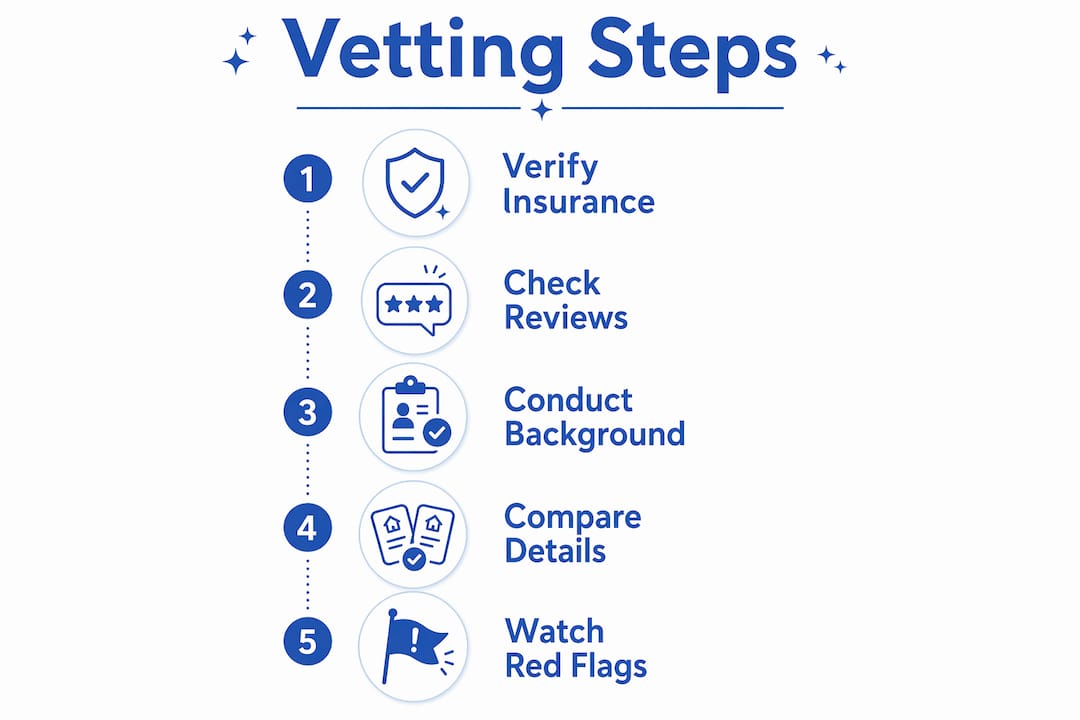
Vetting trustworthy home cleaners is the process of systematically verifying insurance, bonding, employee background checks, and customer satisfaction indicators before allowing anyone unsupervised access to your home. Done correctly, this process protects your belongings, your family, and your peace of mind. Done carelessly, it leaves you exposed to theft, property damage, and unreliable service. This guide walks you through every verified step, from credential checks to red flag recognition, so you can hire with confidence rather than hope.
What credentials and insurance to verify when vetting trustworthy home cleaners
The first question to ask any cleaning company is not “How much do you charge?” It is “Can you send me your certificate of insurance?” That single request separates professional operations from risky ones faster than any other screening step.
Industry standards require at least $2 million in general liability insurance and full bonding before a cleaner enters your home unsupervised. That threshold exists because accidental damage to a home, from a broken fixture to a flooded bathroom, can easily reach five figures. Without adequate coverage, you absorb that cost yourself.
Understanding the difference between bonding and liability insurance matters here. Bonding protects you against theft or dishonest acts by employees, while liability insurance covers accidental property damage. You need both, not one or the other. A company that carries liability but no bond is still a financial risk if an employee steals.
Workers’ compensation coverage is equally non-negotiable. If a cleaner is injured in your home and the company lacks workers’ comp, you could face a personal injury claim. Business licensing and state registration confirm the company operates legally and has met minimum regulatory requirements in Washington or Oregon.
- Verify liability insurance of at least $2 million by requesting a certificate of insurance directly from the provider, not just the company.
- Confirm bonding coverage is current and covers employee dishonesty.
- Ask specifically about workers’ compensation for all cleaning staff.
- Check business licensing through your state’s business registry (Washington Secretary of State or Oregon Business Registry).
- Request documentation in writing. Verbal assurances are not sufficient.
Pro Tip: Call the insurance provider listed on the certificate to confirm the policy is active. Certificates can be outdated or falsified, and a 60-second phone call eliminates that risk entirely.
How to evaluate reputation and customer reviews effectively
Online reviews are not just social proof. They are a structured data set that reveals how a company performs under real conditions. The key is knowing how to read them critically rather than scanning for star counts.
Reliable cleaning companies maintain consistent 4.5-star ratings or higher across at least three platforms, with a minimum of 50 verified customer reviews. That combination matters because a 5-star average from 8 reviews is statistically meaningless, while 4.6 stars from 200 reviews on Google, Yelp, and Facebook tells a genuine story about consistency.
Pay close attention to how a company responds to negative reviews. A professional company acknowledges the complaint, apologizes without deflecting, and explains the corrective action taken. A defensive or dismissive response to a single bad review signals that the same attitude will appear when something goes wrong in your home.
Personal referrals from neighbors or friends remain the gold standard for finding reliable cleaners. A neighbor who has used the same service for two years and trusts them with a spare key is more valuable than 500 anonymous reviews. If you are new to an area or lack referrals, vetted platforms with verified review systems are the next-best option. You can explore trusted cleaning alternatives if you are comparing providers in the Portland or Vancouver, WA area.
- Check Google, Yelp, and Facebook as your three baseline platforms.
- Look for volume and consistency, not just the highest rating.
- Read the one and two-star reviews carefully. Patterns in complaints reveal systemic problems.
- Avoid any company with no online presence, no verifiable reviews, or a preference for cash-only payments.
- Ask the company directly for two or three client references you can contact personally.
Pro Tip: Search the company name plus “complaint” or “BBB” in Google. The Better Business Bureau database and local consumer complaint boards surface issues that never appear in curated review profiles.
What background checks for cleaners actually involve
Background screening is the most misunderstood part of evaluating home cleaning services. Many homeowners assume any professional company runs checks. The reality is that screening depth varies significantly, and the difference matters.
Background checks range from basic name-based criminal record searches to enhanced checks that include identity verification, address history, and broader conviction records. Vulnerable sector checks go further still, covering offenses relevant to working in private homes or with families. For standard residential cleaning, an enhanced check is the appropriate minimum.
The timing of those checks is equally important. Documented screening should occur before any employee enters a home unsupervised for the first time. A company that screens after the first visit, or only screens managers, is not operating a trustworthy system. Ask directly: “Are background checks completed before the first unsupervised visit?”
A background check is also a point-in-time snapshot. Companies should re-screen employees periodically, not just at hire. An employee who passed a check three years ago may have a more recent record that the company has never reviewed. Ask about the frequency of re-screening as part of your vetting process.
Here is a practical sequence for evaluating a company’s screening program:
- Ask whether all cleaning staff, not just supervisors, are background-checked before their first unsupervised home visit.
- Request written confirmation or documentation of the screening process. Trustworthy companies provide this willingly.
- Ask what type of check is performed: basic, enhanced, or vulnerable sector.
- Confirm how often employees are re-screened after initial hire.
- Note any defensiveness or vague answers. Evasion on this topic is a clear warning sign.
For additional context on how rigorous screening compares across service industries, the 2026 nanny hiring guide from NannyHire outlines the screening benchmarks used for in-home childcare professionals, which parallel what reputable cleaning companies should meet.
Comparing service details, pricing, and satisfaction guarantees
Once credentials and reputation check out, the next layer of evaluation is the service agreement itself. This is where many homeowners skip steps and end up surprised by charges, scope gaps, or poor results.
The distinction between standard cleaning and deep cleaning is not cosmetic. Standard recurring service covers surface cleaning, vacuuming, and bathroom and kitchen maintenance. Deep cleaning addresses baseboards, inside appliances, grout lines, and areas that accumulate buildup over months. Knowing which service you are quoting prevents the common frustration of paying for a clean home and receiving a tidied one.
Transparent pricing includes itemized breakdowns of labor, supplies, equipment, and any extra service fees. A quote that gives you a single number with no breakdown makes it impossible to compare providers fairly or understand what you are actually paying for. Request line-item quotes from at least two companies before deciding.
| Service detail | What to ask and why |
|---|---|
| Pricing structure | Request itemized quotes covering labor, supplies, and extras to avoid surprise charges. |
| Market rate comparison | Prices 30% below local average often signal missing insurance, poor wages, or inadequate screening. |
| Satisfaction guarantee | Confirm whether a 24-hour re-clean policy is offered at no extra charge for missed areas. |
| Cancellation policy | Understand notice requirements and any fees before signing a recurring service agreement. |
| Supplies and equipment | Clarify whether the company brings its own products or expects you to provide them. |
Pro Tip: A 24-hour re-clean guarantee is one of the clearest signals of a company’s confidence in its own work. If a company hesitates or adds conditions to that guarantee, treat it as a yellow flag worth probing further.
Red flags to watch for when evaluating home cleaning services
Recognizing warning signs early saves you from a bad hire and the disruption of switching services mid-contract. Most red flags appear during the first conversation, not after the first clean.
Companies that are slow to respond or vague about service agreements typically deliver the same inconsistency inside your home. If getting a straight answer about pricing or scheduling takes three follow-ups before you have even hired them, that pattern will continue. Transparency and clear communication are early reliability indicators, not just nice-to-haves.
Here are the specific red flags that should stop a hiring conversation:
- No proof of insurance or bonding. Any legitimate company can produce a certificate of insurance within 24 hours. Inability to do so means the coverage likely does not exist.
- Refusal or inability to provide references. A company with satisfied long-term clients will offer references without hesitation. Reluctance signals a thin or troubled client history.
- Pricing significantly below market rate. Prices 30% or more below local average almost always indicate corner-cutting on insurance, wages, or employee screening.
- Vague or shifting answers about what is included. If the scope of service changes between the quote call and the written agreement, expect the same inconsistency in the actual cleaning.
- Pressure for upfront cash payments. Professional cleaning companies accept standard payment methods and provide receipts. Cash-only arrangements remove your ability to dispute charges or document the transaction.
If you want to understand what a professional cleaner actually prioritizes when they walk into a home, this piece on what cleaners notice first offers a useful perspective on the standards that separate trained professionals from casual operators.
Key takeaways
Vetting trustworthy home cleaners requires verifying insurance and bonding, confirming background screening documentation, reading reviews across multiple platforms, and identifying red flags before any cleaner enters your home.
| Point | Details |
|---|---|
| Insurance and bonding minimum | Verify at least $2 million in liability insurance and active bonding before hiring any cleaning service. |
| Review volume and consistency | Look for 4.5-star ratings or higher across at least three platforms with 50 or more verified reviews. |
| Background check documentation | Request written proof of screening and confirm checks occur before the first unsupervised visit. |
| Pricing transparency | Require itemized quotes and treat prices 30% below market average as a serious warning sign. |
| Satisfaction guarantee | A 24-hour re-clean policy at no extra charge signals genuine confidence in service quality. |
What I’ve learned after years of watching homeowners hire the wrong cleaner
The most common mistake I see is homeowners treating the vetting process as an awkward formality rather than a professional evaluation. They feel uncomfortable asking for insurance certificates or background check documentation because they do not want to seem distrustful. That hesitation is understandable, but it is misplaced.
A company that has done the work of building a legitimate operation welcomes those questions. They have the certificates ready. They can tell you exactly what type of background check they run and when. They have a written satisfaction policy. Asking those questions does not offend a trustworthy company. It filters out the ones that are not.
Personal referrals remain the most reliable starting point, in my experience. When a neighbor tells you they have used the same team for four years and hands over a spare key without a second thought, that is more meaningful than any review platform. Start there when you can.
One thing most guides do not mention: re-evaluate your service periodically even after a good start. A company that was excellent in year one can change ownership, lose key staff, or shift its standards without announcing it. A quick review of your satisfaction every six months keeps the relationship honest and your expectations clear.
Ask the tough questions. A good cleaning company will thank you for it.
— Steven
Why Octomaids is built for homeowners who vet carefully
Octomaids has served homeowners and businesses across Vancouver, WA and Portland, OR since 2006. As a family-owned operation, we carry full liability insurance and bonding, background-check every team member before their first unsupervised visit, and send the same trusted cleaners to your home on every scheduled service. We welcome every question on this list because we have already answered them. If you want to see the standards we hold ourselves to, our home cleaning best practices page walks through exactly how we work. Ready to book a service you can trust? Explore our residential and commercial services and schedule with confidence.
FAQ
What insurance should a home cleaning company carry?
A reputable cleaning company carries at least $2 million in general liability insurance and maintains active bonding. Workers’ compensation coverage for all cleaning staff is also required to protect homeowners from injury liability.
How do background checks for cleaners work?
Background checks range from basic criminal record searches to enhanced checks covering identity verification and broader conviction history. Trustworthy companies complete these checks before any employee enters a home unsupervised and can provide written documentation on request.
What does a 24-hour re-clean guarantee mean?
A 24-hour re-clean guarantee means the company will return to correct any missed areas within 24 hours of your cleaning at no additional charge. This policy is a standard quality indicator among professional cleaning services.
How can I tell if a cleaning company’s price is too low?
Prices 30% or more below the local market average typically signal missing insurance coverage, inadequate employee screening, or below-standard wages. Request an itemized quote and compare it against at least two other local providers before deciding.
Are personal referrals better than online reviews for finding reliable cleaners?
Personal referrals from neighbors or friends who have used a service long-term are the most reliable vetting source available. If referrals are not available, verified reviews across Google, Yelp, and Facebook with 50 or more responses provide the next-best evidence of consistent quality.