


A rough clean happens during construction and removes debris, scrap and heavy dust so trades can work safely. A final clean happens after the work is finished and turns the space into something you can move into: detailed, sanitized and free of visible dust. Rough is about safety and progress. Final is about handover.
That is the short version. The longer version matters if you are a homeowner planning a remodel, a builder writing a scope of work, or someone staring at a contract line that says “final clean” and wondering whether the rough clean is already covered. Below we walk through both stages, what the rules say, where the lines blur, and how to schedule them.
TL;DR
- Rough clean: during construction, after major trades finish a phase. Debris, scrap and bulk dust come out so the next trade can work safely.
- Final clean: after construction is complete, just before occupancy. Detail work on every surface, fixture, floor and vent.
- They are not interchangeable. A final clean on a site that never had a rough clean takes longer, costs more and risks scratching new finishes.
- Dust is the real hazard. Dry sweeping and ordinary household vacuums can put fine particles back into the air. Wet-wiping and HEPA-filtered vacuums are the standard.
- Ask what the contract means. Some contractors use “final clean” loosely, so confirm in writing which stage is included.
Table of Contents
- What a rough clean is
- What a final clean is
- Rough clean vs. final clean side by side
- Where does the touch-up clean fit?
- Why dust control decides how the cleaning is done
- Why skipping or merging the stages costs more
- Reading your contract: what “final clean” really means
- Our perspective: why we treat these as two different jobs
- A realistic timeline for a home remodel
- How we help
- FAQ
- Sources
What a rough clean is
Rough cleaning is housekeeping for an active job site. It takes place while the building is still changing: after framing, after drywall, after flooring prep, sometimes several times in a single project. The goal is not shine. It is to keep the site workable.
Typical rough clean tasks:
- Collecting and hauling off scrap lumber, drywall offcuts, packaging and fasteners
- Removing nails, screws and sharp debris from floors and stairways
- Sweeping or vacuuming heavy dust and drywall residue
- Clearing walkways, stairs and work areas so people and materials can move
- Staging materials and tools out of the way of the next trade
There is a regulatory reason behind this stage. OSHA’s housekeeping rule requires that during construction, alteration or repairs, scrap lumber with protruding nails and all other debris be kept cleared from work areas, passageways and stairs. In other words, rough cleaning is not a cosmetic extra. It is a daily safety duty on a construction site, and the people doing it may be the builder’s own crew, a laborer, or a cleaning company brought in at set milestones.
Think of it as clearing a kitchen counter before you start the next step of a recipe. Nothing is spotless, but you can now work without tripping over what the last step left behind.
What a final clean is
Final cleaning begins once the trades are done: painters, flooring installers, electricians, plumbers and finish carpenters have all left, and the punch list is largely complete. It is the stage that makes the space presentable and safe to occupy.
On commercial and institutional projects, final cleaning is a written part of the contract. A typical university closeout specification, such as the Division 01 closeout procedures used by CU Anschutz, treats final cleaning as a required step before a project can be accepted as substantially complete. These documents spell out surprisingly granular work, including removing temporary labels, replacing disposable air filters and cleaning HVAC components.
A residential final clean is less formal but follows the same logic. Expect:
- Dusting every surface from top to bottom: ceiling fans, light fixtures, window sills, vents, shelving, door tops
- Cleaning inside and outside of cabinets and drawers
- Washing interior windows, tracks and frames, and removing stickers and paint overspray where it is safe to do so
- Scrubbing sinks, tubs, showers, toilets and fixtures, and polishing faucets
- Cleaning appliances inside and out, including the range hood
- Vacuuming carpets and mopping hard floors, with the right products for each finish
- Wiping baseboards, door frames, switch plates and outlet covers
If the project touched your garage or basement slab, ask whether the floor is being coated. Coatings depend on the concrete being dry, and a moisture testing checklist for concrete floors is worth reading so the coating crew and the cleaners do not work against each other. Floors should be cleaned after coating work is cured enough to walk on, not before.
Rough clean vs. final clean side by side
| Rough clean | Final clean | |
|---|---|---|
| When | During construction, after major phases | After all work is complete, before move-in |
| Purpose | Safety, access, keeping the job moving | Handover, hygiene, appearance |
| Focus | Debris, scrap, heavy dust | Detail work on every surface and fixture |
| Level of finish | Broom-clean, workable | Move-in ready |
| Frequency | Repeated, often daily or per phase | Once, near the end |
| Who often does it | Site crew or labor | Professional cleaning team |
| Risk if skipped | Trip hazards, damaged materials, slower trades | Dust in finishes, failed walkthrough, delayed move-in |
Where does the touch-up clean fit?
Many builders break the process into three phases rather than two. After the final clean, small tasks like punch list repairs, a last paint touch-up or a delivery of appliances often leave new marks. A touch-up clean is a short return visit to handle those. It is not always priced separately, but it is worth asking about, because a perfect final clean can be undone by the last two days of finishing work.
A practical rule: schedule the final clean after the last trade has left, not after the last trade is scheduled to leave. If the punch list is still open, the final clean will need a touch-up.
Why dust control decides how the cleaning is done
Construction dust is not ordinary house dust. Sanding drywall compound, cutting tile and demolishing old plaster produce very fine particles, and in older homes, remodeling can disturb lead paint.
The EPA’s renovation guidance for lead-safe work is clear about method. Work areas must be cleaned thoroughly at the end of the job, with the area completely free of dust and debris. That booklet describes using HEPA vacuums and wet-wiping and working from higher surfaces to lower ones so that dust falling from above is captured last, not tracked across a floor you just finished.
On the asbestos side, EPA’s guidance on safe work practices says dry sweeping or dusting can cause fibers to be re-suspended in a building’s air, which is why wet cleaning is recommended. The same principle explains why a household vacuum is the wrong tool for the post-renovation stage. A vacuum without a HEPA filter can pass the finest particles straight through its exhaust and spread them around the room.
What this means in practice for homeowners:
- Do not dry sweep a freshly renovated room. Use a HEPA vacuum first, then damp wipes or a damp mop.
- Clean top to bottom. Ceilings, fixtures and shelves first, floors last.
- Change HVAC filters after the dust-heavy work, and keep vents covered or protected while sanding is under way.
- If your home was built before 1978 and the remodel disturbed painted surfaces, ask your contractor whether they are lead-safe certified, and see the EPA booklet above for what proper cleanup involves. If you are concerned about lead exposure for a child or pregnant family member, talk to your doctor or your local health department.
If you want a deeper walkthrough of the equipment, our page on post-construction cleaning equipment and HEPA standards covers it, and our 48 to 72 hour post-renovation dust protocol explains why dust keeps settling for days after the crew leaves.
Why skipping or merging the stages costs more
Skipping the rough clean. Debris piles up, trades work around it, materials get damaged, and someone eventually trips. Beyond safety, a heavy layer of drywall dust on every surface means the final cleaners have to spend hours on removal before they can start detailing. Dust that is ground into new flooring or stuck to fresh paint can also leave marks.
Skipping the final clean. On commercial jobs, the closeout specifications we mentioned tie final cleaning to acceptance of the work, so a missed or poorly done clean can hold up the handover. For a home, the consequence is more personal: you move furniture into a space that still has a film of fine dust on every shelf, and it keeps coming back into the air each time you open a cabinet.
Combining them into one visit. Sometimes budgets push people to book one big clean at the end. That can work on a small cosmetic remodel, such as new paint and flooring in two rooms, where there is little debris. On a kitchen gut job or new build, one visit has to do the work of two, so expect it to be longer and to need more than one pass.
Reading your contract: what “final clean” really means
The community conversation around this keyword shows the confusion: builders and cleaners in industry forums regularly ask whether a request for a “final clean” assumes a rough clean already happened. Often it does, but not always. Before you sign or book, get answers to these questions:
- Who handles the rough clean, and is it included in the construction price?
- Does “final clean” mean broom-clean or move-in ready? Those are very different levels.
- Does the scope cover windows, cabinets interiors, appliances, vents and fixtures?
- Which vacuums and cleaning methods are used around fine dust?
- Is there a return visit for touch-ups, and is it included?
- What happens if the walkthrough finds something missed?
A reputable cleaning company will answer these plainly and put the scope in writing.
Our perspective: why we treat these as two different jobs
We have cleaned homes and businesses in Vancouver, WA and Portland, OR since 2006, and the single most common misunderstanding we hear is that post-construction cleaning is just a bigger version of a deep clean. It is not. A deep clean assumes a lived-in space with ordinary soil. Post-construction dust is finer, drier and more abrasive, and it behaves differently. It floats, it settles in places you cannot see, and it scratches when you wipe it dry.
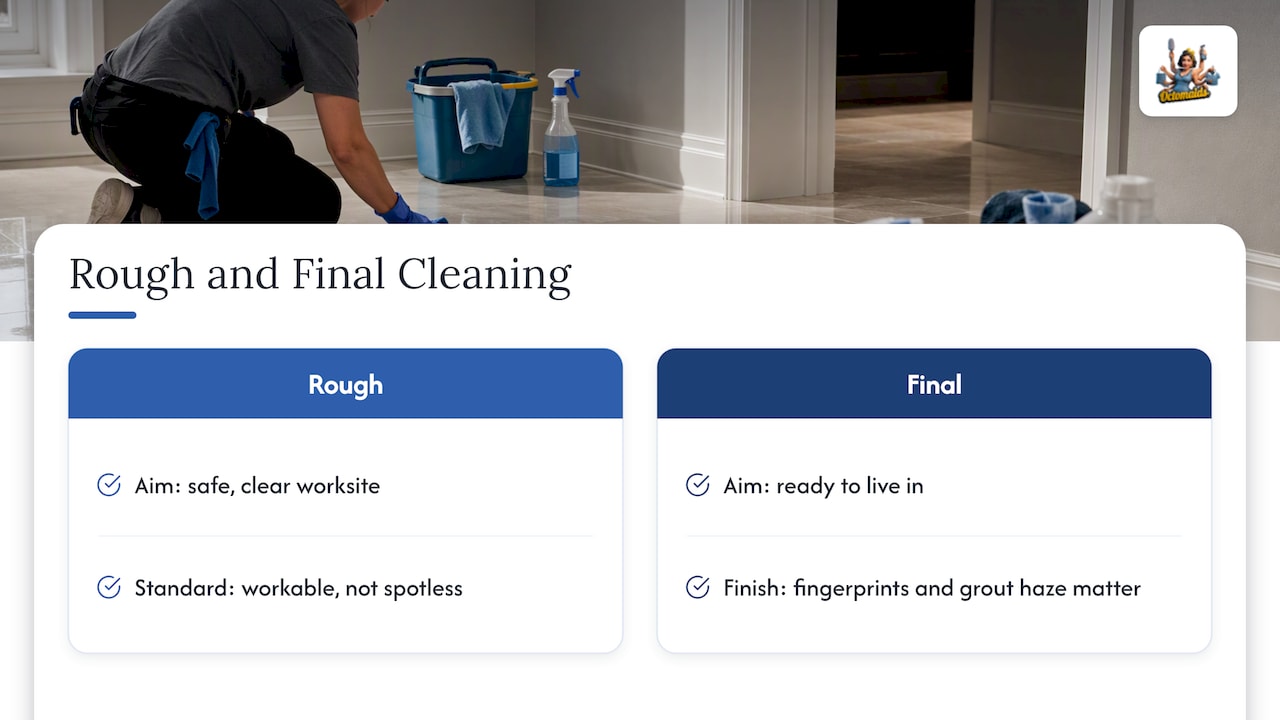
That is why we like to think about it in the order the project itself moves. Rough work is about getting the site safe and clear. Final work is about getting the home ready to be lived in. When homeowners ask us to handle everything in one visit after a remodel, we explain what that means for time, method and the order of rooms, rather than promise a shortcut. If you want to understand how a standard deep clean differs, our deep clean vs. regular clean guide lays that out.
The other thing we care about is consistency. Because we send the same dedicated, background-checked, insured team rather than whoever is available, the people who walk through your finished kitchen know what a careful job looks like and take responsibility for it. For a final clean, where details like fingerprints on new stainless steel or grout haze on fresh tile are the difference between “done” and “nearly done,” that familiarity helps.
— Steven
A realistic timeline for a home remodel
Here is how the stages usually line up on a kitchen or whole-room remodel:
- Demolition complete. Rough clean to remove debris and heavy dust before framing or rough-in work begins.
- Drywall, taping and sanding done. Another rough clean. This is the dustiest phase, and the one that most affects final cleaning time later.
- Paint, flooring, cabinets and fixtures installed. Trades are finishing; keep debris cleared daily.
- Punch list mostly closed. Schedule the final clean now, not before.
- Final walkthrough. Note any marks or missed spots while the crew is still available.
- Touch-up clean, if finishing work continues after the final clean.
- Move-in or furniture return. Wipe surfaces again lightly once you reinstall items, since dust continues to settle for a few days.
How we help
If you are near the end of a remodel or a new build in Clark County or the Portland metro area, our post-construction cleaning service covers the final clean stage: detail work throughout the home so it is ready for move-in or for your final inspection. You can also see the range of what we do on our services page, and if you want a checklist to review before the cleaners arrive, start with our post-construction cleaning checklist for homeowners. We do not publish prices for this work because it depends on the size of the home and how much dust and debris the project left behind, so request a quote and we will scope it with you.
After the final clean, many of our clients move to a regular schedule so the new space stays that way. That is where our recurring home cleaning comes in.
FAQ
What does final clean mean in construction?
Final clean is the last cleaning stage, done after all construction and punch list work is complete and just before the owner or tenant takes occupancy. It covers detailed cleaning of surfaces, fixtures, floors, windows and often HVAC components. On commercial projects it is typically a written closeout requirement.
What is a rough clean?
A rough clean is a pass during construction that removes debris, scrap and heavy dust so the site stays safe and trades can keep working. It is not meant to leave the space polished. OSHA’s housekeeping rule for construction sites is the safety reasoning behind it.
Can one cleaning visit replace both stages?
Only on small jobs with little debris, such as a repaint and new flooring. After a kitchen remodel, addition or new build, a single visit has to remove bulk dust before it can detail, which takes longer and risks scratching new finishes. Two stages usually give better results.
Is a regular house cleaner enough after a renovation?
Usually not. Fine construction dust needs HEPA-filtered vacuums and wet-wiping, and a standard household vacuum can send particles back into the air. Ask any cleaner what equipment and method they use before you book.
Who is responsible for the rough clean, the builder or the homeowner?
That depends on your contract. Many builders include site cleanup as part of their work and use their crews for it, while the final clean may be a separate line item. Ask for it in writing before the project begins.
Sources
- OSHA 1926.25, Housekeeping
- EPA, Steps to Lead Safe Renovation, Repair and Painting
- EPA, Safe Work Practices (asbestos)
- CU Anschutz, Section 017700 Closeout Procedures
Recommended
- Deep Clean vs Regular Clean: A Homeowner’s Guide
- Deep Clean House Checklist for Every Room
- What Does Deep Cleaning Include? a Room-by-Room Guide
- Types of Cleaning Packages for Professionals: 2026 Guide
About Octomaids
Octomaids is a locally operated professional cleaning company serving Vancouver, Clark County, and the surrounding Portland metro area. Since 2006, our cleaning teams have helped homeowners, renters, property managers, and businesses with recurring cleaning, deep cleaning, move-in/move-out cleaning, and commercial cleaning.
Our cleaning articles are reviewed to ensure the information reflects our real-world experience and professional cleaning practices.