


The essential post-construction cleaning equipment is a true HEPA vacuum, tool shrouds with local exhaust ventilation, a cyclonic pre-separator, a portable HEPA air cleaner, wet-mopping systems with disposable wipes, pressure washers or floor scrubbers, respirators and other PPE, access gear, and containment supplies. OSHA and EPA guidance is why HEPA and wet methods come first. The sections below cover specs, selection tips, and safe practices.
TL;DR:
- Choose a sealed vacuum with HEPA filtration as its final stage, rated to capture 99.97% of particles at 0.3 microns; retrofitted shop vacs can leak.
- Use a fitted shroud, a smooth 2 inch hose no longer than 15 feet, and a vacuum motor rated at least 10 amps for dust capture.
- Maintain roughly 65–80 cfm of airflow as a working target, not a regulatory limit, and empty the cyclone before debris reaches its fill line.
- OSHA prohibits dry sweeping where it can raise silica exposure unless no alternative is feasible; use HEPA vacuuming and wet methods instead.
- Use pressure washers only on water tolerant exterior surfaces and slabs; finished interior floors need a suitable scrubber because excess water can damage them.
Table of Contents
- 1. Which HEPA vacuums belong in your kit for renovation cleanup?
- 2. How do shrouds and local exhaust ventilation cut dust at the source?
- 3. Why add a cyclonic pre-separator, and how do you keep airflow steady?
- 4. How do you size HEPA air cleaners with CADR?
- 5. Which wet-mopping systems and disposable wipes does a pro need?
- 6. When do pressure washers and floor scrubbers make sense?
- 7. What PPE and respiratory protection should every crew carry?
- 8. Which access gear gets crews to high surfaces safely?
- 9. What do the regulations say about housekeeping, verification, and disposal?
- 10. How should an experienced pro pack the kit and sequence the clean?
- 11. When does hiring a professional crew beat buying the equipment?
- FAQ
- Sources
1. Which HEPA vacuums belong in your kit for renovation cleanup?
A HEPA vacuum is not a shop vac with a fancy filter bolted on. EPA’s RRP guidance describes one that has a HEPA filter as the last filtration stage and a sealed housing, so all intake air leaves through the HEPA filter. Retrofitted shop vacs often lack that sealed design, which means fine dust can leak straight back into the room you just cleaned.
Check these specs before you buy:
- A HEPA stage rated at 99.97% capture at 0.3 microns.
- A sealed housing with no bypass leaks around the filter.
- A beater bar or carpet head for finished flooring.
- HEPA-compatible bagging so you can seal dust without a second release.
- A filter-change procedure you can follow without shaking dust loose.
Run the machine with a cyclonic pre-separator in front of it to cut the load on the HEPA stage, and replace filters on the manufacturer’s schedule. Never dry sweep first. If you want to understand why this machine earns its price, our explainer on HEPA vacuum benefits walks through what qualifies a vacuum as HEPA.
Pro Tip: Change filters outdoors or inside a bag, wearing your respirator, and tape the used filter into heavy-duty plastic before it goes in the truck.
2. How do shrouds and local exhaust ventilation cut dust at the source?
The cheapest dust to clean is the dust that never lands. A local exhaust ventilation (LEV) setup pairs a shroud on the tool with a hose and a vacuum source, and NIOSH engineering-control studies treat the whole chain as one system. If any link leaks, the system underperforms.
For your crews, that means thinking in components:
- Shroud: match it to the tool and keep the gap to the surface small.
- Hose: NIOSH points to diameters around 1.5–2 inches, and a 2-inch hose is a sound default.
- Length: keep runs short, and NIOSH’s engineering controls database cites no more than 15 feet with a smooth bore.
- Vacuum source: HEPA filtration, a cyclone or pre-filter, and a motor drawing at least 10 amps.
Compatibility matters more than most buyers expect. A shroud that fits loosely or a hose with a crushed section will show up as visible dust at the tool. Watch for it, and use a pressure gauge where the vacuum has one. OSHA and EPA guidance also favors water-fed tools and shrouds with HEPA-vacuum attachments where the work allows. For one example of how contractors keep dust down at the source, see this low-dust door replacement process.
3. Why add a cyclonic pre-separator, and how do you keep airflow steady?
A cyclone spins bulk debris out of the airstream before it reaches the HEPA stage. The practical result is a filter that clogs later and suction that holds up through a full shift. Think of it as a bouncer at the door: the big, coarse material never gets inside.
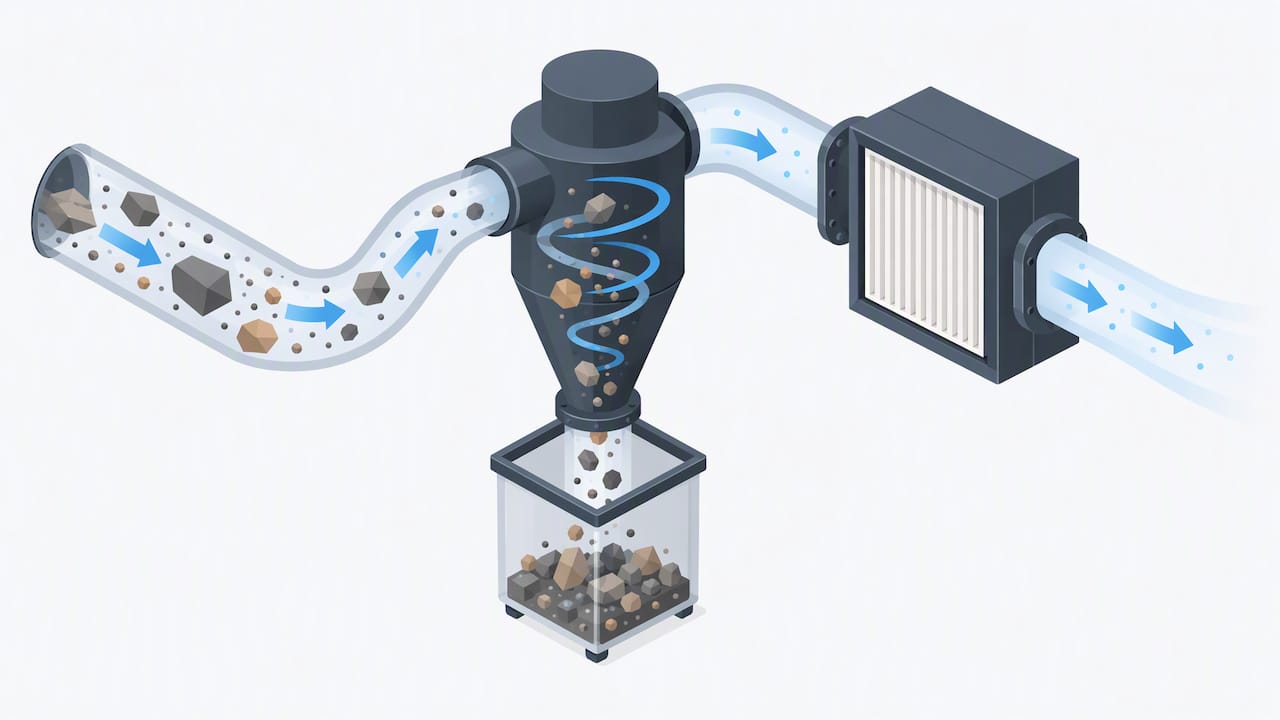
Airflow is the number that decides whether capture works. Practitioner guidance for many dust-control tasks targets roughly 65–80 cfm, and that range is a working target rather than a regulatory limit. If your suction drops below what the tool needs, dust escapes the shroud no matter how good the filter is.
A simple maintenance routine keeps it consistent:
- Empty the pre-separator before it fills, not after.
- Watch the gauge, or look for visible dust at the tool.
- Keep hoses short, with as few elbows and kinks as possible.
- Check seals and gaskets at every container change.
Pro Tip: Mark a fill line on the pre-separator bin with tape. When debris reaches it, empty it, and suction stays steady instead of fading by mid-afternoon.
4. How do you size HEPA air cleaners with CADR?
Clean Air Delivery Rate, or CADR, is one useful performance measure for a portable air cleaner. It tells you how much filtered air the unit delivers, so you can compare a machine against the volume of the room instead of trusting a filter label alone. EPA also notes that lab filter efficiency is different from real-world effectiveness.
An air cleaner is a supplement. It does not replace shrouds, HEPA vacuums, or ventilation, and it will not rescue a job where dust was left to settle on every ledge. Use it to catch what stays airborne after the heavy work.
Put the practical rules to work:
- Choose a CADR suited to the room’s size, and step up for large open spaces.
- Place the unit where air can circulate freely, away from walls and furniture.
- Run it during heavy dust work and for a stretch afterward.
- Keep spare filters on the truck so a clogged unit never idles.
5. Which wet-mopping systems and disposable wipes does a pro need?
OSHA’s housekeeping rule in 29 C.F.R. § 1926.1153 prohibits dry sweeping and dry brushing where they could contribute to silica exposure. It points to wet methods or HEPA-filtered vacuuming instead. That is why a good wet-mopping system is core equipment, not an afterthought.
Follow this order on a typical room:
- Mist dust-covered sheeting lightly before you fold or remove it.
- Fold the sheeting inward, seal it, and double-bag it with the debris.
- Vacuum with the HEPA machine, then wet-mop with a two-bucket wringer system.
- Finish with disposable mop heads or wipes for the final pass.
EPA’s Steps to Lead Safe Renovation, Repair and Painting lists the supplies this takes: heavy plastic bags, a HEPA vacuum, a wet-mopping system, and disposable cleaning cloths. Keep a spray bottle on every cart.
Pro Tip: Use a fresh disposable wipe for each verification spot. Reusing one smears dust and hides what is still on the surface.
6. When do pressure washers and floor scrubbers make sense?
Pick the machine by the surface. Pressure washers suit exteriors, concrete, and other hard surfaces that tolerate water and force. Floor scrubbers with the right pads suit finished interior floors, where blasting water would do damage.
Check the specs that matter:
- Pressure washers: PSI and GPM, plus a surface-cleaner attachment for flat slabs so you get even passes.
- Floor scrubbers: brush or pad type matched to the floor, and a detergent the machine and the finish can both handle.
- Wastewater: plan where rinse water goes, especially after heavy debris.
Keep pressure away from finishes, seals, and window frames, and avoid it indoors. Use a scrubber for interior finished floors and save the washer for the slab, the driveway, and the exterior walls. The right machine saves hours on heavy soil, and the wrong one costs you a repair.
7. What PPE and respiratory protection should every crew carry?
Respirators come first. When a respirator is required, OSHA’s silica rule expects a respiratory-protection program behind it: training, fit, and maintenance, not just a mask in a bag. The rule covers the exposure-control side, and your equipment kit supports it.
Silica housekeeping is a rule, not a preference: OSHA’s standard requires written exposure control plans and tool-specific controls, with vacuums and dust collection maintained per manufacturer instructions.
Pack these for each worker:
- A respirator suited to the task, with spare filters.
- Eye and face protection.
- Gloves matched to the chemicals and debris you handle.
- Protective footwear.
- Hearing protection when running machines.
- Hi-vis garments where traffic or active trades are present.
Clean and store reusable gear after each shift. OSHA’s guidance on silica disposal says contaminated filters and PPE should be handled to minimize exposure, including sealing them in heavy-duty plastic bags.
8. Which access gear gets crews to high surfaces safely?
Extension poles with head attachments handle most high work without leaving the floor. Use them for ceiling corners, light fixtures, and tall window tracks. Reach for a ladder or compact scaffolding when the job needs two hands and a clear view.
A few habits keep access safe and effective:
- Inspect ladders and poles before every job for cracks, loose locks, and worn feet.
- Wipe high ledges with a pole-mounted microfiber duster before you vacuum, so falling dust lands on surfaces you still have to clean.
- Carry corner, sill, and ledge attachments for the vacuum so you are not improvising.
- Keep the area below clear while anyone works above.
Work top to bottom. Dust that drops from a ledge onto a freshly cleaned floor means you do the job twice.
9. What do the regulations say about housekeeping, verification, and disposal?
These anchors support the equipment choices above. Treat them as the baseline your kit must meet.
- OSHA silica housekeeping: 29 C.F.R. § 1926.1153 prohibits dry sweeping, dry brushing, and compressed-air cleaning that can raise silica exposure unless no alternative is feasible. Wet methods and HEPA-filtered vacuums are the preferred route.
- EPA RRP Rule: it requires HEPA vacuums for renovation cleanup, and the program’s contractor page covers training, firm certification, and work practices for pre-1978 housing and child-occupied facilities. Cleaning verification means wiping a surface with a disposable cloth and comparing it to a verification card.
- Disposal: seal contaminated filters and waste in heavy-duty bags, and write the procedure into the exposure control plan when one is required.
Practitioner note: cleaning verification with wet wipes against the card is the difference between a job that passes inspection and one that needs re-cleaning.
For a homeowner-facing version of the same rules, see our OSHA-aligned checklist and our dust protocol.
10. How should an experienced pro pack the kit and sequence the clean?
I have watched good crews lose hours to a missing spare bag. A kit that is packed in the order you use it prevents that, and the sequence below keeps dust from coming back. Our own team’s approach to this is covered in what professional cleaners do differently.
- Pack the primary vacuum with its cyclone, spare HEPA filters, and bags.
- Add the wet-mop kit, disposable wipes, and misting bottles.
- Include the HEPA air cleaner and PPE for each worker.
- Bring pressure-washer accessories, tape, and sheeting.
Then work in this order: control the source, capture bulk dust with the vacuum and cyclone, wet-wipe and mop, run the air cleaners, and finish with a visual check and a wet-wipe verification before client handoff. Recommend third-party clearance testing, or an EPA-certified renovator, when lead is involved or the contract requires testing.
Pro Tip: Photograph the wet-wipe results at handoff. A clean cloth on camera settles most disputes before they start.
— Steven
11. When does hiring a professional crew beat buying the equipment?
The equipment above adds up fast, and it only pays off when you use it often and know the rules behind it. If you manage a renovation and want the dust gone without buying a HEPA fleet, we can take that off your plate. Our team handles post-construction cleaning across Vancouver, WA and Portland, OR, with the same dedicated crew on every visit, background-checked, trained, and insured. Current pricing details are on our site.
Need a clean-up after a remodel, or a full reset before a move-in? See our services and request a quote for your project.
FAQ
What is included in post-construction cleaning?
It covers dust and debris removal from every surface, from ceilings and fixtures down to floors, plus a final wipe-down and verification. Pros use HEPA vacuums and wet methods rather than dry sweeping. The scope varies by project and contract.
What are the stages of post-construction cleaning?
Crews generally work in passes: remove bulk debris, capture dust with a HEPA vacuum, wet-wipe and mop, then do a final detail clean and verification. Most contractors call these rough, main, and final cleans. The names differ between companies, but the order stays top to bottom.
Why use a HEPA vacuum instead of a regular shop vac?
A true HEPA vacuum has a HEPA filter as its final stage and a sealed housing, so fine dust does not leak back out. Ordinary shop vacs often lack that sealed design. The difference matters most when lead or silica dust is possible.
What supplies do I need for lead-safe cleanup?
EPA’s lead-safe guide lists heavy plastic bags, a HEPA vacuum, a wet-mopping system, and disposable cleaning cloths. Add PPE and a respirator suited to the task. Keep spare filters on hand.
Sources
- Silica, Crystalline – Occupational Exposure to Respirable Crystalline Silica 29 C.F.R. § 1926.1153 | Occupational Safety and Health Administration
- The RRP Rule requires HEPA vacuums to be used for cleaning up the dust created by renovations. What should I look for when purchasing a HEPA vacuum? | US EPA
- Engineering Controls for Silica in Construction – Concrete Grinder | NIOSH | CDC
Recommended
- 99.97% Capture: HEPA Vacuum Benefits for Homeowners and Pros
- OSHA Compliant Post Construction Cleaning Checklist for Homeowners
- Homeowners: 48–72 Hour Post-Renovation Dust Protocol
- Post Construction Cleaning Near Me | Vancouver WA & Portland OR
About Octomaids
Octomaids is a locally operated professional cleaning company serving Vancouver, Clark County, and the surrounding Portland metro area. Since 2006, our cleaning teams have helped homeowners, renters, property managers, and businesses with recurring cleaning, deep cleaning, move-in/move-out cleaning, and commercial cleaning.
Our cleaning articles are reviewed to ensure the information reflects our real-world experience and professional cleaning practices.