


A good monthly house cleaning checklist covers the places your daily and weekly routine skips: light fixtures, the tops of cabinets, vents, baseboards, grout, appliance interiors and the bedding you rarely wash. Below you’ll find those tasks grouped by room, a way to split them into two manageable sessions, and the health reasoning behind them, so the list feels like a plan rather than a chore pile.
We’ve cleaned homes in Vancouver, WA and the Portland area since 2006, and the pattern is the same in nearly every house. Daily upkeep gets done. The monthly layer is what slips, and that layer is what makes a home feel truly clean.
TL;DR
- Monthly tasks target “out of sight” spots where dust, allergens and grime build up: fixtures, cabinet tops, vents, baseboards, grout and appliance interiors.
- Don’t try to do it all in one day. Split the list into two sessions, such as the first and third weekend of the month.
- Clean first, disinfect only when someone is ill or at higher risk. Soap, water and scrubbing do most of the work.
- Use a damp cloth for dust, keep indoor humidity between 30% and 50%, and never mix cleaning products.
- If the list never gets finished, that is a scheduling problem, not a character flaw. A recurring professional visit can take the heavy items off your plate.
Table of Contents
- What belongs on a monthly list (and what doesn’t)
- Why 30 days is the right interval
- The two-session method
- The monthly checklist, room by room
- Get the method right: five habits that matter more than the product
- A sample month at a glance
- Our perspective: why monthly is where homes fall behind
- When a DIY checklist isn’t enough
- Let us handle the monthly layer
- A quick printable version
- FAQ
- Sources
What belongs on a monthly list (and what doesn’t)
Think of your cleaning routine in layers. Daily tasks keep surfaces usable: wiping counters, running the dishwasher, putting clutter away. Weekly tasks reset the whole house: vacuuming, mopping, bathrooms, bedding. The American Cleaning Institute’s home cleaning routine lays out the same daily and weekly tiers, and the monthly layer sits on top of them.
Monthly tasks are the ones where dirt accumulates slowly enough that you don’t see it day to day. The professional organizer behind Home Made Simple’s monthly checklist points to areas such as the tops of cabinets and the refrigerator, ceiling fan blades, light fixtures and baseboards. Tackling them about every 30 days keeps buildup from turning into a scrubbing project, and it can help appliances last longer.
A useful rule: if a task takes more than ten minutes and needs a ladder, a pulled-out appliance or a soaking time, it’s monthly. If it takes two minutes with a cloth, it belongs in your weekly routine.
What doesn’t belong on the monthly list:
- Seasonal jobs like washing exterior windows, flipping mattresses or cleaning gutters.
- Full deep cleans such as scrubbing every wall and cabinet interior. Our deep clean house checklist for every room covers that scope.
- Repairs like re-caulking a tub. Note them as you go, but they’re a separate job.
Why 30 days is the right interval
Dust is not just a cosmetic issue. The EPA explains that indoor dust is settled particulate matter that cleaning, vacuuming and even walking can kick back into the air. Dust can carry mold spores, dust mite droppings and pet dander, all of which are known asthma triggers.
Think of dust like a word you repeat until it stops meaning anything: you stop seeing it. Your brain files a gray film on a ceiling fan blade as “normal” long after it has become a reservoir for allergens. A monthly checklist works because it forces a look at places your eyes have stopped noticing.
This matters most for children, seniors and anyone with respiratory sensitivities. The ACI’s guidance frames a consistent routine as a preventive health measure, and its message is that small, regular habits beat occasional heavy-duty cleaning.
The two-session method
The biggest barrier to monthly cleaning is the belief that it must happen all at once. Organizer Sandy Park, quoted by Home Made Simple, recommends dividing and conquering: split the list across two sessions or assign tasks to specific weekends.
Here is a simple way to do that:
- Session A (first weekend, about 90 minutes): high and dry tasks. Light fixtures, fans, vents, blinds, cabinet tops, baseboards, vacuum filter.
- Session B (third weekend, about 90 minutes): wet and appliance tasks. Grout, tub and shower surrounds, refrigerator, dishwasher, washing machine, garbage cans.
The logic is practical. Dry dusting goes top to bottom, and you want it finished before you mop. Wet tasks leave a damp bathroom and kitchen, so they’re better grouped together. Anchoring each session to a fixed weekend also removes decision fatigue, because you never ask yourself when you’ll do it.
The monthly checklist, room by room
Tick these off over your two sessions. Times are rough guides for an average-size home and will vary.
Kitchen
- Clean the inside of the microwave: steam a bowl of water with a splash of vinegar for a few minutes, then wipe.
- Wipe down the exterior of the refrigerator, including the top and the door gaskets.
- Vacuum the refrigerator coils or grille if your model has accessible ones. Check your manual first.
- Empty and wipe fridge shelves and drawers, and toss expired items.
- Run a cleaning cycle on the dishwasher and clear the filter.
- Degrease the range hood and the cabinet fronts above the stove, where cooking residue turns tacky.
- Dust the tops of cabinets. In kitchens, that dust is mixed with grease and needs a damp cloth and a little dish soap.
- Wash the trash can and recycling bin.
- Clean the coffee maker and descale it if you have hard water.
Bathrooms
- Scrub grout lines with a stiff brush and a paste of baking soda and water.
- Wipe tub and shower surrounds, and clean the showerhead if water flow has dropped.
- Wash the shower curtain or liner, or replace it if mildew has set in.
- Wipe the inside of medicine cabinets and drawers.
- Clean the exhaust fan cover. A clogged fan moves less moisture, and bathrooms need that moisture out.
- Check and clean faucet aerators. If you have dark-finish fixtures, this guide to caring for black taps explains how to protect the finish while you clean the aerators. It comes from a UK retailer, so product names may differ.
- Wash bath mats and the toilet brush holder.
Bedrooms
- Launder pillow protectors and mattress protectors.
- Vacuum the mattress surface and the area under the bed.
- Dust blinds, ceiling fans and the tops of dressers and wardrobes.
- Wipe baseboards and door frames.
- Sort one drawer or one shelf. A single small purge each month stops clutter from piling up.
Living areas
- Vacuum under furniture and sofa cushions, and along the edges of rugs.
- Dust all blinds, one slat at a time with a microfiber cloth or a blind duster.
- Dust ceiling fan blades and light fixtures. Use a pillowcase over each blade to catch the dust rather than scatter it.
- Wipe baseboards and the tops of door frames.
- Wipe TV screens, speakers and electronics with a dry microfiber cloth.
- Wipe light switches, doorknobs and remote controls. These are high-touch spots, so more often is fine.
- Clean the window sills and tracks.
Whole house
- Replace or clean the HVAC filter according to the manufacturer’s schedule. Many one-inch filters are changed every one to three months, so check yours monthly.
- Clean the vacuum filter and empty or wash the canister.
- Dust vent covers and return grilles.
- Wipe down walls where hands and furniture touch them, such as around light switches and hallways.
- Wash entry mats and sweep the entry area.
That’s roughly 40 individual actions, which group into about 30 distinct tasks, and none of them is difficult. The challenge is remembering them all, which is why a printed or phone-based checklist helps.
Get the method right: five habits that matter more than the product
Use a damp cloth, not a dry one
The EPA notes that dry dusting can send fine particles back into the air, while a damp cloth traps them. That matters most on blinds, fan blades and shelves. Work top to bottom so the dust falls onto surfaces you haven’t cleaned yet, and vacuum last.

Clean first, disinfect only when needed
Many people assume “clean” and “disinfect” mean the same thing. The CDC explains that cleaning removes dirt and germs with soap, water and scrubbing, and that disinfecting only makes sense after a surface is cleaned. CDC guidance on cleaning and disinfecting adds that, in most situations, cleaning alone with soap and water removes most germs, and disinfecting is likely not needed unless someone in the home is sick or at higher risk.
So for your monthly list, soap and water is the default. Reserve disinfectant for a bathroom after a stomach bug, for example, or a household with someone who has a weakened immune system. If you’re unsure what applies to your household, ask your doctor.
Never mix products
If you do use bleach, the CDC is firm: never mix household bleach with any other cleaner or disinfectant, because the vapors can be very dangerous to breathe. That includes the “stronger is better” shortcut of combining a bathroom spray with a drain cleaner. Ventilate the room, use one product at a time and rinse between them.
Watch humidity
The EPA recommends keeping indoor relative humidity below 60%, ideally between 30% and 50%, to discourage mold and dust mites. This is relevant in the Pacific Northwest, where a local HVAC contractor notes that excess winter humidity and condensation are common in Vancouver, WA homes. A small hygrometer costs little and tells you whether your shower grout and window sills are fighting a losing battle. If you see condensation on windows most mornings, wipe sills during your monthly pass and run exhaust fans longer.
Stop dirt at the door
The cheapest cleaning product is a doormat. The EPA’s guidance on household dust points to prevention: leave shoes at the door, use good HVAC filters and keep humidity in range. Less soil tracked in means less dust to chase.
A sample month at a glance
| Week | Focus | Time |
|---|---|---|
| Week 1 (weekend) | Session A: fixtures, fans, vents, blinds, cabinet tops, baseboards | 90 min |
| Week 2 | Weekly routine only. Check HVAC filter | 15 min extra |
| Week 3 (weekend) | Session B: grout, shower surrounds, fridge, dishwasher, washer, bins | 90 min |
| Week 4 | Weekly routine only. Bedding protectors, entry mats | 20 min extra |
This is a template. If you have pets, kids or allergies, shift more tasks to Session A and add a mid-month vacuum of upholstery.
Our perspective: why monthly is where homes fall behind
In almost every first visit we make, the same things stand out. Surfaces people see daily are fine. The dust on ceiling fan blades, the film on range hoods and the grime in shower tracks are what we find, and these are the monthly items. Nobody ignores them on purpose. They simply don’t announce themselves.
We also see the effect of cleaning schedules that are too ambitious. A homeowner builds a 60-item list, does it twice and then stops, feeling guilty. We’d rather you do half the list every month than all of it twice a year. Sustainable beats heroic.
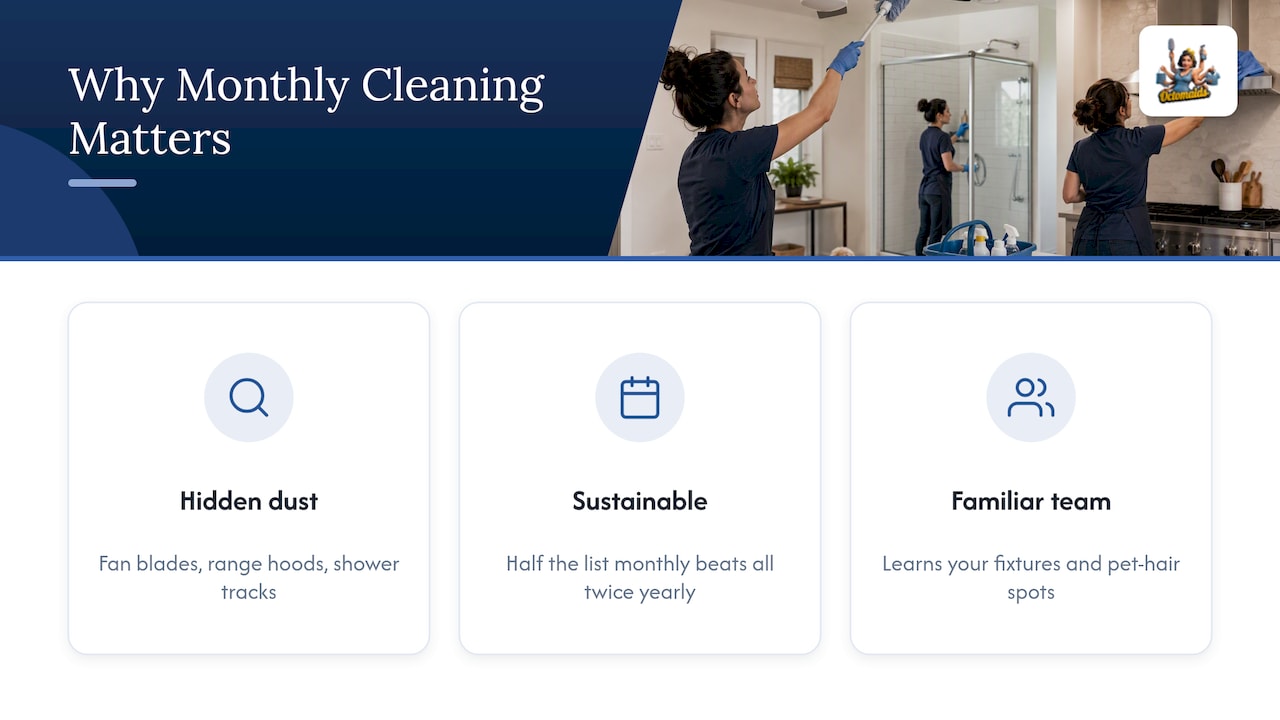
That’s also why we assign the same dedicated team to your home for every visit. A team that knows your home knows which fixtures collect dust fastest, which shower needs extra attention and where the pet hair gathers. That familiarity is what makes monthly detail work easier. For some households, a monthly or biweekly vs monthly cleaning schedule comparison is useful, because two weeks versus four weeks changes how much buildup there is to remove each visit. For others, the answer is to keep daily and weekly tasks themselves and hand the monthly layer to us.
Most of all, we want you to feel supported, not judged. A home that is a little behind is a normal home.
— Steven
When a DIY checklist isn’t enough
A checklist works when you have the time and energy to run it. Some situations call for help:
- Busy seasons. Work deadlines, newborns or caring for a parent make the monthly layer the first thing to go.
- Physical limits. Ladders, ceiling fans and scrubbing grout are hard for many seniors. A professional visit removes the risk.
- A big backlog. If it has been a year or more since the last thorough clean, a monthly list will feel impossible. Start with a reset, then maintain. Our guide on what deep cleaning includes shows what a reset covers, and our home cleaning frequency guide helps you choose a rhythm afterward.
- Moves and rentals. Between tenants or before you hand over keys, the monthly list isn’t the right tool. See our move-out deposit checklist.
Not sure which tasks are worth outsourcing? Our piece on cleaning tasks worth hiring out walks through the trade-offs.
Let us handle the monthly layer
If you live in Vancouver, WA, Portland, OR or elsewhere in Clark County and the Portland metro area, we can take this list off your plate. Our recurring home cleaning runs weekly, bi-weekly or monthly, with the same background-checked, insured team each visit. If your home needs a thorough reset first, our one-time deep cleaning is the place to start. Tell us which monthly tasks matter most to you and we’ll build the visit around them. You can also see everything we offer on our services page, including commercial and short-term rental cleaning.
A quick printable version
Copy this into your notes app and tick it off as you go:
Session A (dry and high)
- [ ] Ceiling fans and light fixtures
- [ ] Blinds and window sills
- [ ] Vent covers and return grilles
- [ ] Cabinet tops and refrigerator top
- [ ] Baseboards and door frames
- [ ] Vacuum under furniture and sofa cushions
- [ ] Vacuum filter and HVAC filter check
Session B (wet and appliances)
- [ ] Grout, tub and shower surrounds
- [ ] Showerhead and faucet aerators
- [ ] Medicine cabinets
- [ ] Microwave, fridge interior, dishwasher cycle
- [ ] Range hood and cabinet fronts
- [ ] Trash cans and recycling bin
- [ ] Pillow and mattress protectors, bath mats
FAQ
How long does a monthly house cleaning take?
For an average home, plan on about three hours in total, split into two sessions of roughly 90 minutes. Larger homes, pets and hard water add time. If you’re starting from a backlog, the first month will take longer.
Do I need to disinfect during monthly cleaning?
Usually not. The CDC says that in most situations cleaning with soap and water removes most germs, and disinfecting is likely not needed unless someone is sick or at higher risk. If you do disinfect, clean the surface first and never mix products.
What is the difference between a monthly clean and a deep clean?
A monthly clean maintains the hidden spots, such as fixtures, vents and baseboards, so they never get bad. A deep clean is a one-time or occasional reset that goes further, including interiors of cabinets and heavy scrubbing. Our guide to deep clean versus regular clean explains the split.
Can I skip months?
Yes, and nothing breaks. Dust and grime simply build up a little more, so the next session takes longer. If you skip often, shorten the list to your top ten tasks and keep those consistent.
Is monthly professional cleaning enough?
For some homes, yes, especially smaller households without pets. Busier homes usually do better with a bi-weekly rhythm so less buildup needs removing each time. We can talk through which fits your household when you book.
Sources
- Home Made Simple: Professional Organizer’s Monthly Cleaning Checklist
- American Cleaning Institute: Home Cleaning Routine
- US EPA: Sources of Indoor Particulate Matter
- CDC: When and How to Clean and Disinfect Your Home
- CDC: Cleaning and Disinfecting
- CDC: Cleaning and Disinfecting with Bleach
- Tri-Tech Heating: Indoor Air Quality in Vancouver WA Homes
Recommended
- Deep Clean House Checklist for Every Room
- Cleaning Priorities for Small Urban Homes That Work
- Home Cleaning Best Practices for a Spotless Home
- Move Out Cleaning Room by Room Guide for Renters
About Octomaids
Octomaids is a locally operated professional cleaning company serving Vancouver, Clark County, and the surrounding Portland metro area. Since 2006, our cleaning teams have helped homeowners, renters, property managers, and businesses with recurring cleaning, deep cleaning, move-in/move-out cleaning, and commercial cleaning.
Our cleaning articles are reviewed to ensure the information reflects our real-world experience and professional cleaning practices.