


For most modern offices, a hybrid schedule that leans toward daytime cleaning wins because it improves responsiveness, visibility, and staff retention, while heavy or noisy tasks still belong after hours. The right mix depends on your building’s occupancy pattern, equipment, and how willing your team is to pilot a change before committing fully. We’ll walk through the trade-offs so you can test what fits before you overhaul anything.
TL;DR:
- Daytime cleaning improves responsiveness, security, and staff retention but requires careful planning to minimize noise and occupant disruption.
- Night cleaning offers faster deep cleaning and loud equipment use but faces challenges with staffing, safety concerns, and higher wages.
- Cost benefits of switching schedules depend heavily on labor premiums, task restructuring, and energy savings, warranting small-scale pilots to test impacts.
- Indoor air quality is better during day shifts with proper filtration and ventilation, especially when using stronger cleaning chemicals.
- A hybrid schedule combining daytime routine tasks with after-hours heavy or chemical cleaning often provides the best operational balance.
Table of Contents
- Benefits and drawbacks of daytime cleaning
- Benefits and drawbacks of nighttime cleaning
- Costs, staffing, and scheduling trade-offs
- Ventilation, indoor air quality and chemical safety considerations
- Tools, noise control, and task timing for workable schedules
- Decision checklist and a 4-week pilot plan
- Octomaids’ practitioner perspective and best-practice examples
- Environmental sustainability implications of cleaning schedules
- Comparative effectiveness and quality outcomes of day vs night cleaning
- Legal and insurance implications of day vs night cleaning
- Author perspective: recommended stance for facility leaders
- How Octomaids can help implement or pilot a schedule
- FAQ
- Sources
Benefits and drawbacks of daytime cleaning
Daytime cleaning puts custodial staff in the same hallways as your employees, and that visibility changes the job in ways worth understanding before you switch.
The upside shows up quickly once a program is running well:
- Faster response to spills and messes, since staff are already on-site instead of hours away.
- Greater visible security, because occupied buildings with custodians present tend to feel safer and better monitored.
- Lower energy costs, since buildings do not need full HVAC and lighting running into the night just for cleaning crews.
- Better retention for cleaning staff, who often prefer standard hours over isolated overnight shifts.
The drawbacks are just as real. Vacuums and buffers can interrupt calls and concentration, foot traffic complicates deep cleaning, and chemical use around occupied desks raises safety questions that night shifts never have to consider. Industry consultants covering day and night cleaning note that daytime programs help with labor shortages and energy costs, but only when tasks get re-engineered rather than simply moved earlier on the clock, according to practitioner coverage of day and night cleaning trade-offs.
Mitigation is mostly a matter of planning. Low-decibel, battery-powered equipment removes most of the noise complaints. Zoning, cleaning one wing or floor while another stays quiet, keeps disruption contained. A short communication plan, even a one-page notice of what’s happening and when, heads off the majority of occupant friction before it starts. Our shared workspace sanitation best practices resource covers occupant communication in more depth.
Pro Tip: Run a two-week noise audit before committing to daytime cleaning: track which tasks draw complaints, then move only those to after-hours instead of abandoning the whole schedule.
Benefits and drawbacks of nighttime cleaning
Night cleaning remains the default for a reason: an empty building lets crews move fast and use equipment that would never work around people.
Core advantages include:
- Uninterrupted deep cleaning, since there is no foot traffic, no meetings to avoid, and no desks to work around.
- Freedom to use louder, heavier equipment like floor buffers and carpet extractors without disturbing anyone.
- Higher per-shift productivity on large, repetitive tasks because crews can move through a floor without pausing.
The drawbacks fall mostly on the workforce. Recruiting for overnight shifts is harder, turnover tends to run higher, and isolated staff working alone in a dark building face real safety concerns that daytime crews simply do not. Premium wages for night work are common precisely because the job asks more of the people doing it.
Some tasks genuinely belong at night regardless of your broader schedule: floor stripping and refinishing, heavy machine polishing, and large-scale carpet extraction all involve wet floors, strong odors, or extended drying time that make them impractical during business hours. Keeping those jobs after hours, even inside an otherwise daytime-first program, is standard practice. Our guide to handling after-hours office cleaning breaks down which tasks fit that window.
Costs, staffing, and scheduling trade-offs
The financial case for either schedule rests on a few variables: wage premiums, turnover costs, energy use, and how much task re-engineering a switch requires.
Night shifts typically carry a wage premium to offset the inconvenience and isolation, and that premium compounds with the higher turnover common to overnight custodial work. Daytime roles are easier to staff and retain, which lowers recruiting costs over time even when hourly wages are comparable. Industry reports cited in practitioner interviews describe labor savings in the range of 5 to 10% and energy savings of roughly 10 to 15% in some large daytime operations, though results vary by building type and how aggressively tasks are restructured, according to coverage of day and night cleaning cost trade-offs.
Industry reporting links daytime cleaning to measurable labor and energy savings in some operations, though the size of the effect depends heavily on building type and task redesign, per that same practitioner analysis.
When modeling the switch, a few levers matter most:
- Wage differential between night premium rates and standard daytime rates.
- Turnover and recruiting costs specific to your local labor market for each shift type.
- HVAC and lighting hours saved or added depending on when the building stays active.
- Task re-engineering costs, including new equipment and staff training.
Run the numbers on a single floor or department first. A small pilot gives you real labor hours and energy readings instead of estimates borrowed from other buildings.
Ventilation, indoor air quality and chemical safety considerations
Air quality is one of the more overlooked variables in the day versus night decision, and the evidence points in a specific direction.
Indoor PM2.5 concentrations tend to run lower during standard work hours when ventilation systems are operating as designed, and upgrading filtration makes a measurable difference. A study of office buildings in four countries found that higher-rated filters were associated with substantially lower indoor PM2.5 during occupied hours.
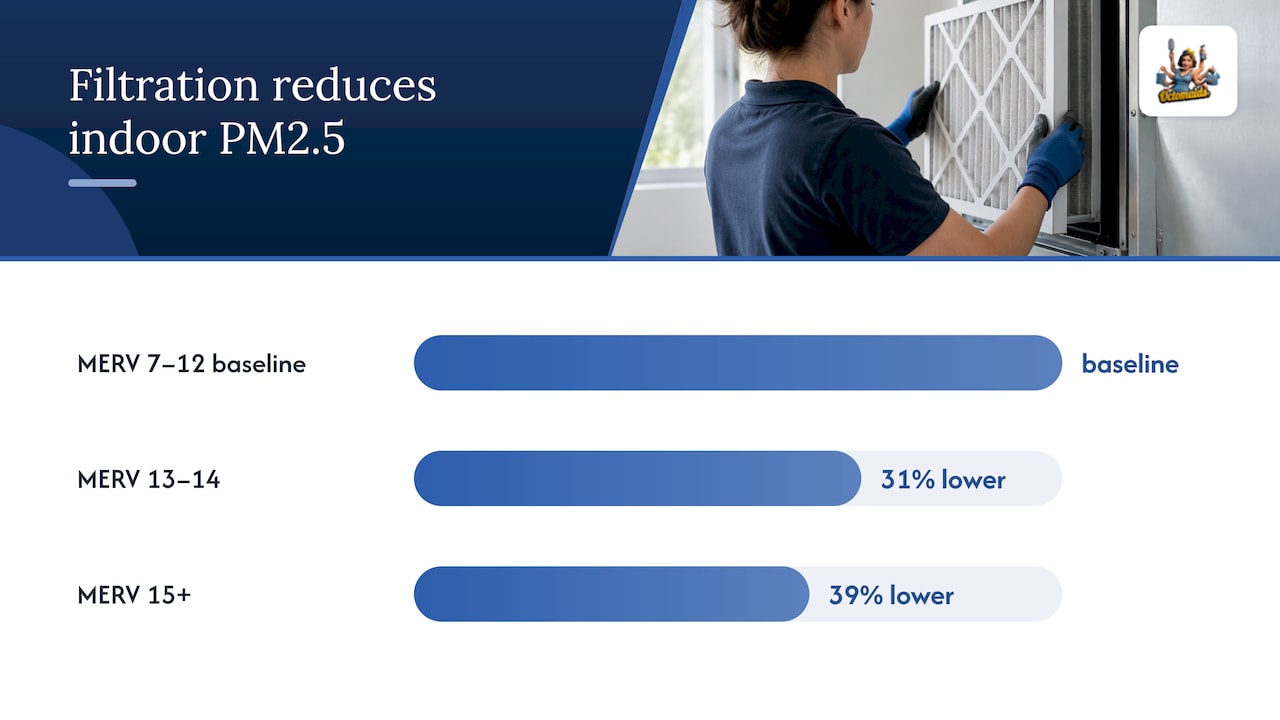
MERV 15+ filters were associated with roughly 39% lower indoor PM2.5 during work hours compared to MERV 7 to 12 filters, with MERV 13 to 14 filters showing about 31% lower levels, according to CDC-published research on ventilation and filtration. That gap matters if cleaning tasks stir up dust and particles while people are at their desks.
Practical steps that follow from this:
- Upgrade to MERV 13 or higher filtration where your HVAC system supports it.
- Keep ventilation running continuously during and after cleaning, not just during occupied hours.
- Coordinate chemical use with airflow, running exhaust or fresh-air cycles when stronger products are in use.
OSHA guidance on cleaning chemicals requires training, proper labeling, and protective equipment whenever workers handle hazardous products, and that obligation does not change based on the hour. In occupied daytime settings, coordinating cleaning chemical use with HVAC operation becomes more important specifically because people are breathing the same air in real time, as outlined in OSHA’s guidance for workers who use cleaning chemicals.
Tools, noise control, and task timing for workable schedules
The equipment list for daytime cleaning looks different from what a night crew needs, and getting it right is what makes a daytime program bearable for everyone sharing the space.
Recommended equipment for daytime work includes, and for cleaning surfaces consider guidance on the best thing to clean interior doors with:
- Battery-powered, low-decibel vacuums, with a practical target of staying under roughly 68 decibels.
- HEPA-filtered vacuums, which capture fine particles rather than redistributing them into occupied air.
- Walk-behind autoscrubbers, reserved for off-hours or low-traffic zones given their size and sound.
Industry guidance on daytime custodial operations specifically recommends keeping vacuum noise under that 68-decibel mark and re-sequencing tasks around occupancy rather than simply running the same routine earlier in the day, according to CleanLink’s reporting on daytime carpet cleaning practices.
Task sequencing matters as much as the tools. Restrooms, kitchens, and high-touch surfaces work well during lunch or other low-occupancy windows. Trash collection and spot cleaning fit easily around a normal workday. Wet mopping, floor buffing, and anything involving strong-smelling chemicals should stay on the after-hours list even in a mostly daytime program, since drying time and odor dispersal both benefit from an empty building.
Pro Tip: Pair your chemical choice with your ventilation schedule, run exhaust fans or open fresh-air dampers during and after any task that uses a stronger cleaning product, even a quick one.
Decision checklist and a 4-week pilot plan
Rather than choosing a schedule on instinct, run a short pilot and let the data decide.
- Audit current tasks and flag which ones generate noise, odor, or visible disruption.
- Map must-be-after-hours tasks, including floor care, extraction, and anything requiring extended drying time.
- Survey occupants and stakeholders about current complaints and willingness to see cleaning staff during the day.
- Select a pilot zone, ideally one floor or department rather than the whole building.
- Run the pilot for four weeks, tracking the metrics below before expanding or reversing course.
Track these during the pilot:
- Complaint volume, compared to the same period under the old schedule.
- Response time for spill and mess requests.
- Labor hours and cost, measured against your projected savings.
- IAQ readings, if you have access to particulate monitoring.
- Staff turnover or recruiting ease, for both the cleaning team and the office itself.
| Decision gate | What it means |
|---|---|
| Complaints rise and stay elevated after week 2 | Scale back daytime tasks, keep more work after hours |
| Labor cost drops without a quality complaint increase | Expand the pilot to additional floors |
| IAQ readings worsen during cleaning windows | Revisit ventilation coordination before expanding |
| Staff turnover improves on the new shift | Strong signal to make the change permanent |
Our guide on building an office cleaning schedule that works walks through the audit step in more detail.
Octomaids’ practitioner perspective and best-practice examples
We’ve found that the schedule question rarely has a universal answer. It depends on the building, the industry, and how occupants feel about seeing cleaning staff during the day.
What tends to work in practice:
- Assigning the same dedicated team to a client rather than rotating staff, so occupants recognize who’s cleaning and when.
- Starting with a small-area pilot, auditing one floor or wing before touching the rest of the building.
- Using a short communication template, a single notice explaining what’s changing and why, before the first daytime visit.
- Reviewing results after a defined window rather than committing indefinitely on day one.
Background-checked, trained teams make the daytime transition smoother because occupants are interacting with familiar faces, not unfamiliar staff rotating through. That consistency addresses the biggest daytime concern we hear from office managers: comfort with people present in shared space during work hours.
Environmental sustainability implications of cleaning schedules
Cleaning schedule has a real, if underdiscussed, environmental footprint tied to when a building’s systems are running.
Daytime cleaning generally avoids the extra HVAC and lighting hours that night shifts require, since the building is already heated, cooled, and lit for occupants. That overlap reduces the marginal energy draw attributable to cleaning itself. Night cleaning, by contrast, often means running full building systems for a crew working a fraction of the space, which adds energy use that would not otherwise occur.
Equipment choice also plays a role. Battery-powered daytime equipment draws less continuous power than many corded, heavy-duty night machines, and electric vehicles or equipment charged during off-peak hours can shift demand to cleaner parts of the grid depending on your local utility’s energy mix. None of this makes night cleaning environmentally irresponsible. Certain tasks, like large-scale floor stripping, use specialized machines regardless of the hour. But for buildings weighing sustainability alongside operational factors, the overlap between daytime cleaning and already-running building systems is a genuine point in its favor, worth factoring in alongside noise and staffing considerations.
Comparative effectiveness and quality outcomes of day vs night cleaning
Neither schedule is inherently more effective. Quality outcomes come down to task fit, equipment, and oversight rather than the hour on the clock.
Night cleaning allows uninterrupted, methodical work, which can mean more thorough coverage per shift since crews are not pausing for foot traffic or noise-sensitive moments. Daytime cleaning trades some of that uninterrupted time for faster response to visible messes and ongoing small-scale maintenance that would otherwise sit until the next overnight visit. A spilled coffee at 10 a.m. gets addressed in minutes during a daytime program and sits until evening under a night-only schedule.
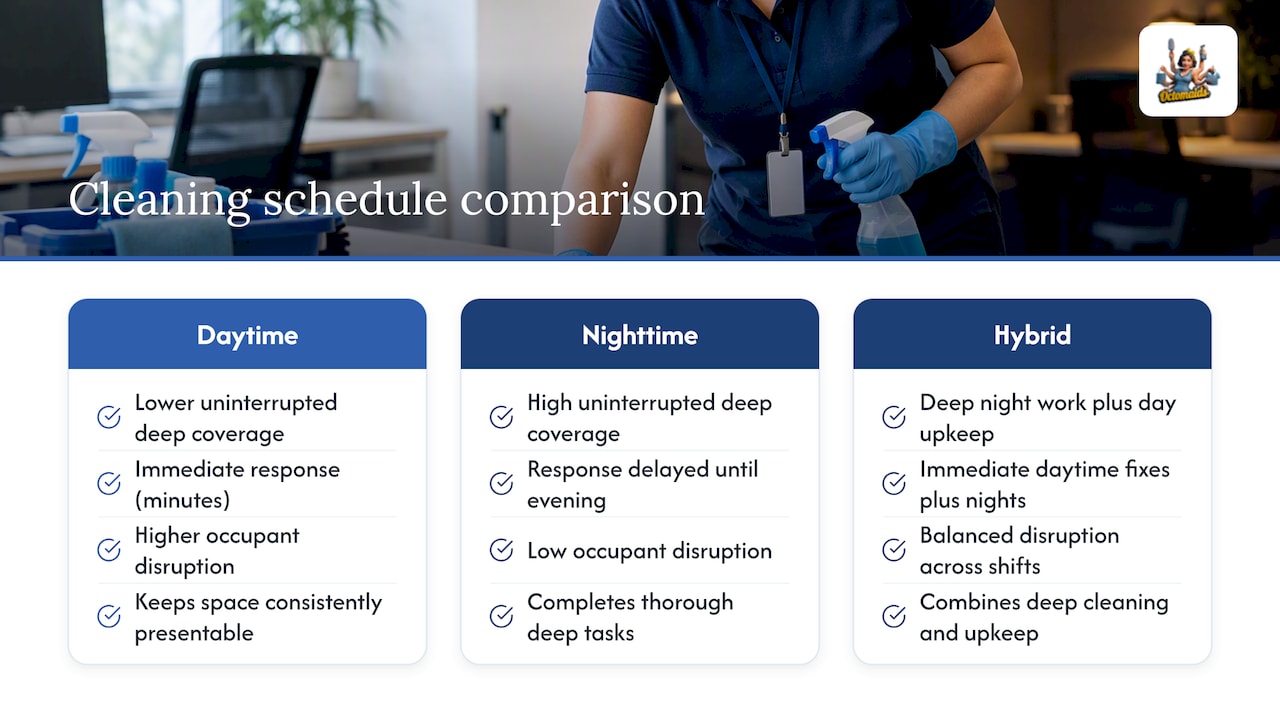
Practitioner guidance on day cleaning suggests the two approaches serve different kinds of thoroughness: night work finishes large, visible tasks completely, while daytime work keeps a building consistently presentable between those deeper sessions, according to coverage of daytime cleaning programs. The strongest programs we’ve seen combine both: scheduled deep work after hours, paired with daytime attention to the smaller things that affect how a space feels day to day.
Legal and insurance implications of day vs night cleaning
Schedule changes carry a few legal and insurance considerations worth checking before you commit.
Workers’ compensation and general liability coverage should account for where and when staff are working. Night staff working alone in an otherwise empty building may fall under different risk assessments than daytime staff working alongside your employees, and insurers sometimes price that risk differently. It’s worth confirming with your provider or your cleaning partner’s insurer how coverage applies under each schedule.
OSHA’s hazard communication requirements apply regardless of shift: employers must ensure workers handling cleaning chemicals receive proper training, labeling, and protective equipment, as detailed in OSHA’s hazard communication standard interpretations. Daytime cleaning around occupants adds a layer of consideration around liability if a chemical reaction or spill affects an employee rather than just cleaning staff.
Lone-worker safety for night shifts is its own legal consideration in many jurisdictions, with some requiring check-in protocols or additional security measures for after-hours staff. Before switching schedules, it’s worth a short conversation with your insurance broker and, if your cleaning service is contracted rather than in-house, a review of their insurance certificate and worker protections for the shift you’re choosing.
Author perspective: recommended stance for facility leaders
We’d rather see a facility manager run a disciplined four-week pilot than debate day versus night cleaning in a conference room. The data from your own building, complaint volume, labor hours, air quality readings, will tell you more than any industry average. Our honest recommendation is a hybrid default: daytime for routine, visible, low-noise work, after-hours for anything loud, wet, or chemical-heavy. Invest in training your cleaning staff to work around people respectfully, choose equipment with noise and air quality in mind, and keep occupants informed before, not after, you change their routine.
— Steven
How Octomaids can help implement or pilot a schedule
If you’re weighing a pilot but don’t want to manage the logistics yourself, our team handles the planning as well as the cleaning. We staff office and commercial accounts with the same dedicated, background-checked team for every visit, which makes a daytime transition far less disruptive since your staff see familiar faces rather than rotating crews.
Services relevant to this kind of program include:
- Office Cleaning, for ongoing daytime or hybrid visits tailored to your building’s occupancy.
- Commercial Cleaning, covering broader janitorial needs across shared or multi-tenant spaces.
- One-Time Deep Cleaning, useful for establishing a clean baseline before a new schedule starts.
If you’re ready to test a daytime or hybrid schedule, reach out through our office and commercial cleaning services page to talk through a pilot for your building.
FAQ
What is the 5 5 5 rule for cleaning?
Definitions vary by industry, but the phrase generally refers to a simplified routine of spending five minutes on five key areas, five times a week, often used informally for home tidying rather than commercial office protocols. It isn’t a standard referenced in commercial cleaning or OSHA guidance, so office managers should rely on task-specific schedules instead.
What are the signs of a poorly cleaned office?
Common signs include lingering odors, visible dust buildup on surfaces and vents, sticky or grimy high-touch points like door handles and light switches, and overflowing trash left past a normal collection cycle. Recurring employee complaints about air quality or visible mess are also a reliable signal that the current schedule or task list needs review.
What is the 20 minute rule in cleaning?
The timeboxing rule generally refers to focusing on high-impact tasks within a fixed short window rather than attempting a full deep clean at once. It’s more common in residential cleaning advice than commercial janitorial standards, where task lists are typically scoped by square footage and frequency instead.
Is daytime cleaning better than nighttime cleaning for most offices?
Daytime cleaning tends to work well for routine, low-noise tasks and offers faster response to spills, better visibility, and often lower energy costs, while nighttime cleaning remains preferable for loud, wet, or chemical-heavy jobs like floor stripping. Most offices benefit from a hybrid approach rather than choosing one schedule exclusively.
How do I know if my office is ready to pilot daytime cleaning?
Start by surveying occupants about noise tolerance and reviewing which tasks currently generate the most disruption complaints. A four-week pilot in a single zone, tracking complaints, response times, and labor cost, gives a clearer answer than guessing based on another company’s results.
Sources
- Benefits and tradeoffs of day and night cleaning
- The effects of ventilation and filtration on indoor PM2.5 in office buildings in four countries (supplementary data)
- Protecting workers who use cleaning chemicals (OSHA infosheet)
Recommended
- 30 Day Test: Day Porter vs Janitor for Facility Managers
- How to Handle After-Hours Office Cleaning Efficiently
- How to Create an Office Cleaning Schedule That Works
About Octomaids
Octomaids is a locally operated professional cleaning company serving Vancouver, Clark County, and the surrounding Portland metro area. Since 2006, our cleaning teams have helped homeowners, renters, property managers, and businesses with recurring cleaning, deep cleaning, move-in/move-out cleaning, and commercial cleaning.
Our cleaning articles are reviewed to ensure the information reflects our real-world experience and professional cleaning practices.