
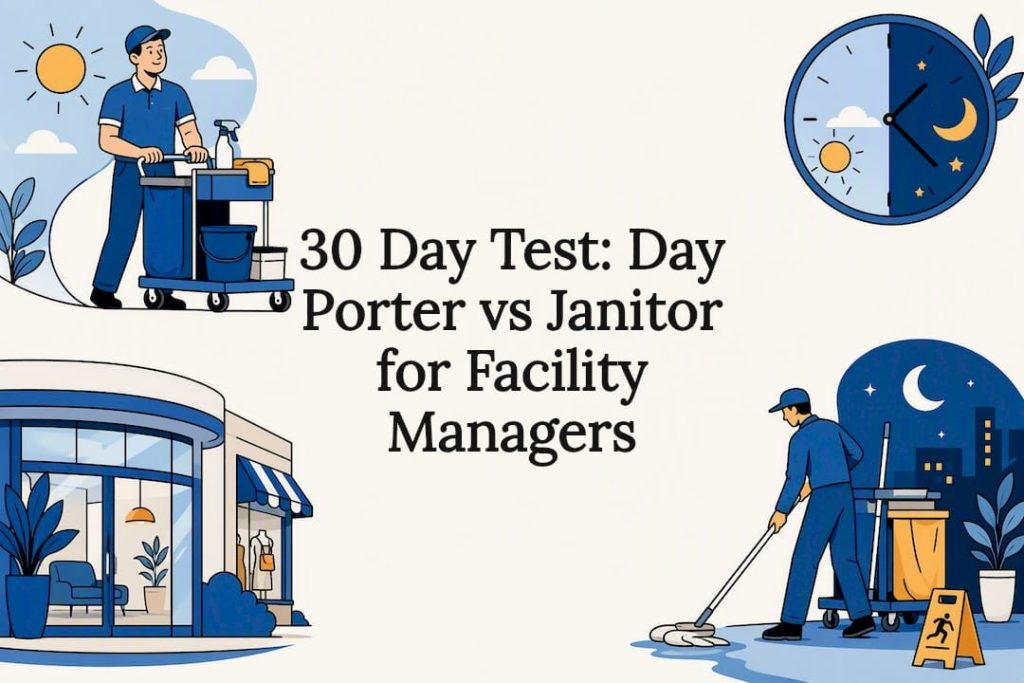


A day porter maintains a facility while it’s open, handling spills, restocking, and appearance checks in real time. A janitor works after hours, running a full deep-clean reset the building needs once the occupants leave. Choose based on when problems actually happen: midday complaints call for a porter, while a rough morning start points to your nightly janitorial program. Many properties need both, and the diagnostic below shows how to decide.
TL;DR:
- Most properties require both a day porter and a nightly janitorial service, but their roles should be clearly defined to avoid scope overlaps.
- A day porter responds instantly to daytime spills, complaints, and appearance issues, while a janitor performs thorough deep cleaning after hours without real-time responsiveness.
- Pricing models differ: porters are billed hourly for visible, in-person presence, while janitorial services are priced based on visit frequency and scope of tasks.
- For effective coverage, match the service to problem timing, using a pilot program to track KPIs like restroom failures and response times before expanding scope.
- Clear documentation, shared logs, and defined ownership of zones prevent gaps and reduce complaints in mixed-vendor cleaning setups.
Table of Contents
- What Does a Day Porter Do?
- What Does a Janitor Do at Night?
- Day Porter vs Janitor: The Operational Differences
- How to Decide: Porter, Janitorial, or Both?
- Writing Scope and Budget That Prevent Gaps
- What We See on the Ground at Octomaids
- Steven’s Take: Test Before You Commit Long Term
- How Octomaids Builds Coordinated Cleaning Programs
- Sources
- FAQ
What Does a Day Porter Do?
A day porter’s job is presence, not just cleaning. The role exists to maintain appearance and respond to problems as they happen, which is exactly what separates it from scheduled overnight work, according to CleanQuote’s facility manager guide. If a coffee spill hits the lobby floor at 11 a.m., nobody wants to wait until 9 p.m. for it to disappear, which is why understanding on-call moving services can be helpful when coordinating timely event cleanups or immediate porter coverage.
Typical day porter tasks include:
- Restroom checks and restocking every few hours
- Trash touch-ups in high-traffic common areas
- Spill response and wet-floor safety
- Lobby and entryway upkeep between visitor waves
- Meeting-room resets between back-to-back bookings
- Wiping down high-touch surfaces like door handles and elevator buttons
Coverage windows usually run several hours during business hours, with the porter logging interval checks and any incidents for the property manager’s records. Day porters are the right first call whenever the complaint is about how the building looks or feels during the day.
Pro Tip: Ask any day porter candidate how they’d log a bathroom supply shortage at 2 p.m. on a Friday. Their answer tells you whether they think in real time or just in checklists.
What Does a Janitor Do at Night?
Janitorial work is a full reset, done when the building is empty and the deep-clean tasks that require open floor space can actually get done. The primary goal isn’t responsiveness. It’s thoroughness, according to Anvil Facility Services, which frames the night crew as the team that owns deep cleaning while the day porter owns daytime appearance.
A standard nightly janitorial visit covers:
- Full restroom sanitation, not just restocking
- Vacuuming and mopping every floor surface
- Trash pickup and liner replacement throughout the building
- Floor care like buffing, waxing, or scrubbing
- Scheduled disinfection of shared equipment and surfaces
Running a floor buffer or stripping wax while employees are walking through the lobby is inefficient at best, and a safety hazard at worst. That’s why these tasks get pushed to the off-hours shift. For buildings with light daytime traffic and no visitor-facing complaints, a well-run nightly janitorial program is often sufficient on its own.
Day Porter vs Janitor: The Operational Differences
The real distinction shows up in four places: timing, ownership, pricing, and property type.
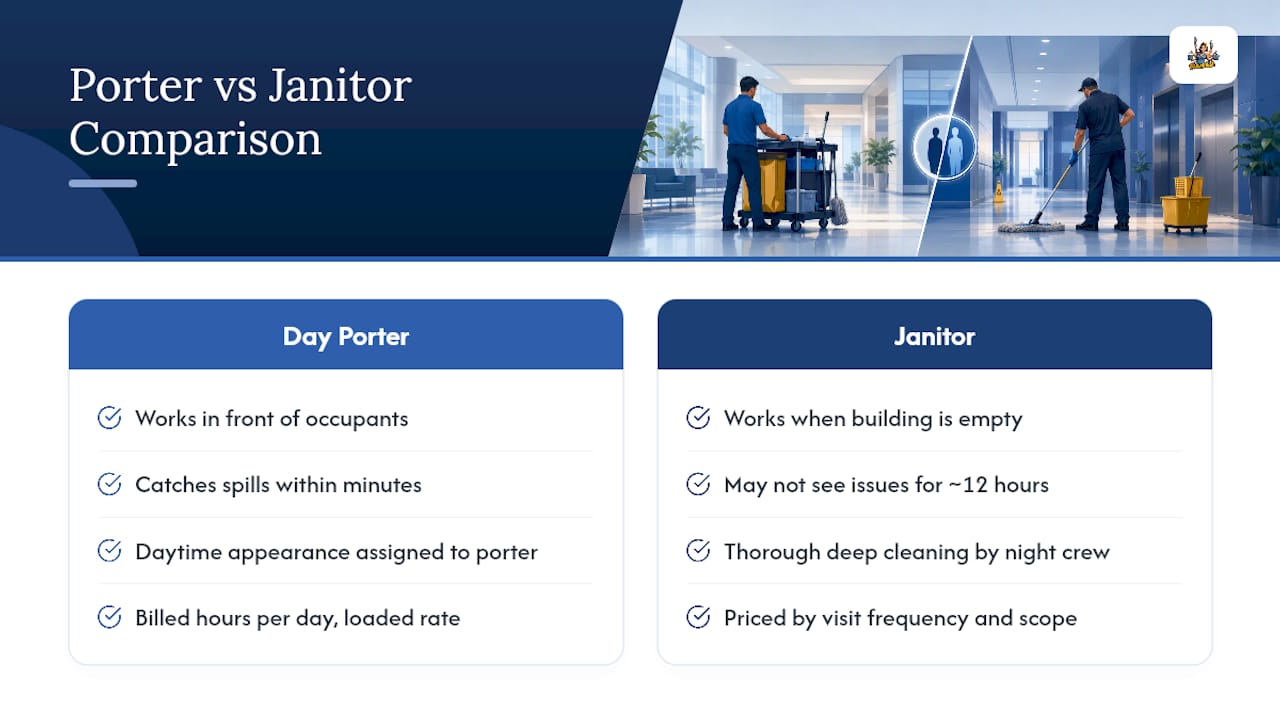
Timing and visibility. A porter works in front of occupants; a janitor works in an empty building. That changes what each can realistically fix. A porter can catch a spill within minutes. A janitor won’t see it until the next scheduled visit, sometimes 12 hours later.
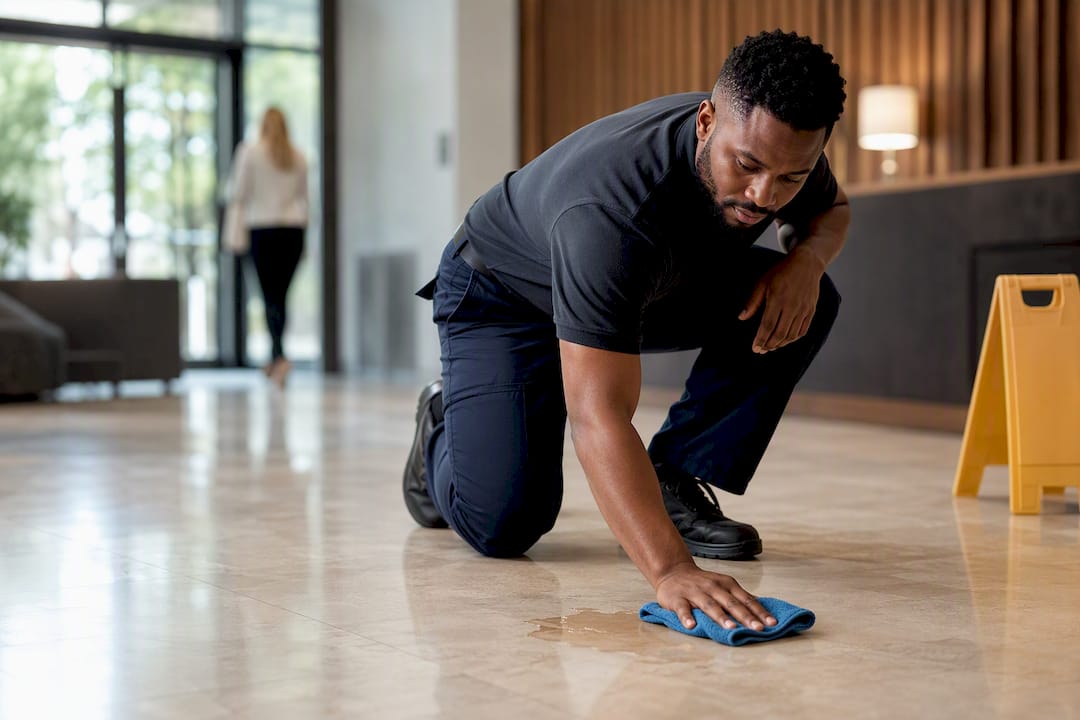
Scope and ownership. The clearest programs assign daytime appearance to the porter and thorough, deep cleaning to the night crew, with no gray area between them, per Anvil’s operational breakdown.
Pricing logic. Porters are typically billed as defined hours per day at a loaded labor rate. Nightly janitorial is priced by visit frequency and task scope, not hourly presence.
Best-fit property types. Class A office lobbies, medical offices, and retail locations with steady foot traffic tend to justify combining both services, a pattern Master Care’s facility guide confirms across visitor-facing sites. Schools and gyms with defined open hours often follow the same logic. Quieter back-office buildings can frequently run on nightly janitorial alone.
The most common budgeting mistake: adding porter hours to solve a problem that’s actually a night-crew quality issue, or expanding janitorial scope to try to cover daytime responsiveness it was never built to deliver.
How to Decide: Porter, Janitorial, or Both?
Match the fix to when the complaint actually happens. That’s the whole diagnostic, according to the problem-based approach ZipRecruiter’s facility staffing guide recommends over guessing which service to add.
- Complaints happen mid-morning through afternoon? Add day porter hours matched to your visitor traffic curve, not a flat half-day block.
- Building looks rough at opening, before anyone walks in? The problem is nightly janitorial quality, not a missing porter. Audit that program first.
- Both patterns show up? You likely need coordinated coverage, not a bigger version of one service.
Track a few signals before committing: restroom supply failures per shift, visitor flow by hour, and how the space actually looks at opening versus midday. A 30-day pilot with clear KPIs, restroom fails, mid-day response time, and tenant complaint volume, tends to show fast whether the fix is porter hours or a better-scoped night program.
Writing Scope and Budget That Prevent Gaps
Because porters and janitorial crews are priced on different logic, hours versus visits, a proposal that blends the two without separating line items almost guarantees confusion later.
Build the scope around:
- Priority zones (lobby, restrooms, break rooms) with named ownership
- Trigger tasks that specify who responds to spills versus who does floor care
- A shared incident log both teams update
- A set inspection cadence, weekly at minimum
Avoid open-ended hourly porter billing with no task list, and avoid splitting vendors without one operations lead tying the two schedules together, a seam that Anvil’s guide flags as the single most common source of dropped tasks.
Pro Tip: Request a sample inspection report before signing any janitorial contract. If a vendor can’t produce one, they’re not tracking what they’re actually doing.
What We See on the Ground at Octomaids
The mismatch we run into most often isn’t a bad vendor. It’s a scope that never named who owns what. A property adds porter hours to fix a problem that’s actually a night-crew training gap, or expects nightly janitorial to catch a lobby spill that happened six hours before the crew arrived.
Once day and night programs report to one plan, with documented routes and shared logs, the pattern we see is fewer repeat complaints and a building that looks consistent whether someone walks in at 9 a.m. or 5 p.m.
Steven’s Take: Test Before You Commit Long Term
Most facility managers overcommit before they’ve measured anything. Run a 30-day pilot with defined KPIs first, restroom fails, response time, complaint counts, and let the data tell you whether you need porter hours, a better nightly scope, or both. Document who owns what and how issues escalate before either team starts. If you want a second set of eyes on your current setup, ask for a walkthrough.
— Steven
How Octomaids Builds Coordinated Cleaning Programs
The same dedicated team runs on every visit, whether that’s a nightly reset or a scheduled daytime touch-up, so you’re never explaining your building’s quirks to a stranger. That consistency is what closes the seam between day and night coverage that trips up so many mixed-vendor setups.
Our commercial cleaning and janitorial services cover offices, retail spaces, and visitor-facing properties throughout Clark County, WA and the Portland Metro area, with documented routes, inspection reporting, and background-checked staff on every job. If you’re weighing porter hours against a nightly program, or your current setup has an ownership gap you can’t quite name, request a walkthrough and we’ll help you scope it properly before you commit to either.
Sources
- What Does a Day Porter Do? | Facility Manager’s Guide | CleanQuote
- Day Porter vs Nightly Janitorial | Anvil Facility Services
- Day Porter: What is the difference between Day Porter vs Janitor | ZipRecruiter
- Day Porter vs Nightly Janitorial Services | Master Care
FAQ
Is a Day Porter a Janitor?
Not exactly. Both clean, but a day porter works during business hours to maintain appearance and respond to issues in real time, while a janitor performs a scheduled, deeper reset after the building closes.
What Is the New Name for Janitors?
Many facilities now use “custodian” or “janitorial technician” in job postings, though “janitor” remains the common industry term for scheduled after-hours cleaning staff.
Can a Porter Be a Janitor?
Some staff cross-train to cover both roles, but the responsibilities differ enough, real-time responsiveness versus scheduled deep cleaning, that most properties staff them as separate functions with separate scopes.
What Is the Difference Between a Porter and a Custodian?
“Custodian” is often used interchangeably with janitor, referring to scheduled maintenance and cleaning, while “porter” specifically implies a daytime, occupant-facing presence. Octomaids structures both under one operations lead so the terminology never creates a service gap.
Recommended
- Facility Managers: Janitorial vs Commercial Cleaning, 6 Questions
- 7 Elements Facility Managers Need in an RFP Ready Janitorial Scope
- Janitorial vs Cleaning Service Options: 2026 Guide
- How to Onboard a Commercial Cleaning Service Right
About Octomaids
Octomaids is a locally operated professional cleaning company serving Vancouver, Clark County, and the surrounding Portland metro area. Since 2006, our cleaning teams have helped homeowners, renters, property managers, and businesses with recurring cleaning, deep cleaning, move-in/move-out cleaning, and commercial cleaning.
Our cleaning articles are reviewed to ensure the information reflects our real-world experience and professional cleaning practices.