
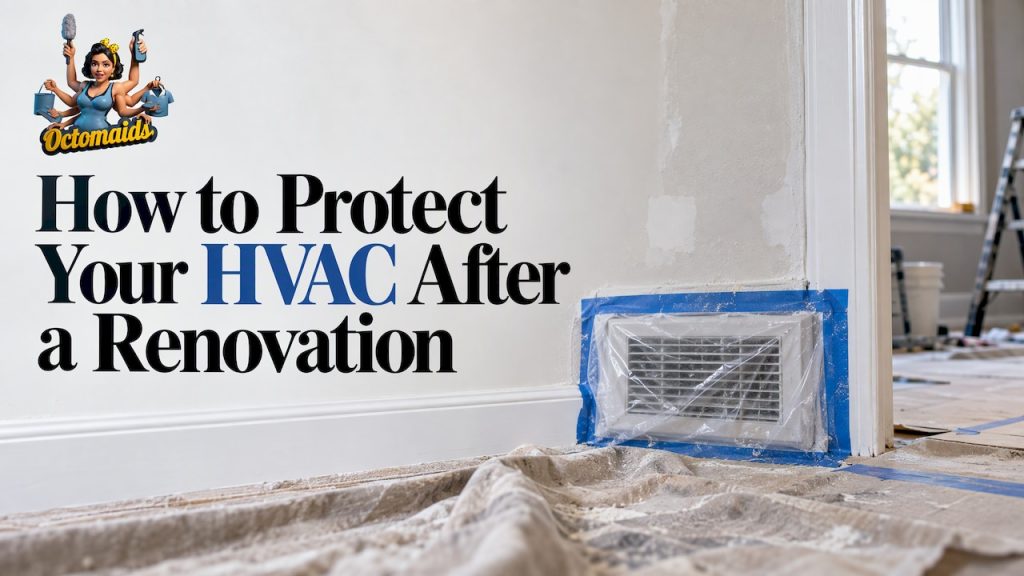


The best way to protect your HVAC system through a renovation is to keep it off while dust is in the air, seal every register and return in the work zone, and clean up the dust before the fan ever runs again. The EPA’s Indoor airPLUS bulletin calls it critical not to run the system during work that creates airborne dust. Once the dust is out of the rooms, a fresh filter and a quick check of the registers finish the job. Our post-construction cleaning team in Vancouver, WA and Portland, OR handles the dust-removal part of that sequence, so the air your system pulls in afterward is clean.
Key Takeaways
- Do not run your furnace, heat pump or air conditioner while sanding, sawing, demolition or drywall work is happening. Fine dust gets pulled into ducts and equipment.
- Seal supply and return registers in the work area with plastic and painter’s tape, and remove the covers only after the dusty work and the cleanup are done.
- A basic filter stops large debris, not fine dust. Replace the filter before anyone moves back in, and again if it loads up quickly.
- Dust on surfaces becomes dust in your ducts. Thorough, HEPA-based cleanup of the rooms is what keeps the system clean after the contractors leave.
- Duct cleaning is a specialist job for an HVAC professional, and it is worth considering when registers were left open or the system ran during demolition.
Table of Contents
- Why Renovation Dust Is an HVAC Problem
- Before the Work Starts: Plan the HVAC Into the Project
- During the Work: Seal, Shut Off, Contain
- After the Work: A Step-by-Step Restart
- When You Need Duct Cleaning or an HVAC Inspection
- What We Do Differently: Rooms First
- Book the Cleanup Before You Restart the System
- FAQ
- Sources
Why Renovation Dust Is an HVAC Problem
Renovation dust is not the same as everyday household dust. Sanding drywall joint compound, cutting tile or tearing out old flooring produces particles fine enough to hang in the air for hours. Your HVAC system moves the air in your whole house through a closed loop, so anything airborne near a return register can be pulled into the ductwork and pushed back out through every supply register.
The EPA’s Indoor airPLUS bulletin explains what happens next: particulates and debris inside ducts can reduce the efficiency and life of components, block airflow, and be blown throughout the home. The same bulletin notes that indoor air quality matters most for people with allergies, respiratory conditions such as asthma or COPD, or cardiovascular issues. If someone in your household falls in those groups, it is worth treating the HVAC as part of the project plan, not an afterthought.
The filter is your first line of defense, and it is also the part most people overestimate. A University of Georgia Extension guide explains that a filter’s main job is keeping particles from damaging components such as the blower fan, and that a dirty one restricts airflow, makes the system work harder and can lead to failure. The EPA bulletin adds that a fiberglass filter catches large debris but does not stop fine dust from reaching the equipment and ducts.
Before the Work Starts: Plan the HVAC Into the Project
The cheapest protection happens before the first hammer swing. Three decisions matter.
1. Decide which zones the work touches. If the renovation is a single bathroom, only the registers in and near that room need sealing. If you are opening walls across the house or refinishing floors, plan for the whole system to be off during the dustiest phases.
2. Ask your contractor and your HVAC company for a protection plan. The EPA bulletin recommends asking the HVAC contractor for a duct and equipment protection plan. Agree in writing who covers registers, who removes the covers and when.
3. Plan for temporary comfort. If the system will be off, you need another way to stay comfortable. Mass.gov’s guidance on construction pollutants in occupied buildings recommends deactivating the HVAC during high-dust work, with alternative ventilation if the activity lasts more than a day. In practice that means fans, portable units, or scheduling the dustiest days for mild weather.
Keep the equipment area clear too. NIOSH’s workplace guidance says to avoid storing construction materials or equipment in HVAC mechanical rooms. The same goes for a furnace closet or basement utility corner at home: bags of drywall mud and tools do not belong next to the air handler.
During the Work: Seal, Shut Off, Contain
Turn the system off during dusty phases
The EPA’s guidance on duct cleaning says that during construction or renovation that produces dust, you should seal supply and return registers and not operate the heating and cooling system until the dust has been cleaned up. The Building America Solution Center is specific about the trades: do not run the HVAC while drywalling, sanding or sawing.
Seal registers the right way
The EPA’s remodeling guide recommends taping 6-mil polyethylene sheeting over doors, other openings, and the supply and return registers in the work room. For a home, that translates to:
- Use clear plastic sheeting or a commercial duct-cover product, secured with painter’s tape so it does not damage finishes.
- Cover both supply registers and return grilles in the work zone.
- Mark covers on floor openings so no one steps on them or forgets them.
- Leave the covers on until flooring, cabinetry and finish carpentry are complete, as the EPA bulletin advises for ducts that are already installed.
Do not cover everything and keep the fan running
This is where well-meaning homeowners go wrong. Angi’s remodeling guide warns that closing vents while the system is running can strain the unit and shorten its life. The safe approach is to shut the system off, or the zone serving the covered vents, and to cover only the vents in danger of collecting dust. An HVAC company’s 2026 guide makes the same point: don’t leave a return sealed while the fan is operating, and have a clear plan for removing the covers.
If part of the house must stay in use
Sometimes you cannot shut everything down, for example when the renovation is in one wing and a family member needs heat in another. UC Irvine’s construction reference guide says that when full isolation is not feasible, use temporary filters on grilles and diffusers that are inspected and replaced frequently. NIOSH likewise advises raising filtration on any occupied-area system to the highest level it supports and checking and replacing filters as needed.
Cut dust at the source
The less dust you make, the less your HVAC has to survive. The EPA remodeling guide suggests misting surfaces with water before sanding or scraping, covering the area under work with durable protective sheeting, and cleaning up daily. For off-gassing products such as paints and adhesives, it recommends maximum ventilation during installation and for at least 72 hours afterward.
After the Work: A Step-by-Step Restart
The order matters. Starting the fan before the rooms are clean undoes everything the plastic did.
Step 1: Finish every dusty trade first
Wait until sanding, cutting, painting and flooring are done. Pulling covers off after drywall work but before the floor finisher arrives just invites a second round of dust.
Step 2: Remove dust from the rooms, not just the floors
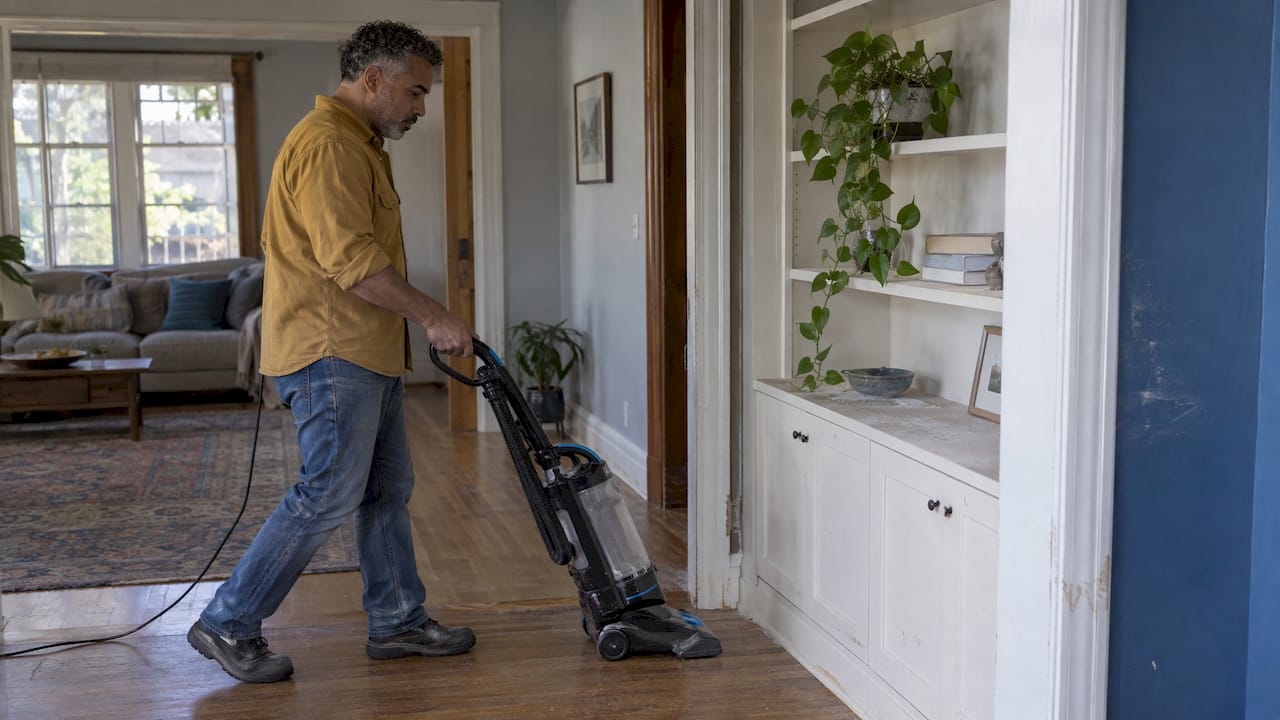
Fine dust settles on ceilings, window tracks, shelves, door tops, light fixtures and inside cabinets. If it is left there, any air movement lifts it back up and sends it toward your returns. The EPA recommends vacuuming regularly with a HEPA vacuum or the highest-efficiency bags your vacuum accepts, and Mass.gov adds wet wiping and mopping. This is the stage where a professional post-construction clean pays off. Our team follows a 48 to 72 hour post-renovation dust protocol, and our post-construction cleaning equipment page explains the HEPA vacuums we use.
Step 3: Remove the register covers carefully
Fold the plastic inward so dust trapped on it does not fall into the opening. The Building America guide recommends removing the registers themselves and wet-cleaning them with a detergent cleaner. Check the boots, the short ducts just behind each register, with a flashlight. Drywall film or visible debris there is your signal that more than a surface clean is needed.
Step 4: Put in a fresh filter
The Building America guide says to run the furnace or air handler with a filter installed and to replace the filter before occupancy. It also says soiled filters should be bagged and sealed with tape before you carry them outdoors, so the dust does not escape through the house.
What kind of filter? A University of Florida standard for renovation work calls for construction-phase filters rated at least MERV 8 or 9 and replacement with MERV 13 filters before the space is occupied. That is a commercial-building standard, and many home systems are not designed for very dense filters, so use the highest rating your equipment’s manufacturer allows. UGA Extension notes that MERV 1 to 4 filters are under 20 percent effective on particles of 3 to 10 microns, while MERV 13 and above capture particles down to 0.3 microns at 50 to 95 percent efficiency.
| Filter rating | What it does with fine dust | Where it fits in a renovation |
|---|---|---|
| MERV 1 to 4 | Under 20% effective on 3 to 10 micron particles | Basic equipment protection only |
| MERV 8 or 9 | Minimum construction-phase level in the UF standard | Temporary filters when the system must run |
| MERV 13 | Captures particles down to 0.3 microns at 50 to 95% | Final filter before you move back in, if your system supports it |
Step 5: Watch the first weeks
Run the system and check the filter after a couple of weeks. A filter that is already gray and loaded tells you dust is still moving through the system. One HVAC company’s guidance suggests that filters loading up within two or three weeks is a sign the ducts may need attention.
When You Need Duct Cleaning or an HVAC Inspection
Duct cleaning is not something to do by default, and it is not something to do yourself. The EPA’s position is that it is not routinely needed, but it should be considered when there is visible mold, vermin, or so much dust and debris that particles are released from supply registers, which can happen after a renovation. UGA Extension also notes that duct cleaning may be needed after initial construction or major renovations.
Signs that call for a licensed HVAC professional include:
- Registers were uncovered during demolition or sanding.
- The furnace or air conditioner ran during dusty work.
- You can see drywall film or debris in the register boots.
- Filters clog within a few weeks.
- Someone in the home has asthma or allergies.
The Building America guide explains why this is professional work: flexible ducts are lightweight and easy to puncture, tear or crush, so cleaning should be done by HVAC professionals who meet ACCA Standard 6 qualifications, using vacuums and brushes made for ducts. It rules out wet solvents, sanitizers and UV light as substitutes for physically removing the dust. The same guide says the air handler should be cleaned at the same time and that the work be done with negative pressure and HEPA filtration or outdoor exhaust. Duct cleaning is not something we do, so call a licensed HVAC contractor for that step, and we take care of the rooms.
NIOSH also recommends that before re-occupancy, work areas be ventilated with outdoor air if possible and the HVAC system tested and balanced. If you had your system modified during the renovation, ask the HVAC contractor to confirm airflow before you consider the project closed.
What We Do Differently: Rooms First
HVAC protection and room cleaning are two halves of one job. The plastic over your registers keeps dust out of the ducts, but the dust in the house still has to go somewhere. Left on shelves, trim and floors, it ends up in the return air within days.
That is why we treat post-construction cleaning as part of protecting your equipment. Octomaids has served Vancouver, WA and Portland, OR since 2006 as a family-owned team, and our post-construction cleaning is delivered by background-checked, insured staff. If you are planning the cleanup budget, our guides to post-renovation cleaning rates and post-construction cleaning costs in Portland show what goes into a quote. Our post-construction cleaning checklist lays out the rooms and surfaces we cover, and the HEPA vacuum benefits page explains why that equipment matters when the dust is fine.
Book the Cleanup Before You Restart the System
If your renovation is wrapping up, schedule the post-construction clean for the day after the last trade leaves and before you remove register covers or switch the HVAC back on. We serve homeowners, landlords and rental owners across Clark County and the Portland metro area, and our dedicated teams show up for the job from start to finish.

See our post-construction cleaning services or contact Octomaids to plan the timing around your contractor’s schedule.
Our Perspective
When a renovation wraps up, the homeowner’s attention goes to the new kitchen or the fresh paint. We think about the air. Fine dust is the part of a remodel nobody photographs, and it travels farther than most people expect: onto the tops of cabinets, into window tracks and, if the registers were not covered, into the ductwork.
Our approach is to work from the top of each room down, so what falls lands on a surface we have not cleaned yet, and to use HEPA vacuums so fine particles are captured rather than blown back into the room. Being family-owned and local since 2006, we send the same dedicated team to your home, so the people who understand your space are the ones finishing it.
Our advice is simple. Keep the system off while the dust is flying, cover what the contractor and HVAC technician agree to cover, have the rooms professionally cleaned, then put in a new filter and restart. You will breathe easier, and your equipment will be working with clean air from day one.
Steven
FAQ
Should I turn off my HVAC during a renovation?
Yes, during any dusty phase. The EPA says not to run the system while work creates airborne dust, and to keep registers sealed until the dust has been cleaned up. If the work is quiet and dust-free, such as painting with low-odor products, you can usually run it normally with good ventilation.
Is it safe to cover all my vents with plastic?
Only in the work zone, and only with the system off or the affected zone turned off. Closing vents while the system runs can strain the equipment, so uncover them before restarting. Covering vents in rooms far from the work is usually unnecessary.
When should I change the filter after construction?
Change it once the dusty work and cleanup are finished and before anyone moves back in. Then check it after a couple of weeks. If it is already loaded with dust, replace it again and consider having an HVAC professional inspect the system.
Do I need my air ducts cleaned after a remodel?
Not always. Duct cleaning is worth considering if registers were open during demolition or sanding, the system ran during the work, debris is visible in the register boots or dust blows from the vents. It should be done by a qualified HVAC professional, not with household tools.
How long should I ventilate after renovation work?
The EPA recommends maximum ventilation during installation and for at least 72 hours after activities that off-gas pollutants, such as painting or installing certain flooring and adhesives. Open windows when weather allows and use exhaust fans.
Sources
- EPA Indoor airPLUS Technical Bulletin: Duct Protection During Construction
- EPA: Should You Have the Air Ducts in Your Home Cleaned?
- EPA: Best Practices for Indoor Air Quality when Remodeling Your Home
- NIOSH: Maintaining acceptable indoor environmental quality during construction
- Building America Solution Center: Removing Construction Debris from Ducts
- Mass.gov: Construction and renovation generated pollutants in occupied buildings
- UC Irvine EHS: Indoor Environmental Quality During Construction Projects
- University of Florida EHS: IEQ New Construction and Renovation
- UGA Extension: HVAC filters, duct cleaning, and indoor air quality
- Angi: Ways to Protect Your HVAC During Remodeling
- Alex Air & Heating: How to Protect HVAC From Construction Dust During a Remodel
- Top Air HVAC: Duct Cleaning After Renovation
- HVACBase: Is Air Duct Cleaning Worth It? What the EPA Says
Recommended
- Homeowners: 48–72 Hour Post-Renovation Dust Protocol
- Post Construction Cleaning Equipment: 99.97% HEPA, OSHA Rules
- OSHA Compliant Post Construction Cleaning Checklist for Homeowners
- 99.97% Capture: HEPA Vacuum Benefits for Homeowners and Pros
About Octomaids
Octomaids is a locally operated professional cleaning company serving Vancouver, Clark County, and the surrounding Portland metro area. Since 2006, our cleaning teams have helped homeowners, renters, property managers, and businesses with recurring cleaning, deep cleaning, move-in/move-out cleaning, and commercial cleaning.
Our cleaning articles are reviewed to ensure the information reflects our real-world experience and professional cleaning practices.