



Most post-construction cleaning jobs run between $210 and $379 for smaller projects, scaling up to $0.15 to $0.60 per square foot for full-home work and as high as $1.00 per square foot for heavy-detail finishes. It’s how much drywall dust, adhesive residue, and finish work your crew left behind. Get a walkthrough before you accept any quote.
TL;DR:
- A standard post-renovation cleaning for a 2,000-square-foot home typically costs between $300 and $1,200, depending on dust levels and finish details.
- Heavy-dust projects and high-end finishes require more passes, specialized equipment, and can push rates toward or above $1.00 per square foot.
- Flat-rate quotes depend heavily on a walkthrough to assess debris type, space accessibility, and scope, minimizing surprises and lowball bids.
- Waiting to schedule cleaning until after all trades are complete reduces total costs by avoiding multiple visits and extra labor charges.
- Including add-ons like duct cleaning or upholstery can significantly increase the final bid beyond basic scope estimates.
Table of Contents
- What Does Post-Renovation Cleaning Cost?
- What Drives Post-Renovation Cleaning Cost
- Rough, Standard, and Detail Cleans Explained
- How Professional Quotes Get Built (and How to Spot a Bad One)
- DIY vs. Hiring a Professional Crew
- How to Control the Cost Without Cutting Corners
- What Octomaids Sees on Real Renovation Jobs
- The Smartest Way to Budget for This
- Get a Walkthrough Quote From Octomaids
- Sources
- FAQ
What Does Post-Renovation Cleaning Cost?
The national average for post-construction cleaning lands around $210 to $379 per project, though that figure covers a lot of ground. A single remodeled bathroom sits at the low end. A gutted kitchen with new cabinetry sits well above it.
Per-square-foot benchmarks give you a more reliable planning tool, especially for whole-house jobs. Typical residential per-square-foot pricing runs between $0.15 and $0.60, with heavy-dust or high-detail projects climbing toward $1.00 per square foot.
Here’s how that translates into real numbers:
| Project size | Square footage | Typical total |
|---|---|---|
| Small (single room/bathroom remodel) | 100–300 sq ft | $210–$379 |
| Medium (kitchen remodel or full-floor renovation) | 1,200–1,800 sq ft | $300–$900 |
| Large (whole-house renovation) | 2,000–2,500 sq ft | $600–$1,600 |
| Luxury or heavy-detail finish | 2,500+ sq ft | $900–$1,600+ |
A few patterns worth flagging as you compare quotes against these numbers:
- Costs often increase significantly once you’re dealing with whole-home renovations, second-story work, or multiple bathrooms with tile and grout detailing.
- Luxury finishes, marble, custom millwork, and detailed glass work push jobs toward the higher end of the price range due to increased cleaning time.
- Any quote noticeably below typical price ranges for similar square footage often indicates a rough clean only, rather than the full detail pass most renovations require before move-in.
What Drives Post-Renovation Cleaning Cost
Square footage sets the baseline, but it’s rarely what separates a $400 quote from a $1,400 one. The real variables live in the details.
- Square footage and room count. More rooms mean more corners, more trim, more cabinet interiors, and more labor hours regardless of overall size.
- Debris type and volume. Fine drywall dust behaves nothing like sawdust or paint chips. It settles into HVAC returns, light fixtures, and cabinet joints, which is why heavy-dust jobs often require HEPA filtration and multiple cleaning passes.
- Interior finishes. Natural stone, unlacquered brass fixtures, and matte paint all demand slower, more careful techniques than standard laminate or eggshell paint.
- Accessibility. Vaulted ceilings, exposed beams, stairwells, and tight crawlspaces add equipment needs and time that flat square footage numbers don’t capture.
- Timeline pressure. Rush requests, particularly jobs booked with less than 48 hours’ notice, commonly carry a premium of around 1.5 times standard pricing.
Add-ons compound these factors further. Carpet and upholstery cleaning, duct and HVAC service, exterior window washing, pressure washing, and bulky debris hauling are the most common line items that push a bid higher than the base estimate.
Rough, Standard, and Detail Cleans Explained
Every post-construction quote should specify a tier, because the tier determines both the task list and the price. Vague scopes (“we’ll clean it up”) are how budgets get blown.
- Rough clean. Bulk debris removal, sweeping, and disposal of construction trash, packaging, and leftover materials. This happens while trades are still finishing up and is not a substitute for the final clean.
- Standard clean. Surface-level cleaning of floors, counters, and fixtures, along with basic dust removal from accessible surfaces. Good for lighter renovations without heavy drywall work.
- Detail or final clean. The full pass: HEPA vacuuming of vents and returns, cabinet interiors and exteriors, window tracks, baseboards, light fixtures, and polish work on hardware and glass.
Heavy dust from drywall sanding routinely requires two passes, one to pull bulk dust, a second to catch what resettles after the first pass disturbs the air. That second pass is normal, not an upsell, and it’s a fair reason for a higher quote on a heavily renovated space compared to a lightly touched one.
- Rough cleans are billed lowest because they involve minimal detail work.
- Detail cleans command the highest per-square-foot rate because of the labor hours involved.
- A move-out or final walkthrough checklist gives you a useful reference for what a true detail clean should cover room by room.
How Professional Quotes Get Built (and How to Spot a Bad One)
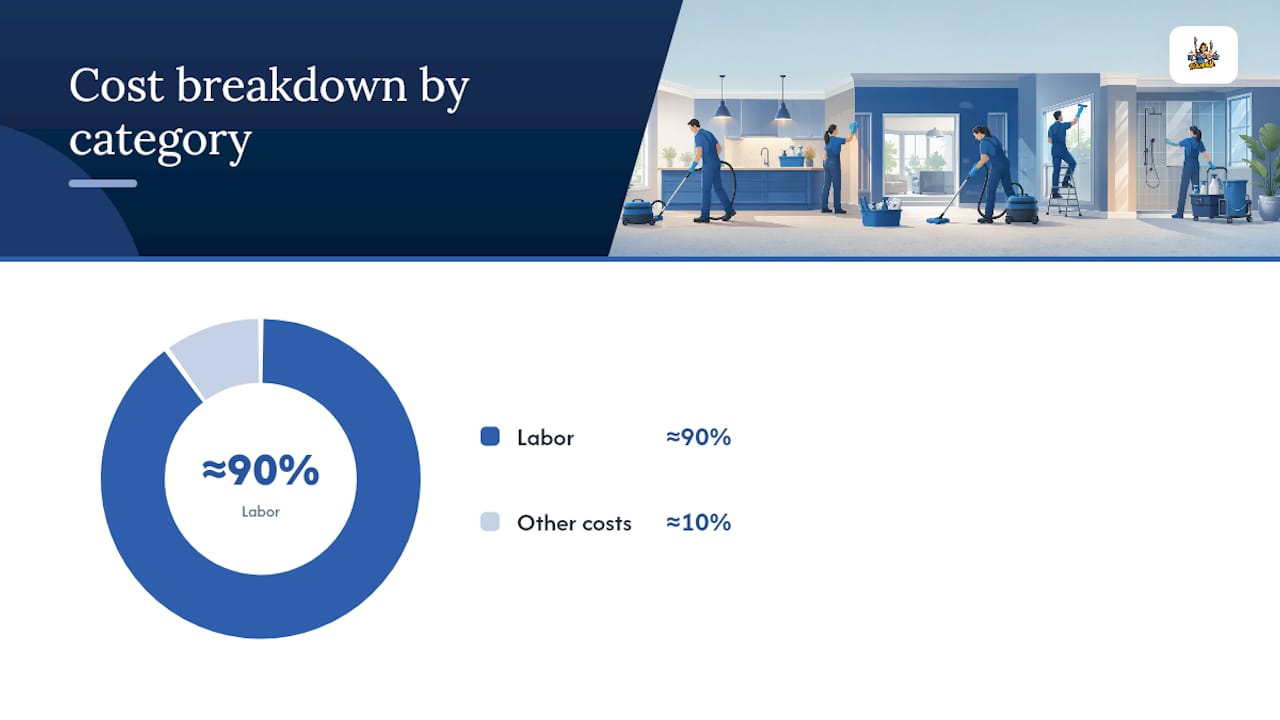
Since labor accounts for around 90% of the total cost, a company can’t quote accurately without seeing the space. A walkthrough lets a crew estimate exact labor hours and equipment needs, which is why professionals overwhelmingly prefer flat, per-project bids over hourly billing. Flat rates protect you from surprise costs; hourly billing tends to create friction the moment a crew uncovers debris nobody accounted for.
Before accepting any bid, ask directly:
- Does the crew use HEPA filtration for fine dust, or standard vacuums?
- Is the company insured, and will they provide proof?
- Is waste hauling included, or billed separately?
- What specific add-ons (windows, ducts, carpets) are and aren’t in this price?
- What’s the turnaround time, and does it carry a rush surcharge?
Watch for red flags: a bid given without ever seeing the property, a scope described in a single vague line, or a number that undercuts every comparable quote by half. That last one almost always means a rough clean disguised as a full detail service.
Pro Tip: Ask every bidder for the same three line items in writing, dust removal method, pass count, and add-ons included. Comparing those three lines side by side exposes lowball bids faster than comparing bottom-line totals.
DIY vs. Hiring a Professional Crew
A household vacuum simply isn’t built for fine construction dust. It lacks the filtration to trap particles that settle back into the air within minutes, which is why professionals lean on HEPA-equipped equipment for anything beyond light surface debris.
Hiring a professional crew makes the most sense when:
- Drywall sanding or demolition generated heavy, fine dust throughout the space.
- The project involves high-end finishes, natural stone, or custom cabinetry that punishes improper cleaning technique.
- You’re working against a hard handover deadline, a closing date, a tenant move-in, or an inspection.
DIY carries hidden costs that rarely show up in the initial “we’ll just do it ourselves” calculation: HEPA vacuum rental, disposal fees for debris, and the very real chance of a repeat cleaning once dust resettles days later. Factor in your own labor hours, and DIY frequently costs more in time and frustration than it saves in dollars. A side-by-side look at deep cleaning versus routine cleaning is worth reading before you decide.
How to Control the Cost Without Cutting Corners
Timing is the single biggest lever you control. Scheduling the clean before all trades have finished almost guarantees a second visit, which increases total labor costs.
- Wait until all trades, electrical, plumbing, flooring, paint, are fully done before booking.
- Handle non-dust tasks yourself: clear large debris, move furniture, and open up access points.
- Ask about bundled pricing if you’re managing multiple units or a repeat renovation schedule.
- Collect at least two or three quotes and compare scope line-by-line, not just the bottom number.
Coordinating trade schedules tightly, a challenge familiar to anyone managing a small remodel, pays off directly in your cleaning invoice.
What Octomaids Sees on Real Renovation Jobs
Octomaids has cleaned homes and commercial spaces throughout Vancouver, WA and the Portland metro area since 2006, and post-construction work has been part of that mix for most of it. Renovation debris behaves differently than everyday mess, which is why our approach always starts with a walkthrough rather than a phone quote.
A 1,200-square-foot kitchen and adjoining living area remodel, moderate drywall dust, new cabinetry, no flooring replacement, typically lands in the $350 to $600 range for a full detail clean with HEPA vacuuming of vents and cabinet interiors. A whole-house renovation near 2,500 square feet with heavier dust and multiple bathrooms often runs $900 to $1,600, depending on finish level and pass count.
These are representative ranges, not fixed quotes. Every project gets its own walkthrough, a documented scope covering exactly which rooms and tasks are included, and a flat-rate proposal before any work begins. That process is what keeps our numbers defensible instead of guesswork dressed up as a bid.
The Smartest Way to Budget for This
If you manage renovation projects regularly, the pattern becomes obvious fast: waiting for a single final clean after every trade finishes beats scheduling early every time. That cushion has saved more project budgets than any negotiated rate ever has.
— Steven
Get a Walkthrough Quote From Octomaids
Skip the guesswork of averaging square-footage numbers against a bid you can’t verify. Octomaids builds every post-construction cleaning quote from an actual walkthrough of your property, so the number you get matches the dust, debris, and finish level actually in the space, not a generic estimate pulled from a phone call.
Before your walkthrough, have a few details ready: approximate square footage, photos of the current condition, your target completion timeline, and any special finishes (natural stone, custom cabinetry, hardwood) that need extra care. That’s enough for our team to scope a flat-rate proposal on the spot, no hourly surprises once the crew starts pulling dust out of your vents. If you’re weighing which cleaning tasks are worth handing off entirely, our guide to tasks worth hiring out covers that too. Ready to see your number? Request a quote through our services page and get a walkthrough scheduled this week.
Sources
- How much does it cost to clean a construction site? — Angi
- 2026 Post-Construction Cleaning Rates: Costs and Tips — Thumbtack
- How Much Does Post Construction Cleaning Cost? Pricing Guide — FlexCrew
- What Factors Affect Post-Construction Cleaning Cost? — CR Maids
FAQ
How Much Is Post-Renovation Cleaning?
Most projects fall between $210 and $379 for smaller jobs, with whole-home renovations commonly running $0.15 to $0.60 per square foot, and heavy-detail work reaching about $1.00 per square foot.
What Does Post-Renovation Cleaning Include?
A full detail clean covers bulk debris removal, HEPA vacuuming of vents and surfaces, cabinet interiors and exteriors, window tracks, baseboards, and fixture polishing, often across two passes for heavy dust.
How Much Should I Charge to Clean a 2,000-Square-Foot Home?
At typical per-square-foot rates of $0.15 to $0.60, a 2,000-square-foot post-renovation clean generally lands between $300 and $1,200, depending on dust level, finishes, and add-ons like carpets or ducts.
How Much Does It Cost to Clean a 10,000-Square-Foot Building?
At typical per-square-foot rates of $0.15 to $0.60, large commercial or residential spaces vary widely depending on debris and finish detail, with costs scaling up accordingly.
Is a Walkthrough Really Necessary Before Getting a Quote?
Yes.
Recommended
- Home Cleaning Time Cost Analysis: 2026 Guide
- Move-In Cleaning Cost: What to Expect and Budget For
- Renters: $100–$475 Apartment Move Out Cleaning Costs and 5 Prep Steps
- Post Construction Cleaning Near Me | Vancouver WA & Portland OR
About Octomaids
Octomaids is a locally operated professional cleaning company serving Vancouver, Clark County, and the surrounding Portland metro area. Since 2006, our cleaning teams have helped homeowners, renters, property managers, and businesses with recurring cleaning, deep cleaning, move-in/move-out cleaning, and commercial cleaning.
Our cleaning articles are reviewed to ensure the information reflects our real-world experience and professional cleaning practices.