


A true HEPA vacuum captures at least 99.97% of particles as small as 0.3 microns, so it measurably cuts the pollen, dander, and dust mite debris that ordinary vacuums send right back into your air. That’s the main benefit, but it comes with real limits: a HEPA vacuum won’t cure asthma, won’t fix mold growing in a damp basement, and only performs as advertised in a sealed, well-designed machine used the right way. For allergy-prone households and cleaning professionals alike, it’s a genuinely useful tool, not a magic fix.
TL;DR:
- True HEPA vacuums must have a sealed system to prevent dust leaks, and filters must meet the EPA standard of capturing at least 99.97% of 0.3-micron particles.
- HEPA vacuums effectively remove pollen, pet dander, dust mite fragments, and mold spores, especially benefiting households with allergy or asthma sufferers.
- They do not address moisture issues or mold growth; vacuuming can temporarily stir up settled dust, and maintenance is essential for optimal performance.
- Choosing a sealed, bagged HEPA vacuum and following proper usage practices, including regular filter replacements, improves allergen control.
- Professional targeted cleaning is often more effective than consumer vacuuming alone for chronic allergen or mold concerns.
Table of Contents
- HEPA Vacuum Benefits Start With How the Filter Actually Works
- What HEPA Vacuums Remove and Who Benefits Most
- What HEPA Vacuums Can’t Fix
- Choosing and Using a HEPA Vacuum the Right Way
- Keeping the Filter Working: Maintenance and Replacement
- How Professional Cleaners Put HEPA Equipment to Work
- Where the Real Value Lies, and Where Expectations Need Adjusting
- Sources
- FAQ
HEPA Vacuum Benefits Start With How the Filter Actually Works
The term “true HEPA” isn’t marketing fluff. It’s a specific performance standard: the filter must remove at least 99.97% of particles measuring 0.3 microns in diameter, according to the EPA. That 0.3 micron figure isn’t arbitrary. It represents the “most penetrating particle size,” the range where filters historically struggled most. Particles larger or smaller than 0.3 microns are actually captured even more efficiently, which is the MPPS nuance most product pages never mention.
Inside the filter, three physical mechanisms do the work. Larger particles slam directly into fibers (impaction). Mid-sized particles get snagged as they drift near a fiber (interception). The tiniest particles bounce around erratically until they collide with a fiber almost by accident (diffusion). Together, these three mechanisms are why HEPA media outperforms standard foam or paper filters across nearly the entire particle spectrum.
Here’s where most vacuum shopping goes wrong: the filter is only half the story. A HEPA vacuum needs a sealed system, meaning every bit of air the motor pulls in has to pass through the filter with zero leaks around the housing or hose connections.
- A filter marketed as “HEPA-type” or “HEPA-like” usually means a lower-grade filter that hasn’t met the 99.97% standard.
- A genuine HEPA cartridge bolted into a vacuum that wasn’t engineered for it can still leak dust around the seams, which the EPA’s renovation dust guidance specifically calls out.
- Look for manufacturers who reference EPA HEPA standards directly, and treat vague ISO or EN filtration class mentions as a secondary signal, not proof on their own.
What HEPA Vacuums Remove and Who Benefits Most
A true HEPA vacuum captures pollen grains, pet dander flakes, dust mite fecal fragments, many mold spore types, and fine particulate matter (PM2.5) that would otherwise settle back into carpets, upholstery, and mattresses after every cleaning pass. Carpets and soft furniture act as reservoirs, trapping these particles until foot traffic or a weak vacuum stirs them back into the air you breathe.
By the numbers: A true HEPA filter removes at least 99.97% of particles at 0.3 microns, the EPA’s benchmark for the classification, while standard vacuum filtration lets a far larger share of that same particle range pass straight through and back into the room.
Evidence on the health payoff is encouraging but not overstated. Reviews of household allergen interventions have found small but measurable improvements in respiratory outcomes when HEPA vacuums are used alongside other allergen control steps, not as a standalone fix. The effect size varies by study and household, and the strongest results tend to show up in bundled interventions rather than vacuuming alone.
Certain groups get outsized value from this technology:
- Households with allergy or asthma sufferers, especially where carpet and upholstery cover most of the home.
- Pet owners dealing with dander that regular filtration recirculates constantly.
- Anyone preparing a space for mold remediation, where settled spores need containment before other work begins.
- Renovation crews and lead-paint contractors, where the EPA’s RRP Rule mandates HEPA vacuums for dust cleanup, not as an option but as a requirement, often follow a low-dust door replacement process for homeowners to minimize dust during renovations.
Asthma and allergy organizations back this up directly. The Allergy & Asthma Network continues to recommend HEPA filtration as the reliable standard for capturing airborne allergens, and independent product testing consistently rates HEPA-equipped vacuums highest for allergy suitability.
What HEPA Vacuums Can’t Fix
A HEPA vacuum is a filtration tool, not a remediation service. It can’t dry out a damp crawl space, and it won’t stop mold from regrowing on a leaking bathroom ceiling. Moisture problems need moisture solutions first.
- Mold and structural moisture require source removal and drying, not vacuuming. A HEPA vacuum can pick up loose spores from a surface, but it does nothing about the underlying dampness feeding the colony.
- Vacuuming itself temporarily stirs up dust. The American Lung Association notes that even a well-filtered vacuum agitates settled particles during cleaning, so sensitive people may want to step out of the room, or wear a mask, while the work is happening.
- “HEPA-type” labels and bagless designs undercut real performance. Emptying a bagless canister routinely releases a visible dust cloud, undoing much of the filtration benefit right at the moment of disposal.
- Expect modest, not dramatic, gains. HEPA vacuuming works best paired with ventilation and source control, exactly what the EPA’s air cleaner guidance recommends. Filtration supplements a healthy home strategy; it doesn’t replace one.
Choosing and Using a HEPA Vacuum the Right Way
Buying the right machine matters as much as owning one at all. Confirm the listing explicitly says “true HEPA,” not just “HEPA filtration system” or “HEPA-style,” and check that the manufacturer describes a sealed housing rather than a bolt-on cartridge.
Selection checklist:
- Verify “true HEPA” language and sealed-system design in the product specs, not just the box art.
- Favor bagged models over bagless ones. Consumer testing shows bagged, sealed vacuums release less debris back into the home during use and emptying.
- Match suction power and brush-roll type to your flooring. Deep carpet needs a beater brush; hard floors need a soft roller to avoid scattering debris.
- Check for independent emissions testing or a stated AAFA certification where available.
- Confirm replacement HEPA cartridges are actually sold and easy to find, since a filter you can’t replace is a filter that eventually stops protecting anyone.
Usage best practices matter just as much as the machine itself. Run high-traffic carpeted areas at least twice weekly if allergies are a concern, using slow, overlapping passes rather than quick sweeps. Vacuum mattresses and upholstery with the crevice or upholstery attachment monthly, since these surfaces trap dust mite debris that regular floor passes never touch. Never vacuum standing water or visibly wet mold. It smears spores rather than removing them, and a damp filter loses effectiveness fast.
Pro Tip: If anyone in the home has severe respiratory sensitivity, leave the room for 15 to 20 minutes after vacuuming high-dust areas. Even a sealed HEPA system momentarily lifts settled particles before capturing them.
For heavy contamination, renovation dust, or chronic allergy flare-ups that aren’t improving, it’s usually time to bring in a professional deep clean rather than relying on a single vacuum session.
Keeping the Filter Working: Maintenance and Replacement
A clogged HEPA filter loses suction and stops protecting your air the way it should. Watch for reduced pickup power or visible buildup on the filter surface, and replace it according to the manufacturer’s stated interval rather than waiting for total failure.
- Empty bagged models by sealing and discarding the bag whole, never shaking it out over a trash can.
- Empty bagless canisters outdoors, or into a disposable liner bag, to avoid releasing a dust cloud indoors.
- Clean or replace pre-filters and secondary filters regularly. A clogged pre-filter forces the HEPA element to work harder and shortens its life.
- Call a technician if you notice a cracked seal, a gap around the filter housing, or a sudden drop in suction that basic cleaning doesn’t fix.
How Professional Cleaners Put HEPA Equipment to Work
Professional cleaners incorporate HEPA-capable equipment and trained vacuuming technique into cleaning visits to reduce both airborne and settled allergens throughout a home. That’s a different approach than a homeowner running a vacuum solo once a week.
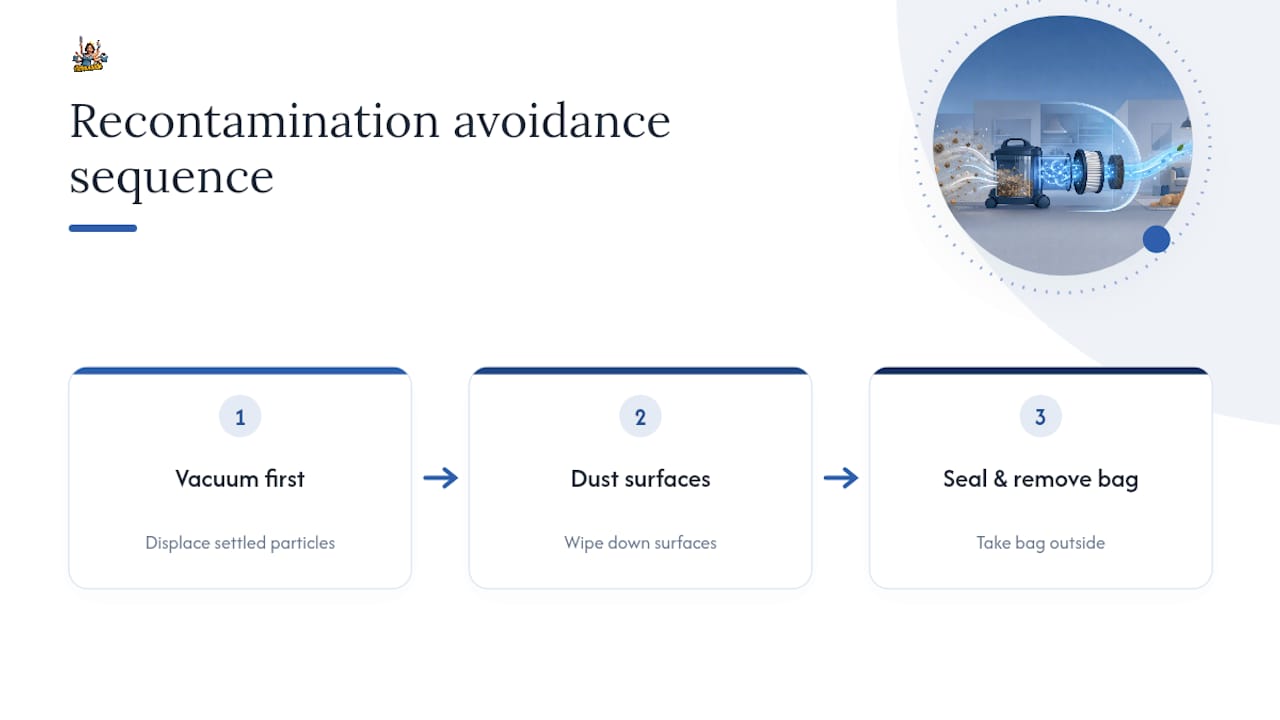
Trained technicians sequence a job to avoid recontamination: vacuuming before dusting displaces settled particles onto surfaces that then get wiped down, rather than the reverse order, which just resettles dust onto freshly cleaned floors. Containment matters too. Bags get sealed and removed rather than emptied inside the home mid-job.
Homeowners dealing with recurring severe allergy symptoms, a post-construction cleanup, or a move-in deep clean on an unfamiliar property typically see better results from a professional visit than from consumer equipment alone, since the technique and sequencing matter almost as much as the filter itself.
Where the Real Value Lies, and Where Expectations Need Adjusting
The evidence supports a specific, bounded claim: true HEPA vacuums reduce resuspended allergens measurably, and that benefit compounds when paired with ventilation and source control. What the evidence doesn’t support is treating a HEPA vacuum purchase as a health intervention on its own. Too much marketing implies that swapping vacuums fixes asthma or eliminates mold risk, and neither is true.
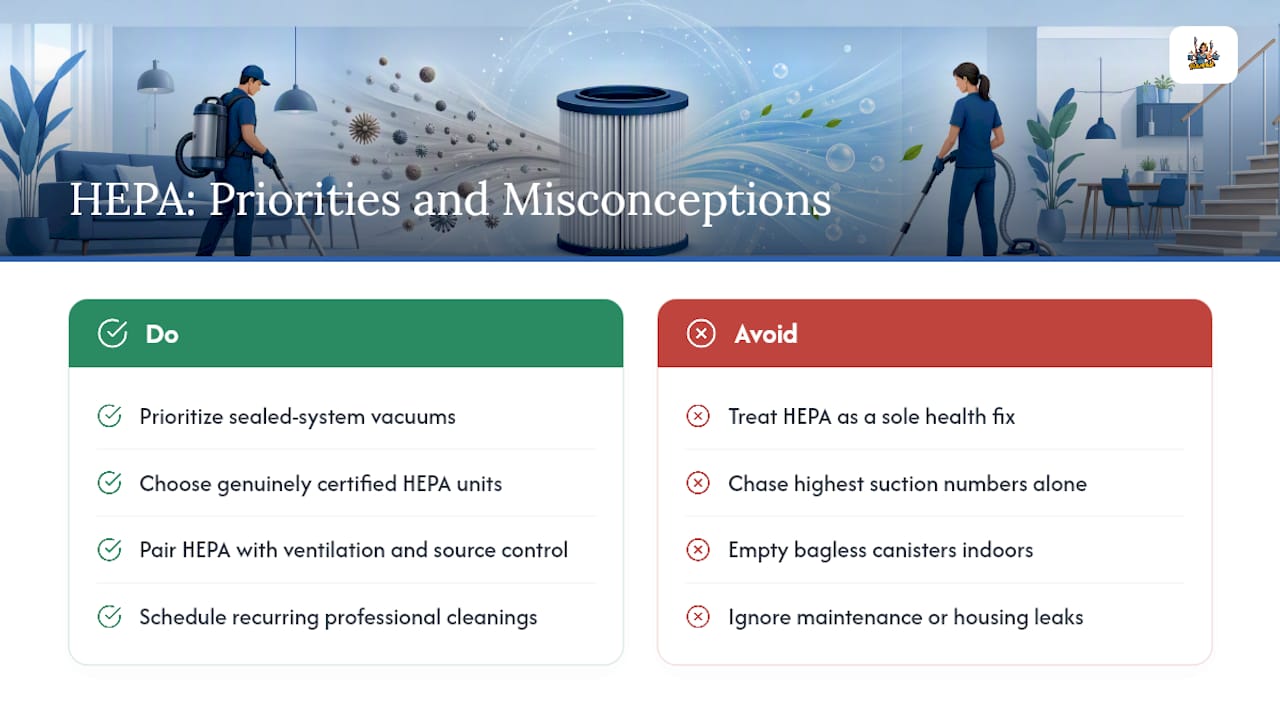
The conventional advice online tends to overweight the filter spec and underweight technique and maintenance. A true HEPA filter in a poorly sealed housing, or a bagless canister emptied carelessly indoors, can perform worse than a mediocre filter used correctly. If you take one thing from this, prioritize sealed system design and consistent maintenance over chasing the highest suction number on the box.
For most households, the smartest first move isn’t buying the most expensive machine. It’s pairing a genuinely certified HEPA vacuum with better ventilation habits and, for heavier allergen loads, a recurring professional cleaning schedule that keeps reservoirs like carpet and upholstery from building up between sessions.
— Steven
This article is general information, not a substitute for advice from a qualified doctor. Consult a qualified healthcare professional about your own circumstances before acting on anything here.
Sources
- What is a HEPA filter? | US EPA
- Guide to Air Cleaners in the Home (EPA, 2nd edition)
- Interventions — Evidence summary on household interventions (NCBI / National Academies)
- Vacuum for allergies — Consumer Reports
- Not All Vacuums Are Created Equal: Pick the Best One for Your Health | American Lung Association
FAQ
Do HEPA vacuums actually make a difference?
Yes, when the vacuum is genuinely “true HEPA” with a sealed system. It captures at least 99.97% of particles at 0.3 microns, which measurably reduces the pollen, dander, and dust mite debris that regular vacuums recirculate.
What are the downsides of HEPA filters?
Two main ones: they don’t address moisture or mold source problems, and vacuuming itself can temporarily stir settled dust back into the air even with a HEPA filter running. Filters also need timely replacement, since a clogged HEPA element loses much of its capture efficiency.
Does a HEPA vacuum remove mold?
A HEPA vacuum can pick up loose, settled mold spores from a hard surface, but it does not fix the underlying moisture problem causing mold growth. Active or wet mold growth needs remediation and moisture control, not vacuuming.
Is a HEPA filter on a vacuum worth it?
For allergy sufferers, pet owners, and anyone managing dust-heavy environments, yes. Independent testing shows sealed, true HEPA vacuums release less debris back into the home compared to standard filtration, making it a worthwhile upgrade for allergen control.
Recommended
- Why Professional Cleaning Creates a Healthier Home
- Deep Clean vs Regular Clean: A Homeowner’s Guide
- What Professional Cleaners Do Differently in Your Home
- Professional House Cleaning Explained for Homeowners
About Octomaids
Octomaids is a locally operated professional cleaning company serving Vancouver, Clark County, and the surrounding Portland metro area. Since 2006, our cleaning teams have helped homeowners, renters, property managers, and businesses with recurring cleaning, deep cleaning, move-in/move-out cleaning, and commercial cleaning.
Our cleaning articles are reviewed to ensure the information reflects our real-world experience and professional cleaning practices.