


For a new home, buy a small starter kit before moving day: an all-purpose cleaner, a disinfectant, glass cleaner, toilet bowl cleaner, microfiber cloths, a scrub brush, a broom and dustpan, a mop and bucket, a vacuum, and rubber gloves. Add oven cleaner and a grout brush if the kitchen and bathrooms need them. Keep the kit in one box and carry it in first, so you can wipe down shelves, drawers and bathrooms before your belongings come off the truck.
This guide covers what belongs in that box, what is worth skipping, how to store and use products safely, and how to decide between doing the first clean yourself and hiring a team.
TL;DR
- Start with about a dozen items, not forty. Most lists from home-improvement and moving brands overlap on the same core: all-purpose cleaner, disinfectant, microfiber cloths, a broom, a mop, a vacuum and gloves.
- Buy room-specific extras only after you have seen the room. Oven cleaner, grout brushes and drain cleaner are “if needed” items.
- Never mix cleaning products, and keep everything in its original container with the label intact.
- Clean top to bottom, finishing with the floors, so you never re-dirty a surface you just cleaned.
- If moving week is already overloaded, a professional move-in clean lets you spend the supplies budget on a smaller kit for upkeep.
Table of Contents
- Why the first clean is different from regular cleaning
- The starter kit: what to buy first
- Room by room: what to reach for
- Use the right order
- Using and storing products safely
- Budget and homemade options
- What professionals actually use
- Prioritize with the 80/20 rule
- Our perspective: the kit is only half the job
- When it makes sense to hand off the first clean
- Let us do the first clean
- FAQ
- Sources
Why the first clean is different from regular cleaning
You are cleaning a space you have never lived in. You do not know what the previous occupants used, what has been sitting in the back of the cabinets, or how long the oven has gone untouched. That is why a new-home kit looks different from the one you will keep a year from now.
A maintenance kit is built for light, frequent cleaning. A move-in kit has to handle the one-time jobs: inside cabinets and drawers, closet shelves, appliance interiors, bathroom grout, baseboards and the first full floor wash. Those jobs happen while the house is empty, which is the only time they are easy. Once furniture is in place, you will not move the couch to scrub a baseboard.
The practical consequence is to buy in two waves. The first wave is what you need on day one. The second wave is whatever the house tells you it needs after that first walk-through.
The starter kit: what to buy first
Several checklists agree on a core set. Extra Space Storage’s move-in guide suggests packing a box with disinfecting cleaner, microfiber cloths, oven cleaner, glass cleaner, toilet bowl cleaner, a grout cleaner with brush, drain cleaner, dish soap, a broom, a vacuum, a mop and rubber gloves, then delivering it to the house first so you can start right away. Realtor.com’s new-homeowner list leans on tools: a microfiber mop, microfiber cloths, a traditional mop and bucket, a broom, a vacuum, a duster, an all-purpose cleaner and a pair of scrub brushes, one for general surfaces and one for detail work.
Putting those together, here is the version we would hand a friend.
Cleaners
| Item | What it does | Buy now or later |
|---|---|---|
| All-purpose cleaner | Counters, cabinet fronts, shelves, door frames, light switches | Now |
| Disinfectant spray or wipes | Toilets, faucet handles, doorknobs, other high-touch points | Now |
| Glass cleaner | Windows, mirrors, glass shower doors | Now |
| Toilet bowl cleaner | Inside the bowl, under the rim | Now |
| Dish soap | Gentle cleaning, washing cabinet interiors, dishes | Now |
| Oven cleaner or degreaser | Baked-on grease inside ovens and on range hoods | After you inspect the oven |
| Grout cleaner | Stained tile joints in showers and floors | After you inspect the bathrooms |
| Drain cleaner | Slow drains | Only if a drain is slow |
| Hard-floor cleaner | Wood, tile or vinyl, matched to the floor type | Once you know your floors |
Tools
- Microfiber cloths. Buy a multipack. They pick up dust and grime without leaving lint, and you can launder and reuse them.
- Broom and dustpan. An angled broom reaches corners and the edge where floor meets wall.
- Mop and bucket, or a microfiber flat mop with washable pads. Libman’s new-homeowner checklist also lists an extendable duster, sponges and scrub brushes, and a heavy-duty push broom if your home has a garage, basement or driveway.
- Vacuum. If you are buying one, look for attachments for crevices and upholstery, and consider HEPA filtration, which both Realtor.com and Care.com’s move-in checklist recommend.
- Scrub brushes. One stiff brush for grout and one softer, larger brush for general scrubbing.
- Non-scratch sponges. Scouring pads on a new-to-you countertop or cooktop are a quick way to leave marks you cannot remove.
- Rubber gloves, trash bags and a step stool. The stool is the item people forget. Top shelves and ceiling fans are where the dust is.
Care.com’s list also mentions baking soda, white vinegar, a melamine sponge, a pumice stone, and cabinet and drawer liner. These are good extras, not day-one essentials. Liner, for instance, is something you buy once you have cleaned the drawers and know what size you need.
Room by room: what to reach for
The fastest way to waste money is to buy a specialty product for every surface. Match products to the task in front of you.
Kitchen
The kitchen is where the previous owners’ habits show up most. Grease collects on range hoods, the tops of cabinets and inside the oven. According to Realtor.com’s guidance, kitchens call for a degreaser and a non-scratch powder cleanser for stubborn spots. Use all-purpose cleaner for cabinet fronts and counters, and clean inside the refrigerator, microwave and dishwasher before you put food in them.
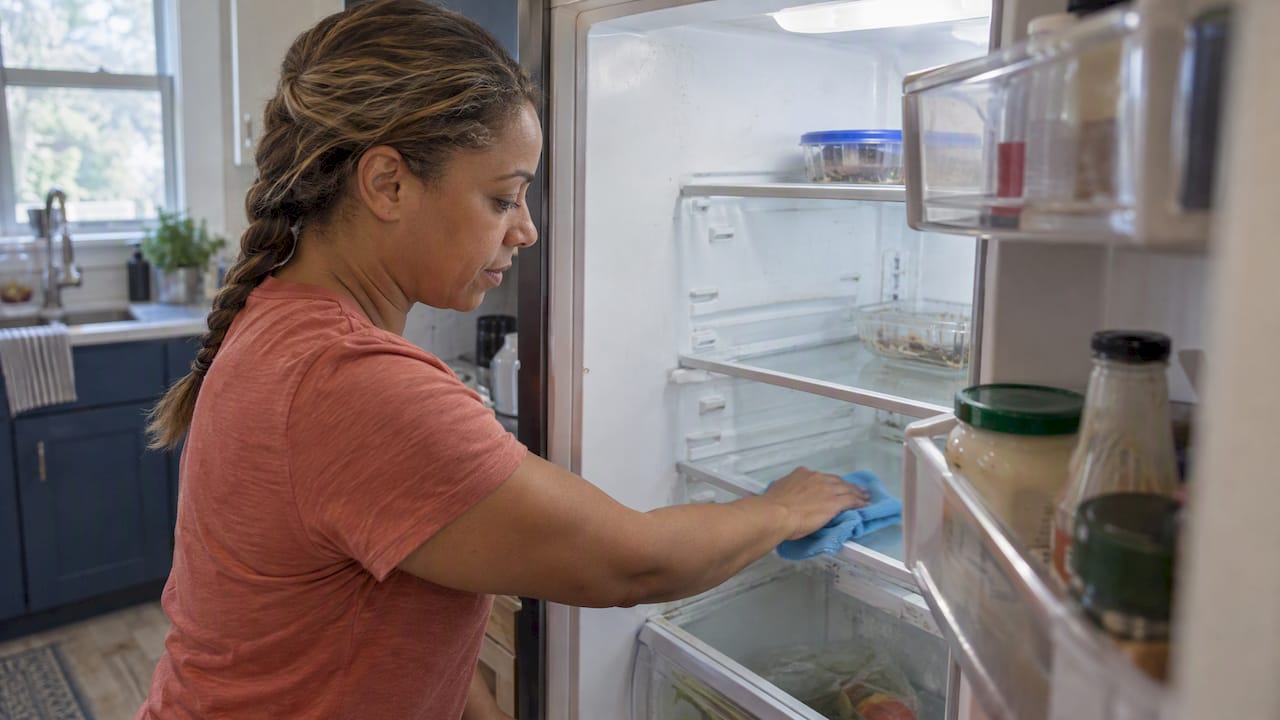
If your new kitchen has painted cabinets, go gentle. The same cloth that is fine on a laminate counter can dull a painted finish if you scrub or leave water sitting. A guide on caring for painted cabinets recommends rinsing, drying and using microfiber, which is a good rule for any cabinet you do not yet know the finish of.
Bathrooms
Bathrooms need three things: a disinfectant for fixtures, a cleaner that cuts soap scum, and a grout brush. Realtor.com also points to specialized scum removers for built-up residue. Start with the mildest option that works. If the grout is stained rather than just dirty, that is when a dedicated grout cleaner earns its place.
Do the toilet last in the bathroom, and use a separate cloth for it. Keep a different color of cloth for toilets than for counters so they never swap jobs.
Floors
Sweep or vacuum first, then mop. Lowe’s move-in guide says to use the right floor cleaner for each floor type without oversaturating, and to vacuum the edges and corners of carpet. For wood, a damp microfiber mop is safer than a soaking-wet string mop because it adds less water. We cover the common errors in our piece on hardwood floor cleaning mistakes.
Windows, mirrors and dusting
Glass cleaner and a clean microfiber cloth are enough. For ceiling fans, vents and high corners, an extendable duster does the job without a ladder. Dusting comes before floors, always, because what falls goes down.
Use the right order
Supplies matter less than sequence. The American Cleaning Institute’s room-by-room guide advises working top to bottom: ceiling fans and high corners first, then surfaces, then floors last. That way dust and drips land on areas you have not cleaned yet instead of ruining the ones you have.
A practical order for an empty house:
- Open windows if the weather allows and set out your kit in the room you start in.
- Dust ceilings, fans, vents and light fixtures.
- Clean inside cabinets, drawers, closets and shelves, while they are empty.
- Wipe walls, doors, switches, doorknobs and railings. Lowe’s lists these high-touch points specifically.
- Clean appliances and kitchen surfaces.
- Clean and disinfect bathrooms.
- Vacuum and mop, moving from the farthest room toward the exit.
If you want to see what a full version of that looks like, our deep clean house checklist for every room goes through it in more detail.
Using and storing products safely
A new home often means a new storage spot under a sink or in a garage, and the first week is when people combine half-used bottles from the old house. This is where safety matters most.
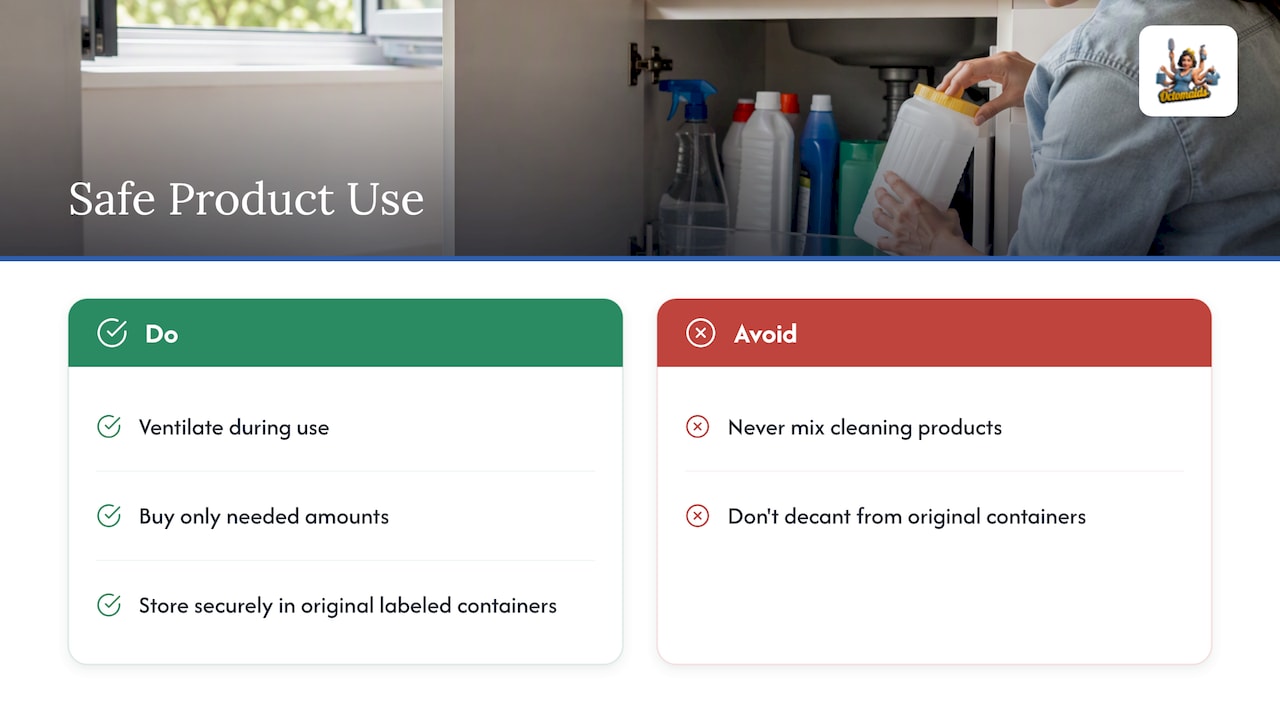
Never mix products. The U.S. EPA’s guide to cleaning for healthier indoor air says to follow label directions and never mix cleaning products, with ammonia-containing products and chlorine bleach called out as a specific danger. Poison Control explains in its dish soap article that bleach combined with an acid such as vinegar can release chlorine gas, and bleach combined with ammonia, often found in glass cleaners, can create chloramine gas. If you see a “natural” recipe that pairs vinegar with bleach, skip it.
Ventilate. Open a window or run the bathroom fan, especially when using oven cleaner, drain cleaner or bleach-based products.
Buy only what you need. The EPA recommends buying the quantity you will use, keeping containers tightly closed and stored in a well-ventilated area, and minimizing powdered or spray products that spread particles into the air. If you are choosing between two products that do the same job, use the least harmful one that works. The EPA also suggests avoiding strong fragrances if anyone in the household is sensitive to them.
Keep the original container. Decorative spray bottles look good in an Instagram-ready laundry room, but the American Cleaning Institute warns about decanting because the label and safety information stay behind, which raises the risk of mix-ups and accidental exposure. With children or pets moving into a new house, that is worth taking seriously. Store everything up high or in a locked cabinet.
Budget and homemade options
You do not need a premium brand for every item. A good store-brand all-purpose cleaner and a pack of microfiber cloths will cover most of a first clean. Spend a little more on the tools you will use for years: the vacuum and the mop.
Homemade cleaners are popular for cost reasons, but the savings are not always real. Poison Control notes that commercially formulated cleaners go through safety and performance evaluation and that some homemade alternatives are less effective or more expensive. The American Cleaning Institute makes a similar point: commercial products are tested, packaged and labeled according to government agency standards. Baking soda as a gentle scrub and plain dish soap with warm water are low-risk choices. Beyond that, a labeled commercial product is more predictable than a mixture you improvised.
To keep the cost down:
- Buy one multipurpose cleaner instead of separate kitchen, bathroom and dusting sprays.
- Choose reusable microfiber over paper towels.
- Skip air fresheners. Cleaning does more for odor than fragrance does, and the EPA suggests limiting strong scents anyway.
- Wait on specialty products until you know they are needed.
What professionals actually use
A common question is what professional cleaners carry that you do not. Mostly it is not exotic chemistry. It is better tools and a system. A CNN Underscored roundup quotes experts from New York’s Little Elves recommending a durable, high-suction canister vacuum as the workhorse of a home cleaning setup. Other than that, a team brings a caddy with color-coded cloths, a few cleaners, scrub tools and a vacuum, and works in a fixed order every time.
That is also worth borrowing at home. Put your starter kit in a caddy or bucket you can carry from room to room, so you are not walking to the garage for a sponge.
Prioritize with the 80/20 rule
People often ask about the 80/20 rule in house cleaning. It borrows from the Pareto principle, which Investopedia describes as a prioritization heuristic rather than a strict mathematical law: a smaller share of inputs tends to produce a larger share of results. Apartment Therapy applies it to housework by focusing on chores with an outsized visible payoff, such as clearing floors and surfaces, making the bed, vacuuming, and cleaning glass and mirrors.
For a move, this helps you prioritize supplies. If you run out of time or budget, make sure you can do the high-payoff things: a vacuum, a mop, an all-purpose cleaner, glass cleaner and cloths. The specialty products can wait.
Our perspective: the kit is only half the job
We have cleaned homes in Vancouver, WA and Portland, OR since 2006, and the pattern with new homeowners is consistent. People spend a week researching products, then run out of time and energy on moving day. The supplies are not the bottleneck. Time is.
Our view is that a new-home kit should be small enough to buy in one trip and unpack in one box. Pick products that you will keep using after the first clean, because a cabinet full of one-use specialty bottles is clutter, and clutter is its own kind of visual noise in a home you are trying to settle into.
We also think the first clean is worth treating differently from upkeep. Inside cabinets, closet shelves, appliance interiors, baseboards and the first full floor wash are jobs that are far easier when the house is empty. Some people enjoy doing them. Others have a closing date, a job and two kids, and that is a perfectly reasonable reason to bring in a team for the one-time work and keep a lighter kit for everyday cleaning afterward. We explain why in why new homes need professional cleaning before move-in, including that a house can look clean and still have dust and residue in places you cannot see.
Whichever route you choose, read labels, never mix products, and clean from the top down.
— Steven
When it makes sense to hand off the first clean
Doing it yourself makes sense when the home is small, recently cleaned and you have a free weekend before move-in. Hiring out makes more sense when:
- The previous occupants left the home in poor condition.
- You are moving on a tight timeline, with closing and move-in days close together.
- Several family members are sensitive to dust or strong products.
- The home is large, or has multiple bathrooms and a heavily used kitchen.
- You would rather spend the weekend unpacking.
Our move-in cleaning services page explains the different levels of service so you can match the scope to the house.
Let us do the first clean
Octomaids is a family-owned cleaning company serving Vancouver, WA, Portland, OR and the surrounding Clark County and Portland Metro area. Our staff are background-checked, trained and insured, and our services are satisfaction guaranteed. If you would rather arrive at a house that is already clean, see our move-in and move-out cleaning service.
Once you are settled, the same team can keep it that way with recurring home cleaning, so your supply kit only needs to handle the small stuff between visits. If your home needs a more thorough reset first, ask about one-time deep cleaning.
FAQ
What cleaning supplies do I need for a new house?
Start with an all-purpose cleaner, disinfectant, glass cleaner, toilet bowl cleaner, dish soap, microfiber cloths, a scrub brush, a broom and dustpan, a mop and bucket, a vacuum and rubber gloves. Add oven cleaner, grout cleaner and drain cleaner only after you have seen what the house needs. Trash bags and a step stool are easy to forget.
What is the 80/20 rule in house cleaning?
It is a way to prioritize: roughly, a small share of your tasks produces most of the visible improvement. In practice that means clearing surfaces, vacuuming, mopping and cleaning glass and mirrors before you worry about detail work. It is a rule of thumb rather than a precise formula.
What do professional home cleaners use?
Mostly the same basic products you can buy at a store, plus better tools and a repeatable system: microfiber cloths, a strong vacuum, scrub tools and a carry caddy. Their advantage is the order they work in and the experience of knowing which product suits which surface.
Is it safe to mix vinegar, bleach or ammonia with other cleaners?
No. Poison Control says bleach mixed with an acid like vinegar can create chlorine gas, and bleach mixed with ammonia can create chloramine gas. Use one product at a time, rinse surfaces between products, and keep the room ventilated.
Should I clean before or after moving furniture in?
Before. Cabinets, closets, floors and baseboards are much easier to clean when the home is empty, and you avoid moving boxes through freshly mopped rooms. Do a lighter wipe-down afterward for any dust the move itself creates.
Sources
- Ultimate Move-In Cleaning Checklist For Your New Home, Extra Space Storage
- 10 Essential Cleaning Supplies All New Homeowners Need, Realtor.com
- New Homeowner Cleaning Checklist, Libman
- New home cleaning checklist, Care.com
- New Home Cleaning Checklist, Lowe’s
- Room by Room Cleaning Guide, American Cleaning Institute
- Three Steps to Clean Your Way to Healthier Indoor Air, U.S. EPA
- What to know about dish soap, Poison Control
- Is Windex toxic?, Poison Control
- ACI survey on decanting cleaning products, American Cleaning Institute
- DIY or Homemade Cleaners, American Cleaning Institute
- 32 cleaning products every home needs, CNN Underscored
- The 80-20 Rule, Investopedia
- Clean Your House with the 80/20 Pareto Principle, Apartment Therapy
Recommended
- Why Move-In Cleaning Is Essential for Your New Home
- Why New Homes Need Professional Cleaning Before Move-In
- Types of Move-In Cleaning Services for Your New Home
- Deep Clean House Checklist for Every Room
About Octomaids
Octomaids is a locally operated professional cleaning company serving Vancouver, Clark County, and the surrounding Portland metro area. Since 2006, our cleaning teams have helped homeowners, renters, property managers, and businesses with recurring cleaning, deep cleaning, move-in/move-out cleaning, and commercial cleaning.
Our cleaning articles are reviewed to ensure the information reflects our real-world experience and professional cleaning practices.