


A solid janitorial scope of work spells out seven things: an area inventory, a task-frequency matrix, measurable performance standards, clear exclusions, a pricing model, staffing and equipment responsibilities, and an inspection protocol. If you only do one thing today, build the task-frequency matrix and drop it into your RFP exhibit. Everything else in the contract should trace back to it, and any change later goes through a formal change order rather than an email.
TL;DR:
- Building a detailed task-frequency matrix with specific zones and surface types helps ensure clear, measurable standards that reduce disputes and guide contractor performance.
- Requiring separate line-item breakdowns for labor, supplies, and equipment in bids exposes lowball offers and promotes transparency in pricing, especially for specialized or add-on services.
- Clearly defining responsibilities for staff, equipment, and supplies prevents mid-contract conflicts and ensures consistent service delivery aligned with documented standards.
- Using documented correction windows, inspection logs, and formal change orders maintains accountability and keeps scope adjustments aligned with ongoing facility needs.
- Incorporating standard reference guides and detailed frequency schedules in the scope helps facilitate supplier compliance and simplifies day-to-day management.
Table of Contents
- What Is a Janitorial Scope of Work Supposed to Cover?
- How Do You Build the Area Inventory and Task-Frequency Matrix?
- What Counts as an Objective Cleaning Standard?
- Which Pricing Model Fits Your Facility?
- Who Provides the Staff, Equipment, and Supplies?
- How Do You Separate In-Scope Work From Exclusions?
- How Should the SOW Drive Vendor Selection?
- Copy-Ready SOW Template and Sample Frequency Matrix
- Notes From the Field on Making an SOW Work Day to Day
- Three Lessons From Writing Scopes That Actually Get Used
- Let Octomaids Handle the Scope You Just Built
- Where to Go for Primary Standards
- Sources
- FAQ
What Is a Janitorial Scope of Work Supposed to Cover?
A janitorial scope of work is the contract exhibit that defines exactly what gets cleaned, how often, to what standard, and who is responsible for supplies and labor. Facility managers often call it a janitorial services checklist, but that undersells it. A real scope of cleaning services functions more like a blueprint than a checklist. It has to survive a vendor transition, a staffing turnover, and a facility renovation without anyone guessing what “clean” means.
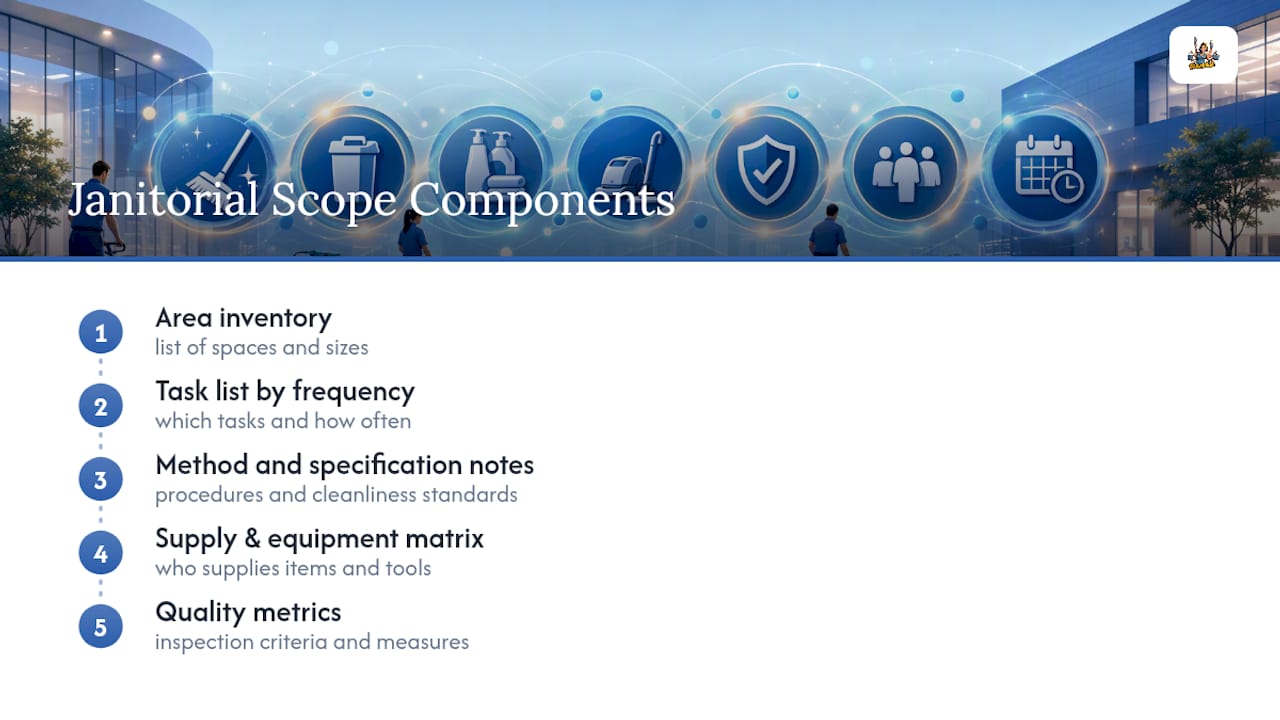
The National Janitorial Authority breaks the standard structure into five recurring parts across facility types: area inventory, task list by frequency, method and specification notes, a supply and equipment matrix, and quality metrics. That structure holds whether you’re writing for a 12,000-square-foot dental office or a 300,000-square-foot distribution center. The scale changes. The skeleton doesn’t.
How Do You Build the Area Inventory and Task-Frequency Matrix?
Start by walking the building and recording cleanable square footage zone by zone, not floor by floor. Lobbies, restrooms, private offices, open workstations, break rooms, corridors, and specialty rooms (server rooms, labs, locker rooms) each carry different task sets and different risk if missed. A generic “40,000 square feet” figure tells a bidder almost nothing about labor hours.
Note the floor material and surface type in every zone. Vinyl composition tile, sealed concrete, carpet tile, and natural stone each require different chemicals, equipment, and frequencies, and the EPA’s housekeeping task guidance is a useful reference for mapping standard actions to surface types.
Build the matrix itself with this convention:
- Rows list each zone or room type.
- Columns list task frequency bands: daily, weekly, monthly, quarterly, and annually.
- Cells describe the specific task, not a vague category.
Example entries that remove ambiguity:
- Restrooms: empty trash and restock daily; disinfect high-touch surfaces daily; deep-scrub grout monthly.
- Lobbies: dust mop and spot-clean glass daily; strip and wax hard floors quarterly.
- Offices: empty trash and vacuum daily; wipe baseboards monthly.
This matrix becomes the single reference every bidder prices against, and it’s the artifact your task-frequency matrix in the RFP exhibit should mirror exactly.
What Counts as an Objective Cleaning Standard?
“Clean” is not an inspection standard until you attach a number to it. Vague language is the single biggest driver of disputes between facility managers and vendors, according to Facility Executive, which points to documented inspection and correction processes as the fix.
Three ways to make standards measurable:
- Visual checklists with pass/fail line items per zone (no debris, no streaking, no odor).
- ATP swab testing on high-touch surfaces, with a relative light unit threshold the vendor must meet.
- Numeric inspection scoring, typically a weighted percentage across zones, following the outcome-based approach Facility Management Insights recommends for SOW deliverables.
Pro Tip: Set a documented correction window, such as 24 or 48 hours for a failed item, directly in the contract language. An undocumented “we’ll get to it” response is where most scope disputes start.
Design the inspection process with named roles: a site supervisor who inspects weekly, a facility manager who spot-checks monthly, and a shared scoring sheet both sides sign. Track three KPIs at minimum: inspection pass rate, average time-to-correct, and complaint resolution time. Tie remediation credits or service extensions to missed thresholds in the contract itself, and schedule a formal SOW review at least annually so the matrix keeps pace with how the space actually gets used.
Which Pricing Model Fits Your Facility?
Janitorial services cost in Portland and most metro markets breaks down into four common structures, and each shifts risk differently between you and the vendor.
- Monthly flat rate — predictable budgeting, but hides labor-hour assumptions unless you require a breakdown.
- Per-square-foot — easy to benchmark across bids, though it can undervalue high-traffic zones.
- Hourly — transparent labor tracking, but rewards slower work if not paired with output standards.
- Per-task — precise for specialty work, but cumbersome for daily recurring service.
Legal Clarity’s guidance on janitorial RFPs recommends requiring every bidder to break out labor, supplies, equipment, and overhead as separate line items rather than one bundled number. That single requirement does more to surface a lowball bid than any other clause. If a bid comes in noticeably below the field, check whether it skipped the breakdown entirely or assumed unrealistic labor hours per square foot.
Reserve floor stripping, carpet extraction, and window cleaning above the first floor as priced add-ons rather than folding them into the base rate, and require the same cost-breakdown format for any change order.
Who Provides the Staff, Equipment, and Supplies?
Unassigned responsibilities cause more mid-contract friction than almost anything else in a janitorial contract. Spell out staffing levels by shift, whether a supervisor is on-site or on-call, and minimum qualifications including background checks for anyone with keys or badge access.
- Specify which party supplies HEPA-filtered vacuums, auto-scrubbers, and specialty equipment.
- List consumables (liner, tissue, hand soap) and note historical monthly usage from past invoices where available.
- Require documented PPE and chemical-handling training aligned with OSHA hazard communication standards.
Sharing 12 months of consumable usage data with bidders removes guesswork from their pricing, an approach Facility Management Insights flags as one of the more effective ways to get comparable bids.
Pro Tip: If your building has textured tile, natural stone, or antique hardware, borrow method language from surface-specific guides like One Day Doors & Closets’ cleaning tips for interior doors rather than leaving the method column blank.
How Do You Separate In-Scope Work From Exclusions?
Every dispute I’ve seen traces back to a task nobody assigned in writing. List in-scope items with specifics: interior window cleaning, trash removal from private offices, restroom restocking. List exclusions with equal specificity: exterior windows above the first floor, construction debris removal, pest control, specialty floor refinishing.
The recurring gray zones worth naming explicitly:
- Entrance mat cleaning and rotation.
- Restockable supplies versus client-purchased inventory.
- Interior glass partitions versus exterior building glass.
For anything outside the written scope, run a change order:
- Vendor submits a written description and price estimate.
- Facility manager approves or negotiates the line item.
- Both parties sign before work begins.
- The change gets logged and folded into the next annual SOW review.
Treating the scope as a living document, updated on a fixed cadence rather than an ad hoc basis, is what keeps commercial cleaning duties from drifting away from what you’re actually paying for.
How Should the SOW Drive Vendor Selection?
The scope of work only earns its value if it shapes the RFP itself, not just the final contract. ISSA’s guidance on cleaning RFPs recommends building walkthroughs and vendor Q&A directly into the procurement timeline rather than treating the RFP as a one-way document drop.
- Require every bidder to return the SOW with a signed acknowledgement, or a line-by-line deviation list if they can’t meet a requirement as written.
- Host a site walkthrough and give bidders a window to submit written questions, so assumptions get documented rather than left to chance.
- Score proposals on a rubric: SOW compliance, staffing plan, quality-control methodology, references, and cost-breakdown clarity.
- Flag red flags early: no labor-hour breakdown, no named on-site supervisor, or production rates that don’t match the square footage.
A bidder who won’t commit to a deviation list in writing is telling you something about how they’ll handle disputes later.
Copy-Ready SOW Template and Sample Frequency Matrix
Structure the exhibit in this order so bidders can navigate it without a cover letter:
- Project objective and facility overview.
- Area inventory (zones, square footage, floor types).
- Task-frequency matrix.
- Performance standards and inspection protocol.
- Staffing and equipment matrix.
- Exclusions.
- Pricing instructions and change-order process.
Sample frequency entries you can adapt directly:
- Restrooms: trash and restock, daily; disinfect fixtures, daily; grout deep clean, monthly.
- Lobbies: dust and glass spot-clean, daily; hard floor strip and wax, quarterly.
- Offices: trash and vacuum, daily; dust surfaces, weekly; baseboards, monthly.
- Break rooms: wipe counters and appliances, daily; deep-clean refrigerator, monthly.
- Conference rooms: wipe tables and chairs, daily; carpet extraction, quarterly.
- Kitchens (commercial-grade): degrease surfaces, daily; hood and vent cleaning, per manufacturer schedule.
For healthcare, industrial, or high-traffic retail sites, add a compliance column referencing the governing standard (Joint Commission for healthcare, OSHA for industrial) and tighten disinfection frequency in clinical zones. The EPA’s model custodial contract language is a solid starting point for adapting method specifications to regulated environments. Photograph reference examples from a room-by-room deep clean checklist can also help translate general task descriptions into the specific wording an inspector can score against.
Notes From the Field on Making an SOW Work Day to Day
Some commercial janitorial contracts across Vancouver, WA and the Portland metro have shown that scopes which hold up share a pattern: dated inspection logs, a signed acknowledgement of the frequency matrix, and a change-order trail instead of verbal side deals. Frequencies get adjusted at renewal based on that documented history, not guesswork.
Three Lessons From Writing Scopes That Actually Get Used
Clarify consumables before the bid, not after. Require inspection logs as contract evidence, not internal paperwork. Formalize every change order in writing, even the small ones.
This week: confirm your area inventory, draft the frequency matrix, define one measurable standard per zone, set a correction window, and schedule your first annual review date.
— Steven
Let Octomaids Handle the Scope You Just Built
Writing the scope of work is half the job. Executing it consistently, visit after visit, is the other half, and it’s where a lot of vendor relationships quietly fall apart. Facility managers in Vancouver, WA and the Portland metro who want the task-frequency matrix and inspection protocol above actually run by the same trained team every time, rather than whoever a staffing agency sends that week, have a direct option available.
Octomaids’ commercial janitorial services cover the recurring cleaning duties, restroom and break room servicing, and office cleaning responsibilities most SOWs call for, with staffing consistency built into the contract rather than left to chance. If your building needs a scheduled rhythm rather than a one-off, the recurring cleaning service options map directly to weekly and bi-weekly frequency columns in the matrix you just built. Request a scope review through the services page and see how your current SOW compares to what a dedicated team can deliver on the ground.
Where to Go for Primary Standards
For method language and templates beyond this guide, consult EPA’s custodial model language and ISSA’s education resources directly.
Sources
- EPA — Custodial model contract language
- Facility Management Insights — How to write a scope of work
- Legal Clarity — How to write a janitorial RFP, scope, pricing and terms
- Facility Executive — What facility managers get wrong about commercial cleaning contracts
FAQ
What Falls Under Janitorial Services?
Janitorial services typically cover trash removal, restroom sanitation, floor care, dusting, glass cleaning, and break room servicing, with frequency and depth defined by the facility’s task-frequency matrix.
What Are the Job Duties of a Janitor?
Daily duties usually include trash and recycling removal, restroom cleaning and restocking, floor maintenance, surface disinfection, and reporting maintenance issues, with specific tasks varying by the property’s written scope of work.
What Is the 20/10 Rule for Cleaning?
The 20/10 rule is a personal productivity method involving alternating cleaning and rest periods, and it’s not a commercial janitorial standard; commercial scopes rely on documented task frequencies instead.
What Are the 7 Stages of Cleaning?
Definitions vary by industry source, but a common version covers preparation, dry soil removal, applying cleaning solution, agitation, soil removal, rinsing, and drying; commercial SOWs typically translate these into task-specific method notes rather than a numbered sequence.
How Often Should a Janitorial Scope of Work Be Reviewed?
Most facility managers should schedule a formal annual review, with any interim changes handled through a documented change-order process rather than informal requests.
Recommended
- 6 Steps to an Audit Ready Office Cleaning Checklist for Managers
- Types of Cleaning Packages for Professionals: 2026 Guide
- Janitorial vs Cleaning Service Options: 2026 Guide
- What Is a Cleaning Service Agreement? A Clear Guide
About Octomaids
Octomaids is a locally operated professional cleaning company serving Vancouver, Clark County, and the surrounding Portland metro area. Since 2006, our cleaning teams have helped homeowners, renters, property managers, and businesses with recurring cleaning, deep cleaning, move-in/move-out cleaning, and commercial cleaning.
Our cleaning articles are reviewed to ensure the information reflects our real-world experience and professional cleaning practices.