


For routine recurring cleaning, a well-managed janitorial program often costs less per year than outsourcing it. For specialized work, compliance-heavy environments, or multi-site portfolios, outsourced commercial cleaning usually delivers better value once you account for the fully loaded cost of running a crew yourself. The right answer depends on your square footage, your risk tolerance, and whether you compare bids on an apples-to-apples basis.
TL;DR:
- Fully loaded in-house costs are often 30% to 50% higher than wages alone when accounting for taxes, benefits, supervision, and supplies.
- Many bids below industry norms may indicate missing hours or scope, so comparing rates requires checking labor hours and scope details.
- In-house staffing is more cost-effective for large, predictable sites, secure environments, or urgent tasks, but must be compared against the full outsourced contract cost.
- Accurate proposal evaluation depends on detailed workloading breakdowns, quality control plans, and clear escalation and termination clauses.
- Using workloading standards, like ISSA’s guidance, helps verify bids and avoid hidden costs that undermine initially low rates.
Table of Contents
- Fully Loaded In-House Cost vs. Outsourced Contract Price
- What Belongs in a True Cost Comparison
- How Pricing Models and Rates Typically Work
- When Hiring In-House Staff Makes Financial Sense
- Questions to Ask Before You Sign Any Proposal
- How Octomaids Approaches Commercial and Janitorial Pricing
- A Facility Manager’s Three-Step Decision Framework
- Get a Comparable Quote from Octomaids
- Sources
- FAQ
Fully Loaded In-House Cost vs. Outsourced Contract Price
The mistake most facility managers make is comparing a janitor’s hourly wage to a vendor’s quoted rate. Those two numbers are not measuring the same thing. The U.S. Bureau of Labor Statistics reported a 2024 median hourly wage of $17.27 for janitors and building cleaners, but that figure says nothing about payroll taxes, benefits, supervision, or the equipment sitting in a supply closet.
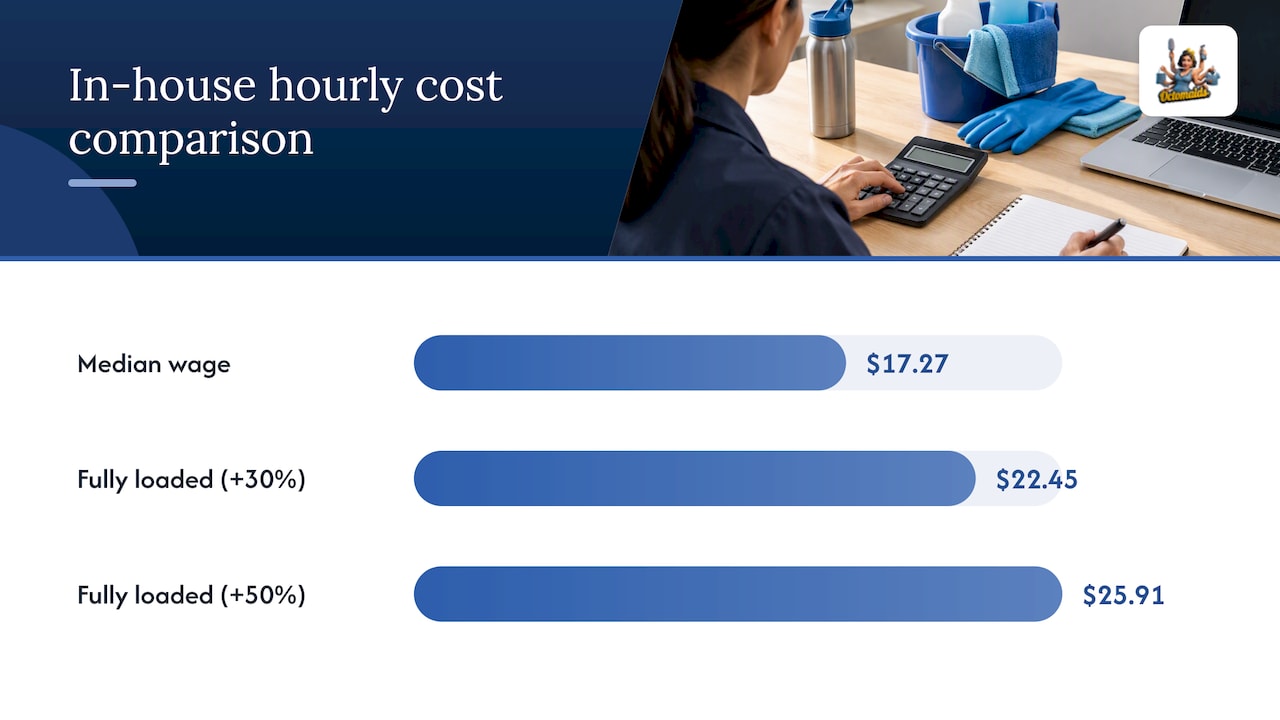
A “fully loaded” cost adds all of that back in. Say you hire one full-time janitor at the median wage for a 2,080-hour work year. Base wages alone come to roughly $35,930. Add payroll taxes, workers’ compensation, basic benefits, and a modest allowance for supplies and equipment, and the real annual cost of that single position often lands 30% to 50% higher than the wage line suggests, before you have paid a single dollar toward supervision or admin overhead.
ISSA publishes benchmark per-square-foot ranges that let you sanity-check a quote against industry norms rather than guessing. When a bid lands far below what workloading and local wage data suggest it should, that gap usually means missing hours, not efficiency gains. Before comparing numbers, make sure you are weighing:
- The vendor’s quoted rate against your own fully loaded in-house estimate, not against wages alone.
- The scope of tasks and frequency built into each number, since two quotes at the same price can cover very different work.
- Whether supervision, quality control, and supplies are included or billed as extras.
What Belongs in a True Cost Comparison
Every proposal, whether it is a vendor’s bid or your own in-house budget, hides cost drivers that are easy to overlook until they show up as a surprise line item in month three.
- Labor: base wage, payroll taxes, benefits, overtime, and the recruiting and training cost that comes with turnover.
- Supplies and consumables: chemicals, paper products, trash liners, and personal protective equipment.
- Equipment: vacuums, scrubbers, floor machines, and their depreciation and eventual replacement.
- Insurance and compliance: general liability, bonding, background checks, and OSHA-related training records.
- Supervision and administration: account management, scheduling software, payroll processing, and quality inspections.
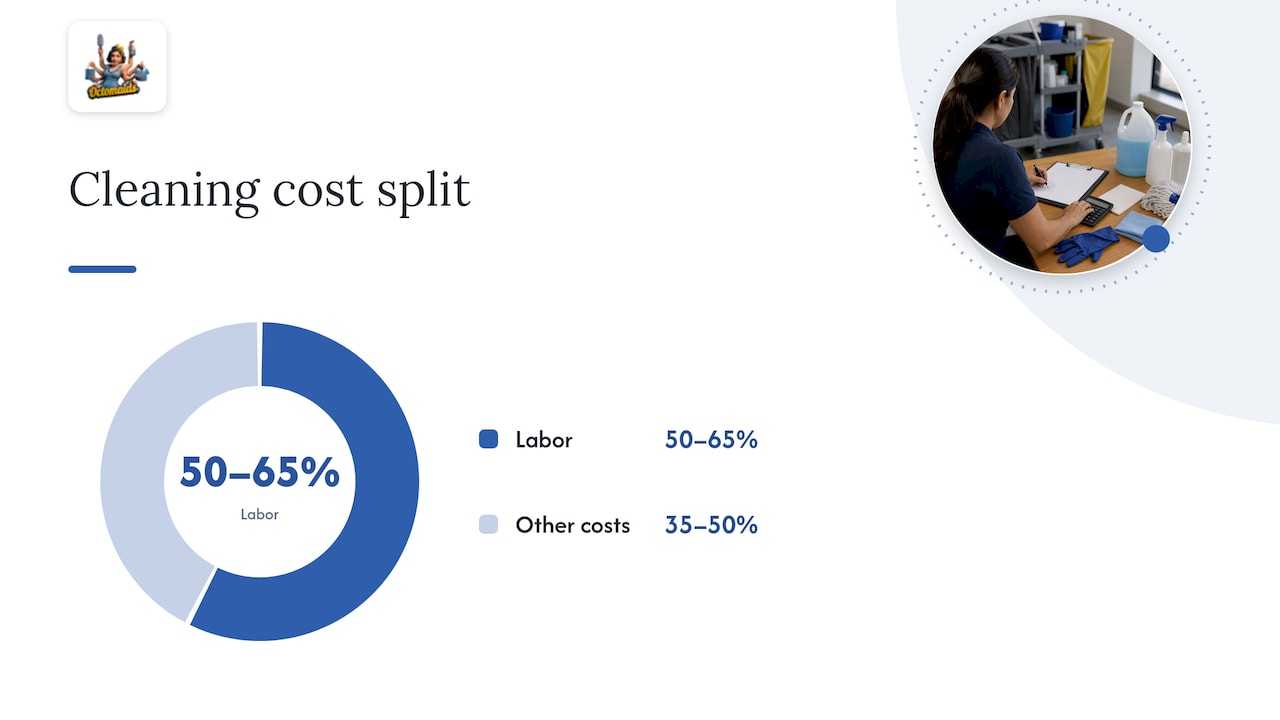
Statistic: Labor commonly makes up 50% to 65% of total cleaning expense, which means a shift in wage levels or staffing hours moves your total cost far more than a change in chemical pricing ever will.
That labor share is why a vendor who pads productivity assumptions, planning for one person to cover more square footage than is realistic, can quote a lower rate without actually reducing your risk of missed tasks. It is also why in-house budgets that only track wages routinely understate true cost by a wide margin.
Pro Tip: Ask every bidder, including your own facilities team, to break out labor hours separately from materials and overhead. If a quote cannot do that, treat it as incomplete.
How Pricing Models and Rates Typically Work
Cleaning contracts are priced in a few different ways, and knowing which model you are looking at helps you compare bids fairly. Per-square-foot pricing is common for recurring office and retail accounts, flat monthly pricing suits predictable scopes, hourly pricing fits small or irregular jobs, and project pricing applies to one-time work like post-construction cleanup.
ISSA’s pricing guide offers benchmark ranges by facility type, useful as a reference point rather than a firm quote since local wage levels and building condition shift the actual number. Specialized services are typically billed separately from routine janitorial work:
- Carpet cleaning and hard-floor stripping and refinishing, priced per square foot or as a flat project fee.
- Electrostatic disinfection, which the CDC distinguishes from routine cleaning and which is usually quoted as an add-on rather than folded into a base contract.
- After-hours or security-clearance work, which carries a premium because it limits the labor pool and adds scheduling complexity.
Several factors push a rate above the benchmark range: poor building condition at the start of a contract, high cleaning frequency, restricted access windows, background-check or security-clearance requirements, and local wage pressure in high-cost labor markets.
When Hiring In-House Staff Makes Financial Sense
In-house janitorial staffing tends to pay off in specific, identifiable situations rather than as a general rule.
- Single, large site with consistent nightly hours: a facility with steady, predictable square footage can usually justify a dedicated crew because there is little idle time to pay for.
- Confidentiality or security needs: healthcare records, financial data, or secure facilities often favor direct employees who go through your own background screening and training process.
- Immediate, on-demand tasks: spills, event turnovers, and urgent requests are easier to handle with staff already on-site than with a vendor’s scheduled visit.
The real test is a break-even comparison: calculate your annual fully loaded FTE cost, including the items from the section above, and set it against the annual price of an outsourced contract covering the same scope and frequency. Factor in the non-financial costs too, since managing payroll, HR compliance, and scheduling continuity takes real time away from your core job. Many facility managers land on a hybrid model: in-house staff for daily coverage, with specialists outsourced for carpet care, floor refinishing, or disinfection work that requires equipment they do not own.
Questions to Ask Before You Sign Any Proposal
A proposal that looks cheap on paper can turn expensive fast if it is missing the details that make costs predictable. ISSA’s workloading guidance is the standard method for converting a vague square-footage quote into real labor hours, and it is the single best tool for catching a bid that will not hold up.
Before accepting any proposal, request:
- A full workloading breakout showing labor hours per task, task frequency, and the frequency of quality-control inspections.
- A staffing continuity plan, including how absences and turnover are covered without gaps in service.
- Proof of chemical-handling training and hazard communication compliance under OSHA’s hazard communication standard, along with current insurance and bonding limits.
- Contract language covering annual price escalation, change-order pricing for added scope, and a correction service-level agreement for missed tasks.
- Clear termination terms so you are not locked into a contract that underperforms.
Watch for red flags: a bid with no visible labor hours, vague task descriptions, no Safety Data Sheet access on file, or a per-square-foot number well below what the workloading math supports. Staffing continuity can matter more than a marginally lower rate, since a provider with lower turnover and a tighter route plan tends to produce fewer missed visits and fewer correction costs that quietly erode the savings on paper.
Pro Tip: Keep a running log of missed or re-cleaned tasks for 90 days after any new contract starts. It is the fastest way to see whether a low bid is actually delivering the scope you paid for.
How Octomaids Approaches Commercial and Janitorial Pricing
A cleaning company serving the Vancouver, WA and Portland, OR metro area since 2006 offers recurring home cleaning, commercial cleaning, janitorial services, office cleaning, and post-construction cleaning under one family-owned operation rather than a franchise model. Every account is staffed by the same dedicated team at each visit, which supports the continuity argument in the section above: fewer new faces generally means fewer missed tasks and less retraining friction.
Quotes are built from the scope and frequency you actually need rather than a flat per-square-foot guess, which lines up with the workloading approach ISSA recommends. Compliance items, including chemical handling and documentation, are part of how the team operates day to day. To get a quote you can compare directly against an in-house budget or another vendor’s bid, send over your square footage, cleaning frequency, current pain points, and any after-hours access or security requirements.
A Facility Manager’s Three-Step Decision Framework
Skip the temptation to rank bids by their headline per-square-foot number. Convert every proposal, including your own in-house estimate, into a fully loaded annual cost per coverage: labor hours from workloading, plus supplies, equipment, insurance, and admin overhead. Then weigh that total cost against capability gaps: can an in-house crew handle electrostatic disinfection or floor refinishing without renting equipment you do not own?
Once you have real numbers and a clear capability match, choose in-house, outsourced, or a hybrid model, and write annual escalation clauses and a correction service-level agreement into whatever you sign. The cheapest per-square-foot bid without documented hours and a quality-control plan is rarely the cheapest option by the end of the contract year.
— Steven
Get a Comparable Quote from Octomaids
Comparing bids is easier when at least one quote is built the right way from the start. Octomaids prices commercial cleaning and janitorial service by scope and frequency rather than a flat guess, so you get a number you can set directly against your own fully loaded in-house math.
To get a quote that lines up against another bid or your current budget, send over:
- Total square footage and layout, including any specialized flooring or high-traffic zones.
- Desired cleaning frequency and preferred service hours, including after-hours or weekend access needs.
- Current problem areas or complaints with your existing arrangement.
- Any upcoming special projects, such as post-construction cleanup or a one-time deep clean before an event.
Reach out through the commercial cleaning services page to start that conversation, or browse the service overview for the full range of offerings, including office cleaning and post-construction work.
Sources
- Janitors and Building Cleaners : Occupational Outlook Handbook : U.S. Bureau of Labor Statistics
- Commercial Cleaning Rates per Square Foot: Full Pricing Guide – ISSA | The Association for Cleaning & Facility Solutions
- 1910.1200 – Hazard Communication | Occupational Safety and Health Administration
- When and how to clean and disinfect a facility | CDC
FAQ
Is janitorial the same as commercial cleaning?
Janitorial service usually refers to routine, recurring upkeep like trash removal, restrooms, and floor care, often performed daily or several times a week. Commercial cleaning is a broader term that can include janitorial work plus specialized or periodic jobs like carpet extraction, floor stripping, or post-construction cleanup.
Is $50 an hour for cleaning good?
Whether $50 an hour is a good rate depends on what is included: a rate that covers labor, supplies, supervision, and insurance is a different value proposition than a bare labor rate. Compare it against the fully loaded cost of an in-house hire, including the median wage reported by the BLS plus payroll taxes and benefits, rather than judging it in isolation.
What is the common pricing to clean a 10,000 sq ft warehouse?
Pricing for a space that size depends heavily on cleaning frequency, floor type, and whether the job is routine upkeep or a deeper specialized clean. ISSA’s pricing guide offers benchmark per-square-foot ranges by facility type that are a useful starting point, but a workloading breakdown of actual labor hours gives a far more accurate number than a flat rate alone.
What type of cleaning services make the most money?
Specialized services like carpet cleaning, window washing, and pressure washing tend to carry higher margins than routine recurring janitorial contracts, since they require specific equipment and skills that command a premium. Recurring janitorial work typically offers steadier, lower-margin revenue built on volume and contract length rather than per-job profit.
What is janitorial cleaning?
Janitorial cleaning covers the recurring, day-to-day upkeep of a facility, including trash removal, restroom sanitation, floor care, and general tidying on a set schedule. It is typically priced and staffed differently from one-time or specialized cleaning projects, which focus on a specific deep-cleaning or restoration task rather than ongoing maintenance.
Recommended
- Facility Managers: Janitorial vs Commercial Cleaning, 6 Questions
- 7 Elements Facility Managers Need in an RFP Ready Janitorial Scope
- Janitorial vs Cleaning Service Options: 2026 Guide
- 30 Day Test: Day Porter vs Janitor for Facility Managers
About Octomaids
Octomaids is a locally operated professional cleaning company serving Vancouver, Clark County, and the surrounding Portland metro area. Since 2006, our cleaning teams have helped homeowners, renters, property managers, and businesses with recurring cleaning, deep cleaning, move-in/move-out cleaning, and commercial cleaning.
Our cleaning articles are reviewed to ensure the information reflects our real-world experience and professional cleaning practices.