


A cleaner marketplace like Turno suits a solo host or a small portfolio that needs reliable cleaners fast. Breezeway-style operations platforms suit professional managers who need inspections, maintenance tickets, and reporting across many units. Checklist apps sit between them for hosts with their own cleaner. The tradeoff is speed and access versus standards enforcement versus operations depth. If you want no software at all, a local managed cleaning team is the simplest route.
TL;DR:
- Before choosing a marketplace, compare per job fees with your actual booking volume and ask how the cleaner pool handles last minute reservations.
- A checklist app suits hosts with an existing cleaner, but each property needs a task template and reference photos before a backup can follow standards.
- For larger portfolios, operations platforms add maintenance tickets, inspections, vendor scheduling, and analytics, but expect higher costs and a guided rollout after a demo.
- Before committing, verify property management system and calendar integrations, then pilot a property with a cancellation, a same day booking, and a flagged damage report.
Table of Contents
- Which platform category should you evaluate first?
- How do the three categories compare side by side?
- How does a cleaner marketplace work?
- When does a visual checklist app make sense?
- What do full property-operations platforms add?
- How do you choose the right category?
- What do cleaners see when software meets the field?
- Prefer a hands-off option? Hire a local team instead
- FAQ
- Sources
Which platform category should you evaluate first?
Three categories cover most of what hosts are shopping for, and each solves a different problem.
A cleaner marketplace connects you with vetted cleaners, schedules them against your bookings, and handles payment and ratings. A visual checklist app gives your existing cleaner room-by-room tasks with photo proof of completion. A full property-operations platform adds maintenance ticketing, inspections, vendor scheduling, and analytics on top of cleaning.
Here is the quick pick:
- Solo host with a small portfolio or a single cleaner: a marketplace gets you running fastest, with little setup.
- Host with a dedicated cleaner and high presentation standards: a checklist app protects your standards with photo proof.
- Professional manager with many units: an operations platform covers cleaning, maintenance, and reporting in one place.
- Pricing shapes: marketplaces tend to be free or low-cost per job, checklist apps usually charge per property on a subscription, and operations platforms generally quote pricing after a demo.
- Onboarding: marketplaces take an afternoon, checklist apps take as long as it takes you to build templates, and operations platforms take a guided rollout.
How do the three categories compare side by side?
Turno and Breezeway are the two names hosts compare most, and they represent opposite ends of this spectrum. GetApp’s comparison page lists user review scores of roughly 4.6 for Breezeway and 4.7 for Turno in 2026, and describes Breezeway as a property operations and experience platform while Turno simplifies scheduling, paying, and finding vacation rental cleaners. Close ratings tell you both are well liked. They do not tell you which one fits your portfolio, so compare the jobs they do.
| Dimension | Cleaner marketplace | Visual checklist app | Full ops platform |
|---|---|---|---|
| Primary job solved | Finding and scheduling cleaners | Enforcing cleaning standards | Running cleaning, maintenance, and inspections |
| Best for | Solo hosts, small portfolios | Hosts with their own cleaner | Professional managers, larger portfolios |
| Key features | Auto-scheduling, in-app payments, ratings | Photo tasks, room checklists, completion proof | Maintenance tickets, vendor scheduling, analytics |
| Pricing shape | Free or low per-job fees | Subscription per property | Demo-based quote |
| Integrations | Booking calendars | Calendars, some PMS | PMS, smart locks, vendor networks |
| Onboarding effort | Light | Moderate, template building | Heavy, guided rollout |
| Maintenance and inspections | Cleaning only | Cleaning only | Included |
Notice where the lines fall. Cleaning-only categories are cheaper and faster to adopt. Maintenance and inspection coverage lives almost entirely in the operations tier, and that is where the price and setup time climb.
How does a cleaner marketplace work?
A marketplace is the quickest path to a working cleaning operation. You connect your booking calendar, browse cleaners in your area, and the platform creates a cleaning job for each reservation. Payments and ratings stay inside the app, so you are not chasing invoices.
Strengths and limits worth knowing:
- Fast onboarding: you can have a cleaner assigned to your next turnover within days, not weeks.
- Vendor access: you tap a pool of cleaners instead of building one from scratch.
- Light setup: basic checklists are enough to start.
- Cost structure: some marketplaces are free to the host, while others charge per property or take transaction fees, so read the fee page before you commit.
- Limits: cleaning is the core job. If you need inspections or maintenance dispatch, you will outgrow a marketplace.
Pro Tip: Ask any cleaner you find on a marketplace how they handle a last-minute reservation, since a same-day booking is where a thin cleaner bench shows up.
Hosts who find full platforms overwhelming often land here. App Store reviews of Turno Hosts praise its checklist system, photo verification, automated scheduling, and responsive support.
When does a visual checklist app make sense?
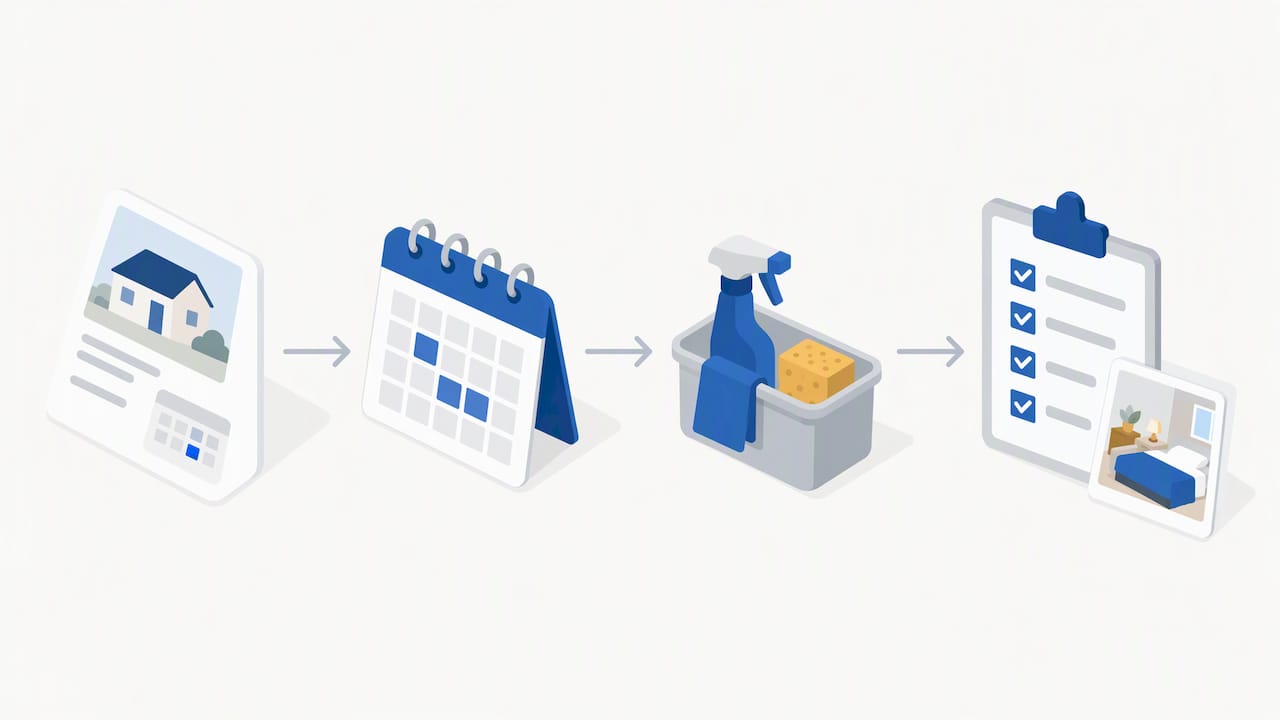
If you already have a cleaner you trust, a checklist app protects the standard you worked to get. Each room has tasks, each task can require a photo, and you see proof of completion before your guest arrives. It turns “the place looked fine” into evidence.
What these apps do well:
- Photo-based tasks that show the finished state of each room.
- Room-by-room checklists the cleaner works through on site.
- Completion checkpoints so you know when a turnover is finished.
- Reference photos that show a new cleaner what “ready” looks like.
The setup cost is real. You will build a template for each property and shoot reference photos, which takes time for each home. That investment pays back when a backup cleaner steps in and still hits your standard. Our short-term rental cleaning checklist is a good starting point for those templates, whichever app you choose.
In a demo, confirm key integrations: whether it syncs with your property management system, whether it pulls from your booking calendar, and how it hands off to payments.
What do full property-operations platforms add?
Operations platforms treat a property as a system, not a cleaning job. Cleaning is one task type among many, alongside maintenance requests, inspections, and vendor visits. That is the Breezeway side of the Turno vs Breezeway comparison.
Capabilities you gain:
- Maintenance ticketing that routes a broken lock or leaking faucet to the right vendor.
- Inspections with structured reports after turnovers.
- Automation rules that create tasks from reservations.
- Analytics dashboards that show turnover timing and issue trends across units.
Jurny’s documentation describes how integrations auto-create housekeeping and maintenance tasks from reservations and sync photo confirmations and status updates across platforms, which is the core of why these tools reduce manual coordination.
Expect higher pricing and a demo-led sale. Professional managers and hosts scaling to larger portfolios get the most from them. In a demo, check integrations with your property management system, smart locks, and vendor networks, and ask how long a full rollout takes for a portfolio your size.
How do you choose the right category?
Work through your constraints in this order, then test before you commit.
- Count your units. A small portfolio points to a marketplace or checklist app. A larger portfolio points to an operations platform.
- Check cleaner availability. If you cannot find reliable cleaners, a marketplace solves a problem the others do not.
- List your maintenance needs. If you dispatch repairs weekly, cleaning-only tools will leave a gap.
- Decide what reporting you need. Analytics matter more as your portfolio grows.
- Set a budget. Compare per-job fees against per-property subscriptions at your actual volume.
Questions to ask in every demo:
- Which property management systems and calendars do you integrate with?
- What happens when my cleaner cancels, and how is a backup found?
- How does photo verification work, and can I see it before check-in?
- How are cleaners paid, and who handles disputes?
- How do maintenance issues escalate once a cleaner reports one?
Run a pilot on a property. Test a same-day booking, a cancellation, and a flagged damage report, and see how each tool handles the messy cases rather than the easy ones.
What do cleaners see when software meets the field?
From where we stand, software succeeds or fails at the handoff. The friction our teams run into most often is a vague task list, no clear photo requirement, and a booking that lands hours before check-in. A tool can only help if the instructions it sends are specific.
That is why we put so much weight on a consistent team and predictable standards. When the same people clean your property every time, they learn the quirks, and a checklist becomes a reminder instead of a lesson. Our practical advice: write tasks the way you would explain them to a stranger, attach a reference photo to every high-stakes item, and tell your cleaners the app’s rules before the first job.
— Steven
Prefer a hands-off option? Hire a local team instead
Some hosts would rather not manage software at all. We provide Airbnb and vacation rental cleaning in Vancouver, WA and Portland, OR with the same background-checked team on every visit, backed by a satisfaction guarantee. If you want local backup without learning a platform, book a short-term rental cleaning with us and let us handle the turnovers.
FAQ
Is Turno worth it for a small host?
For most small hosts, yes, if finding reliable cleaners is the main pain point. Turno automates scheduling and payments, and App Store reviewers cite its checklists, photo verification, and responsive support. Check the fee structure against your volume first.
What app is similar to Turno for scheduling cleaners?
Other cleaner marketplaces and checklist apps cover the same ground, and the right one depends on whether you need to find cleaners or manage your own. Operations platforms like Breezeway go further by adding maintenance and inspections. Compare them on integrations and photo verification.
Is Breezeway better than Turno?
Neither wins outright, because they solve different problems. Breezeway is built for property operations across many units, while Turno focuses on scheduling and paying cleaners, and GetApp’s comparison shows both rated highly by users. Pick based on your portfolio size and maintenance needs.
Do I need software if I hire a local cleaning company?
Not necessarily. A managed local team handles scheduling and consistency for you, so you may only need a shared calendar. Software becomes useful when you want photo proof or reporting on top of the service.
Sources
Recommended
- Airbnb Hosts: Calculate Rent vs Buy Linens in Under 10 Minutes
- Why STR Cleaning Differs from Residential: 2026 Guide
- The Role of Professional Cleaners in Rental Management
- Short Term Rental Cleaning Checklist: Host’s Guide
About Octomaids
Octomaids is a locally operated professional cleaning company serving Vancouver, Clark County, and the surrounding Portland metro area. Since 2006, our cleaning teams have helped homeowners, renters, property managers, and businesses with recurring cleaning, deep cleaning, move-in/move-out cleaning, and commercial cleaning.
Our cleaning articles are reviewed to ensure the information reflects our real-world experience and professional cleaning practices.