


Hosts running one or two units with manageable turnover schedules almost always come out ahead buying their own linens, while hosts juggling multiple properties, remote management, or high weekly guest volume typically save time and money by renting through a commercial linen service. The split comes down to labor and logistics as much as raw cost. We break down the full comparison below, including worked numbers you can apply to your own occupancy rate.
TL;DR:
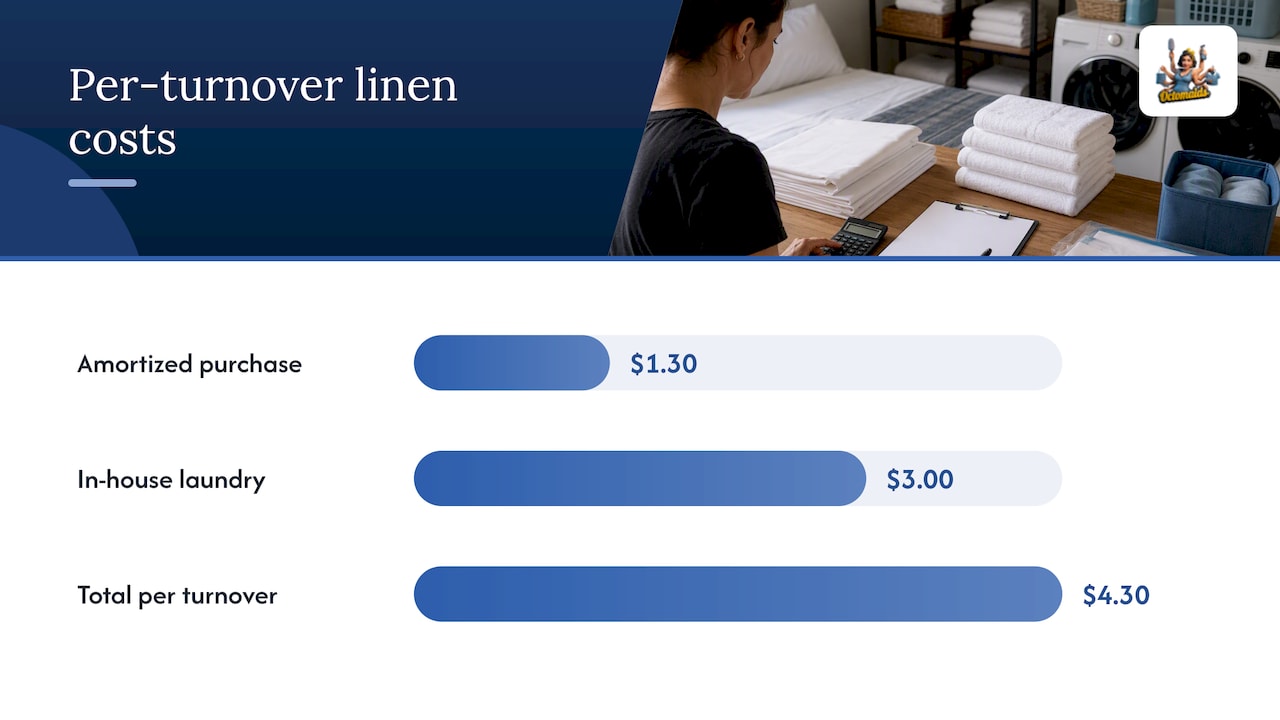
- At eight monthly turnovers, a $250 linen purchase lasting two years costs about $1.30 per turnover before laundering, or roughly $4.30 including a $3 load.
- When weekly laundry approaches a few hundred pounds, compare service fees against the labor and storage costs of washing linens at home.
- Wash sheets and towels after every guest stay at the warmest setting the fabric allows, dry them completely, and bag soiled items before moving them.
- Plan on three to four full sets per bed: one is in use, one is in the wash, and another covers damage or same day changes.
Table of Contents
- Renting vs buying linens: pros, cons, and who fits where
- Do the math: what renting and buying actually cost per turnover
- Turnover logistics, hygiene rules, and keeping enough linen on hand
- If you buy: what to look for in durable, guest-ready linens
- How commercial linen services actually work and what to check before signing
- What most hosts get wrong about this decision
- Let us handle the turnovers while you handle the bookings
- FAQ
- Sources
Renting vs buying linens: pros, cons, and who fits where
Every host eventually faces this decision, and the honest answer is that neither option is universally better. The right call depends on how many beds you manage, how often you turn them over, and whether you have reliable laundry access on-site or nearby.
Pros of renting linens:
- No upfront capital outlay, which keeps cash free for furnishing or marketing your listing.
- A commercial linen service handles washing, drying, and folding, removing that labor from your schedule entirely.
- Replacement and repair are typically built into the service agreement, so a stained pillowcase doesn’t become your problem.
- Scaling up for a busy season means ordering more sets, not buying and storing inventory you may not need in the off-season.
Cons of renting linens:
- Ongoing cost never stops, unlike a purchase that’s paid off after a few years of use.
- You depend on a vendor’s pickup and delivery schedule, which can create risk during same-day turnovers if a route runs late.
- Fabric quality varies by provider, and some commercial linen stock looks and feels more utilitarian than the hotel-style sets guests expect from a well-reviewed listing.
Pros of buying linens:
- Full control over fabric, color, and thread count lets you match the aesthetic you’re marketing in your listing photos.
- Once you’ve amortized the purchase, your per-turnover linen cost drops close to zero aside from washing.
- No vendor dependency means no risk of a missed delivery derailing a same-day guest changeover.
Cons of buying linens:
- You absorb all laundering labor, whether that means doing it yourself or paying a cleaner for wash time.
- Storage space for backup sets becomes a real constraint in smaller units or off-site storage situations.
- Replacement falls entirely on you, and wear from frequent commercial-grade washing shortens the usable life of consumer-grade sheets.
Here’s a quick way to map your situation to the right choice:
| Host profile | Recommended approach |
|---|---|
| Single unit, weekly or less turnover | Buy, with 2 to 3 sets per bed |
| Two to three units, moderate turnover | Buy, but budget for a backup laundry plan during peak weeks |
| Four or more units, or remote management | Rent through a linen service |
| Seasonal spikes well above your normal volume | Rent temporarily, even if you buy the rest of the year |
If your weekly linen volume approaches commercial laundry territory, renting starts to look less like a convenience and more like a cost-saving move, which we’ll walk through next.
Do the math: what renting and buying actually cost per turnover
Numbers settle this debate faster than opinions do. Below are two worked scenarios, one for a low-volume host and one for a high-volume operation, so you can see where the breakeven point tends to fall.
Low-volume example: a single one-bedroom unit, 8 turnovers per month
Say a host buys 3 full sheet sets, 4 towel sets, and 2 duvet covers for one queen bed, spending roughly $250 total. If that linen inventory lasts 2 years of regular guest use before fabric wear forces replacement, the amortized cost works out to about $10.40 per month, or roughly $1.30 per turnover at 8 turnovers a month. Add in-house laundry costs, say $3 per load for detergent and utilities, and the total per-turnover linen cost lands near $4.30.
- Divide the total purchase price by the expected number of months the set will last to get a monthly amortized cost.
- Divide that monthly figure by your average turnovers per month to get a per-turnover cost.
- Add your actual laundering cost per load (detergent, water, electricity, or a paid laundry service fee) to get your true per-turnover total.
High-volume example: a four-unit portfolio averaging 40 turnovers per month.
A host with four units generating 40 turnovers a month needs a far larger standing inventory, more frequent laundering, and more storage. Commercial linen services commonly price by the pound or by the piece with a weekly minimum, and vendors differ on pickup frequency and what’s included in that rate. Once weekly linen volume climbs toward a few hundred pounds, many hosts find that a dedicated linen service for Airbnb hosts ends up cheaper than buying, storing, and laundering that much fabric in-house, largely because the labor and space costs of DIY laundry scale faster than a flat per-pound service fee.
Statistic Callout: Scientific evidence shows that appropriate wash and dry cycle parameters meaningfully reduce microbial load on fabric, which is the core reason laundering frequency and method matter as much as the rental-versus-buy decision itself. A review of laundry and pathogen transfer documents that time and temperature during washing directly affect how much contamination survives, regardless of who owns the sheets.
The variables worth adjusting for your own math are occupancy rate, average nights per turnover (a 1-night stay costs the same in linens as a 5-night stay), and how long your fabric realistically survives commercial-grade washing before it needs replacing. Run the numbers both ways using your actual turnover count, not an estimate, before committing to either path.
Turnover logistics, hygiene rules, and keeping enough linen on hand
Getting the cost math right matters less if your operation falls apart between guests. Turnover logistics, hygiene compliance, and inventory planning are where most new hosts underestimate the real workload.
Hospitality-wide guidance treats laundering as a hygiene requirement, not a nice-to-have. AHLA SafeStay guidelines recommend laundering sheets and towels between every single guest stay using the warmest water setting the fabric allows, then drying items completely before reuse. The same guidance advises against shaking dirty linens, since that motion can spread contaminants into the air, and recommends bagging soiled linens in-room rather than carrying them loose through the property.
Applying this practically means:
- Wash on the hottest setting your fabric label permits, every single turnover, with no exceptions for short stays.
- Bag soiled linens before moving them out of the bedroom instead of carrying an armful loose.
- Run a full dry cycle rather than air-drying when time allows, since complete drying matters for reducing microbial survival.
- Keep a visual damage log so a torn or stained set gets pulled from rotation instead of reused.
A host running 10 weekly turnovers on one queen bed, using one set per turnover, needs roughly 12 to 13 sets in rotation once you include that buffer. That buffer is what keeps a late laundry cycle from turning into a canceled check-in.
Storage matters more than most new hosts expect. Label shelves by room or bed size, rotate stock so older sets get used and worn evenly rather than leaving some sitting unused, and track which sets have visible wear so you retire them before a guest complains. Turnaround time is the real constraint here: in-house laundry for a same-day turnover means washing, fully drying, and remaking a bed within a tight window, often under 3 hours, while a short-term rental cleaning checklist can help structure that window so nothing gets skipped under time pressure. A linen service removes that time crunch entirely by delivering pre-laundered sets on a set schedule, which is part of why high-turnover hosts lean toward renting even when the raw dollar cost is similar to buying.
Pro Tip: Keep one dedicated “emergency” set per bed that never enters normal rotation, reserved only for same-day replacements when a regular set comes back damaged or late.
If you buy: what to look for in durable, guest-ready linens
Buying well the first time saves you from replacing linens twice as often. A few material and sizing decisions determine whether your sheets hold up to commercial-style washing or fall apart within a year.
Percale has a crisp, cool feel, while sateen offers a softer, slightly glossier finish but can show wear and snagging sooner under heavy rotation. Microfiber is cheaper upfront and wrinkle-resistant, but it doesn’t breathe as well and can feel less premium to guests expecting a hotel-style stay, which matters for review scores.
On thread count, aim for a range that balances durability with cost rather than chasing the highest number on the shelf. Extremely high thread counts can actually pill and wear faster because the fibers are finer and more fragile under repeated hot washing, so a mid-range percale weave often outlasts an ultra-high-thread-count sheet in real-world turnover conditions. For towels, look for weights that feel substantial without taking forever to dry between guests, since towels that stay damp too long in storage can develop odor issues.
White linens are worth the slightly higher visual expectation they set, because they can be bleached and sanitized aggressively without worrying about color fading or bleeding, which matters when you’re laundering on the hottest setting permissible every single turnover as hygiene guidance recommends. Colored or patterned linens hide stains better in the short term but limit your ability to use strong detergents and hot water consistently.
A practical buying checklist:
- Choose 100% cotton percale or a reputable hotel-grade blend over synthetic-heavy fabrics.
- Stick to a mid-range thread count rather than the highest number available, since very high counts can pill faster.
- Buy white or off-white for bleachability and easier stain management.
- Plan for 3 to 4 full sets per bed, enough to cover one in use, one in the wash, and a buffer for same-day turnovers.
- Replace sets based on turnover frequency rather than a fixed calendar date, since a high-turnover bed wears fabric faster than a low-occupancy one.
Buy from hospitality or bulk linen suppliers rather than standard consumer retailers when possible, since hospitality-grade stock is built for frequent commercial washing. Red flags include vague fabric descriptions that don’t specify cotton content, unusually low prices on “high thread count” claims, and no stated weave type, all of which usually indicate lower quality unsuitable for repeated hot-water cycles.
How commercial linen services actually work and what to check before signing
Commercial linen services typically price in one of a few ways: per pound of laundry processed, per piece (so many dollars per sheet, per towel, per pillowcase), or a flat weekly rate with a minimum volume requirement. What drives the final cost is your total weekly weight, pickup frequency, and whether replacement and repair are bundled into the agreement or billed separately.
Many hosts find the economics shift clearly in favor of renting once weekly linen volume climbs toward a few hundred pounds, a threshold where the labor and space cost of handling that much laundry in-house starts to outweigh a flat per-pound service fee. We’ve seen this play out firsthand with hosts managing linen service needs around the 300-pound-per-week mark, where outsourcing laundering freed up enough turnover time to take on additional bookings without hiring extra cleaning staff.
Before signing with any vendor, confirm these points:
- Pickup and delivery schedule, and whether it can flex around same-day turnovers during busy weekends.
- Guaranteed replacement terms for items lost or damaged in processing.
- A clearly written damage fee schedule rather than a vague “case by case” policy.
- Labeling systems that prevent your linens from getting mixed into another client’s batch.
- Proof of sanitation practices and insurance coverage.
Pro Tip: Ask any linen vendor for their documented laundering temperature and cycle time before signing, since that detail tells you more about hygiene compliance than a sales brochure ever will.
Red flags worth walking away from include vendors who can’t produce insurance documentation, damage policies that change verbally between conversations, and pickup schedules with no written guarantee. We’ve built our own short-term rental cleaning workflows around these same standards, pairing reliable turnover cleaning with linen-handling guidance for hosts who want one less moving part to manage.
What most hosts get wrong about this decision
The biggest mistake we see isn’t choosing the wrong option, it’s sticking with the wrong one for too long. A host who bought linens for one unit often keeps buying as they expand to four or five properties, not realizing that laundry labor, not linen cost, has quietly become their biggest time sink.
I remember a host telling us their regular cleaner had car trouble on a Saturday morning with three back-to-back check-ins scheduled. There was no backup laundry plan and no spare inventory, so the afternoon turned into a scramble to find clean sheets anywhere nearby. A linen service with a standing delivery schedule would have made that Saturday a non-event instead of a crisis.
If you’re deciding today, start here: count your actual weekly turnovers, check how much storage space you realistically have, and ask whether your current laundry setup could survive a sick cleaner or a broken washing machine. If any of those answers worry you, renting is probably the safer long-term move, not just the more convenient one.
— Steven
Let us handle the turnovers while you handle the bookings
Whether you land on renting or buying, the laundering and turnover work still has to happen on schedule, every time, and that’s where hosts managing multiple units or remote properties tend to feel the most strain. We’ve worked with Airbnb and vacation rental hosts across Clark County and the Portland Metro area long enough to know that a missed turnover costs you more than a bad review, it costs you a booking.
Our Airbnb and vacation rental cleaning service covers the turnover work hosts need most, from bed-making to bathroom resets, with the same background-checked team assigned to your property every visit instead of rotating strangers through your space. If you manage several units, host remotely, or see seasonal booking spikes that overwhelm your current routine, outsourcing turnover cleaning frees up the hours you’d otherwise spend coordinating laundry and last-minute fixes yourself.
Ready to see what a dependable turnover routine looks like for your listing? Visit our services page to check availability for your property.
FAQ
Is it cheaper to buy or rent linens?
For a single unit with light turnover, buying is almost always cheaper once the purchase is amortized over a couple of years of use, since the per-turnover cost drops close to just the laundering expense. For high-volume hosts approaching a few hundred pounds of laundry per week, a linen service often costs less overall once labor and storage are factored in.
What is the 75-55 rule in Airbnb?
This isn’t a standard, recognized Airbnb hosting framework, and we found no authoritative source defining a “75-55 rule.” If you’ve seen it referenced elsewhere, treat it as an informal shorthand rather than an official platform guideline.
Which is more profitable, Airbnb or long-term rental?
Profitability depends heavily on local occupancy rates, nightly pricing, regulations, and operating costs like cleaning and linen management, so there’s no universal answer that applies to every market. What we can say is that short-term rental hosts who control their turnover costs, including linen decisions, tend to protect their margins better than those who don’t track these expenses closely.
What is the 80/20 rule for Airbnb?
The 80/20 rule, sometimes called the Pareto principle, generally refers to the idea that a large share of your bookings, reviews, or revenue tends to come from a small share of your listings or guest types. Applied to hosting, it’s often used loosely to suggest hosts focus their time and cleaning budget on the properties or guest segments that drive the most consistent return.
How many sets of linens do I need per bed?
A common rule of thumb is one set in use, one in the wash, and a buffer set for same-day turnovers or damage, which typically works out to 3 to 4 full sets per bed for hosts doing regular turnovers. High-turnover hosts or those without daily laundry access may want to add an additional set to that baseline.
Sources
Recommended
- When You Hit 300 Pounds/Week: Linen Service Choices for Airbnb Hosts
- U.S. Airbnb Hosts: Same Day Cleaning in 75–85 Minutes
- Stop Emergency Restocks: Airbnb Restocking Checklist for Hosts
About Octomaids
Octomaids is a locally operated professional cleaning company serving Vancouver, Clark County, and the surrounding Portland metro area. Since 2006, our cleaning teams have helped homeowners, renters, property managers, and businesses with recurring cleaning, deep cleaning, move-in/move-out cleaning, and commercial cleaning.
Our cleaning articles are reviewed to ensure the information reflects our real-world experience and professional cleaning practices.