
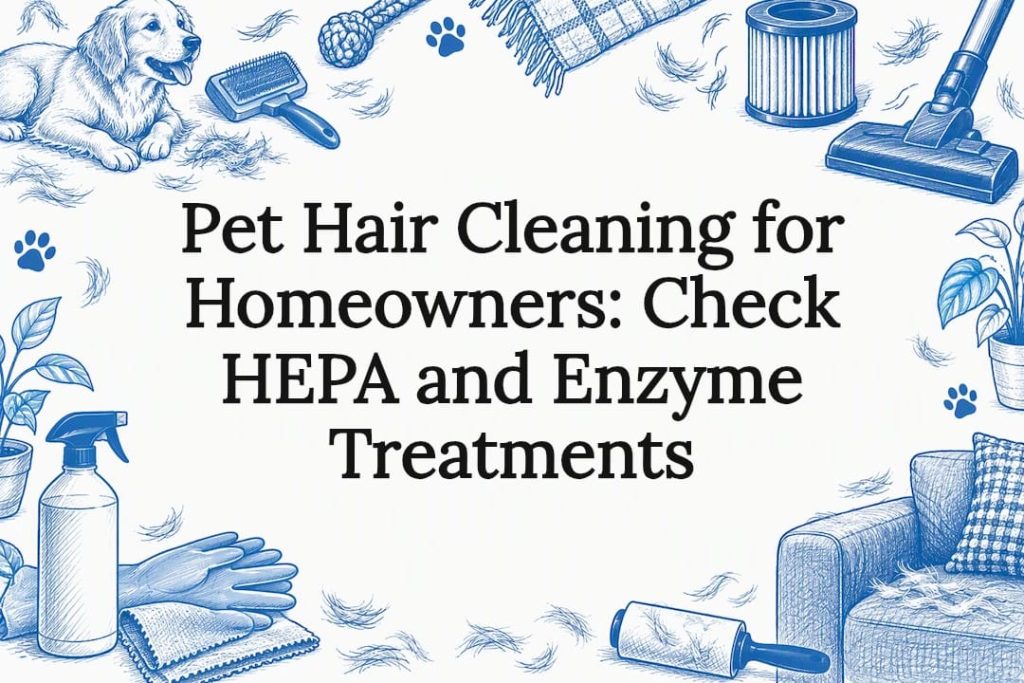


A professional pet hair cleaning service removes loose hair, embedded hair, dander, and lingering pet odors through a planned sequence: loosening, HEPA-equipped vacuuming, handheld tool work, and sometimes hot water extraction or enzyme treatment. Before you book, ask whether the provider uses HEPA vacuums, offers enzyme odor treatments, and accommodates fragrance-free or owner-supplied products. We offer both recurring and one-time cleaning built for pet households.
TL;DR:
- A sealed HEPA vacuum captures 99.97% of particles down to 0.3 microns; ask providers to confirm the machine, not just its filter.
- Pet surcharges cost $15 to $30 per visit, enzyme treatments $20 to $50 per area, and deodorizing $10 to $40 per room.
- Hot water extraction can address odor in carpet fibers, but repeated urine absorption into padding may require replacement rather than another cleaning.
- Vacuum pet areas every two to three days and your home weekly; schedule professional deep cleaning at least every 24 months, sooner for heavy shedding.
Table of Contents
- What’s Included in a Pet Hair Cleaning Visit
- How Pros Remove Embedded Pet Hair, Step by Step
- What Pet Hair Cleaning Typically Costs
- Questions to Ask Before You Book
- How Often to Clean and Schedule Professional Visits
- What We’ve Learned From Pet Homes Over the Years
- Book a Pet Hair Cleaning Service With Octomaids
- FAQ
- Sources
What’s Included in a Pet Hair Cleaning Visit
A pet hair cleaning visit covers more ground than a standard dusting and vacuum pass. Most providers build the service around a core set of tasks, then add specialized steps when hair or odor has worked its way into fabric and padding.
- Extended vacuuming with a HEPA-equipped machine across carpets, rugs, and upholstery.
- Handheld attachment passes on furniture, stairs, and car seats where a canister vacuum can’t reach well.
- Lint-roll or brush finishing on fabric surfaces for a visibly clean result.
- Spot treatment for stains or odor concentrated in one area, such as a favorite pet bed spot.
Some jobs need more than vacuuming and spot work. When pet odor has soaked into carpet fibers or padding, hot water extraction becomes the right tool, and the CRI 205 residential carpet standard treats this kind of periodic deep cleaning as standard maintenance rather than a last resort. In cases where padding has absorbed urine repeatedly, extraction alone won’t solve it, and padding replacement is a separate conversation with the provider.
Before your visit, a good provider will ask about your pets: how many, what kind, where accidents have happened, and whether furniture can be moved. That information shapes which tools and treatments make sense for your home.
How Pros Remove Embedded Pet Hair, Step by Step
Embedded pet hair resists a single vacuum pass because it works its way into carpet fibers and fabric weave, not just the surface. Professionals follow a specific order to break it loose and lift it out completely.
- Loosen the hair first. A rubber squeegee or a damp rubber glove dragged across carpet or upholstery lifts buried hair to the surface, where it clumps instead of scattering.
- Vacuum slowly with a motorized anti-tangle head. Slow, overlapping passes in two directions, vertical then horizontal, pull hair that a single quick pass would leave behind, since hair sits in the weave and needs agitation from multiple angles.
- Switch to handheld tools for upholstery and stairs. A motorized handheld pet attachment reaches corners, cushions, and stair treads that a floor vacuum can’t access.
- Use a spot-extraction tool on bonded hair or stains. A spray-and-suction portable cleaner handles hair that’s bonded into a stain or dried-in mess that dry suction alone won’t release, according to a practical guide on removing pet hair.
- Finish with a lint roller. A final pass catches any stray hair left on cushions or low-pile areas.
Rubber squeegees and damp gloves beat lint rollers on large furniture because the friction they create aggregates hair into removable clumps instead of smearing it across the fabric. Between passes, pros empty vacuum bins often, since a full bin loses suction fast, and they check the brush roll for tangled hair that can slow the motor down.
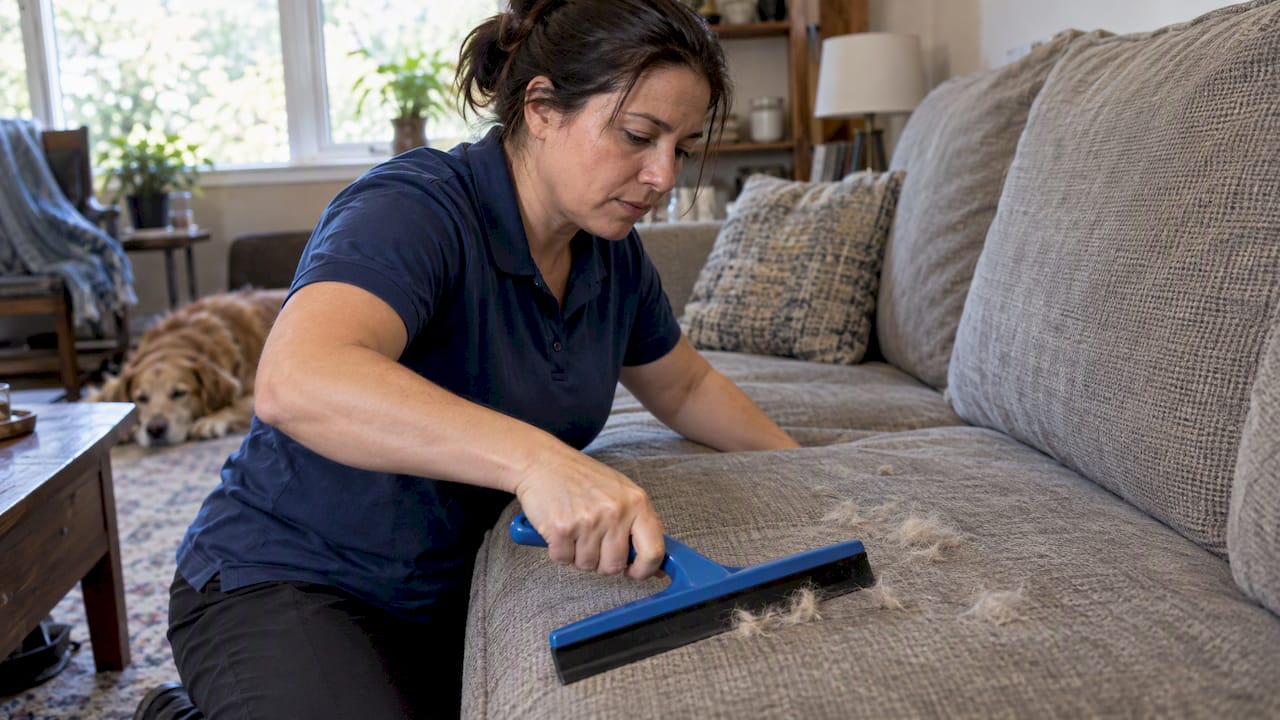
Pro Tip: Ask your provider whether they use a motorized anti-tangle brush head specifically, since a standard beater bar wraps pet hair around the roller instead of lifting it.
What Pet Hair Cleaning Typically Costs
Pricing for pet hair cleaning depends on a handful of factors you can usually estimate before the crew arrives: square footage, how many rooms get heavy pet traffic, the number and type of pets in the home, how much hair or odor has worked into fabric, and whether furniture needs to be moved.
Beyond the base cleaning price, pet households commonly see a few add-on charges. Pet households typically pay $15 to $30 extra per visit for a pet surcharge, $20 to $50 per area for enzyme odor pre-treatment, and $10 to $40 per room for deodorizing, according to a guide on pet-friendly cleaning services. Not every provider itemizes these separately, so ask whether pet-related work is bundled into the base price or billed on top of it.
- Home size and number of heavily used rooms drive the base price.
- Number and species of pets affect how much extra hair and dander need handling.
- Amount of embedded hair or set-in odor can push a job from standard cleaning into deep-extraction territory.
- Furniture-moving requests add time and sometimes a separate line item.
To get an accurate quote, tell the provider your room count, send photos of problem areas, mention any pet accidents, and ask what they expect you to do before they arrive, such as pre-vacuuming high-traffic areas.
Questions to Ask Before You Book
A short conversation before booking saves you from surprises on cleaning day. Ask these questions, then walk through the home with an eye toward preparation.
- Do you use HEPA vacuums, and can you confirm the filtration spec?
- What spot treatments or odor treatments do you offer, and are they itemized separately?
- Can you use products I supply, especially fragrance-free ones?
- Will you move furniture to clean underneath, and are there limits on what you’ll move?
- If you use hot water extraction, how long will the carpet need to dry afterward?
On the preparation side, restrict or crate pets during the visit so the crew can work efficiently and your pets stay calm. Point out any accident spots in advance rather than leaving the crew to find them, remove fragile items from surfaces that will be cleaned, and either move pet beds yourself or leave clear instructions for how you want them handled. If you have product preferences, especially around fragrance, say so when you book rather than at the door. Our guide on preparing your home for a cleaning service walks through these steps in more detail.
Watch for red flags during vetting: a service that can’t tell you what products it uses, one that refuses a reasonable request for fragrance-free or owner-supplied products, or one that quotes a flat price over the phone without asking a single question about your home. Transparency on chemicals and ventilation matters more in a pet household, not less.
How Often to Clean and Schedule Professional Visits
Between professional visits, routine vacuuming keeps hair from building up into something harder to remove. A quick pass in pet areas every two to three days, with a full whole-house vacuum weekly, keeps most households in good shape. During heavy shedding seasons, daily quick passes in the rooms your pets favor make the next deep clean faster and cheaper.
For professional deep cleaning, the CRI 205 standard sets a baseline of at least every 24 months, but pet homes often need it more often to protect carpet fibers and manufacturer warranties. Matching your schedule to both the carpet manufacturer’s recommendation and your pets’ shedding patterns is the safer bet than defaulting to the minimum.
- Quick vacuum passes in pet areas every 2 to 3 days.
- Whole-house vacuuming weekly, more often during shedding season.
- Professional deep cleaning at least every 24 months, sooner for heavy-shedding households.
- Spot checks and targeted enzyme treatment after any new accident, with proper drying time after wet extraction.
What We’ve Learned From Pet Homes Over the Years
Since 2006, we’ve cleaned a lot of homes with dogs, cats, and the occasional shedding rabbit, and the pattern that shows up most often is simple: owners underestimate how much hair hides in upholstery seams and under furniture that never gets moved. A dedicated team that returns to the same home visit after visit catches that pattern faster than a rotating crew would, because familiarity with a home’s layout and its pets makes the work more consistent. Preparing accident locations and pet schedules in advance, rather than explaining them at the door, is the single biggest thing homeowners can do to improve results.
— Steven
Book a Pet Hair Cleaning Service With Octomaids
If embedded pet hair, dander, or lingering odor has become a regular headache, we offer the services built to handle it without you lifting a finger. Recurring Home Cleaning keeps shedding under control between visits, while One-Time Deep Cleaning tackles heavier, long-neglected buildup in carpets and upholstery. For property managers and landlords dealing with a pet-shedding history between tenants, our Move In / Out Cleaning gets a unit ready fast, and our Airbnb and commercial cleaning options cover rental turnovers and office spaces with pets on-site.
- Tell us how many pets you have and what type when you book.
- Point out problem areas or past accidents so we can plan the right treatment.
- Ask for HEPA-equipped vacuuming or enzyme odor treatment if your home needs it, and let us know about any fragrance-free product preferences.
A consistent team typically returns for every visit, so results stay consistent instead of starting from scratch each time. Reach out through our recurring cleaning services page to check availability and get a quote for your home.
FAQ
Does a pet hair cleaning service remove pet odor too?
A pet hair cleaning visit can address odor through enzyme pre-treatment and deodorizing add-ons, typically priced separately from the base cleaning. According to one pet-friendly cleaning guide, enzyme treatments commonly run $20 to $50 per area and deodorizing $10 to $40 per room.
Why do HEPA vacuums matter for homes with pets?
A HEPA vacuum captures 99.97% of particulates down to 0.3 microns, which keeps fine pet dander from being stirred back into the air during cleaning. The vacuum must be sealed so all intake air passes through the HEPA stage for this capture rate to hold.
How often should I get a professional pet hair cleaning?
Routine vacuuming should happen weekly at minimum, with quick passes in pet areas every two to three days. Professional deep cleaning should happen at least every 24 months per CRI 205 guidance, though heavy-shedding households often benefit from a shorter interval.
Can I ask a cleaning service to use my own pet-safe products?
Most providers will accommodate fragrance-free or owner-supplied products when you ask in advance, rather than on arrival day. If a service can’t tell you what products it uses or won’t work with your preferences, that’s worth noting while you compare providers.
What should I check on interior surfaces where pet hair collects?
Pet hair and dander often settle on door panels, trim, and handles near entryways, not just carpets and furniture. A resource on cleaning interior doors covers safe methods for wiping down these surfaces without damaging the finish.
Sources
- The RRP Rule requires HEPA vacuums to be used for cleaning up the dust created by renovations. What should I look for when purchasing a HEPA vacuum? | US EPA
- CRI 205 Residential Carpet Standard for Maintenance and Cleaning
- Pet-Friendly Cleaning Services: What to Ask Before You Book | CleanersRated
- How to Get Pet Hair Out of Carpet and Upholstery | Vacuwiz
Recommended
- Pet-Friendly House Cleaning: The Safe, Non-Toxic Approach
- Home Cleaning Best Practices for a Spotless Home
- Deep Clean vs Regular Clean: A Homeowner’s Guide
- 99.97% Capture: HEPA Vacuum Benefits for Homeowners and Pros
About Octomaids
Octomaids is a locally operated professional cleaning company serving Vancouver, Clark County, and the surrounding Portland metro area. Since 2006, our cleaning teams have helped homeowners, renters, property managers, and businesses with recurring cleaning, deep cleaning, move-in/move-out cleaning, and commercial cleaning.
Our cleaning articles are reviewed to ensure the information reflects our real-world experience and professional cleaning practices.