


For most offices, routine cleaning is sufficient. Disinfection becomes necessary only when risk climbs: a known illness in the building, heavily shared high-touch surfaces, or outbreak conditions in the community. The CDC’s guidance is unambiguous on the order of operations: clean first, disinfect second. Door handles, keyboards, and breakroom counters top the priority list, and OSHA’s rules on PPE and safe handling apply whenever disinfectants come into play.
TL;DR:
- Regular cleaning with soap and friction is enough for most offices, while disinfection should be reserved for high-risk situations or outbreak conditions.
- Disinfectants must stay wet on surfaces for their full contact time to be effective, making proper application and timing critical.
- High-touch surfaces like door handles and shared keyboards should be disinfected more frequently, especially after a known illness or increased community transmission.
- Staff must follow OSHA guidance by using PPE, proper chemical handling, and documentation, with reprocessing tools to prevent cross-contamination.
- Disinfection is unnecessary for porous surfaces like fabric or carpet, which should be cleaned regularly but not disinfected unless there’s a specific risk.
Table of Contents
- What cleaning, sanitizing, disinfecting, and sterilizing actually mean
- When should you clean versus disinfect an office space?
- A step-by-step workflow from cleaning to disinfecting
- Keeping staff safe while they clean and disinfect
- How often should offices be cleaned and disinfected?
- Common mistakes that undercut cleaning and disinfection efforts
- How a cleaning service applies the clean-first rule in practice
- Setting up a clean-first cleaning program for your office
- Sources
- FAQ
What cleaning, sanitizing, disinfecting, and sterilizing actually mean
These four words get used interchangeably in office memos, but they describe different levels of intervention, and mixing them up leads to either wasted effort or false confidence.
Cleaning is the physical removal of dirt, dust, and organic material using soap or detergent and some mechanical action, wiping, scrubbing, or vacuuming. It doesn’t necessarily kill germs, but it removes many of them along with the soil they live in, and it’s a required first step before any disinfectant can work.
Sanitizing reduces germs on a surface to a level considered safe by public health standards, typically applied in food service settings like breakroom counters or shared coffee equipment. It’s a lighter intervention than disinfecting, often used where full disinfection isn’t practical or necessary.
Disinfecting uses an EPA-registered product to kill most remaining germs on a surface after cleaning. This step only works when the product stays wet on the surface for its labeled contact time, a detail many cleaning routines skip.
Sterilizing eliminates essentially all forms of microbial life, a process reserved for medical instruments and lab equipment. It requires specialized equipment like autoclaves and has no practical place in office maintenance.
- Cleaning: removes dirt and organic material with soap and friction.
- Sanitizing: lowers germ levels to a public-health-approved standard.
- Disinfecting: kills remaining germs using an EPA-registered chemical.
- Sterilizing: eliminates nearly all microbial life, used only in medical or lab settings.
When should you clean versus disinfect an office space?
Deciding when to reach for disinfectant instead of just soap and a cloth comes down to a short list of risk factors rather than a blanket rule.
- Default to cleaning for routine daily maintenance. The CDC notes that cleaning alone is sufficient for most everyday office situations, and public health guidance actively discourages routine, blanket disinfection when there’s no elevated risk.
- Disinfect high-touch, shared surfaces more deliberately: door handles, elevator buttons, shared keyboards, and phones accumulate contact from many people in a short time.
- Disinfect soon after learning a sick person used a specific space, targeting the areas they touched rather than the whole floor.
- Factor in occupant vulnerability. Offices with older employees, people with chronic conditions, or a lot of client foot traffic warrant more consistent attention to high-touch zones.
- Prioritize nonporous surfaces for disinfection, since EPA-registered products are validated for hard surfaces like metal, laminate, and glass rather than fabric or carpet.
Community transmission levels matter too. When respiratory illness is circulating heavily, it’s reasonable to tighten the disinfection schedule for shared spaces even without a confirmed case in the building. For examples of which surfaces deserve the most attention day to day, our shared workspace sanitation guide breaks down common office zones in detail.
A step-by-step workflow from cleaning to disinfecting
Turning CDC and OSHA guidance into something staff can actually follow means breaking it into a sequence, not a paragraph of rules.
Start with preparation: open windows or run ventilation if the space allows it, post signage if you’re restricting access during the process, and gather supplies before starting. Skipping this step is how staff end up disinfecting in a closed, poorly ventilated room.
Clean first. Use a detergent or soap solution and physical friction, wiping or scrubbing, to remove visible soil, crumbs, and grime. This isn’t optional groundwork; the CDC is explicit that organic material left behind can block a disinfectant from reaching the surface it’s meant to kill germs on.
Disinfect only where warranted, choosing an EPA-registered product appropriate for the surface, and following the label’s exact contact time. PPE should match what the product label and the SDS require, not just what’s convenient.
Reprocess your tools. Cloths and mop heads that move between a breakroom and a restroom carry contamination with them. Dedicate equipment by zone and launder or replace it on a set schedule, an approach detailed further in the CDC’s guidance on cleaning supplies and equipment.
Verify the work. A quick visual inspection and a signed log entry are usually enough; microbiological testing only belongs in programs that already include lab verification as a standard practice.
- Prep: ventilate, post signage, restrict access if needed.
- Clean: remove visible soil with detergent and friction before anything else.
- Disinfect: apply an EPA-registered product and respect the full label contact time.
- Reprocess: assign cloths and mops to specific zones and clean them on a schedule.
- Verify: log the work and do a visual check.
Pro Tip: Print the contact time for each disinfectant directly on the cleaning cart or checklist so staff never have to guess or rely on memory.
Our office cleaning supplies list walks through zone par levels and label considerations if you’re building this out for a larger facility.
Keeping staff safe while they clean and disinfect
Worker protection isn’t a courtesy add-on to a cleaning program, it’s a legal obligation under OSHA’s environmental services guidance and the Hazard Communication Standard.
- Provide a Safety Data Sheet for every chemical in use and train staff on what it means before they touch the product.
- Match PPE to the specific product label and task, adding respirators only when a formal respiratory protection program is already in place.
- Skip aerosolizing methods, compressed air, high-pressure sprayers, since they can send contaminants into the air instead of removing them.
- Store chemicals according to label instructions, know your spill response steps, and dispose of used materials properly.
OSHA requires employers to train workers on chemical hazards and give them access to Safety Data Sheets and appropriate PPE. That obligation applies whether cleaning is handled in-house or through a contracted vendor, and it’s worth confirming in writing with either one.
How often should offices be cleaned and disinfected?
A workable schedule scales with traffic and risk rather than trying to disinfect everything, every day.
- Daily: clean high-touch surfaces, door handles, light switches, desks, keyboards, phones, and shared workstations, since these accumulate contact fastest.
- Weekly or monthly: handle deeper tasks like soft-surface care, upholstery, and ventilation or HVAC checks that don’t need daily attention.
- Event-triggered: when a sick employee has used a space within the past 24 hours, clean and disinfect the specific surfaces they touched; past that window, cleaning alone is typically enough.
- Adjust for foot traffic and vulnerable occupants, tightening the schedule in lobbies, shared kitchens, and areas used by clients or visitors.
For breakrooms and kitchens specifically, our audit-ready office kitchen checklist covers the details that inspectors tend to flag. If you’re building a schedule from scratch, our guide to creating an office cleaning schedule offers templates you can adapt to your floor plan.
Common mistakes that undercut cleaning and disinfection efforts
Even well-intentioned programs lose effectiveness at a few predictable points.
- Disinfecting before cleaning: skipping the soap-and-friction step leaves organic material that blocks the disinfectant from working.
- Wiping off product too soon: if a surface doesn’t stay visibly wet for the full label contact time, the disinfectant hasn’t done its job.
- Reusing cloths and mops across zones: this moves contamination from a restroom to a desk instead of removing it.
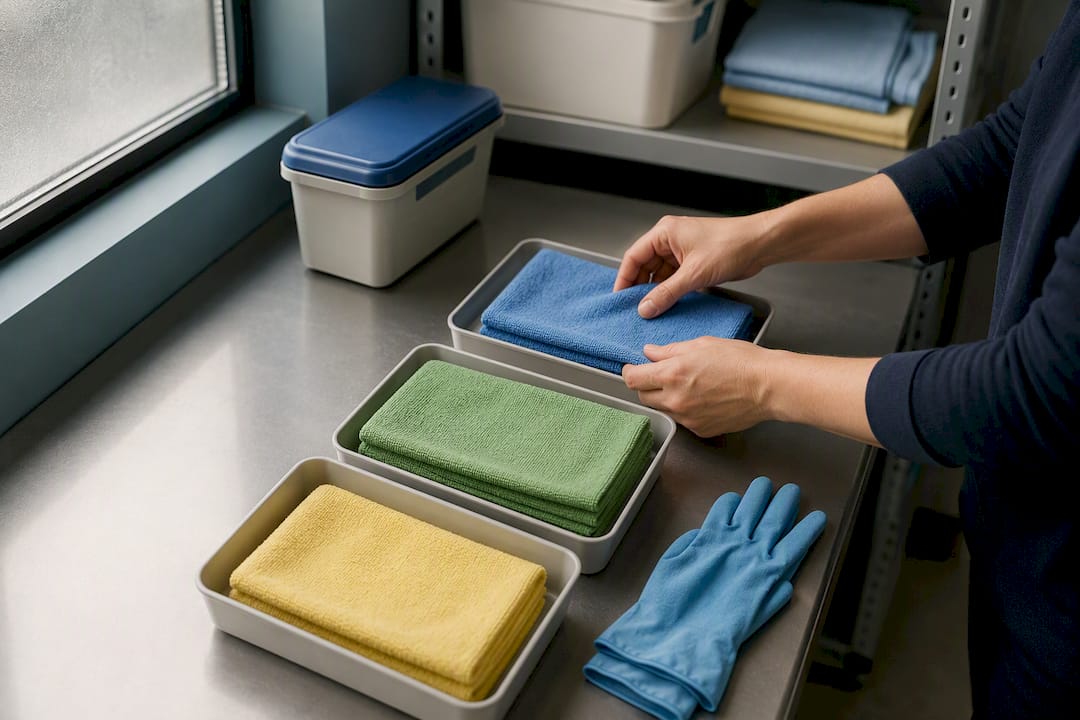
Pro Tip: Color-code your cloths and mop heads by zone, so a green cloth never leaves the breakroom and a red one never leaves the restroom.
Laminated checklist cards with contact times printed next to each product name solve most of these problems without adding training time.
How a cleaning service applies the clean-first rule in practice
A consistent dedicated team to a facility for every visit rather than rotating unfamiliar staff helps maintain cleaning program effectiveness when people know exactly which cloth belongs in which zone. That consistency is where the clean-first rule holds up over months, not just on the day someone writes the SOP.
Our teams document Safety Data Sheets, product contact times, and staff training as part of standard practice, not as an afterthought triggered by an inspection. Facility managers building out their own documentation can lean on our audit-ready office kitchen checklist and office cleaning supplies list as starting templates.
If your current scope of work doesn’t clearly separate routine cleaning from event-triggered disinfection, that’s usually the first thing worth fixing, whether you handle cleaning in-house or through a vendor.
— Steven
Setting up a clean-first cleaning program for your office
If you manage a Vancouver, WA or Portland, OR office and want a team that treats clean-first as standard practice rather than a special request, Octomaids builds that structure into our commercial cleaning service from the start.
Commercial cleaning teams may handle daily high-touch surfaces, deeper weekly tasks, and event-triggered disinfection when a sick employee has used a shared space, typically with trained crews each visit, using specialized exterior cleaning methods like dronevask næringsbygg to ensure efficiency without interrupting operations. What that looks like for your building:
- Office Cleaning for daily and recurring maintenance of desks, common areas, and high-touch surfaces.
- Commercial Cleaning for broader janitorial needs across multi-room or multi-floor facilities.
- One-Time Deep Cleaning for a reset after a contamination event or before a big client visit.
Visits typically include documentation of safety data sheets on file, adherence to contact times, and use of PPE per label guidelines. If you’d rather set up a recurring arrangement than call for one-off service, our recurring home cleaning and one-time deep cleaning pages outline how scheduling works. To see the full scope of what we handle for offices and other commercial spaces, visit our commercial cleaning services page and request a quote for your building.
Sources
- When and How to Clean and Disinfect a Facility | CDC
- Environmental services (cleaning) guidance | OSHA
- List N: Disinfectants for Coronavirus (COVID-19) | EPA
FAQ
What comes first, cleaning or disinfecting?
Cleaning always comes first. The CDC is explicit that removing dirt and organic material with soap and friction is required before a disinfectant can work effectively on a surface.
Is there a difference between cleaning and disinfecting?
Yes, cleaning physically removes dirt and many germs using soap and mechanical action, while disinfecting uses an EPA-registered chemical to kill most of what remains after cleaning. Cleaning alone is enough for most routine office situations, according to the CDC, while disinfecting is reserved for higher-risk moments like known illness or heavily shared surfaces.
What are the three types of disinfection?
Definitions vary by industry, but disinfection is commonly grouped by strength: low-level (used for routine environmental surfaces), intermediate-level, and high-level (used mainly in healthcare settings for equipment). Offices typically only need low-level disinfection on high-touch surfaces, guided by the product label.
What are the CDC guidelines for cleaning and disinfecting?
The CDC’s guidance states that cleaning must always precede disinfection, that cleaning alone is sufficient for most routine situations, and that disinfection should be targeted at high-touch surfaces, known illness, or outbreak conditions rather than applied as a blanket practice. It also stresses following product label instructions for contact time.
Do offices need to disinfect every day?
Not necessarily. Daily attention to high-touch surfaces like door handles and keyboards is recommended, but full disinfection is typically reserved for event-triggered situations rather than a daily default across the whole office.
Recommended
- Shared Workspace Sanitation Best Practices Managers Can Use Today
- Facility Managers: Janitorial vs Commercial Cleaning, 6 Questions
- Why Shared Desks Require Regular Disinfection
- 6 Steps to an Audit Ready Office Cleaning Checklist for Managers
About Octomaids
Octomaids is a locally operated professional cleaning company serving Vancouver, Clark County, and the surrounding Portland metro area. Since 2006, our cleaning teams have helped homeowners, renters, property managers, and businesses with recurring cleaning, deep cleaning, move-in/move-out cleaning, and commercial cleaning.
Our cleaning articles are reviewed to ensure the information reflects our real-world experience and professional cleaning practices.