


A good office cleaning inspection checklist does three things: it walks one fixed route through every zone, it judges each item against a standard you can see, and it records the result so next month’s walk can be compared with this month’s. Below you will find the checklist by zone, a simple scoring method, the safety items to include, and what to do when something is missed.
We clean offices across Vancouver, WA and the Portland metro area, so we sit on both sides of inspections: we are inspected, and we help managers build the forms. What follows is how we would set one up for your building.
TL;DR
- Inspect by zone (entrance, reception, work areas, kitchen, restrooms, meeting rooms, storage, waste points) using the same route every time.
- Write each item as an observable standard, such as “no visible residue on the counter,” not “clean.”
- Score on a simple 0-1-2 scale, and track repeat problems in the same spot, because those point to a cause rather than a slip.
- Separate cleaning defects from maintenance problems and access problems before you assign anything.
- Fix every failed item with a named owner, a deadline and a follow-up check.
Table of Contents
- What an office cleaning inspection actually measures
- Build each line with five fields
- The checklist, zone by zone
- Daily, weekly and periodic tasks to inspect
- How to carry out the walk
- Score it so you can compare
- Add the safety items
- Sort findings before you assign them
- What to do when something fails
- How often to inspect and who should do it
- Let us take the inspection worry off your list
- FAQ
- Sources
What an office cleaning inspection actually measures
An inspection answers one question: is the work being done to the standard we agreed on? It is different from a cleaning checklist, which tells the crew what to do. The crew’s list says “wipe the counters.” The inspector’s list says “counters are free of crumbs, streaks and sticky spots when checked by hand.”
That difference matters because “clean” is a feeling. Two people can walk the same break room and disagree. When each line has a visible or touchable test, the disagreement disappears and the conversation with your cleaning team becomes about facts. If you also need the crew-side task list, our audit-ready office cleaning checklist covers that half.
One note on terms. “Janitorial inspection,” “cleaning audit” and “quality walk” describe the same activity at different levels of formality. A walk takes 20 to 30 minutes with a clipboard or phone. An audit adds scoring, a written record and a review meeting. The checklist below works for either.
Build each line with five fields
A checklist that only lists areas gets filled in with opinions. A row that carries five fields gets filled in with evidence:
- Where: the zone, such as “second-floor restroom.”
- What: the specific task, such as “toilets and urinals disinfected.”
- When: the expected frequency, such as daily.
- Complete: the acceptance standard, such as “no visible residue, no odor, dispenser stocked.”
- Verified: who confirms it and how, such as “manager, visual check at 8 a.m.”
The “Complete” column does most of the work. If you cannot describe what passing looks like, the item is not ready to be inspected. Try describing it to someone who has never seen your office. “Floors look good” fails. “No debris along the baseboards, no dull wet patches, no visible footprints at the entrance mat” passes.
The checklist, zone by zone
Walk the zones in the same order every time. Start at the front door, because that is where visitors form their opinion, and finish at the waste and storage points, where problems hide. The table gives a working starting point. Adjust the standards to your own scope of work.
| Zone | What to check | Passing standard |
|---|---|---|
| Entrance and lobby | Glass doors, mats, floors, handles | No smudges on glass, mats vacuumed, no tracked-in debris |
| Reception | Desk, seating, magazines or sign-in items, high-touch points | Surfaces dust-free and wiped, no clutter from cleaning, pens and screens wiped |
| Open work areas | Desktops (cleared surfaces), floors, trash bins, shared equipment | Bins emptied and relined, floors free of crumbs and spills, shared printers wiped |
| Private offices | Horizontal surfaces, floors, bins | Dust-free ledges, no missed corners |
| Meeting rooms | Tables, chairs, whiteboards, door handles, floors | Tables wiped, whiteboard trays clear, no leftover food or cups |
| Kitchen and break room | Counters, sink, appliance exteriors, microwave interior, floors, bins | No residue or odor, sink free of buildup, bins emptied |
| Restrooms | Toilets, urinals, sinks, mirrors, floors, dispensers, bins | No visible residue, no odor, dispensers stocked, floors dry and clean |
| Hallways and stairs | Floors, handrails, corners, light switches | Handrails wiped, no debris in corners, no slip hazards |
| Storage and waste points | Dumpster area, recycling, supply closet | Waste contained, no overflow, supplies orderly |
For the two zones that generate the most complaints, we keep deeper guides. Use our office restroom cleaning standards when you write the restroom rows, and our audit-ready office kitchen checklist for the break room.
Look where the crew does not usually look
A surface that everyone sees tends to get cleaned. A surface that nobody sees tells you more. Add a short “hidden spots” block to your route:
- Corners and edges where floor meets wall.
- Behind doors and along baseboards.
- Undersides of desk edges and the tops of door frames.
- Vent covers and the tops of cabinets.
- Under the microwave and behind the bin in the break room.
If the hidden spots are tidy, the visible ones are almost always fine. If the visible ones pass and the hidden ones do not, you are looking at a surface-level clean.
Let traffic set the frequency
The lobby and the restroom do not need the same attention as a quiet conference room used twice a week. The busiest route may need a different cleaning frequency from a quiet room, so mark a few “critical zones” on your form (entrance, restrooms, kitchen) and inspect those more often than the rest. A rotation works well: critical zones weekly, everything else on a published schedule so each area is checked at least once a month.
Daily, weekly and periodic tasks to inspect
Your inspection should match what the cleaning scope promises. A typical commercial scope splits work like this, and your form should only check items that are due:
- Daily: restroom cleaning and restocking, trash removal, wiping of high-touch points, spot mopping and vacuuming of traffic areas, break room counters.
- Weekly: detail dusting, baseboards, entry glass, full mopping, interior glass and partitions.
- Monthly: carpet spot treatment, hard-floor scrubbing, vent and high-surface dusting.
- Quarterly or less often: floor stripping and waxing, deep carpet cleaning, tile and grout.
Inspecting a quarterly item in week two is how managers end up with unfair findings. Print the due date next to each row, or keep a separate periodic tab. If you do not yet have a written schedule to inspect against, start with how to create an office cleaning schedule that works. For the heavier periodic work, see our office deep cleaning checklist.
How to carry out the walk
Consistency beats thoroughness. The same route, the same criteria and ideally the same inspector make month-to-month results comparable rather than a pile of subjective impressions. Here is the sequence we recommend:
- Pick a time. Inspect shortly after the crew finishes, or before the workday starts, when the evidence is fresh and the office is quiet.
- Carry the form. Paper, tablet or spreadsheet all work. What matters is that you record as you walk, not afterward.
- Follow the fixed route. Entrance first, waste points last.
- Use your hands and nose. Run a finger along a ledge. Check the dispenser. Smell the restroom and the kitchen bin area.
- Record what you saw. Note the time, location and what you observed, plus any context, such as a locked room or a recent event that explains a mess.
- Use photos selectively. A photo of a failed item speeds up a corrective conversation. A photo of every passing line creates an archive nobody reads.
- Sign and share the result with the cleaning team within a day.
Score it so you can compare
A yes/no tick box hides the difference between “barely acceptable” and “excellent.” A three-point scale is enough for routine walks and fast to fill in:
| Score | Meaning |
|---|---|
| 0 | Failed: does not meet the written standard |
| 1 | Acceptable: meets the standard |
| 2 | Exceeds standard: nothing to add |
Define each rating on the form itself and use the scale the same way every time. Then average the score per zone. Two readings come out of it:
- One low item is usually an isolated miss. Note it, request a fix, move on.
- A zone average that stays low across several inspections signals something structural: the wrong equipment, too little training, too little time allotted, or a scope that does not match the space.
Also track repeat defects: the same issue, in the same place, again. If the baseboards in the east hallway fail three months in a row, retraining one person will not fix it. The task probably is not in the scope, or the crew lacks the tool to reach it. A score, a record and a trend turn “is the cleaning good enough?” into something you can discuss calmly with your provider.
Add the safety items
Cleanliness and safety overlap, and an inspector is already on their feet. In the United States, OSHA’s walking-working surfaces standard, 29 CFR 1910.22, requires employers to keep places of employment, passageways, storerooms and service rooms clean, orderly and sanitary. It also requires walking-working surfaces to be inspected regularly and as necessary, and hazardous conditions to be corrected before employees use the surface again, or guarded if they cannot be fixed immediately. Check the standard directly for the exact wording that applies to your workplace.
In practice, add these rows to your form:
- Floors dry, with wet-floor signs in place after mopping, and spills handled immediately.
- Mats and runners lying flat, with no curled edges.
- Hallways, stairs and exits free of boxes, cords and cleaning equipment.
- Fire extinguishers visible and reachable, and electrical panels clear enough to open.
- Cleaning chemicals stored in the supply closet, not in shared areas.
Singapore’s workplace housekeeping guidelines make the same point about keeping evacuation routes clear, fire extinguishers accessible and electrical panels openable, and it is a sensible habit anywhere, as the Workplace Safety and Health Council guidance shows. Treat that as a good-practice reference, not a U.S. requirement.
Slip hazards deserve their own line. We explain how cleaning methods affect floor grip in what grip-hazard cleaning prevention means. For anything involving a specific injury, medical condition or chemical exposure, check with your safety officer or the safety data sheet for the product in use.
Sort findings before you assign them
Not every failed row is a cleaning failure. Before you send a list to your cleaning team, sort each finding into one of three buckets:
- Cleaning defect: the task was in scope and was not done well. The cleaning team corrects it.
- Maintenance defect: a cracked tile, a leaking tap, a stained ceiling panel. A facility manager or tradesperson corrects it, and cleaning cannot.
- Access or frequency gap: a locked room, a closed door during the shift, or a task that is not on the schedule at all. The fix is an operational change, such as a key, a time window or an updated scope.
This sorting protects your relationship with the crew. An area that is dirty because nobody could enter it needs a different answer than one missed through poor work. It also protects you: a scope that never included vent dusting cannot be “failed” for dusty vents. If you are unsure how the scope should be divided, our comparison of janitorial and office cleaning shows where coverage gaps usually appear.
What to do when something fails
A failed inspection is information, not an accusation. A calm five-step process works well:
- Acknowledge it right away. Tell the cleaning team what you found, the same day.
- Look for the cause. Ask about staffing, instructions, equipment and time before assuming someone was careless.
- Write a corrective action plan with the specific deficiency (a photo helps), a named owner and a deadline.
- Verify on site. Re-inspect that item, not the whole building.
- Close it. Mark the action complete, with the date and the verifier’s initials.
If the same item reopens, escalate to a scope or training conversation instead of repeating step 1. That is where the repeat-defect log pays off.
How often to inspect and who should do it
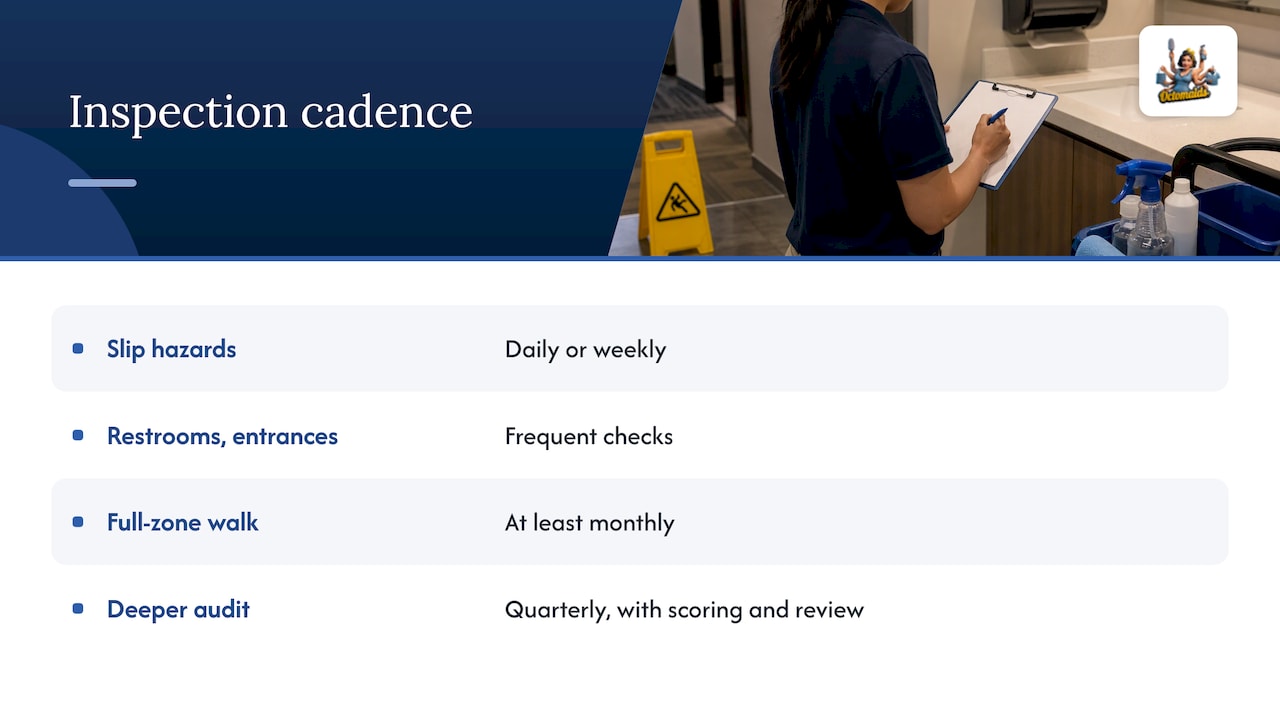
Set frequency by risk. Slip-and-fall walkthroughs may be daily or weekly, restrooms and entrances deserve frequent checks, and a full walk through every zone at least monthly is a sound baseline. Add a deeper quarterly audit with scoring and a review meeting.
As for who: the best inspector is someone who is not the person doing the cleaning and who will use the form the same way each time. That may be an office manager, a facilities lead or a property manager. If rotation is unavoidable, hold a short calibration walk together so two people score a restroom the same way. A shared walk with your cleaning lead, once a quarter, also builds trust, because you both look at the same evidence.
Our perspective
Most inspection forms fail for a simple reason: they are written to catch people, not to improve the result. We prefer the opposite approach. The first step is agreeing on the standard in writing, and the second is keeping the same team in your building, because a crew that knows your space learns which corner collects dust and which door sticks.
That is why we assign the same dedicated team to each client rather than sending whoever is available. When the people stay the same, a finding from an inspection becomes a lesson that sticks, not a note that gets lost with the next rotation. Our staff are background-checked, trained and insured, and our work is backed by a satisfaction guarantee, so a failed line on your form gets corrected, not argued over.
We would also encourage you to share your form with your cleaning provider before you use it. A provider who sees the standard in advance can meet it. One who sees it for the first time in a complaint cannot. We have been serving Vancouver and Portland offices since 2006, and the managers who get the best results are the ones who treat inspection as a conversation.
Steven
Let us take the inspection worry off your list
If you would rather not chase standards across zones, we can build the scope and the checklist with you. Octomaids provides commercial and office cleaning for businesses in Clark County, WA and the Portland metro area, including janitorial services and post-construction cleaning, delivered by the same dedicated, background-checked team on each visit.
Tell us about your space and how you plan to inspect it, and we will match the scope to your standards. You can see the full list of commercial offerings on our services page or start from octomaids.com.
FAQ
What is the difference between an office cleaning checklist and an inspection checklist?
A cleaning checklist tells the crew what to do. An inspection checklist tells the reviewer how to judge whether it was done well. The inspection version adds acceptance standards, a score and a place to record who verified the result and when.
How often should we inspect our office cleaning?
Base it on risk. Check restrooms, entrances and the kitchen most often, and walk every other zone at least monthly on a published rotation. Add a scored, more formal audit each quarter, and use the OSHA standard on walking-working surfaces as the reference for floor and passageway safety.
Who should carry out the inspection?
Choose someone independent from the cleaning team who will apply the same route and criteria each time, such as an office manager or facilities lead. If more than one person inspects, do a calibration walk together so scores match. Ideally, review the results with your cleaning lead afterward.
What score means the cleaning is acceptable?
On a 0-1-2 scale, a rating of 1 means the item meets the written standard, so an average near 1 across a zone is acceptable. A zone that stays below that across several inspections points to a structural cause, such as equipment, training or scope, and deserves a formal review.
Do we need photos for every inspection item?
No. Photograph failures, since they make corrective conversations quicker and clearer. Skip photos for routine passing items, because a huge archive adds work without adding insight.
Sources
- OSHA 29 CFR 1910.22, General requirements for walking-working surfaces
- Workplace Safety and Health Guidelines on workplace housekeeping, Singapore
Recommended
- Office Cleaning Supplies Managers Need: Zone Par Levels & EPA Signals
- Office Deep Cleaning Checklist: Area-by-Area Guide
- 6 Steps to an Audit Ready Office Cleaning Checklist for Managers
- How to Create an Office Cleaning Schedule That Works
About Octomaids
Octomaids is a locally operated professional cleaning company serving Vancouver, Clark County, and the surrounding Portland metro area. Since 2006, our cleaning teams have helped homeowners, renters, property managers, and businesses with recurring cleaning, deep cleaning, move-in/move-out cleaning, and commercial cleaning.
Our cleaning articles are reviewed to ensure the information reflects our real-world experience and professional cleaning practices.