
Grip-hazard cleaning prevention means removing the contaminants and buildup that rob a walking surface of its traction, using methods that don’t leave behind film, residue, or standing moisture that could make the problem worse. In practice, it comes down to three moves you can start today: spot-clean spills the moment you see them instead of waiting for a scheduled mop, block off any section you’re actively cleaning so nobody walks across a wet or freshly treated surface, and stick to mild, correctly diluted cleaners rather than reaching for whatever is under the sink.
Those three habits align with what regulators and manufacturers already tell us works. The UK’s HSE has documented that cleaning itself can either fix a slip hazard or create one, depending on execution. Coefficient-of-friction (COF) testing gives facilities teams a measurable target instead of a guess. And commercial flooring makers like Altro and Amtico publish exact dilution ratios for a reason: guesswork is how good floors turn slippery.
If your team handles this in-house, the checklist below gets you moving immediately:
- Spot-clean, don’t flood. Treat the contaminated footprint, not the whole room.
- Cordon off wet zones. A cone and a sign cost nothing and prevent a fall.
- Match the cleaner to the surface. Mild detergent for daily grime, manufacturer-specified products for grease or heavy soiling.
Teams that would rather hand this off to trained professionals can look at how Octomaids structures recurring cleaning to keep high-traffic surfaces safe between deep cleans.
Key Takeaways
Grip-hazard cleaning prevention works because it treats floor contamination as a measurable, controllable risk rather than a cosmetic issue, using manufacturer-aligned methods that remove residue without leaving surfaces wet.
| Point | Details |
|---|---|
| Definition in one line | Removing contaminants that reduce traction using methods that avoid film, residue, or standing moisture. |
| Spot-clean over flooding | Treat the contaminated footprint first; broad wet-mopping raises slip risk on smooth surfaces. |
| Match cleaner to material | Follow Altro, Amtico, or Jessup technical sheets rather than a generic all-purpose product. |
| Control access during cleaning | Signage, barriers, and section-by-section cleaning keep a dry path open at all times. |
| Call in professional help for high-risk zones | Octomaids offers trained teams for grease-heavy or high-traffic surfaces that need manufacturer-aligned cleaning. |
Table of Contents
- What Grip-Hazard Cleaning Prevention Means for Safety and Operations
- What Contaminants Create the Most Grip Hazards?
- What Cleaning Principles Protect Traction on Grip Surfaces?
- How Do You Clean Abrasive Safety-Grip Tape Without Ruining It?
- How Should You Clean Clear Grip Sheets and Safety Vinyl Flooring?
- What Safety Precautions Should You Take While Cleaning?
- How Often Should You Inspect and Maintain Grip Surfaces?
- What Tools and Supplies Do You Need for Grip-Hazard Prevention?
- A Cleaner’s Perspective on Grip-Hazard Priorities
- How Octomaids Handles Grip-Hazard Cleaning for You
- Sources
- FAQ
What Grip-Hazard Cleaning Prevention Means for Safety and Operations
A dirty floor isn’t just unattractive. It’s a liability sitting in plain sight, and the numbers back that up.
Slips and falls account for a substantial share of workplace injury claims, and industry reporting on workers’ compensation trends points to slip-resistant footwear programs cutting fall rates roughly in half when paired with proactive housekeeping. That’s not a coincidence. Traction depends on a measurable relationship between a shoe sole and a surface, and any film of oil, water, or polish residue changes that relationship instantly.
Statistic Callout: Workers’ compensation data cited by CMM Online shows slips and falls remain one of the largest single categories of workplace injury claims, and slip-resistant footwear programs have been shown to cut incident rates by roughly half when combined with routine cleaning discipline.
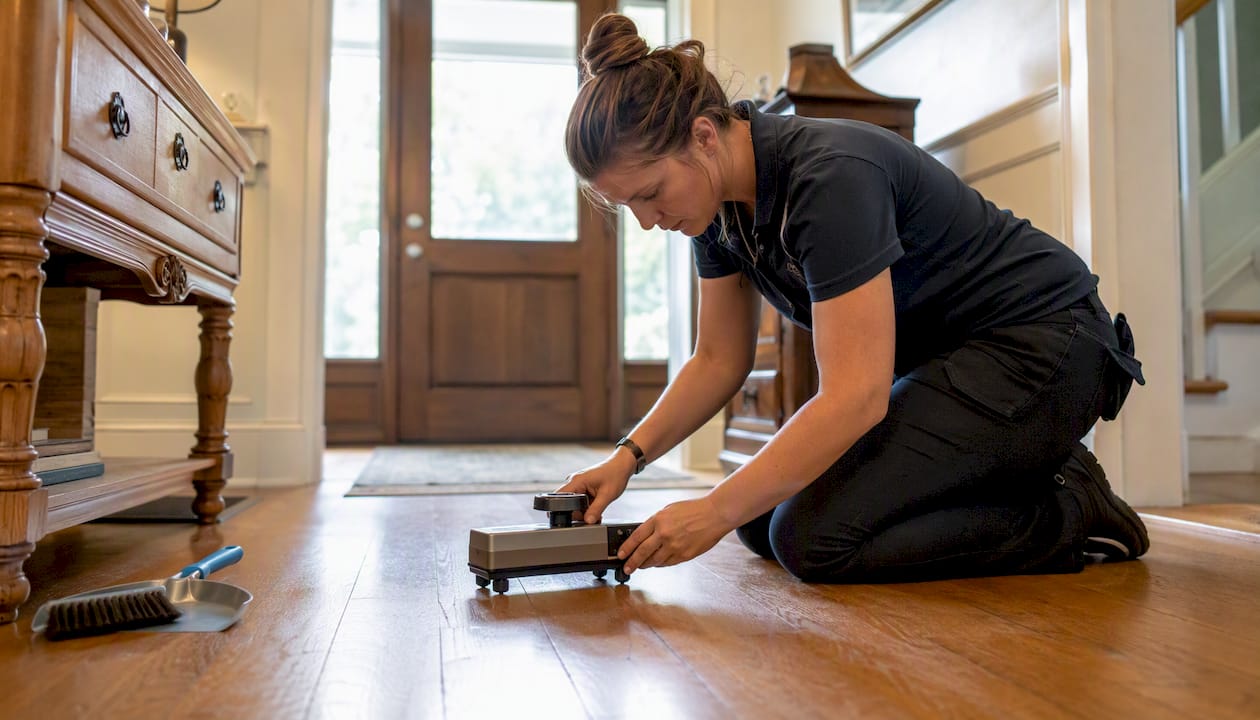
Coefficient of friction is the technical measure behind all of this. It’s a ratio describing how much resistance exists between a shoe and a floor before slipping starts. A higher COF means more grip; a lower one means less warning before someone’s foot slides out from under them. Contamination lowers COF fast, sometimes dropping a “safe” surface into hazardous territory within minutes of a spill.
| Factor | Figure | What It Means for You |
|---|---|---|
| Slip and fall injury share | A major category of workplace injury claims | Floor contamination is a top-tier risk, not a minor housekeeping issue |
| Amtico deep-clean interval | Periodic cleaning as recommended by manufacturer | High-traffic zones typically require more frequent deep cleaning |
| Cleaning method risk | Wet-mopping can leave a thin residual film | Spot cleaning is often safer than broad mopping on smooth floors |
The UK Slip Resistance Group frames a cleaning program as a genuine control measure, not an afterthought tacked onto a maintenance budget. Treat it that way and the injury math changes in your favor.
What Contaminants Create the Most Grip Hazards?
Not every mess behaves the same way on a floor. Some contaminants fill the texture of a grippy surface and get trapped there; others coat it in a slick film that sits on top and spreads with every footstep. Knowing which one you’re dealing with changes how you clean it.
- Dust and dry debris: Tracked-in grit from entryways fills grip texture and can actually reduce traction by smoothing over the surface pattern.
- Water: Rainwater, mop residue, or condensation is the most common film-forming hazard, especially on smooth vinyl or tile.
- Oils and grease: Kitchen spills, loading dock drips, and maintenance overspray create a persistent slick film that ordinary detergent often won’t fully lift.
- Silicone and polish residues: Furniture polish or silicone-based sprays used nearby can drift onto safety flooring and leave a nearly invisible slippery coating.
- Food and organic matter: Spills in break rooms or kitchens combine moisture with sugars or fats, compounding the traction loss.
- Rubber scuff marks: Cart wheels and shoe soles leave marks that harden over time and can mask the texture beneath them.
The film-formers—water, oil, and silicone—are the ones that demand immediate attention. Dust and scuff marks are annoying but rarely dangerous until they build up over weeks of neglect.
What Cleaning Principles Protect Traction on Grip Surfaces?
Three rules cover most of what goes wrong: never leave a surface wet after cleaning, avoid cleaners that leave residue behind, and always follow the manufacturer’s dilution instructions instead of eyeballing it.
Every other guideline is really a variation on those three. Mopping with too much water, using a heavy-duty degreaser at full strength, or reaching for a general-purpose cleaner with silicone in the formula. All of these violate one of the three core rules, and all of them show up repeatedly in HSE’s slip investigation findings
Cleaners and Practices That Help:
- Mild, pH-neutral detergents diluted per label instructions
- Manufacturer-specified cleaners such as AltroClean 44 for moderate soiling
- Microfiber tools that lift contaminant rather than pushing it around
Cleaners and Practices to Avoid:
- Pine oil based cleaners, which can leave a waxy film
- Heavy all-purpose soaps that build up residue over repeated use
- Silicone-based polishes or sprays anywhere near grip surfaces
- Phenolic disinfectants that aren’t rated for the specific flooring type
Pro Tip: “Clean” and “wet” are not the same thing. A floor that looks spotless but is still damp can be more dangerous than a floor with a small amount of dry dust on it. Prioritize removing the contaminant fully, then drying the surface completely, over simply running more water across it.
How Do You Clean Abrasive Safety-Grip Tape Without Ruining It?
The right method for abrasive, grit-coated surfaces is dry-cleaning first, then a light brush pass, then a spot-wash with a diluted mild cleaner, followed by a full rinse and complete drying. Skipping straight to a wet mop packs debris deeper into the grit and can leave a residue that defeats the whole purpose of the surface.
- Sweep or vacuum loose debris using a vacuum with a brush attachment rather than a standard floor nozzle.
- Brush the surface with a stiff nylon brush, working in the direction of the grit pattern to dislodge embedded dirt.
- Apply a mild detergent solution at the dilution rate specified on the product label, working in small sections.
- Rinse thoroughly and squeegee off excess liquid so nothing pools in the grit.
- Allow the surface to air-dry completely before reopening it to foot traffic.
- Inspect the tape for smooth patches or bare spots once dry.
Manufacturer guidance for grip products, including Heskins’ cleaning notes, specifically warns against harsh chemicals and heavy mechanical scrubbing that can wear down the grit prematurely.
Tools worth keeping on hand: a shop vacuum with brush head, a stiff nylon (not wire) brush, clean microfiber towels, a labeled mild detergent bottle, and a squeegee.
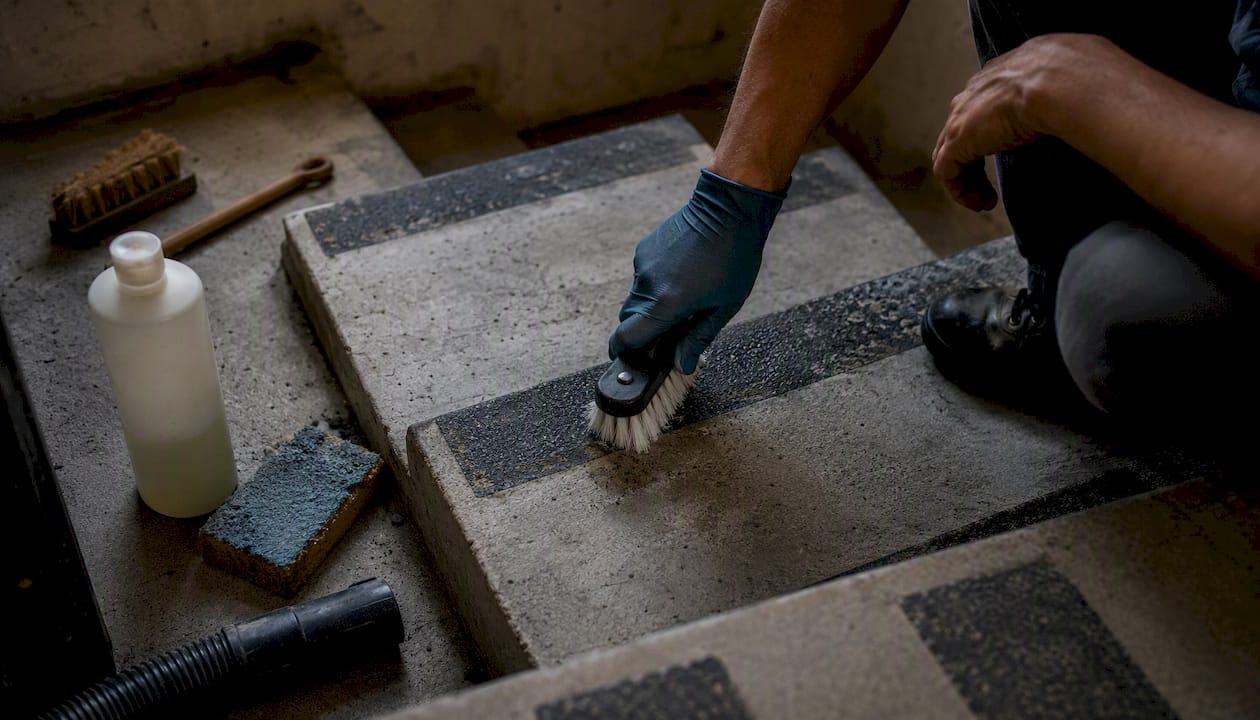
When to replace, not clean: if you see smooth, shiny patches where grit used to be, if the tape edges are lifting or curling, or if brushing no longer restores visible texture, it’s time to replace the tape rather than keep cleaning around the problem.
How Should You Clean Clear Grip Sheets and Safety Vinyl Flooring?
For clear or perforated grip sheets and safety LVT, the safest approach is a manufacturer-recommended cleaner at the correct dilution, spot treatment for grease, and no flooding unless the specific product is designed and cured for wet cleaning. This is where guesswork causes the most expensive mistakes, because these surfaces often look like ordinary flooring but behave very differently underneath.
- Vacuum loose debris first, using a brush attachment to avoid scratching.
- For perforated sheets, use gentle airflow or a soft brush to clear debris trapped in the holes rather than forcing water through them.
- Apply a diluted cleaner and blot, rather than scrub aggressively, to avoid pushing contaminant deeper into the texture.
- Rinse per the product’s technical sheet and allow full drying before reopening the area.
Jessup’s guidance on clear grip tape highlights that perforations are engineered to let air and moisture escape, so aggressive wet cleaning can trap water underneath and cause bubbling. Altro’s cleaning guide recommends AltroClean 44 for moderate soiling and AltroClean 44+ for heavier oil and grease, while Amtico’s maintenance guidelines call for immediate spot-wiping of spills paired with periodic deep cleaning.
Pro Tip: When a technical sheet isn’t handy, treat any clear or perforated grip product as if flooding is off the table by default. It’s much easier to add a second cleaning pass than to undo water damage trapped beneath a sealed surface.
What Safety Precautions Should You Take While Cleaning?
Controlling pedestrian access comes before anything else. Clean in sections, keep at least one dry path open at all times, and never leave a wet zone unmarked, even for two minutes.
- Set up visible signage at every entry point to the cleaning zone.
- Use physical barriers, not just a sign, in high-traffic corridors.
- Schedule cleaning during quiet periods when foot traffic is lowest.
- Avoid trailing cords and hoses across walkways; battery-powered equipment reduces trip hazards.
- Wear appropriate PPE, including slip-resistant footwear, especially when working on a wet section yourself.
HSE’s guidance is direct on this point: smooth floors must be left completely dry before anyone walks on them again, and cleaning in sections rather than all at once is what makes that possible without shutting down an entire space.
Pro Tip: Spot-cleaning beats full-area wet cleaning almost every time it’s an option. It covers less surface area, dries faster, and gives you a much smaller window of risk than mopping an entire floor at once.
How Often Should You Inspect and Maintain Grip Surfaces?
High-traffic zones need a visual check daily; everything else can run on a weekly inspection with a deeper clean on a set interval tied to the manufacturer’s recommendation for that specific product.
Look for these warning signs during every inspection:
- Visible wear patterns or smooth, shiny patches
- Dislodged or missing grit on abrasive surfaces
- Persistent oil or grease staining that doesn’t lift with routine cleaning
- Lifted or curling edges on tape or sheet products
| Surface Type | Recommended Deep-Clean Interval | Note |
|---|---|---|
| Amtico safety flooring | Every 6 to 12 months | Shorter interval for higher-traffic areas |
| Abrasive grip tape | Per manufacturer technical sheet | Inspect grit condition at each cleaning |
| General safety flooring | Routine per UKSRG guidance | Adjust for contamination type and traffic volume |
The UKSRG’s cleaning paper makes the case plainly: a scheduled program is a genuine cost-effective control measure, not a box to check once a year. Translating a manufacturer’s 6 to 12 month deep-clean recommendation into an actual site calendar, tied to your specific traffic patterns, is what keeps a good floor from becoming a liability.
What Tools and Supplies Do You Need for Grip-Hazard Prevention?
Three items solve most day-to-day situations before they become incidents: absorbent pads for immediate spill response, a labeled mild-cleaner dilution bottle, and a stiff brush paired with clean towels.
Keep this short list stocked and visible in the cleaning closet:
- Absorbent pads or rolls for immediate spill control
- Pre-diluted mild detergent in a clearly labeled spray bottle
- Stiff nylon brush for texture and grit surfaces
- Clean microfiber towels, kept separate from general-use rags
- A squeegee for rinse-and-remove steps
- Wet floor signs and portable barriers
Rinse and dry brushes and pads after every use rather than letting them sit damp, and keep them separated by task. A brush used on an oily loading dock shouldn’t touch a food-service floor the next day, since cross-contamination undoes the work you just did.
A Cleaner’s Perspective on Grip-Hazard Priorities
When I walk into a space with a reported traction problem, the first thing I do isn’t clean, it’s figure out what’s actually on the floor and how it got there. Grease from a kitchen exhaust behaves nothing like tracked-in rainwater, and treating them the same way wastes time and sometimes makes the surface worse. That diagnostic step, five minutes of looking and touching before any product touches the floor, prevents more repeat calls than any cleaner on the shelf.
Training matters more than most facilities budgets reflect. A team that understands why dilution ratios exist, not just what number to measure, catches problems before they become incidents. We keep records of what was cleaned, when, and with what product on every visit, partly for accountability and partly because that history tells you when a surface is degrading faster than it should. For routine upkeep, a trained in-house team or a scheduled service handles things fine. For a genuinely high-risk area, a commercial kitchen floor with heavy grease exposure, a lobby with constant weather tracking, bringing in specialized help for the harder jobs is worth the call before an incident forces the issue.
How Octomaids Handles Grip-Hazard Cleaning for You
Octomaids gives facilities and property teams in the Vancouver, WA and Portland, OR area a trained crew that already knows the difference between a mild detergent pass and a job that needs manufacturer-specific treatment, so you’re not troubleshooting dilution ratios on your own schedule.
Booking a visit typically looks like this:
- An initial inspection to identify contaminant type and surface condition before any product is applied
- Cleaning aligned with manufacturer guidance for the specific flooring or grip surface involved
- Follow-up notes on what was found and what to watch for before the next visit
- Recurring scheduling options so high-traffic zones get consistent attention instead of reactive cleanups
If your team is stretched thin managing a busy building, kitchen, or rental turnover schedule, handing off the higher-risk cleaning tasks is often more cost-effective than absorbing an injury claim later. Check out Octomaids’ cleaning services to see what a scheduled visit looks like for your space.
Sources
- Cleaning guide for safety and slip-resistant flooring (Altro)
- Amtico safety flooring maintenance guidelines
- Watch Your Step campaign: Slips and trips: the importance of floor cleaning
- Reducing slips – The importance of effective cleaning and maintenance of floors
- Get a grip on slips and falls
Always check the specific technical sheet for your product before applying a cleaner outside what’s listed here. Manufacturer documents carry final authority on dilution rates and warranty conditions.
FAQ
What Are the Hazards Associated With Cleaning Grip Surfaces?
Cleaning can introduce new slip risk if it leaves a wet or film-coated surface, so the main hazards come from over-wetting, using the wrong chemical, or leaving a section open to foot traffic before it’s fully dry.
What Can You Clean Grip Tape With?
A mild detergent solution diluted per the manufacturer’s instructions, applied with a stiff nylon brush and followed by a full rinse and dry, works for most abrasive grip tape without damaging the grit.
What Safety Precautions Should You Take While Cleaning?
Block off the area with signage and barriers, clean in sections to keep a dry path open, avoid trailing cords, and never leave a smooth or freshly cleaned floor open to traffic until it’s completely dry.
How Do You Clean Grip Tape Without Grip Gum?
Sweep or vacuum loose debris first, then use a stiff brush with a diluted mild detergent to lift embedded dirt, rinse thoroughly, and let the surface air-dry completely before use.
When Should You Call a Professional Instead of Cleaning In-House?
High-grease environments, large commercial areas, or surfaces showing wear despite routine cleaning are good candidates for professional service; Octomaids handles these higher-risk cleaning jobs for properties throughout the Vancouver and Portland area.

