


Bottom line: janitorial services are recurring maintenance contracts that keep a facility clean and ready every day, while office cleaning typically means periodic or specialty jobs like deep carpet extraction or post-construction cleanup. The main decision factor is frequency and scope: daily foot traffic and restroom use call for janitorial coverage, while occasional deep cleans fit an office cleaning job. We’ve outlined the vendor questions to ask below.
TL;DR:
- Janitorial services are a recurring daily or weekly maintenance tailored to foot traffic, restroom use, and supply restocking, with staffing varying by building size.
- Office cleaning involves specific, one-time specialty tasks such as deep carpet extraction or post-construction cleanup, scheduled around events or needs rather than daily routines.
- Pricing models differ, with janitorial work billed as monthly or per-visit contracts based on frequency, while office cleaning typically uses flat project quotes with clear boundaries.
- When selecting vendors, ask for proof of insurance, chemical safety compliance, references, and clarify whether services are bundled or separate to avoid scheduling gaps.
- Regular disinfection of high-touch surfaces should occur at least once daily, using EPA or CDC-approved products, with safety data sheets and staff training documentation required beforehand.
Table of Contents
- What janitorial services actually cover
- What office and commercial cleaning jobs include
- Janitorial vs office cleaning: key differences at a glance
- How to choose between janitorial and office cleaning
- Task checklists for janitorial and office cleaning RFPs
- Safety, training, and when to disinfect versus clean
- How we plan recurring janitorial and one-time office cleans
- Matching Octomaids to your janitorial or office cleaning needs
- FAQ
- Sources
What janitorial services actually cover
Janitorial services are recurring maintenance built around a facility’s daily rhythm: trash removal, restroom sanitation, floor care, and restocking supplies happen on a set schedule, often daily or several times a week. The goal is consistency. A building that hosts foot traffic every day needs a team that shows up every day, not a crew that appears once a quarter.
Staffing models vary by building size and hours. A single location might use a day porter for light upkeep during business hours, while larger facilities often add a night crew for deeper cleaning after occupants leave. Some providers assign a dedicated team that learns the building’s quirks, while others rotate staff across multiple sites.
Contracts typically spell out:
- Cleaning frequency (daily, weekly, or a mix depending on the area)
- Service level agreements covering response times and quality checks
- Supply management, including who stocks paper products and soap
- Backup staffing plans for sick days or turnover
Understanding these pieces before signing helps you compare bids on equal footing rather than guessing at what “janitorial service” includes.
What office and commercial cleaning jobs include
Office cleaning, sometimes called commercial cleaning, usually refers to transactional or specialty work scoped as a single project rather than an ongoing routine. Carpet extraction, window washing, upholstery cleaning, and post-construction cleanup fall into this category. These jobs solve a specific problem at a specific point in time instead of maintaining daily readiness.
Teams typically schedule this work around events: a lease turnover, a renovation, a seasonal deep clean, or preparation for an important client visit. Office managers, property managers, and facility directors are the usual requesters, often triggered by a calendar date rather than daily wear.
Deliverables for a scoped job are concrete and finite:
- A defined area or set of surfaces (all carpets on floor 3, all exterior windows)
- A completion timeline, often a single day or weekend
- A pass or fail outcome measured against a checklist, not an ongoing relationship
- No expectation of return visits unless a new job is scoped
Because the work is bounded, pricing is usually a flat quote per project rather than a recurring monthly rate.
Janitorial vs office cleaning: key differences at a glance
The clearest way to separate these two service types is to compare them across four practical dimensions.
- Frequency: Janitorial contracts run daily or weekly; office cleaning jobs happen once or a few times a year, like an annual carpet shampoo.
- Scope: Janitorial covers routine tasks (restrooms, trash, floors); office cleaning covers specialty tasks (deep extraction, window washing, construction debris removal).
- Pricing shape: Janitorial is billed as a recurring monthly or per-visit rate tied to a contract term; office cleaning is typically a flat project quote.
- Performance measurement: Janitorial quality is tracked through daily checklists and SLAs over time; office cleaning is measured against a single completion checklist at job’s end.
- Overlap cases: Many buildings use both. A janitorial team handles daily upkeep, then the same or a different vendor is scheduled quarterly for a deep clean the janitorial contract doesn’t cover.
Overlap is common and not a problem to avoid. A building with a solid janitorial contract still benefits from periodic deep cleaning, since daily maintenance isn’t designed to restore carpets or strip floor wax. The practical approach is to treat janitorial as your baseline and office cleaning as the periodic reset that keeps the baseline from slipping. When comparing vendors, ask whether they offer both under one roof or whether you’ll need to coordinate two separate contracts, since gaps between vendors are where scheduling problems tend to surface.
How to choose between janitorial and office cleaning
Start by assessing your traffic and risk level: a busy retail floor or medical office has different daily needs than a low-traffic back office used by five people. That assessment points you toward a cadence (daily, three times weekly, or monthly), which in turn determines whether you need a janitorial contract, a periodic office cleaning job, or both.
Once you know the cadence, vet vendors with direct questions:
- Can you provide proof of insurance and worker’s compensation coverage?
- Will you supply Safety Data Sheets and training records for cleaning chemicals used on-site?
- How do you handle staffing continuity if an employee leaves or calls in sick?
- Can you provide references from similar facilities?
- Is pricing flat-rate, hourly, or tied to square footage, and what tasks are included versus billed separately?
Watch for red flags like vague answers about insurance, no written scope of work, or reluctance to share references. Trust signals include documented training, consistent staffing, and a willingness to start with a trial period.
Pro Tip: Run a two-week pilot with daily checklist sign-offs, then do one inspection at the end to compare conditions against your baseline and gauge how responsive the vendor is to feedback.
Our six-question guide for facility managers walks through this comparison in more depth if you want a second framework to cross-check against.
Task checklists for janitorial and office cleaning RFPs
A clear checklist makes it easier to compare vendor bids line by line instead of guessing at what’s included.
- Janitorial daily and weekly tasks: empty trash, clean and restock restrooms, vacuum or mop floors, wipe high-touch surfaces, and refill supply dispensers.
- Office and specialty tasks: carpet extraction, interior and exterior window washing, upholstery cleaning, and post-construction debris and dust removal.
- High-touch surface frequency: clean doorknobs, keyboards, and elevator buttons at least once daily, a baseline recommended for community settings like offices by the CDC.
Paste these directly into a request for proposal and ask each vendor to confirm what’s included at their quoted price.
Safety, training, and when to disinfect versus clean
Chemical safety and public health guidance shape both the scope of work and the paperwork you should request from any vendor. Any contractor using cleaning chemicals on your property is subject to OSHA’s Hazard Communication Standard, which requires a written hazard communication program, accessible Safety Data Sheets, and documented employee training on chemical hazards.
- Ask vendors to provide SDS sheets and training records before the contract starts, not after a problem arises.
- Follow CDC guidance that cleaning high-touch surfaces at least once daily with soap or detergent is usually sufficient, with disinfecting reserved for illness exposure or high-traffic conditions.
- Favor products certified under a recognized indoor air quality service program when stocking supplies.
One sourced figure worth knowing: the EPA Safer Choice program lists nearly 2,000 certified products that meet health and environmental criteria, giving facility managers a straightforward procurement shortcut instead of researching every ingredient label themselves.
How we plan recurring janitorial and one-time office cleans
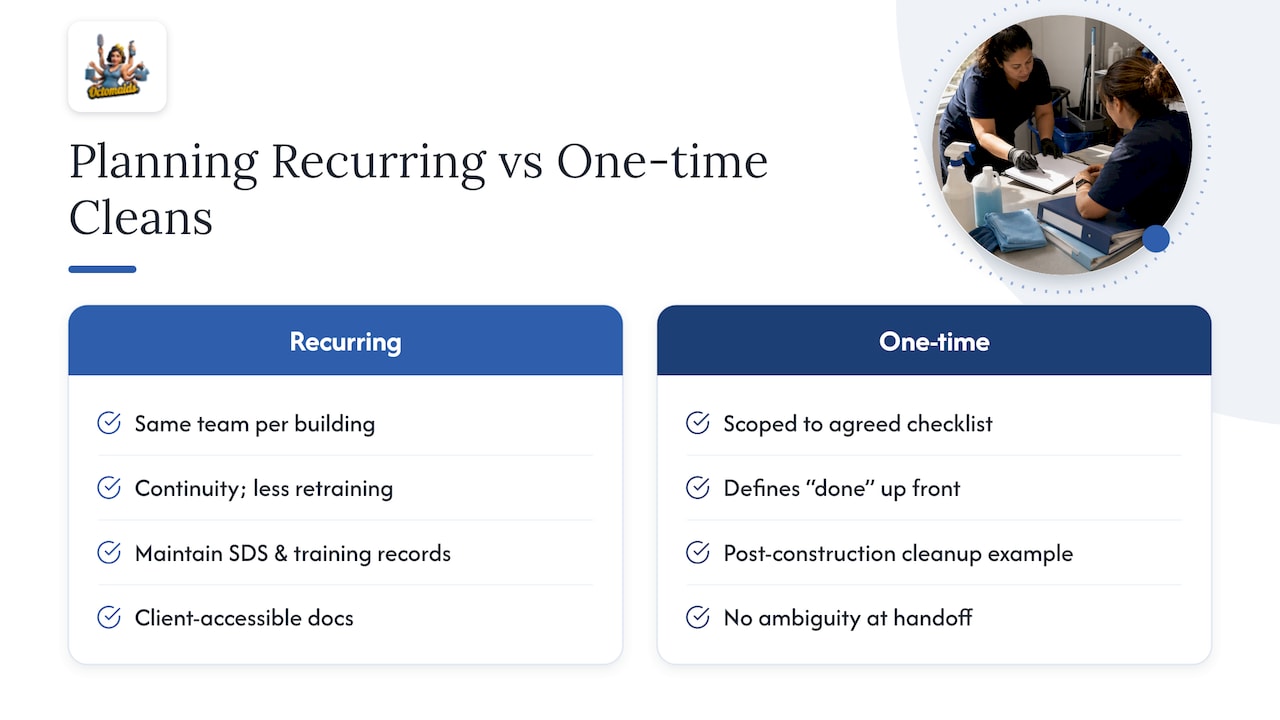
We have experience handling both recurring commercial contracts and one-time specialty jobs. For recurring work, we assign the same team to each building rather than rotating staff through, which helps maintain continuity and reduce retraining. We maintain Safety Data Sheets and track staff training so clients can request documentation as needed.
For one-time jobs like post-construction cleanup, we scope the work against a checklist agreed on upfront, so there’s no ambiguity about what “done” looks like when the crew leaves.
— Steven
Matching Octomaids to your janitorial or office cleaning needs
If daily upkeep is the priority, our recurring cleaning service assigns a consistent team on a schedule you set, so restrooms, floors, and trash are handled without you managing staffing gaps. If you need a one-time reset, like carpet restoration or a post-construction cleanup, our one-time deep cleaning service scopes the job against a checklist before work begins.
- On a first visit, we walk the space, confirm the scope against your checklist, and set expectations for timing.
- Requesting a quote takes a short conversation about square footage, frequency, and any specialty tasks you need covered.
- Our commercial and office cleaning page lists the full range of services if you’re still comparing options.
Reach out through our service page to get a quote scoped to your building.
FAQ
What is the importance of cleaning in a workplace?
Regular cleaning reduces germ transfer on high-touch surfaces and supports a healthier, more presentable workspace for employees and visitors. The CDC recommends cleaning high-touch surfaces at least once daily in community settings like offices as a baseline practice.
Are janitors and cleaners the same job?
The terms overlap significantly, and job duties often blend together depending on the employer. According to the Bureau of Labor Statistics, janitors and building cleaners handle a wide range of tasks including trash removal, floor care, and minor repairs, often on evening or night schedules.
What is the 20/10 rule for cleaning?
This is a time-management technique some people use for home cleaning, where you clean for 20 minutes and rest for 10, rather than a standard used in commercial or janitorial contracts. It isn’t a recognized benchmark in facility management or professional cleaning scopes of work.
How much should you tip for a $200 cleaning job?
Tipping for professional cleaning services is optional and varies by region and relationship with the provider, with no universal standard rate. Many clients who choose to tip offer an amount reflecting satisfaction with the job rather than a fixed percentage tied to the invoice total.
What’s the typical pay for janitorial staff?
Median annual pay for janitors and building cleaners was $35,930 as of May 2024, with a median hourly wage of $17.27.
Sources
- Janitors and building cleaners : Occupational Outlook Handbook : U.S. Bureau of Labor Statistics
- When and how to clean and disinfect a facility | CDC
- Safer Choice | US EPA
- Hazard communication (1910.1200) | Occupational Safety and Health Administration
Recommended
- Facility Managers: Janitorial vs Commercial Cleaning, 6 Questions
- Janitorial vs Cleaning Service Options: 2026 Guide
- How to Create an Office Cleaning Schedule That Works
- 7 Elements Facility Managers Need in an RFP Ready Janitorial Scope
About Octomaids
Octomaids is a locally operated professional cleaning company serving Vancouver, Clark County, and the surrounding Portland metro area. Since 2006, our cleaning teams have helped homeowners, renters, property managers, and businesses with recurring cleaning, deep cleaning, move-in/move-out cleaning, and commercial cleaning.
Our cleaning articles are reviewed to ensure the information reflects our real-world experience and professional cleaning practices.