



Onboarding a commercial cleaning service is defined as the structured process of establishing clear expectations, documented scopes of work, and communication protocols before a cleaning crew sets foot in your facility. Done right, it prevents the service failures that most business owners only discover after 90 days of frustration. For office managers and business owners in Vancouver, WA and Portland, OR, getting this process right from day one is the difference between a reliable cleaning partnership and a revolving door of complaints. Octomaids has worked with local businesses since 2006, and the patterns are consistent: structured onboarding produces lasting results.
What does onboarding a commercial cleaning service actually involve?
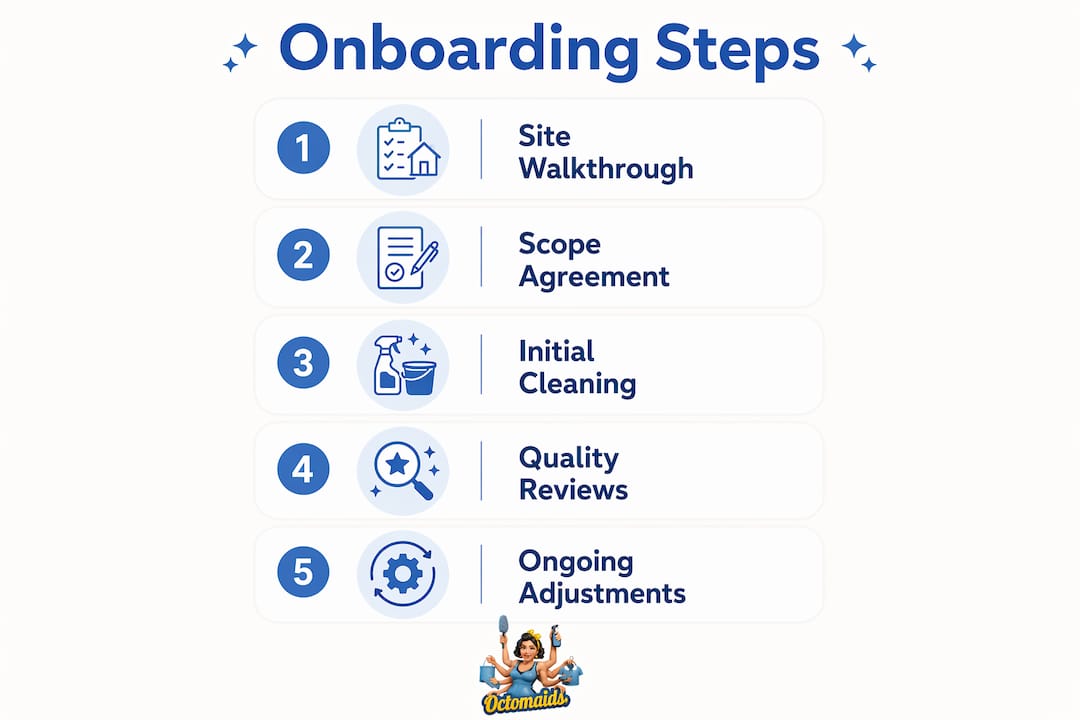
The industry term for this process is “commercial cleaning onboarding,” and it covers every step from your first site walkthrough to your first quality review meeting. It is not simply signing a contract and handing over a key. A proper onboarding process includes a documented site walkthrough, a written scope of work, crew introductions, and emergency communication protocols. According to industry standards, structured onboarding that covers all these areas is the recognized best practice in 2026.
The Building Service Contractors Association International (BSCAI) identifies onboarding as 50% of the battle for both employee retention and lasting client relationships. That statistic applies directly to you as a client. The first 90 days set the tone for everything that follows, and most complaints that surface at day 90 trace back to gaps in the first 30–60 days of service.

What are the essential prerequisites before onboarding?
Preparation on your end is just as important as what the cleaning provider brings to the table. Before your first meeting with a cleaning company, gather the following:
- Facility details: Square footage, number of restrooms, break rooms, conference rooms, and any specialty areas like server rooms or medical spaces
- Access and security information: Key codes, alarm codes, after-hours entry procedures, and any restricted zones. Documenting alarm codes and access protocols in advance prevents early service failures that are very difficult to recover from
- Cleaning frequency preferences: Daily, weekly, or bi-weekly schedules, plus any tasks that require special attention
- Stakeholder contacts: The names and direct numbers of the facility manager, after-hours emergency contact, and any department heads who need to be aware of crew access
- Existing pain points: Areas that previous cleaning providers missed, or surfaces that require specific products
Pro Tip: Schedule your initial site walkthrough during normal business hours so the cleaning provider can see your facility in its actual working state, not an empty shell. High-traffic zones look very different at 3:00 PM than at 8:00 AM.
Never accept a price quote from a provider who has not walked your facility. Generic quotes without walkthroughs are a recognized red flag in the industry and frequently lead to scope misunderstandings or bait-and-switch pricing after the contract is signed.
How do you execute the onboarding process step by step?
A well-run commercial cleaning setup follows a clear sequence. Skipping steps early creates compounding problems later.
-
Conduct a formal site walkthrough. Walk every area with your cleaning provider and document high-priority zones, problem surfaces, and any areas that require special products or restricted access. Professional providers typically deliver a written quote within 48 hours of this walkthrough.
-
Define and sign a written scope of work. This document lists every cleaning task, the frequency of each task, and the standard expected. Ambiguity in written scopes is the leading cause of service disputes, so every task needs a clear frequency attached to it.
-
Request site-specific checklists. Generic duty lists miss the details that matter in your building. Written service plans with site-specific checklists consistently outperform generic lists by capturing unique high-traffic areas and presentation priorities.
-
Introduce the dedicated cleaning crew. Meet the specific people who will clean your facility. Confirm that the same crew returns each visit rather than rotating staff. Consistency in personnel is one of the clearest markers of a professional cleaning partnership.
-
Establish emergency contacts and escalation paths. Document who to call if a crew member cannot access the building, if a spill or damage occurs, or if a scheduled visit is missed. Clear communication and documented escalation paths are hallmarks of professional cleaning providers.
-
Schedule your first quality review walkthrough. Book this meeting before service even begins. Knowing a review is coming keeps both parties accountable from the first visit.
Pro Tip: Ask your provider for a digital onboarding checklist. Research on service business onboarding shows that digital documentation reduces handover errors and creates a clear record for both parties.
| Onboarding step | Purpose | Timing |
|---|---|---|
| Site walkthrough | Document facility needs and access | Before contract signing |
| Written scope of work | Define tasks, frequencies, and standards | At contract signing |
| Crew introduction | Confirm dedicated personnel | Before first service visit |
| Emergency contact setup | Prevent access and communication failures | Before first service visit |
| First quality review | Verify standards and adjust early | 30 days after service starts |
How do you maintain quality after the onboarding is complete?
The onboarding process does not end after the first cleaning visit. Quality maintenance requires active participation from your side as well.
Schedule monthly quality walkthroughs during the first few months of service. Monthly walkthroughs during the initial months are an industry best practice, not an optional extra. These meetings give both parties a structured opportunity to catch issues before they become habits.
Use inspection logs to verify service delivery. A simple dated checklist, signed by the facility manager after each walkthrough, creates an objective record. If a dispute arises later, that documentation protects you. Digital tools with timestamped audits and photo evidence go further, especially for multi-location businesses.
Communicate changes in your facility promptly. If you add a new conference room, change your office hours, or bring in a temporary team for a project, notify your cleaning provider before the next scheduled visit. Reactive communication is the most common reason scope drift happens.
Address issues through a clear escalation path:
- Minor issues: Report directly to the crew supervisor at the next visit
- Recurring issues: Escalate to the account manager in writing
- Unresolved issues after two cycles: Request a formal scope review meeting
Adapt your scope for seasonal needs. Portland and Vancouver businesses often see increased foot traffic and mud during the fall and winter months. Building a seasonal adjustment clause into your contract from the start saves a renegotiation conversation later.
What are the most common onboarding pitfalls and how do you avoid them?
Most commercial cleaning onboarding failures follow predictable patterns. Recognizing them early saves significant time and money.
- Accepting quotes without a walkthrough. This is the single most avoidable mistake. A provider who quotes your facility without seeing it is guessing, and you will pay for that guess in missed tasks and inflated add-on charges.
- Vague scope language. Phrases like “clean restrooms as needed” create disputes. Every task needs a defined frequency: daily, three times per week, or monthly.
- Rotating cleaning staff. A different crew each visit means no one learns your facility’s quirks. Dedicated crews build familiarity with your specific layout, your preferred products, and your security requirements.
- Undocumented access details. Alarm codes, key locations, and after-hours contacts must be in writing before the first visit. Verbal handovers fail.
- No early issue resolution process. Without a defined escalation path, small problems fester. The first 30–60 days are critical for establishing service quality, and issues reported at day 90 almost always started much earlier.
“A well-documented onboarding process prevents ‘first-night disasters’ by ensuring site access and security information are fully documented before service begins. Skipping this step is the most common reason early service relationships break down irreparably.”
What I have learned from onboarding commercial cleaning clients locally
After years of working with business owners across Vancouver and Portland, I have noticed one consistent pattern: the clients who invest 30 minutes in a thorough site walkthrough almost never call with complaints at the 60-day mark. The ones who skip it almost always do.
The local business environment here has its own rhythms. Clark County office parks and Portland’s Pearl District buildings have very different access setups, foot traffic patterns, and facility manager expectations. A cleaning provider who treats every building the same way will miss those details. That is why I always recommend treating the onboarding conversation as a partnership foundation, not a transaction. Ask your provider what they noticed during the walkthrough that you did not mention. A good provider will have observations. A provider who just nods and quotes is not paying attention.
The other thing I have seen repeatedly: business owners who communicate changes proactively get better service. It sounds obvious, but most people assume the cleaning crew will figure it out. They will not, and they should not have to. A quick message before a schedule change or a new area opening up takes two minutes and prevents a missed visit.
Treat the first 90 days as a calibration period, not a trial. Both sides are learning. The goal is a partnership that runs quietly in the background so you can focus on your actual business.
— Steven
Octomaids commercial cleaning onboarding in Vancouver and Portland
Octomaids has served businesses throughout Clark County and the Portland Metro area since 2006. Every new commercial client starts with a thorough site walkthrough, a written scope of work, and an introduction to the dedicated crew assigned to their facility.
For office managers who want reliable, consistent results, Octomaids’ commercial cleaning services cover everything from daily janitorial work to periodic deep cleans. The same trusted cleaners return each visit, which means your crew learns your building and your preferences over time. If you are ready to set up a cleaning service that actually sticks, explore office cleaning in Vancouver, WA or reach out directly to schedule your walkthrough.
Key takeaways
A successful commercial cleaning onboarding requires a documented site walkthrough, a written scope of work, dedicated crew assignment, and monthly quality reviews during the first 90 days.
| Point | Details |
|---|---|
| Walkthrough before contract | Never sign with a provider who has not walked your facility in person. |
| Written scope with frequencies | Every task needs a defined frequency to prevent disputes and scope drift. |
| Dedicated crew assignment | Consistent personnel build facility familiarity and reduce missed tasks. |
| Monthly quality reviews | Schedule the first review before service begins to keep both parties accountable. |
| Document access details | Alarm codes, keys, and emergency contacts must be in writing before day one. |
Perspective: what the first 90 days really tell you
FAQ
What is a commercial cleaning onboarding process?
A commercial cleaning onboarding process is the structured sequence of steps, including a site walkthrough, written scope of work, crew introductions, and communication setup, that establishes how a cleaning service will operate in your facility before the first visit.
How long does commercial cleaning onboarding take?
Most professional providers complete the walkthrough and deliver a written quote within 48 hours. The full onboarding setup, including crew introductions and access documentation, typically takes one to two weeks before service begins.
Why does a site walkthrough matter so much?
A site walkthrough allows the cleaning provider to document your facility’s specific needs, access requirements, and high-priority areas. Providers who skip this step frequently deliver generic service that misses critical zones and leads to disputes.
How often should quality reviews happen after onboarding?
Monthly quality walkthroughs during the first several months of service are the industry standard. These reviews catch issues early and give both parties a structured opportunity to adjust the scope before problems become habits.
What should a written scope of work include?
A written scope of work should list every cleaning task, the frequency of each task (daily, weekly, or monthly), the areas covered, and the contact information for escalation. Vague language like “clean as needed” is a reliable source of future disputes.