


Team cleaning is the right model for most facilities with repeatable tasks and a predictable schedule, and the fastest way to size that team is workloading: total the minutes required for every task using production rates, convert those minutes to staff hours, then add a coverage factor for absences and training. A short pilot confirms whether the number holds up in practice.
TL;DR:
- Team cleaning is most effective in facilities with repetitive layouts, predictable schedules, and multiple staff scheduled each shift, such as offices, schools, and warehouses.
- Calculating staff size with workloading using production rates from task, tool, and time minimizes guesswork and adjusts staffing based on actual workload rather than square footage.
- Proper route design ensures workload balancing among team members, reducing idle time and preventing bottlenecks caused by uneven task durations.
- A coverage factor of 1.2 to 1.4 should be applied to staffing calculations to account for absences, training, and turnover, influencing overall labor costs.
- Consistent crew assignment and a short pilot period improve quality assurance and help refine staffing estimates before full-scale implementation.
Table of Contents
- What Team Cleaning Is and How It Differs from Zone Cleaning
- When Team Cleaning Works Best: Facility Signals and Examples
- Step-by-Step: Calculate Cleaning Team Size with Workloading
- Typical Crew Sizes and Sample Builds by Facility Type
- Team Roles, Routing, and Synchronized Task Breakdown
- Cost Inputs and Budget Impacts: Wages, Utilization, and Coverage
- Octomaids Practical Implementation Notes: Training and a Pilot Plan
- Trade-offs Worth Weighing Before You Commit
- How Octomaids Can Help with Team-Cleaning Pilots
- FAQ
- Sources
- Key Standards and Statistics to Consult
What Team Cleaning Is and How It Differs from Zone Cleaning
Team cleaning assigns each crew member a specialized function, such as trash and dusting, restrooms, or floor care, and moves that person through the entire facility performing only that task. Zone cleaning does the opposite: one person owns a defined area and performs every task within it, from vacuuming to wiping surfaces to emptying bins.
The distinction matters because specialization cuts out the wasted motion that comes with constantly switching tools and tasks. ISSA’s guidance on team cleaning points to reduced tool-switching and less walking as the core productivity gains, along with faster training for new hires since each person masters one job rather than an entire zone.
Teams also make quality assurance simpler because a supervisor can check one function across the whole building rather than auditing isolated zones separately.
- Zone cleaning: one person, one area, every task.
- Team cleaning: one person, one task, every area.
- Specialization payoff: less equipment switching, quicker onboarding, more consistent output.
When Team Cleaning Works Best: Facility Signals and Examples
Team cleaning earns its keep in facilities with repetitive layouts, predictable hours, and more than one cleaner scheduled per shift. The model struggles where tasks vary wildly from visit to visit or where only one person is ever on site.
- Large, repetitive floor plans with similar rooms across multiple sections.
- Multiple staff already scheduled for the same shift window.
- A consistent cleaning calendar that repeats week over week.
Office buildings, school campuses, healthcare facilities, and warehouses tend to fit this profile well, since their floor plans repeat and their schedules rarely change. A single small office with one visit a week, or a highly customized space where every room needs different handling, usually does better with one dedicated cleaner working a zone.
Pro Tip: If your schedule changes week to week, test team cleaning on your most repetitive day before rolling it out facility-wide.
Step-by-Step: Calculate Cleaning Team Size with Workloading
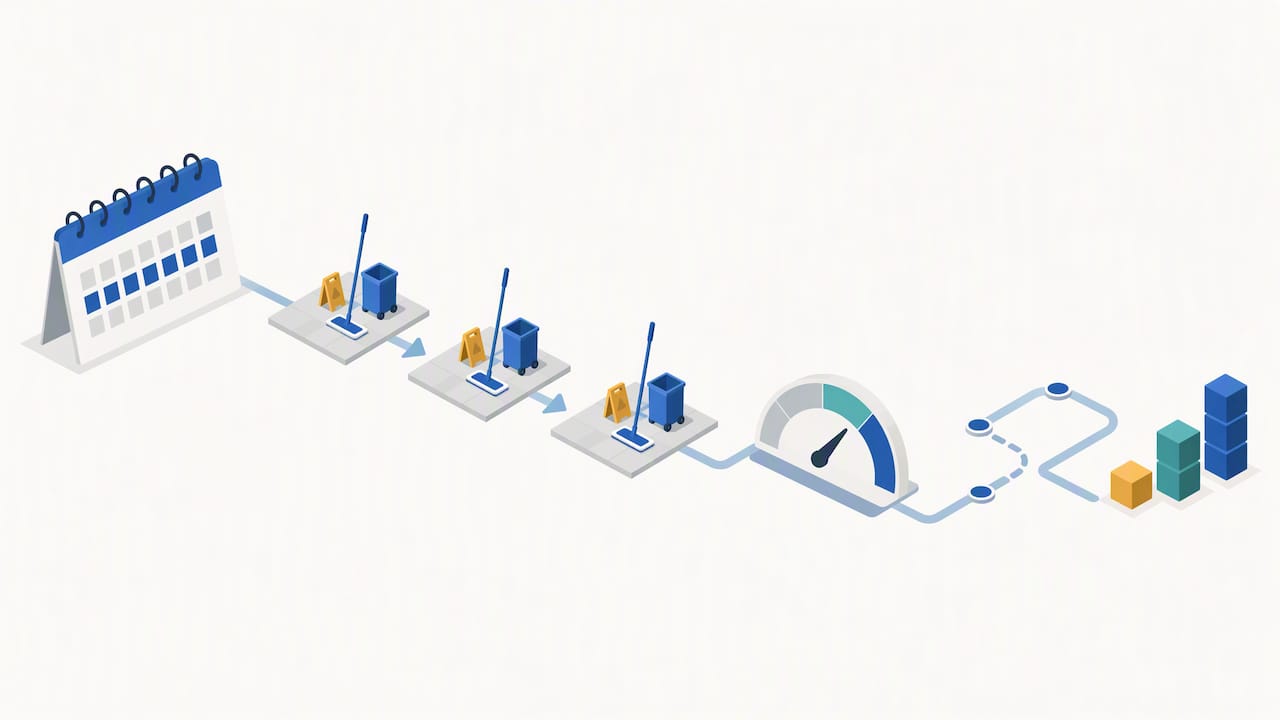
Workloading turns a task list into a staffing number instead of a guess. ISSA’s Cleaning Times and Tasks methodology builds production rates from the task itself, the tool used, and the time it takes, which is far more reliable than estimating by square footage alone.
- List every task, space, and frequency. Note each surface type, fixture count, and how often it needs attention, from daily trash pulls to weekly floor care.
- Apply production rates. Use ISSA Cleaning Times or a comparable fixture-based method to assign minutes per task based on the tools and techniques your crew actually uses.
- Sum the minutes and convert to hours. Add every task’s minutes together, then divide by 60 to get total labor hours required per cleaning cycle.
- Convert hours to full-time equivalents. Divide total hours by the hours in a standard shift to see how many people you need.
- Add a coverage factor. ISSA notes that a coverage factor of roughly 1.2 to 1.4 accounts for absences, training time, and turnover, so multiply your base FTE number by that range before finalizing headcount.
- Run a short time study. Track actual completion times for two or three visits and compare them against your production-rate estimate, then adjust the rates that were off.
Workloading uses production rates built from task, tool, and time to calculate staffing needs rather than relying on square-foot rules of thumb, according to ISSA’s calculation methodology. That distinction keeps a restroom-heavy floor from being staffed the same as an open office with the same square footage.
Typical Crew Sizes and Sample Builds by Facility Type
These numbers are starting templates, not fixed rules. Your task list and frequency will shift them up or down.
- Small office (under 10,000 square feet): One to two cleaners, usually handling trash, surfaces, restrooms, and a quick vacuum pass in a two to three hour shift.
- Medium multi-floor office: Three to six team members split by function: one or two on restrooms, one on trash and dusting, one or two on floors, and a lead who handles quality checks and exceptions.
- Large facility, campus, or warehouse: Six or more cleaners organized into multiple synchronized teams, each covering a wing or building so the whole site finishes on roughly the same timeline.
- Restroom-dense buildings need more dedicated restroom staff relative to overall headcount, since fixture counts drive the production-rate math more than floor area does.
- Floor care and event turnarounds add temporary headcount or extended shifts on top of the baseline crew.
Team Roles, Routing, and Synchronized Task Breakdown
A team only works if its routes are built to finish together. If one role’s route takes twice as long as another’s, the fast workers stand around waiting, and the slow role becomes a bottleneck.
- Trash and light duty: pulls bins, dusts surfaces, and resets common areas.
- Restroom sanitarian: handles all restroom cleaning and restocking across the route.
- Floor and vacuum specialist: covers carpet, hard floor, and entryway care.
- Lead or utility cleaner: floats to help the slowest role, checks finished areas, and handles exceptions.
ISSA recommends designing routes so each role’s workload finishes at about the same minute mark, which reduces idle time and keeps handoffs clean. A simple checklist at the end of each route, confirming trash is pulled, restrooms are stocked, and floors are clear, gives a lead a fast way to spot gaps before a client does.
Pro Tip: Time your slowest role first when designing a route. Everyone else’s workload gets built around that number, not the other way around.
Cost Inputs and Budget Impacts: Wages, Utilization, and Coverage
Once you know your FTE count, labor cost follows directly. The U.S. Bureau of Labor Statistics reports a median hourly wage of $17.27 for janitors and building cleaners as of May 2024, a useful baseline before adding payroll costs.
The median hourly wage for janitors and building cleaners was $17.27 as of May 2024, per the Bureau of Labor Statistics, with a median annual wage of $35,930. Building and grounds cleaning occupations employ several million workers nationally with a mean annual wage near the national average for this sector, according to BLS occupational employment data.
- Start with the median wage, then add payroll taxes and benefits to get a fully burdened hourly cost.
- Apply your coverage factor (1.2 to 1.4) to the base FTE count before calculating total labor spend.
- Higher route density per cleaner improves utilization, but pushing it too far erodes quality and increases turnover risk.
Octomaids Practical Implementation Notes: Training and a Pilot Plan
A cleaning company operating in Clark County, Washington, and the Portland metro area since 2006 supports team-cleaning quality by assigning the same crew to a client on every visit rather than rotating staff. Consistent crews learn a building’s quirks faster and catch problems earlier because they know what normal looks like.
All staff are background-checked and trained before stepping into a client’s space, which matters as much for a four-person office team as it does for a single-home visit. For a facility manager testing team cleaning for the first time, a four to eight week pilot gives enough cycles to validate production-rate estimates, adjust routes, and confirm the crew size actually matches the workload.
Trade-offs Worth Weighing Before You Commit
Squeezing more throughput out of a team can quietly erode the client-specific tasks that made a contract worth keeping in the first place. The real skill is building a route tight enough to be efficient without flattening every account into the same template.
Before expanding team cleaning, run three checks: confirm your task list reflects actual client requirements, time at least one full cycle before trusting the estimate, and build in a buffer for the exceptions that workloading math never quite captures.
— Steven
How Octomaids Can Help with Team-Cleaning Pilots
Sizing a crew on paper is one thing. Running it with a team that shows up consistently and already understands commercial routing is another. Some cleaning services map directly onto the team-cleaning approach covered here, built around the same dedicated-crew model rather than rotating staff.
- Commercial cleaning for offices and multi-tenant buildings that fit the team-cleaning profile.
- Recurring home cleaning for predictable, repeating schedules.
- Janitorial services for larger sites that need synchronized, multi-role crews.
If you want a workload-based estimate for your own facility, or want to pilot a team-cleaning crew for four to eight weeks, reach out through our recurring cleaning services page to get started.
FAQ
What cleaning business is most profitable?
Profitability in cleaning businesses depends more on route density, recurring contracts, and labor utilization than on any single service type. Recurring commercial and office contracts tend to generate steadier margins than one-off jobs because scheduling and routing can be optimized over time.
How much should I charge for 2 hours of cleaning?
Pricing for a short cleaning window depends on local labor costs, overhead, and the specific tasks included, so there is no single national rate. A useful starting point is calculating your fully burdened hourly labor cost, based on wage data like the median janitorial wage, then adding overhead and margin.
What is the 5-5-5 rule for cleaning?
Definitions of the 5-5-5 rule vary across cleaning businesses and are not standardized by an industry body like ISSA. Rather than relying on an informal rule, facility managers get a more reliable staffing number from workloading calculations based on ISSA’s production-rate methodology.
How many cleaners do I need per job?
The right crew size depends on total task minutes divided by productive hours per shift, plus a coverage factor for absences and training. A small office typically needs one to two cleaners, while a multi-floor building often requires three to six working in synchronized roles.
Does Octomaids offer team cleaning for offices?
Some cleaning companies provide commercial and office cleaning with consistent, dedicated crews assigned to each client. Managers can request a workload-based estimate to determine the right team size for their facility.
Sources
- Janitors and building cleaners | Occupational Outlook Handbook | U.S. Bureau of Labor Statistics
- Team Cleaning Methods: Improve Efficiency and Cleaning Quality – ISSA
Key Standards and Statistics to Consult
For deeper reference, ISSA’s team cleaning and cleaning times guides cover methodology in detail, while the BLS Occupational Outlook Handbook tracks current wage and employment data for janitors and building cleaners.
Recommended
- Facility Managers: Janitorial vs Commercial Cleaning, 6 Questions
- 7 Elements Facility Managers Need in an RFP Ready Janitorial Scope
- 30 Day Test: Day Porter vs Janitor for Facility Managers
- Create a Weekly Cleaning Routine Fast: 2026 Guide
About Octomaids
Octomaids is a locally operated professional cleaning company serving Vancouver, Clark County, and the surrounding Portland metro area. Since 2006, our cleaning teams have helped homeowners, renters, property managers, and businesses with recurring cleaning, deep cleaning, move-in/move-out cleaning, and commercial cleaning.
Our cleaning articles are reviewed to ensure the information reflects our real-world experience and professional cleaning practices.