


Most cleaning services require a reasonable notice period before canceling an appointment. Late cancellations typically bring a flat fee, a percentage of the job cost, or, for outright no-shows, the full charge. A fair policy also builds in exceptions and a cancellation path that is genuinely easy to use, both for goodwill and to stay on the right side of consumer-protection expectations.
TL;DR:
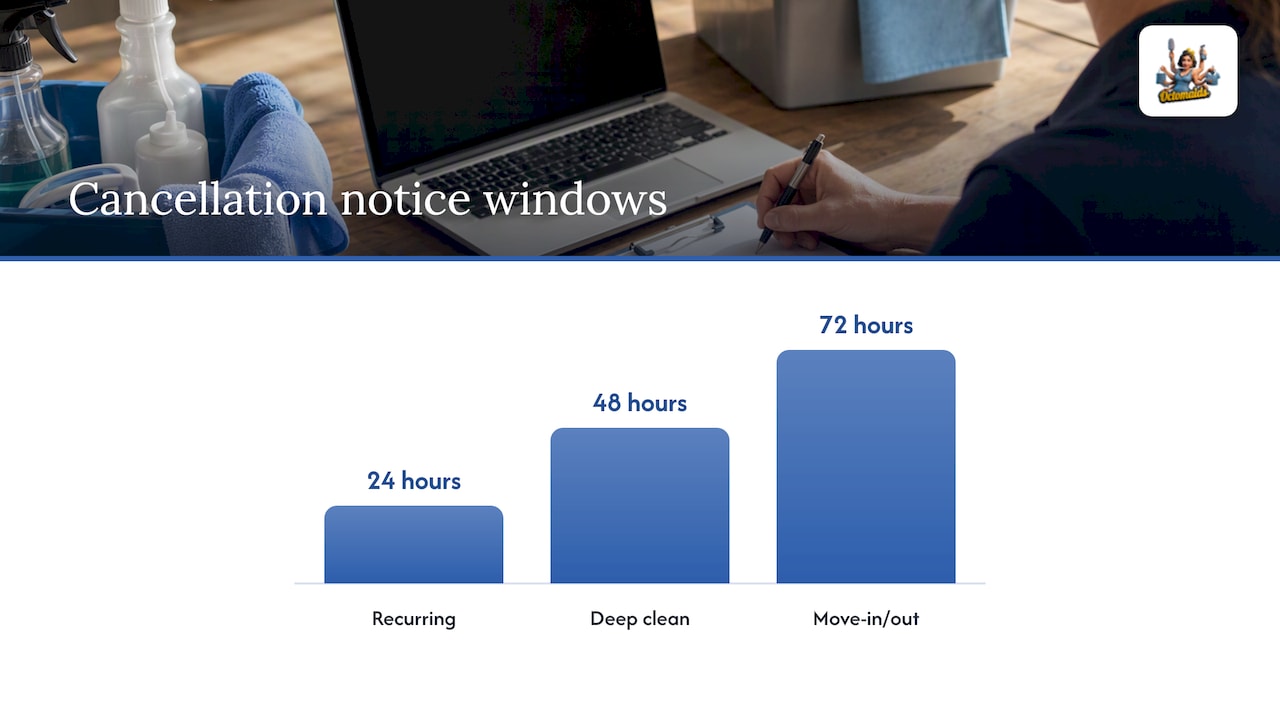
- Set notice windows by job type: recurring visits need 24 hours, deep cleans 48 hours, and move in or move out appointments 72 hours.
- Sample terms charge $35 for late recurring cancellations, 25% for deep cleans, and 50% for move cleans; clients who do not appear pay in full.
- Offer a first cancellation waiver to new clients and excuse documented illness or unsafe weather; reserve full charges for lockouts and true no shows.
- For eligible home purchases of $25 or more, FTC rules allow cancellation within three business days and require refunds within 10 business days.
- FTC guidance calls for renewal disclosures and cancellation as easy as signup; send reminders at 72, 48, and 24 hours, logging contacts before fees.
Table of Contents
- Typical notice periods and fee models for cleaning services
- U.S. legal baseline: Cooling-Off Rule and negative-option guidance
- How to write a clear cancellation policy: templates and required elements
- Practical enforcement: reminders, documentation, and fee collection
- Octomaids’ practical perspective and examples from local operations
- Cancellation policies as a reliability and fairness tool
- How we handle cancellations at Octomaids
- FAQ
- Sources
Typical notice periods and fee models for cleaning services
Notice windows vary by how much flexibility a cleaning schedule can absorb. A 24-hour window suits recurring weekly or biweekly visits, where a missed slot is disappointing but easy to refill the following week. A 48-hour window gives a little more breathing room for one-time deep cleans, since those jobs often require special prep like ordering supplies or assigning a larger team. A 72-hour window tends to apply to move-in and move-out cleanings, which are usually tied to a closing date or lease deadline and are hardest to rebook on short notice.
Fee structures generally follow one of three patterns:
- A flat fee, often modest but varying by service, charged for cancellations inside the notice window but before the appointment time.
- A percentage of the invoice, commonly a significant fraction, charged when the cancellation happens especially close to the scheduled visit.
- The full job charge, applied when a cleaner arrives and cannot access the home or the client is a true no-show.
As a rule of thumb, lighter fees fit recurring services where rescheduling is simple, while move-out and one-time deep cleans warrant firmer terms because the labor and scheduling commitment are harder to recover. Reasonable businesses also build in exceptions: a first-time waiver for new clients, forgiveness for documented illness, and flexibility during severe weather events that make travel unsafe.
U.S. legal baseline: Cooling-Off Rule and negative-option guidance
Two federal frameworks shape what a cancellation policy can reasonably require. The FTC Cooling-Off Rule gives consumers the right to cancel certain purchases of $25 or more made at home or at a temporary location, such as a trade show, within three business days, and it requires the seller to hand over two copies of a cancellation form and refund any payment within 10 business days of a valid cancellation.
The right to cancel runs until midnight of the third business day after the sale, and sellers must provide written notice of that right along with the appropriate forms.
Separately, the FTC’s negative-option rulemaking and guidance addresses recurring-charge arrangements, calling for clear disclosure of renewal terms and a cancellation process that is at least as simple as signing up. Enforcement has followed when it wasn’t: state and local authorities have pursued businesses that made cancellation difficult or charged unreasonable termination fees, a pattern worth remembering before locking a policy into long phone-hold chains or written-only cancellation requests.
How to write a clear cancellation policy: templates and required elements
A workable policy spells out four things: the notice window, the fee schedule, the exceptions, and exactly how to cancel. Here are short templates to adapt.
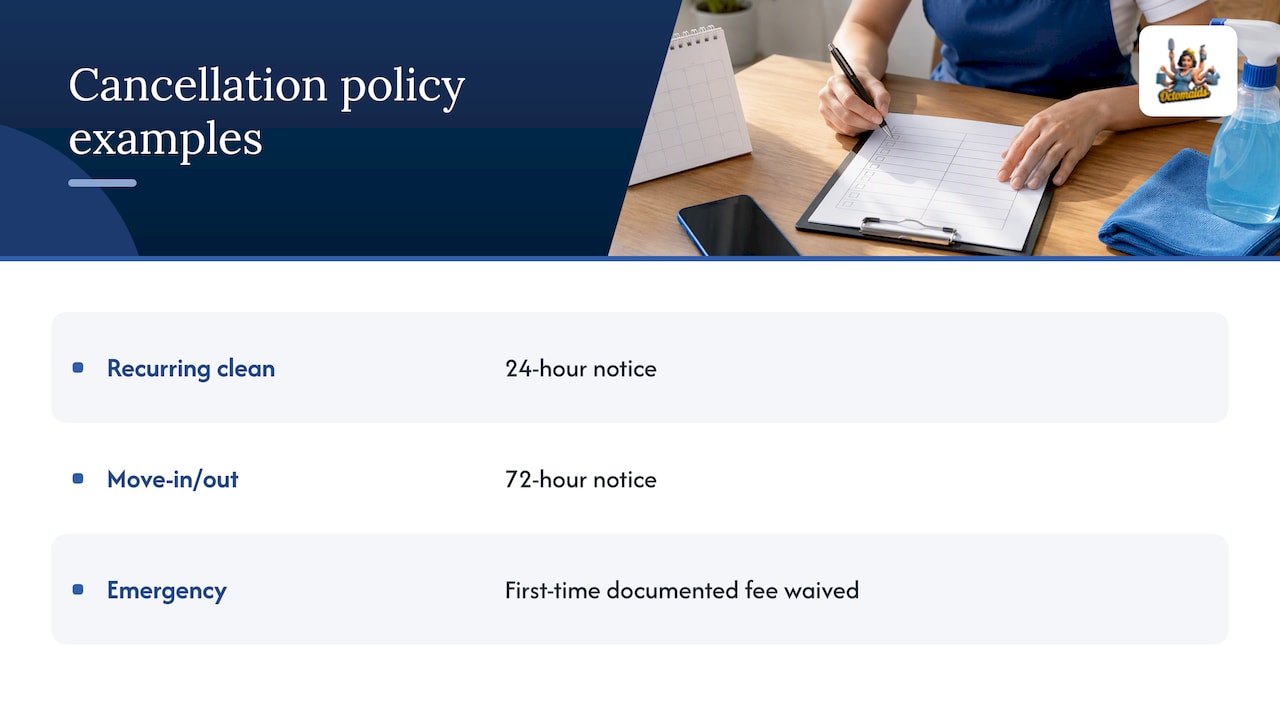
- Recurring service: “Cancel or reschedule at least 24 hours before your visit at no charge. Cancellations inside 24 hours incur a $35 fee. No-shows are billed at the full visit rate.”
- One-time deep clean: “We require 48 hours’ notice to cancel or reschedule without charge. Cancellations inside that window are billed at 25% of the quoted price; same-day cancellations or lockouts are billed in full.”
- Move-in/move-out clean: “Because these appointments are tied to closing or lease dates, we require 72 hours’ notice. Late cancellations are billed at 50% of the job cost; no-shows are billed in full.”
Display the policy in three places: the signed service agreement, the booking confirmation email, and any reminder message sent ahead of the visit. Document consent clearly, whether through a signed agreement, an online checkbox at booking, or a confirmation email that restates the terms, and state refund timing plainly (“refunds for prepaid services are issued within 5 business days of a qualifying cancellation”).
Pro Tip: Put the cancellation window in bold in your confirmation email. Clients who see it twice are far less likely to dispute a fee later.
Practical enforcement: reminders, documentation, and fee collection
A policy only works if it’s enforced consistently and documented along the way.
- Send reminders at 72, 48, and 24 hours before the visit, ideally through automated text or email so timing never depends on staff memory.
- Log every contact attempt and reschedule offer before applying a fee; a timestamped email or portal confirmation is the strongest record if a client disputes a charge.
- Use card-on-file authorization at booking so fees can be collected without an awkward follow-up call.
- Train staff on a short, calm script for fee disputes: acknowledge the situation, point to the policy as written and signed, and offer a reschedule where it makes sense.
Octomaids’ practical perspective and examples from local operations
Across our service lines, recurring home cleaning carries a lighter 24-hour notice window, while move-in and move-out jobs need 72 hours given the fixed scheduling behind them. We waive the fee for a documented first-time emergency rather than charge automatically, a practice that preserves goodwill without eliminating accountability. Our service agreement and our page on handling special requests spell out how these exceptions work in practice.
Cancellation policies as a reliability and fairness tool
We’ve run cleaning routes across Clark County and the Portland metro since 2006, and a clear cancellation policy has always mattered as much to our cleaners’ income as to client trust. A missed slot without notice means a paid worker with no job to do that hour. We’d rather make rescheduling the easy default and keep the cancellation path simple than lean on fees as a backup revenue stream.
— Steven
How we handle cancellations at Octomaids
Our cancellation terms live right in the service agreement every client signs before their first visit, so there’s never a surprise buried in fine print. Whether you book recurring home cleaning or a move in / out cleaning, the same team shows up every time and the notice window is spelled out upfront.
- Review or request a copy of our service agreement before your first booking.
- Reach out by phone or through our booking page to reschedule rather than cancel outright.
- Ask about our first-time waiver if an emergency comes up unexpectedly.
If you’re ready to set a cleaning schedule with clear terms from day one, visit our recurring home cleaning page to see current availability and get started.
FAQ
How do I politely cancel a cleaning service?
Give as much notice as your provider’s policy requires, ideally by phone or through the method they specify in your service agreement. Mention the reason briefly and ask about rescheduling instead of canceling outright, since most companies would rather move your date than lose the booking entirely.
What is a reasonable cancellation policy?
A reasonable policy gives 24 to 72 hours’ notice depending on the job type, charges a modest flat fee or percentage for late cancellations, and reserves a full charge for true no-shows. It should also include waivers for emergencies and a cancellation process that’s as easy as the booking process itself, consistent with FTC guidance on negative-option terms.
Do I legally have to pay a cancellation fee?
If you signed a service agreement that discloses a cancellation fee, you’re generally bound to it under the terms you agreed to. The FTC Cooling-Off Rule gives a three-business-day right to cancel for certain in-home sales of $25 or more, but it does not eliminate properly disclosed late-cancellation fees outside that window.
Do cleaning companies charge a cancellation fee?
Many do, typically a flat fee or a percentage of the job cost for cancellations inside their notice window, with a full charge reserved for no-shows. Terms vary by company, so check the service agreement or booking confirmation for the exact notice period and fee schedule.
Sources
- Cooling-Off Rule — Legal Information Institute (LII)
- Negative option rule — Federal Register (FTC guidance and rulemaking)
- People v. Hawx Services (Los Angeles County complaint) — court filing excerpt
Recommended
- Service Agreement
- 9 Jobs House Cleaners Refuse, Who to Call and How to Prepare
- What Is a Cleaning Service Agreement? A Clear Guide
- How Cleaning Services Handle Special Requests
About Octomaids
Octomaids is a locally operated professional cleaning company serving Vancouver, Clark County, and the surrounding Portland metro area. Since 2006, our cleaning teams have helped homeowners, renters, property managers, and businesses with recurring cleaning, deep cleaning, move-in/move-out cleaning, and commercial cleaning.
Our cleaning articles are reviewed to ensure the information reflects our real-world experience and professional cleaning practices.