



Professional cleaning services handle special requests by establishing clear pre-service communication, defining the scope of added tasks, and setting expectations about fees and scheduling before the first cleaner arrives. This is the industry standard approach, and it works because it protects both you and the cleaning team from confusion. Whether you need a post-party deep clean, allergen-sensitive products, or a room skipped entirely, knowing how the process works helps you get exactly what you need. Octomaids has used this framework with homeowners and renters across Vancouver, WA and Portland, OR since 2006.
How cleaning services handle special requests: scheduling and operations
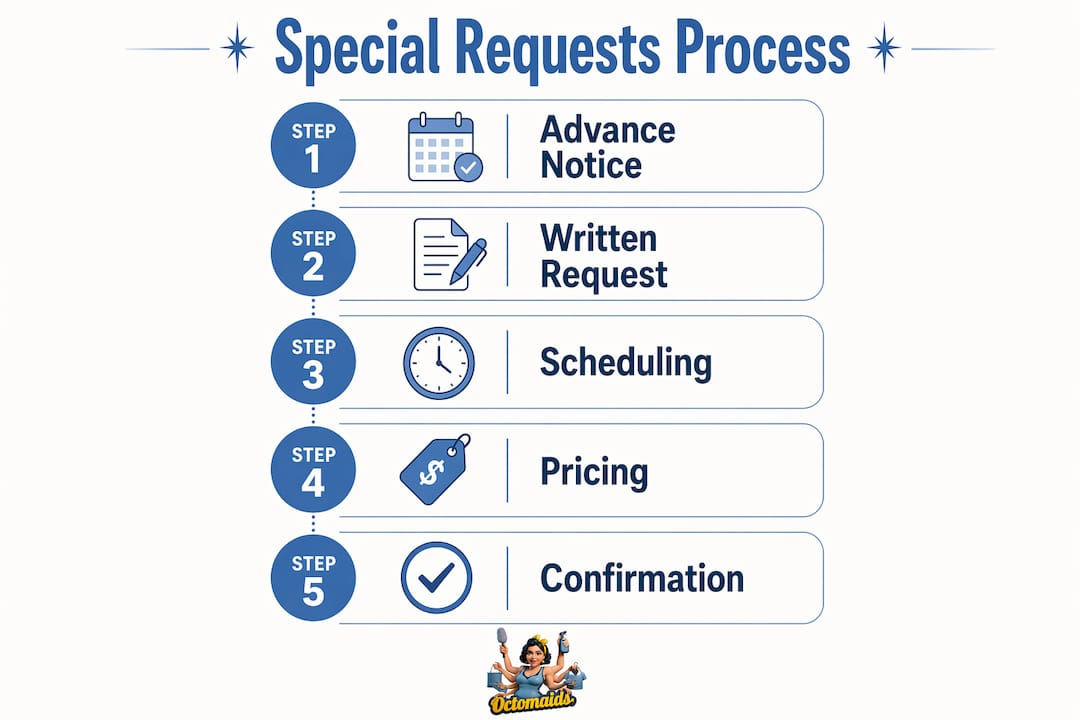
Scheduling is where most special requests either succeed or fall apart. Industry best practice calls for notifying your cleaning provider 24–48 hours in advance for any task outside the standard checklist. That window gives the team time to adjust the schedule, bring the right supplies, and allocate enough time to do the job properly.
Urgent or emergency requests work differently. Professional cleaning companies aim to acknowledge emergency requests immediately and can often mobilize a team within hours, depending on staff availability and location. That speed comes at a cost, though. Emergency bookings almost always carry a premium fee, and the scope of what can be completed may be narrower than a planned visit.
Here is what most cleaning companies need from you when you submit a special request:
- What the task is. Be specific. “Clean the oven” is clearer than “do the kitchen.”
- Where it is. Room, floor, or specific appliance.
- How urgent it is. Same day, next visit, or flexible.
- Any access or product restrictions. Pets, allergies, locked rooms, or fragile items.
- Your preferred communication channel. Text, email, or app message.
Pro Tip: Send special requests in writing, even if you spoke to someone by phone. A written record prevents misunderstandings and gives the cleaning team a reference point on the day of service.
Cleaning companies that handle recurring appointments build special requests into a rotating plan. If you want the refrigerator cleaned every third visit, that gets logged in your profile. Octomaids, for example, sends the same cleaners to each home visit after visit, which means your preferences are remembered without you having to repeat them.

How are extra cleaning tasks priced?
Pricing for special requests follows one of two models: a fixed add-on fee or an hourly increment charge. Tasks outside the standard checklist almost always incur additional fees because they require extra labor time. That is not a surprise tactic. It reflects real cost.
Many cleaning companies bill extra time in quarter-hour increments. So if cleaning the inside of your oven adds 30 minutes to the visit, you pay for two quarter-hour blocks on top of the base rate. Some companies use flat add-on fees instead, listing appliance cleaning, window washing, or cabinet interiors as fixed line items on a menu.
The most common add-on tasks and how they are typically billed:
- Inside oven cleaning. Usually a flat fee ranging from $25 to $50, depending on the oven’s condition.
- Inside refrigerator cleaning. Similar flat fee structure. Requires emptying the fridge first, which you should do before the team arrives.
- Interior window cleaning. Often billed by the number of windows or by the hour.
- Laundry or dishes. Some companies include these; most do not. Confirm before assuming.
- Garage or basement cleaning. Almost always a separate quote due to variable scope.
Agreeing on extras ahead of time avoids billing surprises. Ask your provider to confirm the cost in writing before the visit. A reputable company will not hesitate to do this. If a company resists giving you a clear price upfront, that is a signal worth paying attention to.
The pricing conversation does not need to be awkward. Frame it simply: “I’d like to add oven cleaning to this visit. What does that cost, and how will it appear on my invoice?” That question takes ten seconds and saves you from a dispute later.
What communication strategies work best for special cleaning needs?
Clear, specific, and polite communication is the single biggest factor in whether your special requests get done correctly. Treating priority requests as routine reduces discomfort on both sides and builds a collaborative relationship over time. The cleaning team is not there to judge your home. They are there to help.
A few principles that consistently produce good results:
- State priorities, not procedures. Tell your cleaner that the master bathroom is the top priority, not that they should scrub the grout before wiping the mirror. Professionals know the best sequence for their workflow.
- Rank your priorities explicitly. If time is limited, give your cleaner a ranked list so they can drop lower-priority tasks gracefully if the clock runs short.
- Put complex requests in writing. A quick email or text before the visit removes ambiguity and gives the cleaner a checklist to reference.
- Ask what is realistic. If you have a long list, ask your provider what can be completed in the scheduled time. Adjust the list or the time block accordingly.
Pro Tip: A pre-service walkthrough before the first visit, or after a major life change like a new pet or renovation, aligns expectations and surfaces issues like allergy sensitivities or high-value items that need special handling.
The walkthrough does not need to be long. Ten minutes spent pointing out priorities, flagging fragile items, and confirming product preferences prevents hours of frustration later. Regular check-ins after every few visits also help catch evolving needs before they become complaints.
One thing to avoid: micromanaging the sequence of tasks during the visit. Hovering over a cleaner and redirecting their steps mid-task slows the work and creates tension. Trust the team to execute the priorities you set in advance.
What are common special requests and how do cleaners handle them?
The table below covers the most frequent special requests homeowners and renters submit, along with typical handling and scheduling notes.
| Special request | How cleaners handle it | Scheduling note |
|---|---|---|
| Post-party or post-event deep clean | Full reset of high-traffic areas; trash removal, surface sanitizing, floor care | Book 48+ hours ahead; scope may require extra time block |
| Pet odor or pet hair treatment | Specialized vacuuming, deodorizing products, upholstery attention | Confirm product compatibility with pets present |
| Seasonal allergen cleaning | HEPA vacuuming, vent wiping, reduced chemical products | Plan at seasonal transitions; may require premium products |
| Skipping a specific room | Room is marked off in the service notes | Communicate before the visit, not at the door |
| Handling valuables or sensitive items | Cleaner avoids or works around flagged items; client secures irreplaceable pieces | Flag items during walkthrough or in written notes |
| Appliance interior cleaning | Oven, fridge, or microwave cleaned as add-ons | Confirm pricing and prep requirements in advance |
Seasonal allergen cleaning and post-event deep cleans are the two requests that most often require a separate plan and sometimes a premium fee. Both involve scope that goes well beyond a standard maintenance visit. Knowing that upfront helps you budget and schedule without stress.
Skipping a room is one of the simplest requests and one of the most commonly mishandled. Telling the cleaner at the door creates confusion. Adding it to your written pre-visit notes takes 30 seconds and guarantees it happens. For guidance on preparing your home before a visit, including how to flag rooms or items, Octomaids has a detailed resource worth reviewing.
If you need help thinking through what a deep clean covers room by room, that context helps you identify which tasks are standard and which ones you need to request as extras.
Key takeaways
Special requests work best when you communicate them clearly, in writing, at least 24–48 hours before your cleaning visit, and confirm any added costs upfront.
| Point | Details |
|---|---|
| Give advance notice | Notify your cleaning provider 24–48 hours ahead so they can adjust scheduling and supplies. |
| Confirm pricing in writing | Ask for add-on costs before the visit to avoid billing surprises on extra tasks. |
| Rank your priorities | Give cleaners an explicit priority list so they allocate time to what matters most. |
| Use pre-service walkthroughs | A short walkthrough aligns expectations, flags sensitive items, and surfaces allergy concerns. |
| State priorities, not procedures | Tell cleaners what matters most, not how to do their job, for better results and rapport. |
What I’ve learned about special requests after years in this industry
The clients who get the best results from their cleaning service share one habit: they treat communication as part of the service, not an afterthought. They send a quick note before each visit, they update their preferences when life changes, and they ask questions without hesitation.
What I see go wrong most often is the opposite. A homeowner assumes the cleaner remembers a request from three months ago. Or they mention a new priority at the door, right as the team is starting. Those moments create friction that is entirely avoidable.
The other pattern worth naming: clients who try to micromanage the sequence of tasks during a visit. I understand the impulse. You want things done a certain way. But professional cleaners have workflows built from experience, and interrupting those workflows mid-task costs time and quality. Set your priorities clearly before the visit, then let the team work.
Respectful phrasing matters more than most people realize. Saying “the kitchen is my top priority this week” lands very differently than “make sure you do the kitchen first.” The first is a preference. The second is a directive. One builds rapport. The other creates distance. Over time, that difference shapes the entire relationship.
Periodic plan reviews also pay off. Every few months, take five minutes to confirm that your current cleaning plan still reflects your actual needs. Families change. Pets arrive. Renovations happen. The cleaning plan should keep up.
— Steven
Octomaids adapts to what your home actually needs
Octomaids has served homeowners and renters across Vancouver, WA and Portland, OR since 2006, and flexible cleaning plans have always been central to how the team operates. Special requests are not exceptions. They are part of the service.
Every Octomaids client gets the same trusted cleaners visit after visit, which means your preferences, sensitivities, and priorities are remembered without you having to repeat them. Background-checked cleaning specialists, transparent pricing on add-ons, and a genuine commitment to getting it right make the process straightforward. Whether you need a one-time deep clean or a recurring plan built around your household’s specific needs, Octomaids builds the service around you. Review the home cleaning best practices guide to see how customization works in practice.
FAQ
How far in advance should I submit a special cleaning request?
Submit special requests 24–48 hours ahead of your scheduled visit. That window gives your cleaning provider time to adjust staffing, bring the right supplies, and allocate enough time for the added task.
Will special requests cost extra?
Tasks outside the standard checklist almost always carry an additional fee. Ask your provider to confirm the cost in writing before the visit so there are no surprises on your invoice.
How do I communicate a special request clearly?
Send your request in writing by text or email, name the specific task and location, and rank it among your other priorities. Explicit priority ranking helps cleaners allocate time correctly when the schedule is tight.
Can I ask the cleaning team to skip a specific room?
Yes. Skipping a room is a straightforward request. Add it to your written pre-visit notes rather than mentioning it at the door to make sure it is logged and followed consistently.
What if I need emergency cleaning on short notice?
Professional cleaning companies acknowledge emergency requests immediately and can often dispatch a team within hours. Expect a premium fee and a potentially narrower scope compared to a planned visit.