


Bathroom mildew prevention comes down to one idea: take away the moisture, and the mildew has nothing to grow on. In practice that means running an exhaust fan that vents outdoors, keeping indoor humidity below 50%, wiping or squeegeeing wet surfaces after each shower, and fixing leaks quickly. The rest of this guide shows how to do each of those things well, how to spot the early signs that moisture is hiding somewhere, and when a patch is too big to handle yourself.
Key Takeaways
- Moisture is the cause. The CDC advises keeping home humidity no higher than 50% all day and using exhaust fans that vent outside.
- Run the fan during every shower and for at least 20 to 30 minutes afterward, then dry the walls, glass and linens.
- Leaks and cracked grout are the usual reason mildew keeps returning, because water reaches materials you can’t see.
- A moldy area under about 10 square feet can usually be cleaned by a homeowner. Larger or hidden growth calls for a professional.
- A regular bathroom cleaning routine removes the soap film and residue that mildew feeds on.
Table of Contents
- What mildew is, and why the difference matters less than you think
- Why bathrooms are the first room to go wrong
- Step 1: Get the ventilation right
- Step 2: Keep humidity in range
- Step 3: Dry the surfaces, not just the air
- Step 4: Clean on a schedule, because mildew eats residue
- Step 5: Fix the water source behind the mildew
- When mildew is more than a surface problem
- Our perspective: prevention is a routine, and routines are easier with the same team
- Let us handle the weekly scrub
- A simple bathroom mildew prevention checklist
- FAQ
- Sources
What mildew is, and why the difference matters less than you think
People use “mold” and “mildew” as if they were two different problems. The EPA explains that mildew is a generic term, often used for mold growth with a flat growth habit, while molds are microscopic fungi that grow as filaments. The gray, black or pink film on a shower wall or caulk line is, for practical purposes, the same kind of problem.
That is good news for prevention. You don’t need to identify what is growing in order to stop it. The CDC’s approach puts sustained humidity control, outdoor-vented airflow, leak repair and rapid drying ahead of identifying or testing the growth. If you control water, you control all of it.
Think of mildew as a tenant that moves in only where there is a steady supply of moisture. Our goal is to make the bathroom an unattractive address.
Why bathrooms are the first room to go wrong
A hot shower puts a surprising amount of water into the air. Harvard’s Healthy Buildings program notes that showers and baths distribute droplets that can build up on surfaces and cause mold growth or water damage if the moisture is not exhausted to the attic or outdoors. Those droplets don’t vanish when you step out. They settle on walls, ceiling paint, caulk, the curtain and the grout.
Add soap scum, body oils and shampoo residue, and you have a food source too. Mildew needs both, and most bathrooms supply both daily.
The Pacific Northwest adds a seasonal layer. Many homes in Vancouver and the Portland area spend months of the year closed up against cool, damp weather, so there is little drier outdoor air to help. That is why the habits below matter most from fall through spring.
Step 1: Get the ventilation right
Ventilation is the single most effective habit, and it is the one most often done halfway.
Use a fan that actually vents outside
The EPA says bathroom exhaust fans should remove moisture to the outside, not into an attic. A fan that dumps humid air into attic space only moves the problem upstairs. If you aren’t sure where yours ends, look in the attic or at the exterior wall or roof for the duct termination.
Run it long enough
Guidance varies slightly by source, but the pattern is consistent:
| Source | How long to run the fan |
|---|---|
| Home Ventilating Institute | A control that keeps ventilation running at least 20 minutes after each use |
| Wirecutter | Air the bathroom with a fan or window for at least 20 minutes after showering |
| Consumer Reports | During the shower and at least 30 minutes afterward |
A simple rule for your household: fan on before the water starts, and off 30 minutes after you finish. If you forget, a timer switch or a humidity-sensing switch takes memory out of it. Wisconsin’s health department suggests considering humidistat-controlled exhaust fans for this reason.
Check the fan’s capacity
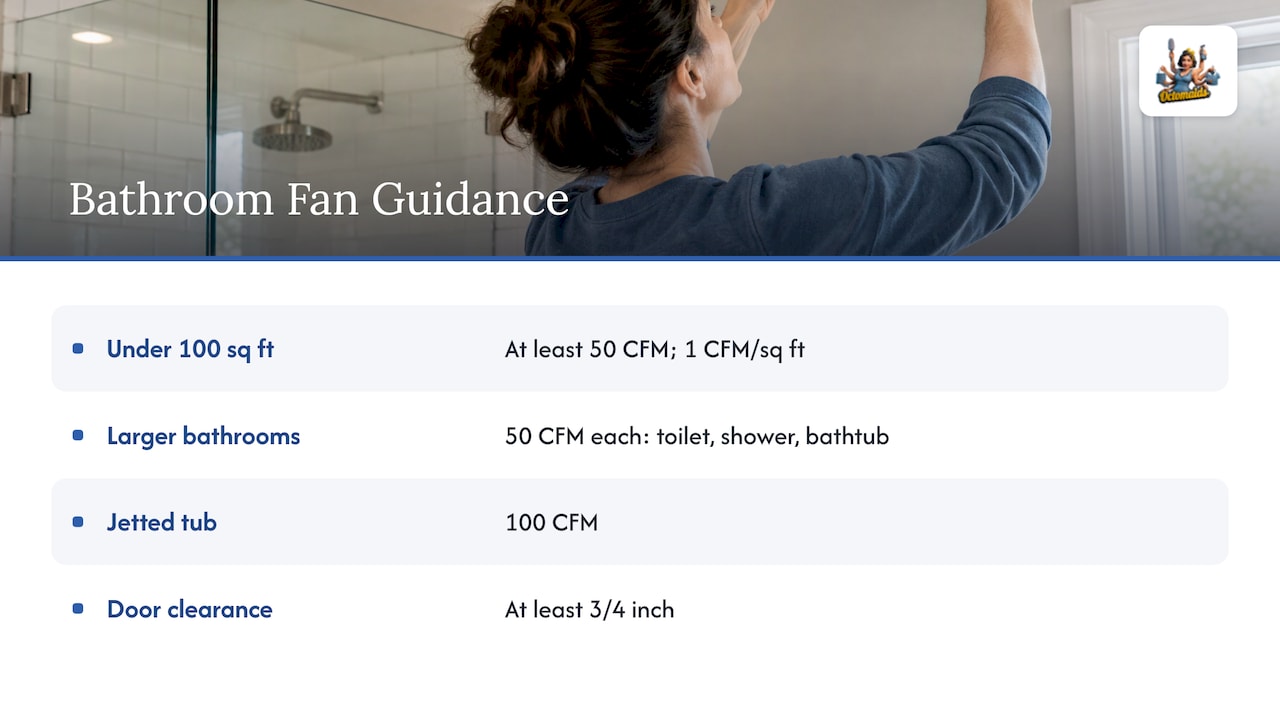
A weak or clogged fan feels like it is working while moisture lingers. The Home Ventilating Institute recommends, for intermittent ventilation, at least 50 CFM for bathrooms under 100 square feet, calculated at 1 CFM per square foot. For larger bathrooms it recommends 50 CFM each for a toilet, shower or bathtub, and 100 CFM for a jetted tub. It also says bathroom doors need at least 3/4 inch of clearance underneath to let replacement air in, so a door that seals tight against the floor can quietly weaken a good fan.
A quick test: hold a single square of toilet paper near the grille. If the fan can’t hold it there, it may be blocked with dust or undersized. Cleaning the cover is a five-minute job.
What about opening a window?
It can help. Consumer Reports says a window and door may be cracked during or right after a shower to help prevent moisture buildup. But it depends on the air outside. The Palm Beach County Cooperative Extension warns that in warm, humid Florida, opening windows can bring saturated outdoor air inside and raise mildew risk. In a cool, drizzly Northwest winter, outdoor air is cold but often damp too, so treat a window as a supplement to the fan, not a replacement.
Step 2: Keep humidity in range
The CDC says to keep home humidity as low as possible and no higher than 50% all day, and that an air conditioner or dehumidifier can help. Washington State’s Department of Health, in its 2026 mold fact sheet, advises keeping indoor humidity between 40% and 60% and suggests a hygrometer as a monitoring aid.
A hygrometer is an inexpensive gauge that reads relative humidity. Place one in or just outside the bathroom and watch two things:
- How high it climbs during a shower.
- How long it takes to drop back to your normal level.
If the number is still high an hour later, your ventilation needs work. If the whole house sits above 50% for days, a dehumidifier on the main floor or in a basement is worth considering.
Step 3: Dry the surfaces, not just the air
Air management handles vapor. Droplets on surfaces need a second step.
- Squeegee or wipe the walls and glass. Consumer Reports recommends squeegeeing or wiping shower walls after bathing. Wirecutter says a squeegee after every shower can reduce deep-cleaning needs to about once a quarter.
- Handle the curtain properly. Extend it so it air-dries instead of bunching. Lowe’s suggests leaving a shower door open for circulation, and closing a curtain while it dries before opening it for airflow.
- Hang towels and mats. Damp towels on the floor or a bath mat left flat on the tub edge hold water for hours. Hang towels so they dry fully, and drape the mat over the tub or a rail.
- Wash linens weekly. Consumer Reports recommends washing bath linens at least weekly.
- Clear the clutter. Bottles lined up on the tub ledge trap water and soap film underneath. Fewer items means fewer damp corners.
The whole routine adds about two minutes to a shower. It is the difference between a bathroom that needs rescuing and one that stays quietly clean.
Step 4: Clean on a schedule, because mildew eats residue
Mildew grows on soap residue as much as on moisture, so a clean surface is a harder surface for it to settle on. Consumer Reports recommends a weekly deep clean of the shower area. Between those, the squeegee habit does much of the work.
A simple rhythm:
| Frequency | Task |
|---|---|
| After every shower | Fan on, squeegee walls and glass, hang towels and mat |
| Weekly | Scrub the tub, shower walls, caulk lines and floor; wash bath linens |
| Monthly | Clean the fan cover, wash the shower curtain or liner, check caulk and grout |
| Quarterly | A more thorough scrub of grout, drain edges and behind fixtures |
If you’d like help deciding how often each room needs attention, our home cleaning frequency guide walks through it, and how to maintain a clean home between visits covers the small daily habits that keep a bathroom from sliding.
A safety note about cleaning products
Never mix bleach with ammonia or other household cleaners. Consumer Reports gives that warning plainly, and Wirecutter adds that mixing acidic cleaners with bleach-containing products can release toxic chlorine gas. Use one product at a time, rinse between products, keep the fan running and the door open while you clean.
For surface mold the EPA’s guidance is simple: scrub hard surfaces with detergent and water and dry them completely. If you are curious whether kitchen staples do the job, we cover that in Can Vinegar Kill Mold?.
Step 5: Fix the water source behind the mildew
If mildew keeps coming back in the same spot after you clean and ventilate, the cause is probably not the shower. It is water getting where you can’t see it.
The EPA says leaks around pipes, tubs and sinks can give biological pollutants a place to grow, and recommends fixing leaks and seepage. Timing matters: Wisconsin’s health department says mold growth can begin within 24 to 48 hours after a water leak, and recommends drying flooded areas fully in that window.
Check these spots every few months:
- Caulk where the tub or shower meets the wall. Look for gaps, discoloration that doesn’t wipe off, or peeling.
- Grout and tile. Consumer Reports says chipped tile or grout can let water reach the subfloor or drywall behind a shower, and recommends professional repair.
- Under the sink. Look at supply lines and the trap for drips or damp cabinet floors.
- Around the toilet base. Soft flooring or a stain that spreads is a warning sign.
- The ceiling below the bathroom. A brown ring or bubbling paint means water is traveling. This guide on ceiling water damage repair explains how to handle the damage once the leak is stopped.
A leaky seal is a repair job, not a cleaning job. Repair it first, then clean.
When mildew is more than a surface problem
Most bathroom mildew is a small, cleanable patch. Some situations are not.
The EPA says a moldy area smaller than about 10 square feet, roughly a 3-by-3-foot patch, can usually be handled by a homeowner. Washington’s Department of Health says to consider professional help when damage exceeds 3 by 3 feet, affects the building structure, involves a sewage leak, or suggests hidden mold. Consumer Reports adds that recurring mold can justify a professional inspection of wall insulation.
Porous materials are a special case. The EPA notes that porous items such as ceiling tiles and carpet may need to be thrown away, because mold can grow into spaces that are hard to clean.
One health point deserves its own line. The CDC’s clinical guidance says people with asthma or other lung conditions should not enter buildings with visible or smelled mold or indoor water leaks. If someone in your household has a respiratory condition, have another person do the cleaning, or hire it out, and ask their clinician about their specific situation.
Our perspective: prevention is a routine, and routines are easier with the same team
We have cleaned homes in Vancouver, WA and Portland, OR since 2006, and the pattern in bathrooms is familiar. Mildew rarely arrives overnight. It builds in the places a quick wipe skips: the caulk line, the bottom of the shower door track, the corner behind the shampoo bottles, the fan cover nobody has looked at in a year.
What we have learned is that consistency beats intensity. A bathroom that is cleaned thoroughly every week, by someone who knows where the trouble spots are, rarely needs a dramatic rescue. That is the idea behind sending the same dedicated team to your home each visit. They notice when a caulk line has started to darken, when grout looks different than last time, or when a corner stays damp. Those small observations are what let you fix a leak before it becomes a repair bill.
Our teams are background-checked, trained and insured, and our work is satisfaction guaranteed. We would never tell you cleaning replaces ventilation and leak repair. We would tell you that the two work together: you control the moisture, and a regular professional clean removes the residue mildew lives on.
Steven
Let us handle the weekly scrub
If the weekly bathroom deep clean is the habit that keeps slipping, that is exactly what our recurring home cleaning is for. You choose weekly, bi-weekly or monthly visits, and the same team returns each time, so they learn your bathrooms.

If your bathroom already needs a reset, a one-time deep cleaning is a good starting point before moving to a regular schedule. You can read what happens in each room in our bathroom deep cleaning guide, or see all our services for Vancouver, WA and Portland, OR homes, rentals and offices. To learn how a clean home supports a healthier one, read why professional cleaning creates a healthier home.
A simple bathroom mildew prevention checklist
Print it, screenshot it or tape it inside a cabinet door.
- Turn the fan on before you shower.
- Keep it running 20 to 30 minutes afterward.
- Squeegee or wipe the walls and glass.
- Extend the curtain and open the door for airflow.
- Hang towels and the bath mat so they dry fully.
- Wash bath linens weekly.
- Scrub the shower, tub and caulk lines weekly.
- Check caulk, grout and under-sink plumbing every few months.
- Clean the fan cover monthly.
- Keep home humidity at or below 50%, using a hygrometer if helpful.
FAQ
How do I keep mildew out of a shower?
Reduce the time surfaces stay wet. Run the exhaust fan during and after the shower, squeegee the walls and glass, extend the curtain so it dries, and hang towels and mats. Then scrub the shower weekly to remove the soap film mildew feeds on.
Does opening a window reduce bathroom mold?
Sometimes. A cracked window and door can help release moisture after a shower, as Consumer Reports notes. It only helps when the outside air is drier than the bathroom air, so use it alongside a fan that vents outdoors rather than instead of one.
What humidity level prevents bathroom mildew?
The CDC says to keep home humidity no higher than 50% all day. Washington’s Department of Health gives a 40% to 60% range for indoor humidity. A hygrometer shows you where your bathroom and home sit, and a dehumidifier can help if the number stays high.
What should I do if mildew keeps coming back?
Look for the water source. Check caulk, grout, plumbing and the ceiling below, and confirm your fan vents outside and runs long enough. If growth covers more than about 10 square feet, or you suspect moisture behind the walls, bring in a qualified professional.
Sources
- Mold | CDC
- What is the difference between mold and mildew? | US EPA
- What are the main ways to control moisture in your home? | US EPA
- Mold Cleanup in Your Home | US EPA
- Bathrooms | Harvard Healthy Buildings
- How Much Ventilation Do I Need? | Home Ventilating Institute
- How to Clean a Shower | Wirecutter
- How to Prevent Mold From Growing in Your Bathroom | Consumer Reports
- Controlling Indoor Mold | Wisconsin Department of Health Services
- Fact Sheet: Mold | Washington State Department of Health
- Avoid Mildew | Palm Beach County Cooperative Extension
- 6 Ways to Stop Mold in the Shower | Lowe’s
- Ceiling Water Damage Repair: A Complete DIY Guide
Recommended
- Bathroom Deep Cleaning: 8 Safe Steps and When to Hire
- Washing Bathroom Rugs the Right Way, Without the Guesswork
- Can Vinegar Kill Mold? What Actually Works and When to Call a Pro
- How to Clean White Grout: Fast DIY Steps for Homeowners
About Octomaids
Octomaids is a locally operated professional cleaning company serving Vancouver, Clark County, and the surrounding Portland metro area. Since 2006, our cleaning teams have helped homeowners, renters, property managers, and businesses with recurring cleaning, deep cleaning, move-in/move-out cleaning, and commercial cleaning.
Our cleaning articles are reviewed to ensure the information reflects our real-world experience and professional cleaning practices.