



When your desk is ten steps from the sink, the house is always in view. The way to keep it clean without losing focus time is to split the work in two: small daily resets that fit into breaks, and the deeper, time-consuming cleaning handed to a dedicated team on a recurring schedule. The daily layer keeps the house functional. The recurring visit keeps it clean. Below is how to build both, with realistic time budgets and what professional cleaning costs for an average-size home.
Key Takeaways
- Aim for a “functional” home on workdays, not a spotless one. Short breaks and a 15-minute closing routine carry most of the load.
- Keep cleaning out of your focus blocks. Use real breaks for 5 to 10 minute bursts, and one 15 to 20 minute zone per day.
- Floors, visible surfaces, beds and mirrors give the biggest visual payoff when time is short.
- Deep tasks (bathrooms, floors, kitchen detail) are where a recurring team saves you the most hours, and the same cleaners each visit mean you explain your home once.
- A 1,500-square-foot home typically costs $150 to $300 for a standard clean nationally, so you can budget before you call.
Table of Contents
- Why a home office makes cleaning harder
- Set the standard at “functional”
- Break-sized tasks that fit between meetings
- The closing routine: 15 minutes at the end of your workday
- A weekly zone plan for the rest
- Where the time goes: tasks that are hard to fit into breaks
- What a professional clean costs for a typical home
- Hiring a cleaner when you work from home: timing, scope and access
- What about the 7-step cleaning process?
- Our perspective
- Recurring cleaning for a home you work in
- FAQ
- Sources
Why a home office makes cleaning harder
Working from home removes the commute, but it also removes the boundary between “at work” and “at home.” The dishes you would have left until evening are now visible from your video call. The laundry basket is in the next room. Every small mess competes with your attention, and cleaning starts to leak into paid hours.
There is also more wear. More hours at home means more meals cooked, more coffee cups, more floor traffic and more trash. A routine built for someone who is out nine hours a day often collapses once you are home all day.
The fix is not more willpower. It is a smaller standard, a fixed rhythm, and a clear decision about which tasks you handle between meetings and which you hand off.
Set the standard at “functional”
The first rule in Working at Home Mom’s remote-work cleaning system is to lower the bar to functional: dishes handled, surfaces usable, floors walkable. That standard is deliberate. A spotless house requires hours you do not have on a workday, and chasing it drains the focus you are paid for.
A functional home means:
- No dishes left overnight.
- Counters clear enough to cook on.
- Trash taken out before it smells.
- A bathroom you would not mind a visitor using.
- A floor path from the door to your desk that is free of clutter.
Everything beyond that, such as baseboards, shower grout, the inside of the oven or mopping under furniture, belongs on a weekly or monthly rhythm or with a professional visit.
Break-sized tasks that fit between meetings
Treat cleaning as something that fills breaks and never touches focus time. The same system suggests using work breaks for 5 to 10 minute cleaning bursts, using a timer so the task does not swallow the break.
Here is a practical sorting by time available, drawing on the lists in NBC News Better’s guide to short cleaning windows:
| Time you have | Tasks that fit |
|---|---|
| 1 minute | Throw away trash, wipe a counter, make the bed |
| 2 minutes | Sweep one room, put away laundry, return ten items to where they belong |
| 5 to 10 minutes | Unload the dishwasher, wipe the kitchen after lunch, vacuum one room, start a laundry load |
| 15 to 20 minutes | One focus zone (see below) |
A useful trick is to attach the task to something you already do. Start the dishwasher after lunch. Switch laundry when you refill your coffee. Wipe the counter while the kettle heats. You are not adding a new habit so much as riding an existing one.
Which tasks to pick when time is short
If you can only do a little, pick the tasks people notice. Apartment Therapy’s piece on the 80/20 principle applied to cleaning recommends prioritizing floors, visible surfaces, beds, and glass or mirrors, and notes that vacuuming usually gives a more noticeable quick refresh than dusting.
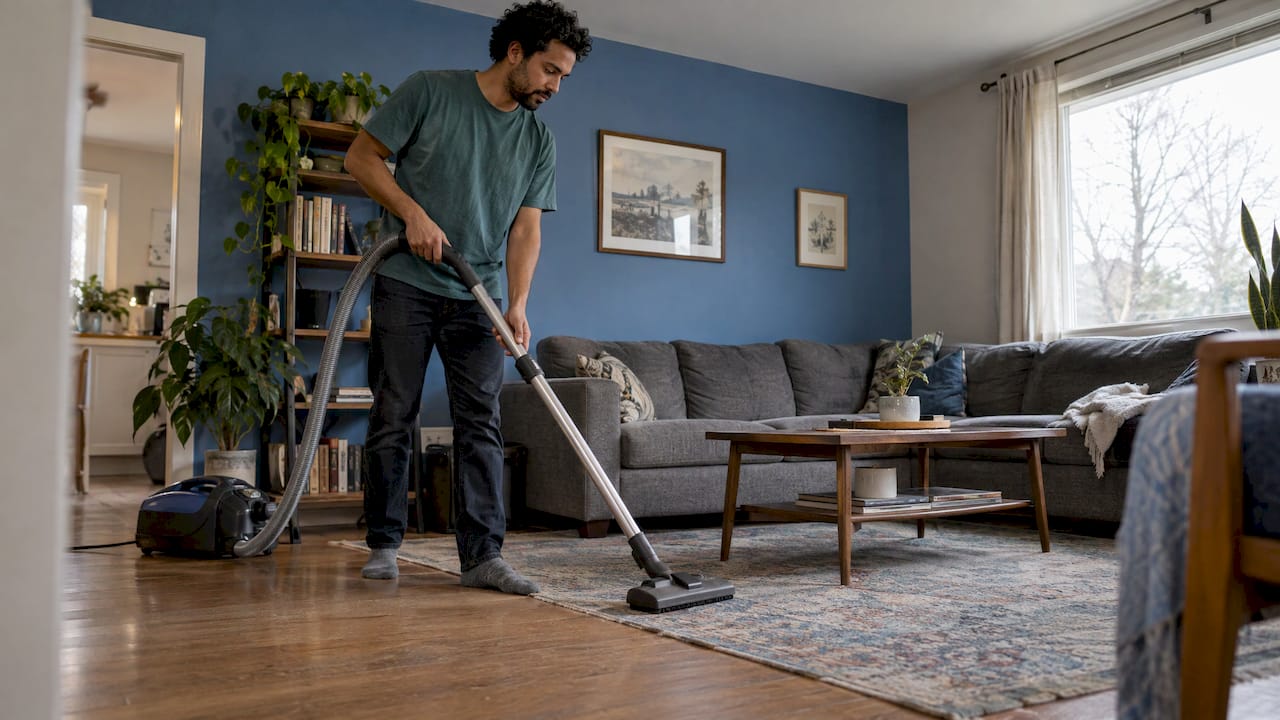
The 80/20 rule, in plain terms, says a small share of your effort produces most of the visible result. In a house, that small share is mostly the floor, the kitchen counters, the bed and the bathroom mirror. If those four are in order, the home reads as clean even when the shelves are dusty.
The closing routine: 15 minutes at the end of your workday
The habit that makes the biggest difference is a short reset when you stop working. It also gives your brain a boundary: when the reset is done, work is done.
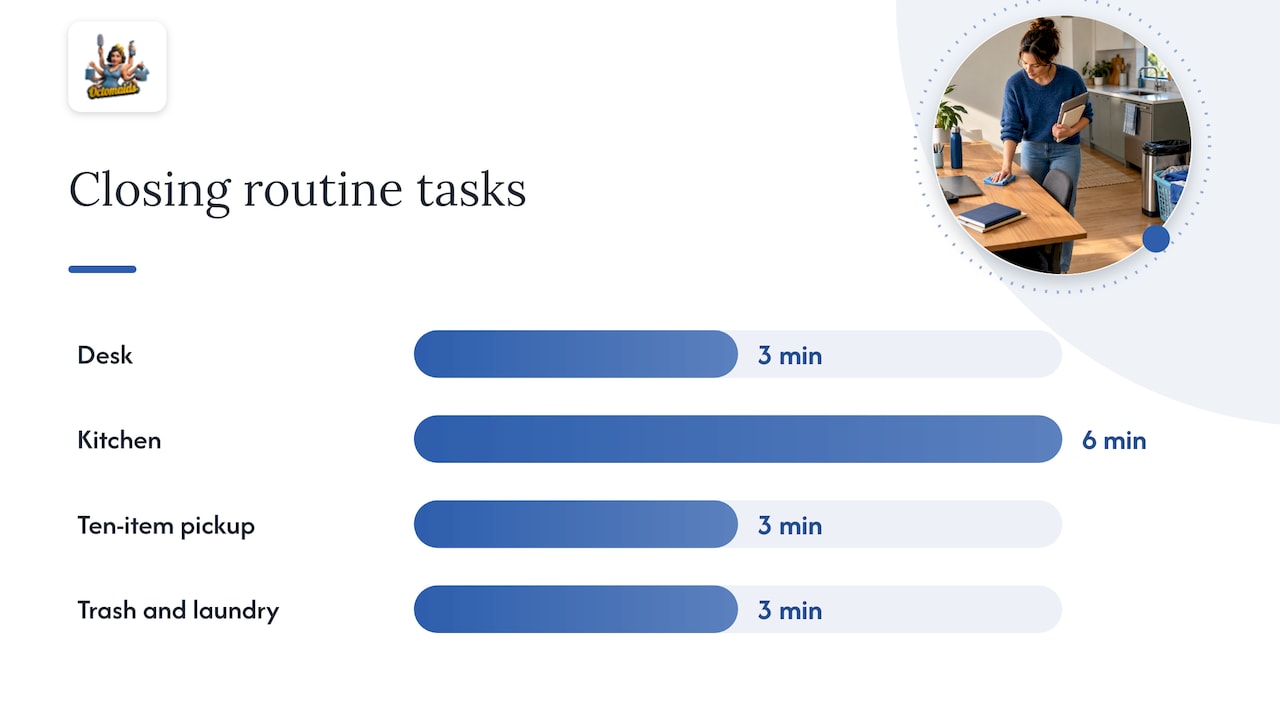
The Working at Home Mom system suggests a 15-minute end-of-day pass that includes tidying the workspace, a kitchen sweep, a ten-item pickup, and starting laundry. Real Simple’s “closing shift” method takes the same idea from restaurants: wash or load dishes, wipe counters, replace the trash bag, restock bathroom essentials, and reset the closet and entryway, so you wake up to a cleaner home.
A simple version you can run on a timer:
- Desk (3 minutes). Clear mugs and papers, close the laptop, put cables away.
- Kitchen (6 minutes). Load dishes, wipe counters and the stovetop, empty the sink.
- Ten-item pickup (3 minutes). Walk the main living area and return ten things to their places.
- Trash and laundry (3 minutes). Replace the bag, start or move a load.
If 15 minutes is too much on a heavy day, shorten it rather than skipping it. Tidied suggests a 10-minute nightly reset centered on the kitchen, living room and floor. The point is consistency, not completeness.
A weekly zone plan for the rest
Daily resets keep a home functional, but they do not clean bathrooms or scrub floors. For that, rotate one zone per weekday, 15 to 20 minutes each. A sample week:
- Monday: Kitchen counters, appliance fronts, microwave.
- Tuesday: Bathroom sink, toilet and mirror.
- Wednesday: Vacuum main living areas.
- Thursday: Bedrooms: sheets, surfaces, floor.
- Friday: Mop hard floors, wipe entryway.
The University of Wisconsin–Madison Extension’s housecleaning guide uses a similar tiering: dishes and counters daily, floors weekly, and the oven and refrigerator monthly. If you want a ready-made version of that rhythm, our recurring cleaning schedule examples and weekly cleaning routine guide show how to lay it out. For how often each task really needs doing, see our cleaning frequency guide.
Leave slack in the plan
Schedules fail when they assume a perfect week. Done Enough’s cleaning schedule for working parents recommends planning for fewer hours than you actually have, keeping a fallback for each slot, and keeping cleaning out of paid hours unless you are on a genuine break. A fallback can be as small as “if I miss Wednesday’s vacuuming, I only do the kitchen floor on Thursday.”
The same page, citing CDC guidance from January 2025, notes that cleaning on its own removes most harmful viruses and bacteria from surfaces, and that disinfecting is needed when someone in the home is sick or immunocompromised. For a home office, that means a regular wipe of the desk, keyboard area, door handles and phone is enough most weeks. If someone is ill or has a weakened immune system, ask their doctor what disinfecting steps they recommend.
Where the time goes: tasks that are hard to fit into breaks
Break-sized cleaning works for upkeep. It struggles with jobs that need an uninterrupted block and a real clean-down:
- Scrubbing showers, tubs and toilets properly.
- Mopping the whole home after vacuuming.
- Kitchen detail: inside the microwave, range hood, appliance fronts and cabinet faces.
- Baseboards, door frames, light switches and ceiling fans.
- Anything that involves moving furniture.
These are the tasks that tend to roll from Saturday to the next Saturday, and the weekend you wanted to rest becomes a cleaning day. When that happens, the cost of doing it yourself is not money, it is the two to four hours you would otherwise spend with family or on work you are good at.
For busy professionals, this is the natural handoff. Our guides on keeping a home clean with long hours and cleaning services and work-life balance cover how people divide the work.
What a professional clean costs for a typical home
Price depends on size, condition and how often. As a national reference, Housecall Pro’s 2026 pricing guide puts a 1,500-square-foot home at $150 to $300 for a standard clean and $180 to $450 for a deep clean. Its per-square-foot ranges are $0.10 to $0.20 for standard and $0.12 to $0.30 for deep cleaning. The guide lists local labor rates and cost of living, the type and scope of cleaning, service frequency, and whether one cleaner or a crew does the work as the main drivers of price.
Those are national averages, and the Pacific Northwest can sit above them. For a quote on your own home, the most reliable number is one based on your floor plan, number of bathrooms and the condition of the house.
Here is a worked example. Suppose your 1,500-square-foot home is quoted at the national standard range of $150 to $300. Choosing a recurring schedule means your home never drifts into deep-clean territory. Deep cleaning is priced higher because it covers more detail on a house that has gone longer between cleans, so staying on a regular rhythm keeps each visit closer to the standard scope.
Hiring a cleaner when you work from home: timing, scope and access
Having someone in your home while you are on calls takes a little planning. These are the decisions to settle once, up front.
Timing. Pick a day when your calendar is lightest, or when you have a standing block away from your desk. A visit is quieter when you have a clear plan for where you will work. Because a cleaner’s vacuum and kitchen noise travel, many people schedule around their most important calls.
Scope. Write down what you want done each visit and what rotates. A common split is bathrooms, kitchen and floors every visit, with baseboards, interior windows or appliances on a rotation. Our monthly house cleaning checklist gives 30 tasks room by room you can use to choose.
Access. Decide how the team gets in: you at home, a key, or a code. Working from home makes access easy, but plan for days you are out. This is also where who comes matters. Our team assigns the same dedicated, background-checked, insured cleaners to your home each visit, so the person in your home while you work is someone you know rather than someone new.
Frequency. Weekly, bi-weekly or monthly. If you are home all day and cook often, bi-weekly is the most common choice. We compare the options in biweekly vs monthly cleaning.
What about the 7-step cleaning process?
The “seven steps” people search for is a general sequence that keeps any cleaning job efficient. The common order is:
- Declutter and put away items.
- Dust from high to low.
- Clean kitchen surfaces and appliances.
- Clean bathrooms.
- Clean glass and mirrors.
- Vacuum.
- Mop hard floors last.
The logic is simple: work top to bottom so dust and crumbs fall onto surfaces you have not cleaned yet, and finish with floors so you do not walk over wet areas. You can run it inside a weekly zone plan, though a full pass through all seven steps is the part that eats a Saturday.
Our perspective
We have been cleaning homes in Vancouver, WA and Portland, OR since 2006, and the pattern for people who work from home is consistent: the daily mess is manageable, but the weekly deep work is what falls behind.
Our view is that a home office changes the question. You are not asking whether you have time to clean. You are asking which hours of the week you want back. Break-sized tidying keeps the house functional, and we think the heavier cleaning is best handled by a team that knows your home.
That is why we send the same dedicated team every visit rather than random staff. Our cleaners are background-checked, professionally trained and insured, and we are a family-owned local company, not a franchise. When the same people return, they learn your layout, your kitchen, your preferences, and you spend less time explaining and more time working.
Use the routines above to keep daily life smooth, then let a recurring visit reset the whole house on a schedule you can plan around.
Steven
Recurring cleaning for a home you work in
If you want the heavy cleaning off your list, our recurring home cleaning service is built for this: weekly, bi-weekly or monthly visits from the same dedicated team, serving homeowners across Clark County, WA and the Portland metro area. Your daily resets stay small, and the bathrooms, floors and kitchen detail are done on schedule.

If your home needs a fresh start first, a one-time deep clean brings it up to a baseline that a recurring routine can then maintain. For pricing based on your home, contact us through our website.
FAQ
How do I keep my house clean while working from home?
Set a “functional” standard, use 5 to 10 minute breaks for tasks like unloading the dishwasher and wiping counters, and finish each workday with a 15-minute reset. Rotate one 15 to 20 minute zone per weekday for the deeper tasks, and keep cleaning out of your focus time.
What is the 80/20 rule for house cleaning?
It means a small share of your effort creates most of the visible result. In practice, that is floors, visible surfaces, beds and mirrors. Vacuuming and clearing surfaces will make a room look cleaner faster than dusting shelves.
How much does it cost to clean a 1,500-square-foot house?
Nationally, Housecall Pro’s 2026 guide lists $150 to $300 for a standard clean and $180 to $450 for a deep clean. Local labor costs, the home’s condition, frequency and crew size all move the number, so a quote for your own home is the reliable figure.
How often should I have a cleaner if I work from home?
Most people who are home all day choose bi-weekly visits, with weekly for larger households or heavy kitchen use. Monthly works when your daily routine is consistent and you only need the deeper tasks covered. Our cleaning frequency guide helps you choose.
Do I need to disinfect, or is cleaning enough?
According to the CDC guidance summarized by Done Enough, cleaning alone removes most harmful viruses and bacteria from surfaces. Disinfecting is called for when someone in the home is sick or immunocompromised, and their doctor can advise on specifics.
Sources
- Cleaning While Working Remotely: A Simple System to Keep Your Home Clean
- How the “Closing Shift” Method Can Help You Wake Up to a Cleaner Home
- What to clean if you only have five, ten or 20 minutes
- Clean Your House with the 80/20 Pareto Principle
- How to Keep House Clean While Working Full Time
- University of Wisconsin–Madison Extension housecleaning guide
- Cleaning Schedule for Working Parents: 20 Minutes a Day
- House Cleaning Pricing Guide 2026
Recommended
- Keep Home Clean with Long Hours: A Busy Pro’s Guide
- Create a Weekly Cleaning Routine Fast: 2026 Guide
- Weekly Cleaning Tasks to Automate for Busy Homes
- Recurring Cleaning Schedule Examples for Busy Homes
About Octomaids
Octomaids is a locally operated professional cleaning company serving Vancouver, Clark County, and the surrounding Portland metro area. Since 2006, our cleaning teams have helped homeowners, renters, property managers, and businesses with recurring cleaning, deep cleaning, move-in/move-out cleaning, and commercial cleaning.
Our cleaning articles are reviewed to ensure the information reflects our real-world experience and professional cleaning practices.