


Short-term rental cleaning is not a faster version of residential cleaning. It is a fundamentally different service, built around a different set of pressures, standards, and consequences. Where residential cleaning maintains a home for the people who live in it, STR turnover cleaning resets a property completely for a stranger arriving in a matter of hours, and that stranger will rate your cleanliness publicly.
The core differences come down to four things:
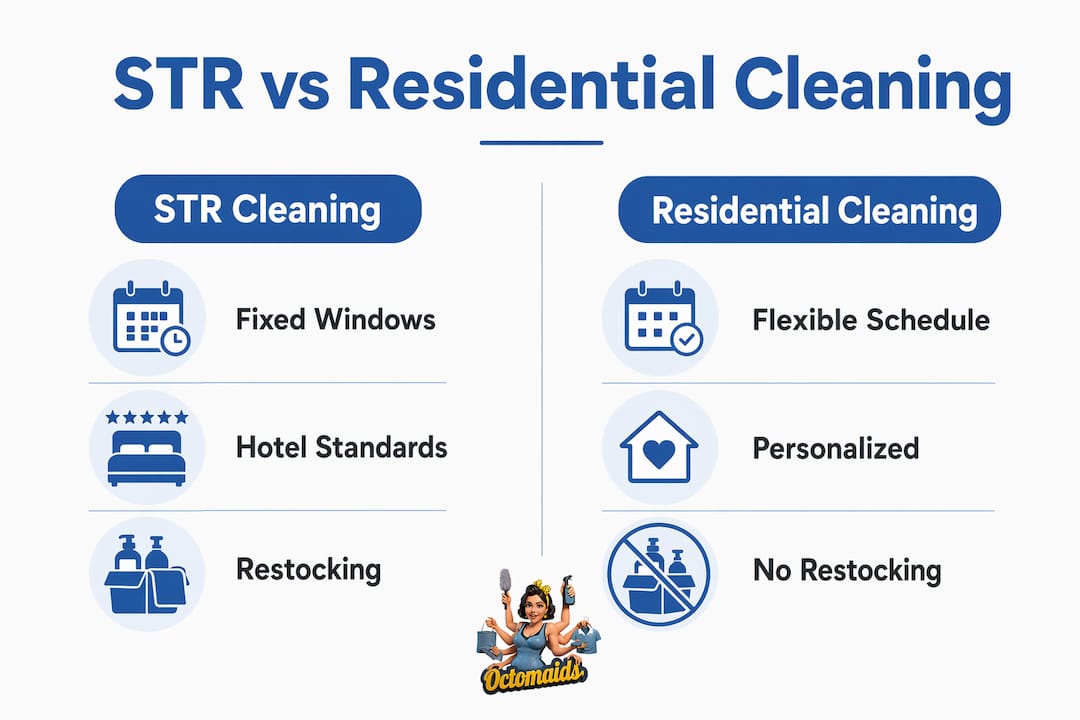
- Time windows are rigid. Turnover cleaning typically runs in a 3–5 hour window between 10:00 AM checkout and 3:00 PM check-in. There is no rescheduling.
- The standard is hotel-ready, not livable. Every surface must be sanitized, every trace of the previous guest removed, and the property staged to match listing photos exactly.
- Scope includes tasks residential cleaning never touches. Restocking toiletries, coffee pods, and linens; photographing the property after cleaning; and conducting a damage inspection are all part of a standard STR turnover.
- The stakes are financial and public. Missing the cleaning window can trigger guest refunds or relocation costs. A single poor cleanliness review can cost a host their Superhost status.
Residential cleaning, by contrast, works on a weekly or biweekly schedule with flexible timing, no restocking obligations, and quality feedback that surfaces slowly over days or weeks. Understanding why STR cleaning differs from residential cleaning is the first step toward managing your property’s reputation and revenue effectively.
How turnover cleaning standards differ from residential cleaning
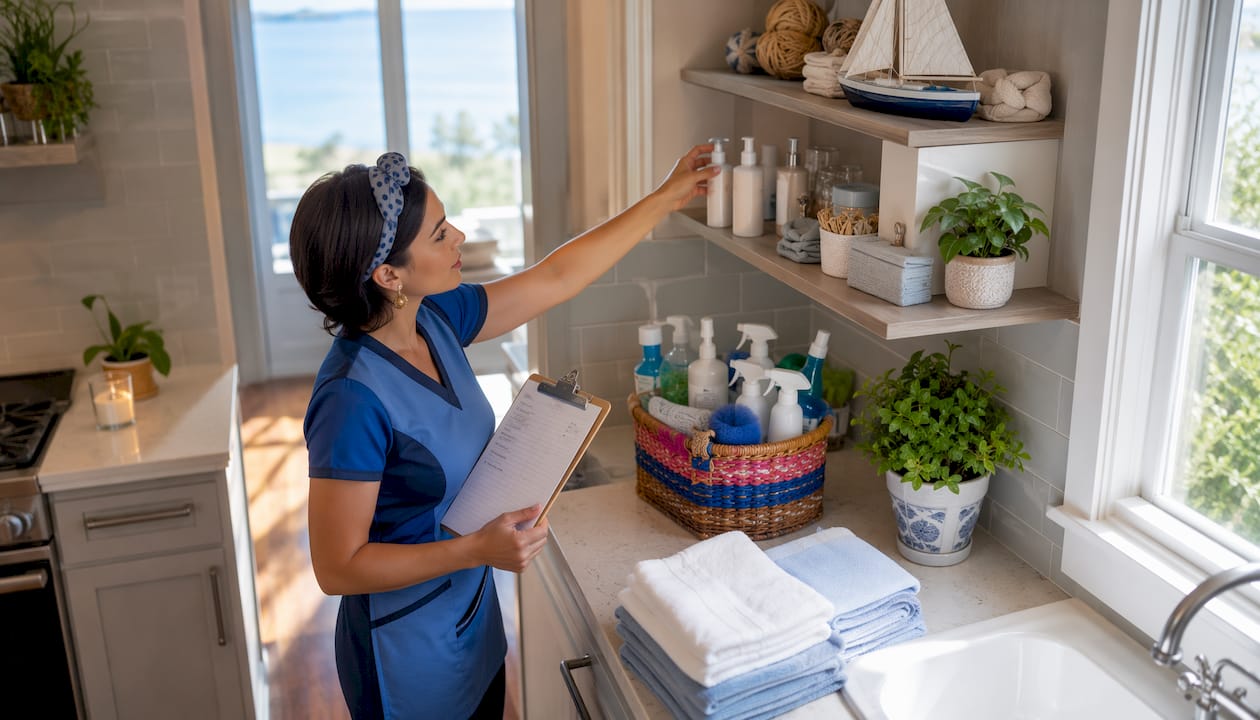
The clearest way to understand the difference between STR cleaning and residential cleaning is to look at what each one actually requires, task by task.
Residential cleaning focuses on maintenance. A cleaner wipes surfaces, vacuums floors, scrubs bathrooms, and leaves the home functional for the people who live there. If a kitchen mat has a stain, you flip it over. If a cabinet is slightly dusty, it can wait until next week. The occupant knows the home, accepts its current state, and provides feedback privately.
STR turnover cleaning operates at a completely different level. The goal is a full reset to hotel-ready standard between every guest stay, with zero traces of the previous occupant. That means:
- Deep sanitization of all high-touch surfaces including light switches, door handles, remote controls, and appliance controls, not just visible countertops
- Full bathroom and kitchen scrubbing including inside the microwave, inside the refrigerator, and behind appliances
- Linen replacement and laundering at every turnover, not just when the occupant requests it
- Restocking consumables including toiletries, coffee pods, paper products, and kitchen supplies to a defined inventory level
- Staging the property to match listing photos precisely, including pillow arrangement, window treatments, and decorative items
- Odor inspection and treatment because guests notice smells before they notice anything else
- Damage inspection with notes on anything broken, missing, or worn
- Photo documentation of the completed clean for liability protection
The staging requirement alone sets STR cleaning apart from anything in a residential contract. Adjusting pillows, repositioning throw blankets, and resetting decorative items to a specific look is a hospitality task, not a cleaning task. Yet it falls squarely within the STR cleaner’s scope every single time.
Pro Tip: Keep a laminated reference photo of each room’s staged setup inside the property. Cleaners can match the photo without guessing, which cuts staging time and eliminates inconsistency across different crew members.
What does an effective STR cleaning checklist look like?
Consistency is the backbone of a five-star cleanliness rating, and consistency comes from a checklist, not from memory. A well-built STR checklist is property-specific, reusable, and detailed enough that any trained cleaner can execute it without supervision.
The checklist framework that works best for STR properties organizes tasks by room and by category within each room: surfaces, floors, linens, restocking, and staging. Auto-task tools tied to guest checkout events can push the checklist directly to a cleaner’s phone the moment a guest checks out, eliminating the need for manual coordination.
Here is a practical room-by-room checklist framework:
| Area | Cleaning Tasks | Restocking / Staging |
|---|---|---|
| Bedroom | Dust all surfaces, wipe headboard, vacuum under bed, clean mirrors | Replace linens, stage pillows, set out fresh towels |
| Bathroom | Scrub toilet, tub, shower, sink; disinfect all surfaces; clean mirror | Restock soap, shampoo, conditioner, toilet paper, tissues |
| Kitchen | Wipe inside microwave and fridge, clean stovetop, disinfect counters | Restock coffee pods, dish soap, sponge, paper towels |
| Living room | Dust all surfaces, vacuum upholstery, wipe remotes and switches | Stage throw pillows and blankets to listing photo |
| Laundry | Wash and dry all used linens and towels | Fold and store backup set; report low inventory |
| Entry / outdoor | Sweep porch, wipe door handles, check for left items | Remove any guest belongings; reset welcome mat |
The difference between this and a residential checklist is not just length. It is the restocking column. Residential cleaners do not track inventory. STR cleaners do, and that inventory management responsibility changes the entire operational model, including pricing and supply chain logistics.
- Use a digital checklist app so completion is time-stamped and trackable
- Build a separate deep-clean checklist for quarterly visits that covers baseboards, air filters, grout, and behind appliances
- Photograph the property after every turnover and store images by date for damage dispute records
How should you schedule STR cleaning and deep cleans?
Scheduling is where the difference between STR and residential cleaning becomes most operationally demanding. Residential cleaning runs on a predictable weekly or biweekly cycle that the cleaner and homeowner agree on in advance. STR cleaning is driven entirely by guest behavior, platform booking patterns, and check-in/check-out windows.
The standard turnover window runs from 10:00 AM to 3:00 PM, giving a cleaner 3–5 hours regardless of property size. A professional cleaner can typically handle 3–4 turnovers per day at most before quality starts to slip. Same-day booking notifications from platforms like Airbnb can generate turnover requests with less than 12 hours’ notice, which is why tracking maintenance schedules and automated task triggering are worth building into your workflow from the start.
Beyond the turnover schedule, STR properties require planned deep cleans on a separate cadence:
- Every 3–6 months for most properties, depending on booking volume and season, per Rent Responsibly’s STR Cleaning 101
- Quarterly for high-traffic properties during peak seasons, when allergens, mold, and wear accumulate faster
- After long stays or large groups, which tend to generate more wear than standard two-night bookings
Deep cleaning tasks go well beyond turnover scope. They include moving and cleaning behind appliances and heavy furniture, steam cleaning carpets and upholstery, scrubbing grout, polishing light fixtures, wiping baseboards, and inspecting air filters. These are the tasks that keep a property feeling genuinely fresh rather than just surface-clean.
Seasonality adds another layer of complexity. A beach property in peak summer may need quarterly deep cleans simply because of the volume of guests cycling through. The same property in the off-season might hold a six-month schedule comfortably. Building that flexibility into your cleaning plan, rather than treating deep cleans as a fixed annual event, protects both the property and the guest experience.
How to set up your STR property for faster, better turnovers
The physical setup of your property has a direct impact on how quickly and thoroughly it can be cleaned. Properties cluttered with personal items, decorative knickknacks, or hard-to-clean surfaces slow every turnover down and create more opportunities for things to be missed.
The most effective STR properties are designed with cleaning in mind from the start:
- Minimize decorative clutter. Every item on a shelf or countertop is something a cleaner must move, wipe under, and replace. Fewer items mean faster turnovers and fewer staging errors.
- Choose durable, easy-to-clean materials. Hard flooring, wipeable countertops, and machine-washable throw covers reduce cleaning time and extend the life of your furnishings.
- Standardize your consumable inventory. Keep a defined par level for every restockable item: two rolls of toilet paper per bathroom, one bar of soap, one bottle of shampoo. Consistent inventory makes restocking fast and makes shortages obvious.
- Store cleaning supplies on-site in a locked cabinet. Professional-grade disinfectants, microfiber cloths, a mop, and a vacuum should be available at the property so cleaners are not transporting supplies between jobs.
- Label storage areas clearly. When backup linens, paper products, and cleaning agents are stored in labeled, consistent locations, any cleaner can find what they need without asking.
Linen management deserves special attention. A typical three-bedroom STR generates a meaningful volume of laundry per turnover, and wash-and-fold services affect pricing differently than residential laundry, where the occupant handles their own. Keeping two full sets of linens per bed allows cleaners to strip and replace immediately, sending the used set to laundry without holding up the turnover.
Pro Tip: Invest in a linen inventory system, even a simple spreadsheet tracking sets per property. Linens are one of the most common sources of inventory loss in STR operations, and knowing your counts prevents shortages on busy weekends.
What professional cleaners know about STR that most hosts don’t
The financial and reputational stakes of STR cleaning create a service environment that experienced cleaners describe as closer to hospitality management than housekeeping. Guest cleanliness scores are collected publicly after every stay, and a single low rating can drop a host below the threshold required for platform status benefits. That pressure changes how professional cleaners approach every turnover.
Experienced STR cleaners treat each turnover as an inspection, not a cleaning appointment. That means documenting the property’s condition with photos before and after the clean, noting any damage or missing items, and flagging issues to the host immediately rather than waiting for the next visit. This documentation practice protects both the cleaner and the host in damage disputes.
Pricing is where many hosts and new cleaning businesses get into trouble. STR turnover rates run 20–40% higher than equivalent residential cleaning rates, reflecting the deadline pressure, linen management, restocking scope, and same-day availability requirements. Anchoring STR pricing to residential rates is one of the most common and costly mistakes new cleaning providers make. The scope simply does not match.
A few other realities that professional cleaners navigate that most hosts underestimate:
- Same-day turnovers require premium pricing. Last-minute booking notifications that generate same-day cleaning requests carry real operational costs, including rerouting crews and accelerating timelines.
- Seasonal demand requires flexible systems. Peak booking seasons compress turnovers and increase the risk of scheduling failures. Automated task management tools that trigger assignments at checkout reduce the chance of a missed window.
- Cleaner relationships matter more in STR than in residential. A reliable, trained cleaner who knows your property is worth protecting. High turnover in your cleaning staff translates directly into inconsistent guest experiences and lower review scores.
The transition from residential to STR cleaning, whether you are a host managing your own property or a cleaning business expanding into the STR market, requires adjusting every assumption about scope, timing, and pricing. The role of professional cleaners in STR management is closer to a hospitality operations partner than a traditional house cleaner.
Key Takeaways
STR cleaning requires a complete property reset under strict time pressure, held to hotel-level standards, with restocking, staging, and photo documentation built into every single turnover.
| Point | Details |
|---|---|
| Turnover windows are fixed | STR cleaning runs in a fixed window between guest checkout and check-in, with no flexibility for delays. |
| Hotel-level standard every time | Every turnover requires full sanitization, linen replacement, and staging to listing photos, not just surface maintenance. |
| Deep cleans are scheduled, not optional | STR properties need a deep clean every 3–6 months, more frequently during peak seasons. |
| Pricing must reflect the scope | STR turnover rates run 20–40% higher than residential cleaning rates due to deadline pressure and expanded task scope. |
| Octomaids handles STR turnover cleaning | Octomaids provides short-term rental cleaning in the Vancouver, WA and Portland, OR area, with the same trusted cleaners every visit. |
The part of STR cleaning most hosts figure out too late
There is a pattern I see repeatedly with hosts who manage their own cleaning or hire a residential cleaner for their STR property. Everything looks fine for the first few bookings. Then a guest leaves a three-star cleanliness review, and the host cannot figure out why. The place looked clean to them.
The problem is that “clean to a resident” and “clean to a guest” are genuinely different thresholds. A resident knows the quirks of their home. A guest walks in with fresh eyes and hotel expectations. They notice the soap dispenser that was not refilled, the pillow that is slightly off-center, the faint smell from a trash can that was emptied but not wiped out. These are not unreasonable complaints. They are the natural result of applying residential cleaning standards to a hospitality product.
What I think hosts underestimate most is the documentation piece. Taking photos after every clean feels like extra work until the day a guest claims damage that was already there before their stay. At that point, those photos are worth more than any cleaning fee. Professional STR cleaners build this into their workflow automatically. Hosts who manage their own cleaning often skip it entirely, and that gap in accountability creates real financial exposure.
The other thing worth saying plainly: if you are pricing your STR cleaning based on what you pay for residential cleaning, you are almost certainly underpaying. The scope is different, the stakes are different, and the operational demands are different. A cleaner who is underpaid for the actual work will eventually cut corners, and those corners show up in your reviews. Paying the right rate for STR cleaning is not a cost. It is a revenue protection strategy.
Octomaids cleans STR properties the way guests actually judge them
Managing a short-term rental in the Vancouver, WA or Portland, OR area means competing with properties that take cleanliness seriously. Octomaids has been serving homeowners and property managers throughout Clark County and the Portland Metro since 2006, and our team understands the difference between a clean house and a guest-ready property.
We bring the same trusted cleaners to your property every visit, which means your STR gets a team that knows your layout, your inventory, and your staging setup. No retraining between bookings. No surprises on turnover day. Our STR cleaning service covers the full scope: sanitization, linen management, restocking, staging, and photo documentation after every clean.
If you want to see what a professionally managed turnover looks like for your property, get in touch with Octomaids to schedule your first STR cleaning and see the difference a trained, consistent team makes.
FAQ
What is the main difference between STR and residential cleaning?
STR turnover cleaning resets a property to hotel-ready standard for each new guest, including restocking, staging, and photo documentation. Residential cleaning maintains a home for its occupants on a flexible schedule without those additional tasks.
Is STR cleaning more expensive than residential cleaning?
Yes. STR turnover rates run 20–40% higher than equivalent residential cleaning rates, reflecting deadline pressure, linen management, restocking obligations, and same-day availability requirements.
How often should an STR property get a deep clean?
Most STR properties need a deep clean every 3–6 months, with high-traffic properties requiring quarterly deep cleans during peak seasons to control allergen and wear buildup.
Is it better to hire a residential or STR-specialized cleaner for a vacation rental?
A cleaner who specializes in STR turnovers understands the hotel-level standard, restocking scope, and time pressure that residential cleaners are not trained for. For a vacation rental, an STR-specialized cleaner consistently delivers better guest outcomes.
What happens if an STR cleaning window is missed?
Missing the cleaning window means the incoming guest cannot check in on time, which typically triggers a refund or relocation cost for the host, along with a near-certain negative review.