


Most Vancouver, WA Airbnb hosts pay somewhere between $75 and $250 per turnover, depending on unit size, with studios and one bedrooms running lower and three bedroom or larger properties running higher. Set your guest-facing cleaning fee at or above your actual cost, and check it against 25% to 50% of your average daily rate. If your fee is mandatory, treat it as taxable Washington lodging revenue and confirm the current thresholds before you publish your listing price.
TL;DR:
- Most Vancouver, WA Airbnb hosts should set cleaning fees between $60 and $170 per turnover, aligning with 25% to 50% of average daily rates.
- Labor costs in Clark County typically range from $20 to $30 per hour, with a two-hour clean costing around $40 to $60 for one- and two-bedroom units.
- Different pricing models exist, but flat per-turnover rates simplify budgeting and are preferable for hosts with consistent cleaning partnerships.
- Short-term rental cleans include linens, bathroom and kitchen sanitation, trash removal, restocking, and guest staging, with add-ons like pet cleanup and deep cleaning increasing costs.
- Reliability and consistency of the cleaning team are more important than the lowest quote to protect your reviews and Superhost status.
Table of Contents
- How Much Does Airbnb Cleaning Cost in Vancouver, WA?
- Pricing Models: How Vancouver Cleaners Structure Their Rates
- Setting Your Guest-Facing Cleaning Fee: A Step-By-Step Method
- Washington Tax Rules and RCW Obligations Every Host Should Know
- What’s Actually Included in a Short-Term Rental Turnover Clean
- Budgeting Scenarios: Running the Numbers for Your Property
- How Octomaids Approaches Short-Term Rental Cleaning in Vancouver, WA
- Why Reliability Beats the Cheapest Quote
- Book a Reliable Vancouver, WA Cleaning Team for Your Rental
- Sources
- FAQ
How Much Does Airbnb Cleaning Cost in Vancouver, WA?
National benchmark data gives you a starting point, but it can also mislead you if you read it wrong. AirROI’s 2026 analysis puts the average US cleaning fee at $188, while the median sits much closer to $75. That gap matters. A handful of large luxury properties with $400 cleaning fees pull the mean upward, but most hosts with a typical one or two bedroom unit charge far less than that average suggests.
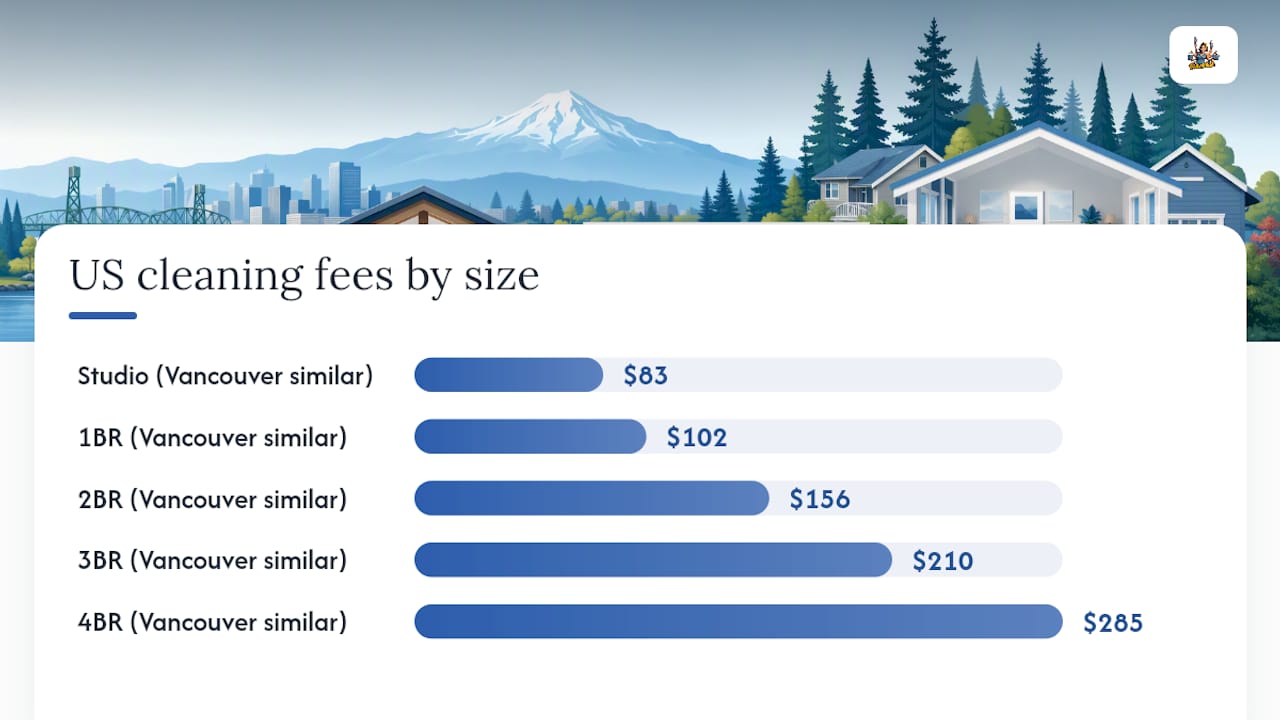
By bedroom count, AirROI’s data breaks down like this nationally: studios average around $83, one bedrooms about $102, two bedrooms roughly $156, three bedrooms near $210, and four bedroom properties closer to $285. Vancouver and Portland area hosts tend to land near or slightly below these figures for standard turnovers, though labor costs in Clark County have crept up in recent years, and demand spikes during summer festival season or Portland Trail Blazers home games can push local cleaner rates higher on short notice.
Labor is the biggest line item in any quote. Professional turnover cleaners typically charge in the $20 to $30 per hour range, and a standard two-hour clean on a one or two bedroom unit often lands between $40 and $60 in labor alone. Larger homes or units needing a deeper reset between guests can run $80 to $150 or more. On top of labor, expect to pay for consumables and restocking.
A realistic per-turnover budget breaks down roughly like this:
- Studio or 1BR: $60 to $110 total, including labor and basic restocking
- 2BR: $100 to $170 total, accounting for an extra bathroom and more linens
- 3BR: $150 to $230 total, with more surface area and higher laundry volume
- 4BR or larger: $200 to $320+ total, especially with multiple bathrooms and outdoor space
Supplies and restocking (soap, paper products, coffee, laundry detergent) typically add $10 to $25 per turnover on top of labor. Short-term rental cleaning also carries a built-in premium over standard house cleaning. HomeGuide’s cost data shows STR turnovers run 20% to 40% higher than equivalent residential cleanings, largely because of compressed turnaround windows and the hotel-style prep guests expect: hospital-corner beds, folded towels, and a kitchen that looks untouched.
Pricing Models: How Vancouver Cleaners Structure Their Rates
The quote you get from a local cleaner will usually follow one of four structures, and each one shifts the risk between you and the cleaning team differently.
- Flat per-turnover rate. You pay one fixed price regardless of how long the clean actually takes. This gives you predictable budgeting and makes it easy to set your guest fee, but you can end up overpaying on light turnovers, like a one-night stay from a tidy solo traveler versus a family of six who stayed a week.
- Hourly billing. You pay for actual time on site, which can save money on easy turnovers but requires you to track hours and occasionally question a bill that runs longer than expected. If you go this route, time two or three real turnovers yourself and compare the billed hours to what you observe. A pattern of consistently inflated hours is your cue to ask for a fixed rate instead.
- Per-room or per-bedroom pricing. Common with larger cleaning companies, this scales cost directly with unit size and works well if your portfolio includes properties of different sizes, since it removes guesswork from quoting a new listing.
- Recurring contract pricing. Hosts with frequent turnovers can often negotiate a discounted rate or a monthly minimum in exchange for guaranteed volume. A recurring service arrangement also tends to improve reliability, since the cleaning company prioritizes scheduled clients over one-off jobs.
Most Vancouver hosts do best with flat per-turnover pricing once they have a consistent cleaning partner, since it simplifies fee-setting on the guest side even if it costs slightly more on the lightest bookings.
Setting Your Guest-Facing Cleaning Fee: A Step-By-Step Method
Your cleaning fee should never be a guess. It’s a calculation with three steps.
Step 1: Tally your actual cost. Add labor, supplies, linen laundering (in-house or outsourced), and a small administrative buffer for scheduling and communication. For a typical two bedroom Vancouver rental, that might total $130 to $150 per turnover once everything is counted.
Step 2: Decide your coverage level. You can pass through 100% of actual cost to guests, or subsidize part of it by folding some cost into your nightly rate to keep the itemized fee lower and more attractive on short stays.
Step 3: Benchmark against your ADR. Market data shows that cleaning fees set between 25% and 50% of average daily rate correlate with stronger annual revenue among listings that charge a fee at all.
Pro Tip: If your ADR is $150 and your actual cleaning cost is $130, a $65 to $75 fee sits comfortably in that 25% to 50% band while still recovering most of your cost.
A few worked examples make this concrete:
- ADR $120, actual cost $90: A $50 fee (42% of ADR) covers most of your cost without scaring off one-night bookers.
- ADR $200, actual cost $140: A $90 fee (45% of ADR) fully covers cost and stays within the revenue-friendly range.
- ADR $300, actual cost $170: A $110 fee (37% of ADR) leaves room to absorb minor cost fluctuations across seasons.
For properties that see a lot of single-night bookings, consider embedding part of the cleaning cost into your nightly rate instead of itemizing the full amount, as explained in how to book a weekend stay and get the best deal. A large itemized fee on a one-night stay reads as expensive per night, even when it is entirely justified on a week-long booking, and AirROI’s analysis notes that high-ADR vacation properties can generally support larger visible fees, while city studios catering to short business trips often perform better with the cost folded in.
Washington Tax Rules and RCW Obligations Every Host Should Know
Washington treats cleaning fees as part of the taxable lodging transaction, not as a separate, tax-free service charge. The Washington Department of Revenue states that mandatory cleaning fees tied to stays of 29 nights or fewer are subject to retail sales tax and applicable lodging taxes, the same as your nightly rate. If your fee is optional rather than mandatory, the tax treatment can differ, so confirm your specific setup with the DOR’s current guidance rather than assuming.
Beyond taxes, RCW 64.37 lays out operator responsibilities that touch your cleaning fee indirectly:
- Register as a short-term rental operator where required by your jurisdiction
- Remit applicable state and local taxes on lodging revenue, including mandatory fees
- Maintain primary liability insurance covering the rental
- Understand that platforms collecting and remitting taxes on your behalf must still notify you of your own obligations
For bookkeeping, record your cleaning fee as part of gross lodging revenue, not as a pass-through reimbursement. That distinction keeps your tax filings accurate and avoids underreporting income at year-end.
What’s Actually Included in a Short-Term Rental Turnover Clean
A proper STR turnover is not the same job as a routine house cleaning, and knowing the difference helps you evaluate quotes intelligently. Core tasks typically include stripping and washing all linens, cleaning bathrooms and kitchens to a hotel-ready standard, removing trash and recycling, restocking guest supplies, and staging the space (fluffed pillows, folded towels, welcome touches) so the next guest walks into something that looks untouched.
Several add-ons commonly push the price higher:
- Same-day rush turnovers between back-to-back bookings, which often carry a premium for scheduling flexibility
- Pet cleanup, including extra vacuuming, odor treatment, and hair removal
- Periodic deep cleans layered on top of standard turnovers every few months
- Appliance cleaning (oven, refrigerator interior, microwave) that guests notice but that isn’t part of a basic turnover
Linen logistics also affect your per-turnover number more than most hosts expect. Hosts who launder in-house save on a laundering fee but add their own labor time, while hosts who outsource to a linen service pay a flat per-set cost that’s easy to plug into your cost tally. A detailed room-by-room checklist is worth reviewing before you finalize a quote, so you know exactly what’s covered and what counts as an extra.
Budgeting Scenarios: Running the Numbers for Your Property
Here’s how to sanity-check your own numbers against what you’re actually paying, using a repeatable process rather than a one-time guess.
- Get two local quotes for your exact property size and compare their scope, not just their headline price. One cleaner’s $120 flat rate might include supplies that another charges separately.
- Time a real turnover yourself or ask the cleaner for the actual duration, then compare that to the $20 to $30 hourly benchmark to see if the total lines up with reasonable labor time.
- Model the fee against booking length. A $75 cleaning fee on a one-night $150 stay adds 50% to the guest’s total cost. The same fee on a five-night stay at the same nightly rate adds just 10%, which is why longer bookings tolerate higher itemized fees more easily.
- Audit your cleaner with direct questions before signing on: Does the quote include supplies? Is linen laundering in-house or outsourced? What’s the backup plan if the assigned cleaner is unavailable on turnover day? Is pricing flat or hourly, and can it convert to flat after a trial period?
Running this process once, with real numbers from your own property, tells you more than any national average ever will.
How Octomaids Approaches Short-Term Rental Cleaning in Vancouver, WA
A locally operated cleaning company serving Clark County and the Portland Metro area has a history of providing cleaning services since 2006. That history matters for hosts because short-term rental cleaning depends on consistency: the same trained team handling your turnovers builds familiarity with your property’s layout, restock needs, and staging preferences.
Octomaids structures Airbnb and vacation rental cleaning quotes around your actual property size and turnover frequency rather than a one-size-fits-all rate, so what you’re quoted reflects your real scope of work. Background-checked, dedicated teams and satisfaction guarantees can provide hosts a way to compare providers on more than just price. When requesting a quote from any cleaner, ask for the same specifics Octomaids provides upfront: scope of work, linen handling, and what happens if your assigned team is unavailable.
Why Reliability Beats the Cheapest Quote
The cheapest cleaner on your list isn’t automatically the smartest choice. A single missed turnover, a guest walking into an unclean unit, or a rushed job that leaves a bathroom smudged can trigger a review that costs you far more in lost bookings than a higher quote ever would. That kind of damage compounds if it threatens your Superhost status.
Pay more for reliability when your ADR is high, your turnovers are frequent, or your listing depends heavily on reviews to stay competitive. Vet cleaners on consistency, not just price: ask about backup coverage, request a documented checklist, and treat a slightly higher flat rate from a dependable team as insurance against the far larger cost of a bad review.
— Steven
Book a Reliable Vancouver, WA Cleaning Team for Your Rental
Some cleaning companies offer hosts the same dedicated, background-checked team on every turnover, so properties get cleaned consistently rather than relying on whoever is available that week.
That consistency is what actually protects your reviews and your Superhost status, not just a low quote. Whether you need standard turnover cleaning between guests, a deep clean before your first listing goes live, or a full move-in/move-out service when you switch a property from long-term rental to short-term, Octomaids builds the quote around your property’s actual size and turnover schedule. Hosts running frequent turnovers can also ask about recurring service scheduling to lock in priority booking and pricing.
Ready to see what a real quote looks like for your unit? Visit the Airbnb and vacation rental cleaning page to request pricing or schedule a trial turnover clean before your next guest checks in.
Sources
- Washington Department of Revenue — lodging industry guidance
- How much does Airbnb cleaning cost? (HomeGuide)
- AirROI — Airbnb cleaning fee economics (2026 analysis)
- Revised Code of Washington (RCW) 64.37 — Short-term rentals
FAQ
What Is a Reasonable Airbnb Cleaning Fee?
A reasonable fee covers your actual cost while staying within 25% to 50% of your average daily rate, a range AirROI’s analysis links to stronger annual revenue. For most Vancouver, WA one and two bedroom units, that typically lands between $60 and $170 per turnover.
What Is the 75/55 Rule in Airbnb?
There’s no single standardized “75/55 rule” recognized across Airbnb’s official guidance or the cost data referenced here. If you’ve seen it referenced elsewhere, treat it as an informal shorthand rather than a platform policy, and rely instead on the 25% to 50% of ADR benchmark for setting your cleaning fee.
How Much Should an Airbnb Cleaner Charge?
Professional turnover cleaners typically charge $20 to $30 per hour, with a standard two hour clean running $40 to $60 in labor. Short-term rental cleaning generally costs 20% to 40% more than standard residential cleaning because of tighter turnaround windows and hotel-style prep.
How Much to Charge for Cleaning a 3 Bedroom Airbnb?
National data puts the average three bedroom cleaning fee near $210, though your actual cost depends on labor time, linen volume, and supply needs specific to your unit. Total per-turnover costs for a three bedroom Vancouver property typically run $150 to $230, and your guest-facing fee should sit at or above that number.
Does Octomaids Offer Airbnb Turnover Cleaning in Vancouver, WA?
Yes, Octomaids provides Airbnb and vacation rental cleaning throughout Clark County and the Portland Metro area, with dedicated teams and quotes built around your property’s size and turnover frequency. Current pricing is available directly through the service page rather than published as a flat rate.
Recommended
- $150–$500 Budgets: Rental Turnover Cleaning Costs for Landlords
- Airbnb Cleaner Didn’t Show Up? Same-Day Help in Vancouver WA
- High-Traffic Rental Areas to Deep Clean: A Room-by-Room Guide
About Octomaids
Octomaids is a locally operated professional cleaning company serving Vancouver, Clark County, and the surrounding Portland metro area. Since 2006, our cleaning teams have helped homeowners, renters, property managers, and businesses with recurring cleaning, deep cleaning, move-in/move-out cleaning, and commercial cleaning.
Our cleaning articles are reviewed to ensure the information reflects our real-world experience and professional cleaning practices.