


A tenant move-in clean standard defines the precise cleaning benchmarks a rental property must meet before a new tenant takes possession. In the professional cleaning industry, this is often called an “inspection-grade clean” or “move-in deep clean,” and the distinction matters. Unlike a routine tidy-up, this standard requires every surface, appliance interior, and hidden corner to be sanitized and residue-free. Getting this right protects your health, your security deposit, and your peace of mind from day one. Understanding what is a tenant move-in clean standard puts you in control before you unpack a single box.
What is a tenant move-in clean standard?
A tenant move-in clean standard is a defined level of cleanliness a rental unit must reach before a new occupant moves in. The goal is a reset to a like-new condition, meaning every room is sanitized, odor-free, and free of the previous tenant’s residue. This is not a surface-level clean. It covers appliance interiors, cabinet shelves, grout lines, and areas most people never think to check.
The stakes are real. Cleaning deficiencies cause over 50% of security deposit disputes between landlords and tenants. That single statistic explains why both parties benefit from a clear, documented standard before move-in day. Laws like California Civil Code Section 1941 require landlords to deliver a habitable unit, and cleanliness is a core component of habitability in most U.S. states.

A move-in clean standard also sets the baseline for the entire tenancy. When both parties agree on the condition of the property at the start, there is far less room for disagreement at the end. Move-in clean standards reduce disputes and improve landlord-tenant relations over the full lease term.
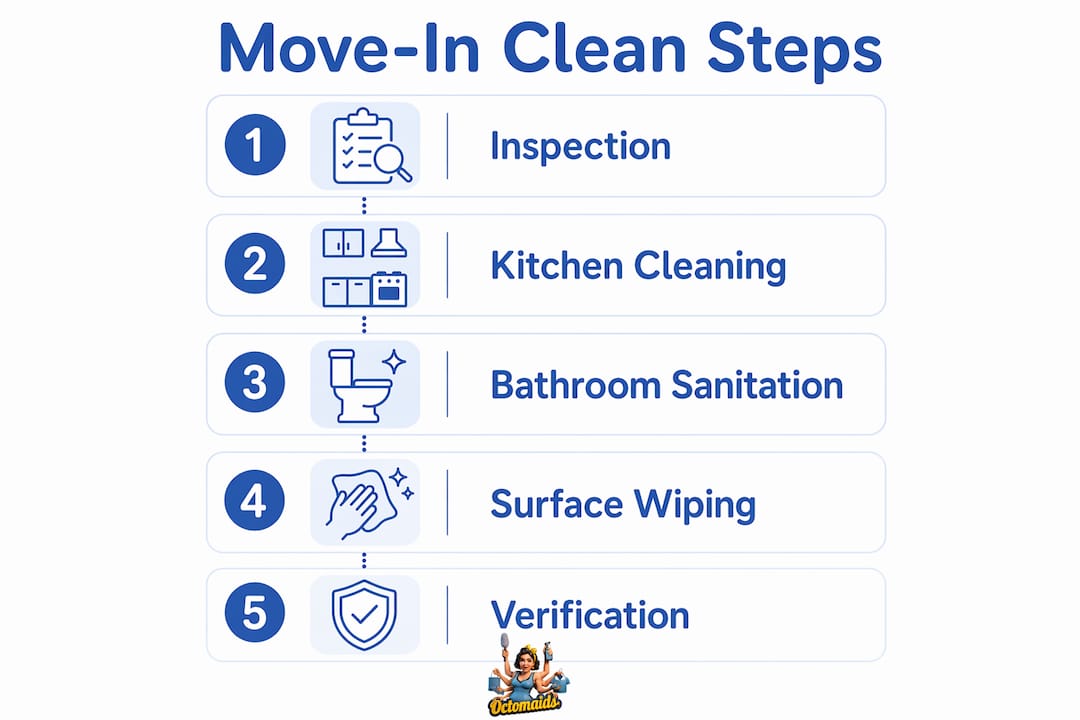
What are the essential components of a move-in clean?
A proper move-in clean covers every room from ceiling to floor, and the order matters. Top-to-bottom systematic cleaning prevents re-soiling, because dust and debris from high surfaces fall onto lower ones. Starting at ceiling fixtures and working down to baseboards and floors is the professional standard.
Kitchen
The kitchen requires food-safe cleaning throughout. Every appliance interior, including the oven, refrigerator, microwave, and dishwasher, must be free of residue and odors. Cabinet interiors and drawer liners need wiping down. Countertops must be sanitized, not just wiped. Grease buildup behind the stove and under the refrigerator is a common miss.
Bathrooms
Bathrooms demand full sanitation. Sinks, tubs, showers, and toilets must be free of mold, soap scum, and hard-water deposits. Grout lines and caulking are high-friction zones where mold hides. Exhaust fans collect dust that most cleaners skip entirely.
Whole-home surfaces
Every room needs dusted baseboards, light fixtures, and ceiling fans. Window sills and window tracks are among the most frequently missed areas and a common source of disputes. Floors must be cleaned to the appropriate standard for their material: hardwood, tile, laminate, and carpet each require a different method. Carpets often need professional extraction, not just vacuuming.
Here is a quick reference for areas that separate a basic clean from a true inspection-grade standard:
- Interior oven racks and drip pans
- Refrigerator coils and drip tray
- Inside all kitchen and bathroom cabinets
- Window tracks and sill channels
- Baseboards and door frames
- Light switch plates and outlet covers
- Exhaust fans in bathrooms and kitchen
- Behind and beneath all appliances
Pro Tip: Walk the unit with a flashlight before accepting it. Shine the beam along baseboards, inside cabinets, and across countertops at a low angle. Residue and grime invisible in normal light show up immediately.
How is a move-in clean documented and verified?
Documentation is what transforms a clean home into a legally defensible baseline. A room-by-room itemized checklist completed and signed by both the landlord and tenant is the most effective tool for preventing disputes. Photos taken at the time of signing add a second layer of evidence that is hard to dispute months later.
The process works best when it follows a clear sequence:
- The landlord or property manager completes the professional clean before the tenant’s move-in date.
- Both parties walk the unit together and complete a room-by-room checklist.
- Each item is noted as clean, damaged, or requiring attention.
- Photos are taken of every room, appliance interior, and any existing damage.
- Both parties sign and date the checklist, and each keeps a copy.
Many states require landlords to provide a written move-in inspection report. Even where it is not legally required, a signed move-in inspection report protects both parties equally. Tenants who skip this step often find themselves disputing charges at move-out with no documented proof of the unit’s original condition.
A signed, itemized move-in checklist with photographs is the single most powerful document a tenant can have. Without it, any dispute about cleaning or damage becomes a “he said, she said” situation that rarely ends well for the tenant.
You can use Octomaids’ move-out cleaning checklist as a reference template to understand what landlords inspect and what your checklist should cover.
What distinguishes a move-in clean from regular or move-out cleaning?
These three types of cleaning serve different purposes, and confusing them leads to unmet expectations.
| Cleaning type | Purpose | Depth | Timing |
|---|---|---|---|
| Regular maintenance clean | Upkeep during occupancy | Surface level | Weekly or monthly |
| Move-out clean | Restore unit for next tenant | Deep, focused on damage areas | After tenant vacates |
| Move-in clean | Set inspection-grade baseline | Comprehensive, every surface | Before new tenant arrives |
A move-in clean is the most thorough of the three. It addresses areas that regular cleaning never touches, like appliance interiors, cabinet shelves, and window tracks. A move-out clean focuses on reversing the wear of occupancy. A move-in clean goes further, verifying that the move-out clean was complete and adding any finishing work needed to reach a true baseline standard.
Timing is critical. Scheduling the clean before furniture arrives gives cleaners full access to every corner, baseboard, and floor section. Once furniture is in place, those areas become inaccessible and stay dirty for the entire tenancy.
Professional cleaning services are the preferred choice for move-in cleans because they follow a structured protocol. They bring commercial-grade products, trained technique, and accountability. A professional team typically takes 3–7 hours to complete a move-in clean, depending on the size and condition of the unit. That time investment reflects the depth of work required.
Pro Tip: Ask your landlord or property manager for a receipt or invoice from the professional cleaning service used before your move-in. This confirms the clean was completed and gives you a reference point if questions arise later.
For a deeper look at how professionals approach rental property cleaning, the difference in technique and product quality is significant compared to a DIY approach.
How can tenants ensure the move-in clean standard is met?
Tenants who take a proactive approach before and during move-in avoid most disputes before they start. The tenant cleaning checklist is your primary tool, but how you use it matters as much as having one.
Start before you sign. Ask your landlord directly: “Will the unit be professionally cleaned before I move in?” Get the answer in writing, whether by email or as a clause in the lease. Verbal assurances are not enforceable.
On move-in day, inspect these areas specifically:
- Kitchen appliances: Open the oven, refrigerator, and microwave. Check for residue, odors, and staining on interior racks and walls.
- Bathroom grout and caulking: Look for dark spots indicating mold. Run your finger along caulk lines around the tub and shower.
- Window tracks: Slide windows open and look at the track channels. Dirt and debris here signal a clean that did not meet the full standard.
- Baseboards and corners: Crouch down and look along the base of walls. Dust buildup here is a clear indicator of a rushed or incomplete clean.
- Cabinet interiors: Open every cabinet and drawer in the kitchen and bathrooms. Wipe a white cloth along the shelf. Any residue means the standard was not met.
Document everything with photos before you bring in a single piece of furniture. Use your phone’s timestamp feature so the date is embedded in the image metadata. If you find areas that do not meet the standard, notify your landlord in writing the same day.
Pro Tip: Create a shared folder in Google Photos or iCloud and upload all move-in photos immediately. Share the folder link with your landlord by email. This creates a timestamped, shared record that neither party can later dispute.
Understanding what to expect after moving in from a professional property clean helps you recognize when a unit has genuinely met the standard versus when it has only been surface-cleaned.
Clear communication between landlords and tenants before move-in avoids vague expectations that cause friction later. A written cleaning standard attached to the lease is the cleanest solution, literally and legally.
Key takeaways
A tenant move-in clean standard requires an inspection-grade deep clean of every surface, appliance interior, and hidden area before occupancy, documented with a signed checklist and photographs to protect both parties.
| Point | Details |
|---|---|
| Inspection-grade baseline | A move-in clean resets the unit to a like-new condition, covering every surface and hidden area. |
| Documentation protects both parties | A signed, room-by-room checklist with photos is the strongest defense against deposit disputes. |
| Timing determines quality | Schedule the clean before any furniture arrives to give cleaners full access to all surfaces. |
| Hidden areas cause disputes | Appliance interiors, cabinet shelves, and window tracks are the most commonly missed spots. |
| Professional services set the standard | Trained cleaners follow a top-to-bottom protocol that DIY cleaning rarely replicates. |
What I’ve learned after years of move-in cleans
Most tenants treat move-in day as a logistics problem. They are focused on boxes, furniture placement, and utility hookups. The cleaning standard is an afterthought, and that is exactly when disputes are born.
What I have seen repeatedly is that the units generating the most end-of-tenancy conflict are the ones where nobody took 20 minutes at the start to walk through with a checklist. A landlord assumes the clean was done. A tenant assumes it was thorough. Neither party checks the oven interior or the window tracks. Eighteen months later, those same areas become the center of a deposit dispute.
The other thing I want to be direct about: not all professional cleaning services deliver the same result. A move-in clean is not the same as a recurring maintenance visit. The depth, the time, and the protocol are fundamentally different. When you hire for a move-in clean, ask specifically whether the service includes appliance interiors, cabinet shelves, and window tracks. If the answer is vague, that is your answer.
My honest advice is to treat the move-in clean as an investment, not a cost. A thorough clean at the start of a tenancy sets the tone for everything that follows. It signals to both parties that the property is valued and that expectations are clear. That foundation pays dividends for the entire lease.
— Steven
Octomaids move-in cleaning services in Vancouver, WA and Portland, OR
Moving into a new home is demanding enough without worrying whether the previous tenant’s oven grease is still in the kitchen. Octomaids has provided professional move-in and move-out cleaning services to families across Clark County, WA and the Portland Metro area since 2006.
Our team follows a structured, inspection-grade protocol covering every room, appliance interior, cabinet shelf, and window track. We bring the same trusted cleaners to every job, so you know exactly who is in your home. If you are preparing for a move and want a clean that meets the full move-in cleaning standard, our team is ready to help. You can also explore our deep clean checklist to see exactly what a thorough clean covers room by room.
FAQ
What does a tenant move-in clean standard include?
A tenant move-in clean standard covers every surface in the home at an inspection-grade level, including appliance interiors, cabinet shelves, bathroom grout, window tracks, baseboards, and floors cleaned to the appropriate method for their material.
Who is responsible for the move-in clean, the landlord or tenant?
The landlord is responsible for delivering a clean, habitable unit before the tenant moves in. Most states, including those following habitability standards similar to California Civil Code Section 1941, require the unit to be in a clean and sanitary condition at the start of the tenancy.
How long does a professional move-in clean take?
A professional move-in clean typically takes 3–7 hours depending on the size and condition of the unit. Larger homes or units with significant buildup require more time to reach the full inspection-grade standard.
What should a tenant do if the move-in clean standard is not met?
Document every deficiency with timestamped photos on move-in day and notify your landlord in writing the same day. A written record created immediately at move-in is your strongest protection if a deposit dispute arises at the end of the tenancy.
Why do move-in cleans focus on hidden areas like appliance interiors and window tracks?
Hidden areas cause the most disputes because they are easy to overlook during a basic clean and easy to notice during a formal inspection. Appliance interiors, cabinet shelves, and window tracks are the clearest indicators of whether a true inspection-grade clean was performed.