


You can switch cleaning companies in about two to four weeks without a gap in service. Read your current agreement for notice and renewal terms. Line up the new provider before you cancel the old one. Hand over access details safely, then inspect the first few visits closely. Most of the stress comes from doing these steps in the wrong order, not from the switch itself.
This guide covers homes, rental properties and small offices. It is written for people who have a cleaner or a company today and are quietly wondering whether it is time for a change.
TL;DR
- Switch when the same problems keep returning after you have raised them, not after one bad visit.
- Check your agreement for the notice period, automatic renewal and any early termination fee before you tell anyone anything.
- Book the new company to start before the old one ends, so you never go without a clean.
- Recover or change every key, fob, garage code and alarm code, and write down room-by-room expectations.
- Inspect the first visits against a baseline, and put problems in writing with photos.
Table of Contents
- Signs it is time to switch
- Read your agreement before you do anything else
- Decide what you actually need this time
- Choose the replacement carefully
- Perspective: what we see when people switch to us
- Plan the handover so there is no gap
- Keys, codes and access
- Hand over the instructions
- Inspect the first visits
- Switching a rental or an office
- Where Octomaids fits
- FAQ
- Sources
Signs it is time to switch
Everyone has an off day, and a good cleaner deserves a chance to fix a miss. The pattern is what matters. Industry guidance on janitorial service lists the usual warning signs: recurring missed tasks, repeated complaints, slow or unanswered communication, frequent staff changes and unexpected charges. That list is written for offices, but it fits homes just as well.
Here is how those signs look in a house:
- The same spots get skipped. Dust on the baseboards, a gritty shower track or a sticky stovetop appears visit after visit, even after you mention it.
- A different person shows up every time. Each new cleaner has to learn your home from scratch, so the details you care about get lost. A team that rotates constantly rarely holds a standard.
- You cannot reach anyone. Messages go unanswered, and rescheduling takes three tries.
- The bill changes without explanation. Add-ons, fuel fees or rate increases appear that were never discussed.
- Something is missing or damaged, and nobody owns it. A professional company acknowledges the issue and has insurance to back it up.
- You feel you have to clean before the cleaners come. If you are tidying, wiping or re-cleaning afterward, the service is not doing its job.
Try one honest conversation first
Before leaving, give the company one clear, written chance. List the specific misses, attach photos, and ask what will change. A good company will answer quickly and specifically. If it does and the next two visits are better, you may have saved a good relationship. If the answer is vague, or the same problems return, you have your decision and a paper trail.
Read your agreement before you do anything else
Many people tell the old company they are leaving, then discover they owed notice. Reverse the order.
Look for four things in your agreement, invoice terms or booking confirmation:
- Notice period. Commercial contracts commonly require 30 to 90 days, according to one commercial cleaning provider. Residential cleaning agreements are often much shorter, sometimes a single visit’s notice, but you will not know until you read yours.
- Automatic renewal. Some agreements roll over for another term unless you cancel in writing by a set date.
- Early termination fees. Check whether leaving before the term ends triggers a charge.
- How cancellation must be delivered. Email, certified mail or a phone call can all be required, and “I told the cleaner” rarely counts.
If you cannot find an agreement, search your email for the original booking confirmation and any terms page you accepted online. Keep a copy of whatever you find.
Cancel the payment and the service separately
This catches many people. According to the Consumer Financial Protection Bureau, stopping an automatic bank payment does not cancel the underlying contract. You need to cancel the payment authorization and the service agreement as two separate steps. If you only block the payment, the company may still treat you as an active customer and pursue the balance.
If a company made cancelling unreasonably hard, the CFPB has said that negative option marketing practices can violate federal law when sellers fail to disclose material terms, get informed consent or offer simple cancellation. If you think that happened to you, a written complaint to the company and, if needed, to your state attorney general’s consumer protection office is the next step. For a legal question about a specific contract, an attorney is the right person to ask.
What about the three-day rule?
The FTC’s Cooling-Off Rule gives you three business days to cancel certain sales made at your home for purchases above $25. It applies to door-to-door style sales, so it may or may not cover a cleaning service you booked online or by phone. If you recently signed with a new company and have second thoughts, check the date and the paperwork immediately. We explain how this works for cleaning in our guide to cleaning service cancellations and the FTC 3-day rule.
Decide what you actually need this time
A switch is the best moment to fix what bothered you. Before you call anyone, write a one-page scope. A good scope includes:
- Property type, square footage, number of bedrooms and bathrooms
- Frequency: weekly, every two weeks or monthly
- Specific priorities, such as pet hair, kitchen detail or inside the oven
- Anything off limits, such as a home office or fragile collections
- Pets, allergies and product sensitivities
National hiring guidance for cleaning services suggests specifying property type, size, frequency and specialized requirements up front so quotes are comparable. For commercial space, it also helps to base the scope on a site walkthrough rather than a phone description.
How frequency changes the answer
Many people switch because the service no longer fits. A household that once needed monthly visits may now need every two weeks. If you are unsure, our home cleaning frequency guide walks through how household size, pets and routines change what is realistic.
Choose the replacement carefully
Switching because of poor quality and then picking the cheapest quote is the most common way to end up switching again. Compare at least two or three companies on the same scope, and ask each of them:
- Will the same people come each time? Consistency is the biggest driver of quality in a home.
- Are your cleaners employees or subcontractors, and are they background-checked?
- What insurance do you carry, and can you send proof? Verify insurance and workers’ compensation documentation before you sign, not after.
- Who brings the supplies and equipment? Our page on whether cleaners bring supplies covers what to ask.
- What happens if you are unhappy? Look for a clear, written satisfaction policy.
- How are price and cancellation terms written down? Ask for the agreement before the first visit.
Ask for references from customers with a similar property to yours. If you are hiring for the first time after a bad experience, how to hire a house cleaner for the first time lays out the process step by step.
A note on price
Quotes that come in far below the others usually reflect something removed: shorter visits, fewer people, no insurance or a rotating crew. Ask what each quote includes and how many labor hours are planned. A fair comparison is hours, scope and terms, not the headline number alone.
Perspective: what we see when people switch to us
We have cleaned homes and businesses in Vancouver, WA and the Portland metro area since 2006, and a good share of our new customers come to us from another company. The story is rarely a single disaster. More often it is a slow loss of trust: a different person each week, details forgotten, a message that never got answered.
That is why we send the same dedicated team to a home every visit. When the same two or three people clean your kitchen over and over, they learn which drawer pulls collect grease and which room your dog sleeps in. Quality stops depending on whoever happens to be available. Our cleaners are background-checked, trained and insured, and we are a family-owned business, not a franchise.
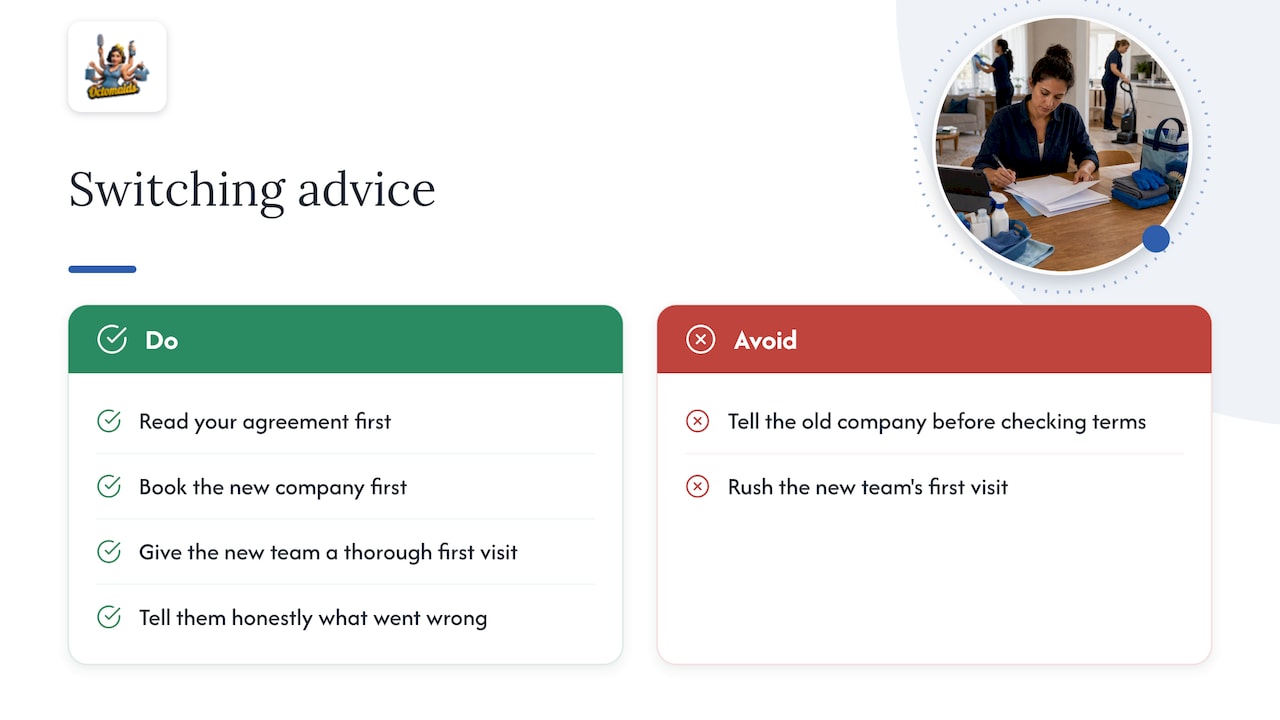
My advice on switching is simple. Do not tell the old company until you have read your agreement and booked the new one. Give the new team a thorough first visit rather than a rushed one, and tell them honestly what went wrong before. People are sometimes embarrassed to say that last part. Please do. It is the most useful information we get, and it helps us set the right scope from the start.
— Steven
Plan the handover so there is no gap
The goal is overlap, not a hard stop. Commercial guidance suggests a typical overlap of one to two weeks, letting the new vendor do a walkthrough, receive access and begin before or as the old notice period ends. For a home, the same logic applies on a smaller scale. A rough timeline looks like this:
- Week one: Review the agreement, write your scope and request quotes.
- Week two: Compare proposals, check insurance and references, and book the new company’s first visit.
- Week three: Send written notice to the old company, timed so its last visit falls just before or after the new start.
- Week four: Collect keys and codes, complete the first visit and inspect.
Government procurement guidance for UK schools offers a useful idea that works anywhere: plan backward from the switch date and set each stage to fit. Start with the day you want the new cleaners working, then count back.
If you have guests, a listing or an inspection coming, schedule the switch around it. Rental owners in particular should never change companies on a turnover day.
One-time deep clean as a reset
If the old cleaning was weak for months, a recurring visit built on that foundation will struggle. Many people book a one-time deep cleaning first, then move to a lighter recurring routine. Our guide on deep clean versus regular clean explains when that makes sense.
Keys, codes and access
Security is the part people forget, and it is the part that matters most. Guidance on switching providers recommends that you recover keys, fobs and codes from the outgoing contractor and change anything you cannot recover. Use this checklist:
- Ask for every key, fob, garage opener and gate card back, and note the date you received them.
- Change the door code, garage code and alarm code the day the old company’s last visit ends.
- Remove the old team from any smart lock app, shared calendar or messaging group.
- Update the spare key location if the cleaners knew about it.
- Tell the new company how you want to grant access: you at home, a lockbox or a smart lock with a unique code.
Our article on how cleaning services handle home access safely goes deeper on lockboxes, unique codes and what a professional company should record.
Hand over the instructions
A transition plan works best when it documents a room-by-room scope, security access and an inventory of supplies and equipment. For a home, that does not need to be a formal document. A single page or a short email does the job:
| What to share | Example |
|---|---|
| Priorities by room | Kitchen: degrease range hood, wipe cabinet fronts weekly |
| Off-limits areas | Home office desk, nursery shelves |
| Pets | Cat stays in the bedroom, dog is friendly but may bark |
| Product preferences | Fragrance-free products only, no bleach on the stone counters |
| Special surfaces | Unsealed wood floor, vintage tile |
| Alarm and access | Lockbox location, alarm code, which door to use |
| Supplies | Who provides the vacuum and products |
If you have unusual requests, say so before the first visit. We cover that in how cleaning services handle special requests. To get the most from a first visit, preparing your home for a cleaning service takes about 20 minutes and makes a visible difference.
Inspect the first visits
Treat the first month as a trial for both sides. Before the first visit, take photos of each room in its current state. That is your baseline. Then:
- Walk through after the first visit. Compare the results to your baseline and your scope.
- Inspect more often at the start. Guidance recommends enhanced weekly inspections in the first period, and a home owner can do the same with a quick weekly walkthrough.
- Report problems in writing, with photos. Be specific: “shower glass has soap film, see photo” works better than “bathroom not clean.”
- Meet or call within the first month. Confirm the service is meeting the standard you agreed, and adjust the scope if it is not.
A good company treats this feedback as useful, not hostile. If a company responds to a clear, polite note with a fast fix, that is a strong sign. If the same issues come back, you have documentation and a clean reason to move on again, with less guilt this time.
Switching a rental or an office
The steps are the same, but the stakes are different.
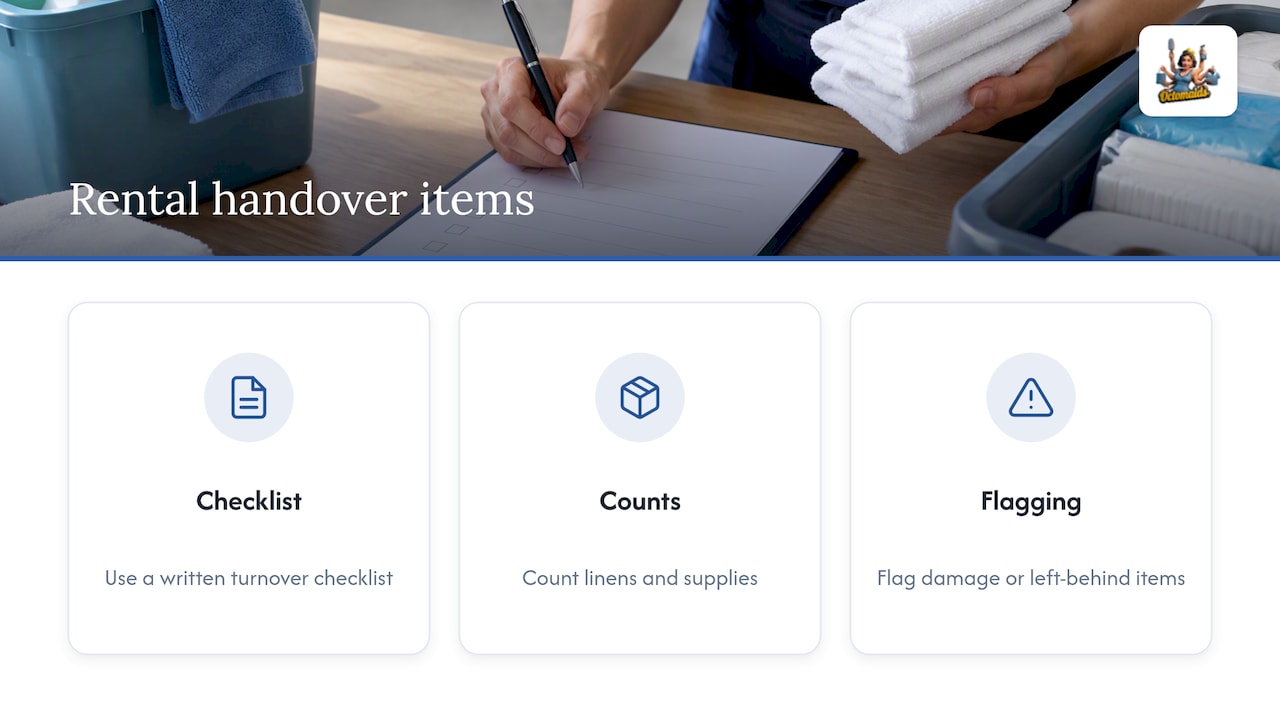
Short-term rentals. Cleaning quality shows up in your reviews almost immediately, so the handover needs a written turnover checklist, linen and supply counts and a clear process for flagging damage or left-behind items. Our short-term rental cleaning checklist is a good starting point, and how cleaning shapes your rental reviews explains why it matters.
Offices. Commercial agreements tend to have longer notice periods and renewal clauses, so the contract review matters more. You will also have restricted areas, after-hours alarm systems and consumables such as paper and soap to transfer. Insurance and workers’ compensation proof matter more when crews are in your building unsupervised.
Where Octomaids fits
If you live or work in Clark County, WA or the Portland metro area, we can take over from your current provider. We start with a conversation about what went wrong, then build a scope around it and assign a dedicated team. We offer recurring home cleaning on weekly, bi-weekly or monthly schedules, and one-time, move-in/move-out, office, short-term rental and post-construction work through our services page. Our written terms are in our service agreement, so you can read them before you book.
To see how we set up a first visit for people switching from another company, contact us through octomaids.com and tell us what you want done differently.
FAQ
How much notice do I need to give my cleaning company?
It depends entirely on your agreement. Commercial contracts often require 30 to 90 days, while many residential services need much less. Read your booking terms, send notice in writing in the way the agreement requires, and keep a copy.
Can I switch cleaning companies in the middle of a contract?
Yes, but you may owe an early termination fee or the notice period’s worth of service. Check the agreement first. If the company failed to deliver the agreed service, document the misses in writing before you cancel, since that strengthens your position.
Do I need to cancel automatic payments too?
Yes, but separately. The CFPB says canceling a bank’s automatic payment does not end the service contract. Cancel the service in writing first, then stop or revoke the payment authorization so you do not get billed or accrue a balance.
Should I tell my old cleaner why I am leaving?
A brief, polite and factual note is enough, and it can help you get a clean exit and your keys back. You do not owe a long explanation. Stay specific about the issues, and avoid blaming individual cleaners if the problem was the company’s management.
How long does it take a new cleaning company to get things right?
Expect the first visit to establish a baseline and the second or third to feel like your routine. Give clear written feedback after each one. A company that assigns a consistent team usually reaches your standard faster, because the same people learn your home.
Sources
- Signs You Need a New Janitorial Service: What to Check
- How to Switch Commercial Cleaning Companies Without a Gap
- Switching Cleaning Companies: Transition Checklist
- How to Hire a Cleaning Service: A Step-by-Step Checklist
- CFPB: How do I stop automatic payments from my bank account?
- FTC: Cooling-off Period for Sales Made at Home or Other Locations
- GOV.UK: Buying for schools, cleaning services
Recommended
- How to Maintain a Clean Home Between Visits
- Independent House Cleaner vs. Cleaning Company
- How to Prepare Your Home for a Cleaning Service
- 9 Jobs House Cleaners Refuse, Who to Call and How to Prepare
About Octomaids
Octomaids is a locally operated professional cleaning company serving Vancouver, Clark County, and the surrounding Portland metro area. Since 2006, our cleaning teams have helped homeowners, renters, property managers, and businesses with recurring cleaning, deep cleaning, move-in/move-out cleaning, and commercial cleaning.
Our cleaning articles are reviewed to ensure the information reflects our real-world experience and professional cleaning practices.