


Standard recurring office cleaning typically runs $0.07 to $0.20 per square foot, or $30 to $75 per hour depending on scope and local labor rates. A small office under 5,000 square feet usually lands somewhere in the low hundreds to low thousands per month, depending on frequency. Before you sign anything, ask every vendor for a workloading breakdown, a task-by-task estimate of how they arrived at your price.
TL;DR:
- Pricing models include per-square-foot, hourly, and flat-rate with add-ons, but workloading based on task time offers the most accurate estimate.
- Vendors should provide a detailed task list with labor minutes for each service to determine fair pricing, especially for complex or specialized jobs.
- Negotiating by adjusting visit frequency, bundling services, or requesting a trial period can reduce overall expenses more effectively than haggling over hourly rates.
- A reliable contract includes clear scope, proof of insurance, and transparency on scope and pricing, avoiding vague bids or unexplained additional charges.
Table of Contents
- What Drives Small Office Cleaning Cost and Pricing Models
- Sample Cost Scenarios for Small Offices
- What Actually Moves the Price
- How Contractors Should Build Your Quote (and What to Demand)
- Negotiating a Fair Price Without Cutting Corners
- Contract Terms and Red Flags Before You Sign
- Our Take on Pricing Small Office Cleaning Fairly
- Get an Accurate Quote for Your Office
- Sources
- FAQ
What Drives Small Office Cleaning Cost and Pricing Models
Three pricing models dominate the commercial cleaning market, and each fits a different situation.
Per-square-foot pricing works best for predictable, recurring work where the scope rarely changes. Most office accounts fall between $0.07 and $0.20 per square foot, with general office space often clustering toward the lower end of that range compared to medical or post-construction sites.
Hourly pricing suits one-time jobs, first-visit deep cleans, or spaces where condition varies visit to visit. Expect hourly rates generally within a typical range, with the higher end reserved for specialty work or after-hours scheduling.
Flat-rate and hybrid pricing bundle a base recurring service with itemized add-ons. These contracts read the cleanest on paper, but that’s exactly where vendors bury costs. Watch for:
- Floor care (stripping, waxing, buffing) billed separately from the base rate
- Restroom “sanitizing upgrades” that should already be part of standard scope
- Supply fees stacked on top of the quoted price
- Minimum-visit clauses that inflate your effective hourly rate
Sample Cost Scenarios for Small Offices
Real budgets depend on square footage, restroom count, and how often the crew shows up. The numbers below assume general office space, one restroom per roughly 1,500 square feet, and a baseline scope of trash removal, vacuuming, surface wiping, and restroom sanitizing.
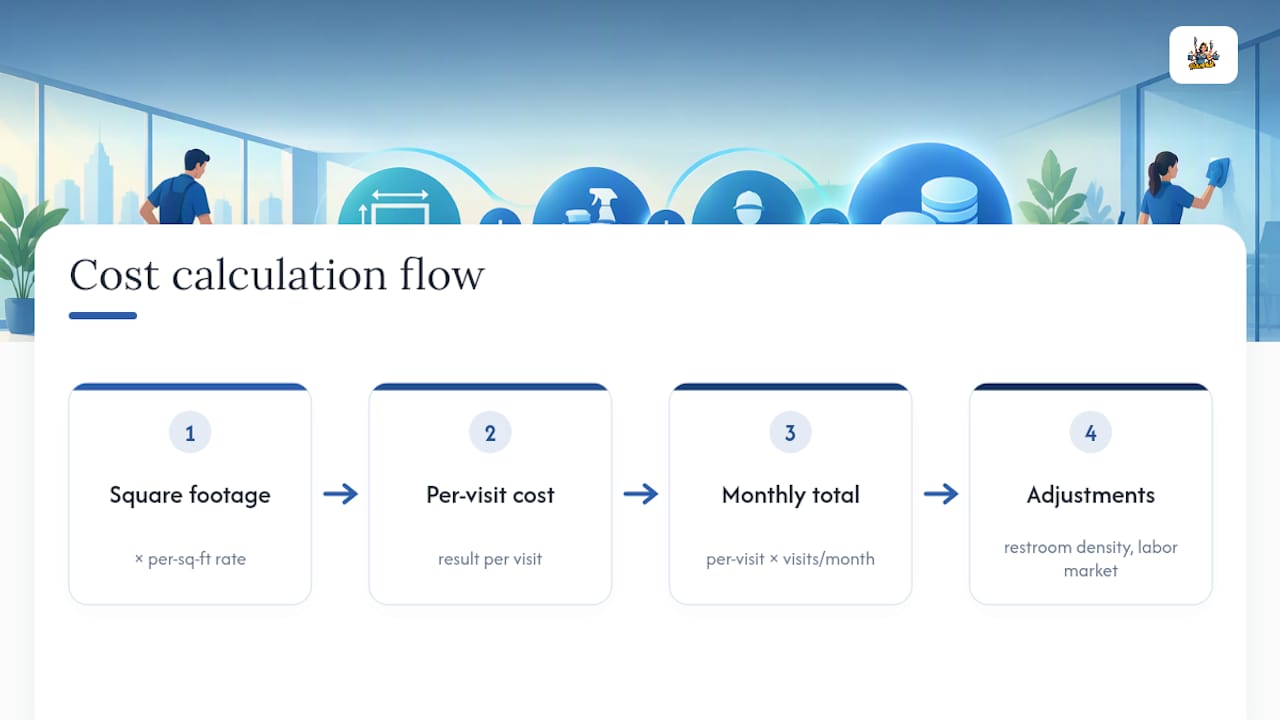
The math is simple: square footage times a per-sq-ft rate gives you a per-visit number, and multiplying by visit frequency gives you the monthly total. If your local labor market runs hotter than the national average, or your office has more than one restroom per 1,500 square feet, expect the higher end of each band.
What Actually Moves the Price
Square footage sets the floor, but several other variables do the heavy lifting on your final quote.
Frequency changes the staffing model, not just the visit count. Moving from three visits a week to five doesn’t simply cost 66% more. It lets a vendor route the same crew more efficiently, so the price bump is often smaller than a straight multiplier suggests, according to ISSA’s workloading guidance.
Restroom and fixture count matters more than raw square footage. Vendors count toilets, sinks, and mirrors specifically because restroom labor doesn’t scale with floor area, it scales with fixtures.
Floor type, condition, and access round out the list:
- Carpet extraction and hard-floor stripping/waxing are priced separately from routine service
- A first-visit deep clean for a neglected space typically costs more than the ongoing recurring rate
- Restricted after-hours access or security check-ins can add a scheduling premium
- Medical-grade sanitizing protocols push per-visit cost well above general office rates
Pro Tip: Ask vendors to quote your restroom count separately from your square footage. If they can’t break out that number, they’re probably not workloading the job at all.
How Contractors Should Build Your Quote (and What to Demand)
A quote based purely on square footage is a guess dressed up as math. The ISSA’s workloading method breaks a job into individual tasks, times each one, and builds the price from actual labor minutes. That’s the standard you should hold every bid to.
Here’s how to evaluate a bid using that framework:
- Request an itemized task list. Vacuuming, trash removal, restroom sanitizing, and surface wiping should each show a time estimate, not one lump figure.
- Check the minutes per task against visit frequency. A 2,000-square-foot office with two restrooms shouldn’t take the same 20 minutes as one with zero.
- Ask about the non-productive time multiplier. Reputable vendors build in time for travel between rooms, setup, and supply restocking, typically 10% to 20% on top of raw task time.
- Compare the labor rate behind the bid to local wage data. The median hourly wage for janitors and building cleaners was $17.27 as of May 2024. A bid built on wages far below that benchmark is either underpaying staff or underestimating the job, and both should worry you.
If a vendor can’t produce this breakdown on request, that’s information in itself. It usually means the quote came from a rough per-square-foot rule of thumb rather than an actual assessment of your space.
Negotiating a Fair Price Without Cutting Corners
You have more leverage than a flat “yes or no” on the quoted rate. Try these adjustments before you sign:
- Trade frequency for scope. Dropping from five visits a week to three, while adding a deeper Friday clean, often costs less than five identical light visits.
- Bundle specialty services deliberately. Carpet care or floor stripping quarterly, folded into one contract with clear per-service pricing, usually beats calling a separate vendor each time.
- Negotiate a 30-day trial with a written checklist and a right to terminate if quality slips. This shifts risk onto the vendor instead of locking you into a year based on a first impression.
Labor typically makes up 50% to 80% of a cleaning contract’s total cost, so any negotiation that touches visit frequency or task scope moves the price more than haggling over the rate itself.
Contract Terms and Red Flags Before You Sign
Every solid contract should spell out insurance and bonding coverage, background-checked staff, an exact scope of work, who supplies cleaning products and equipment, and clear notice or cancellation terms.
Watch for these warning signs in a bid:
- A vague scope of work with no task-level detail or square-footage math shown
- No proof of insurance, bonding, or willingness to provide references
- A price dramatically below competing bids with no workloading explanation, often a sign of underestimated labor that surfaces later as skipped restroom cleaning or rushed visits
- Frequent “change orders” that quietly push the real price above the quoted one
Before committing, ask for a sample cleaning checklist, two references, and a short trial period. Those three requests filter out most underqualified bidders fast.
Our Take on Pricing Small Office Cleaning Fairly
We build every office quote from actual labor time, not a generic per-square-foot guess, because a workloaded quote is the only kind that holds up once the contract is running. A dedicated team for your account is often assigned to provide consistent service, so the crew that walked your space during the estimate typically does the work every week.
— Steven
Get an Accurate Quote for Your Office
Most cleaning bids you’ll collect are built on a square-footage rule of thumb, not an actual look at your space. Some companies take a different approach for office and commercial accounts by walking your space, counting restrooms and fixtures, and building prices from real labor time instead of a flat rate guess.
That on-site audit is also how we assign your dedicated team, the same cleaners return to your office every visit instead of a rotating crew you have to re-explain your space to each time. If you manage a small office and want a quote you can actually verify against the math, request an estimate through our commercial cleaning services page or explore recurring cleaning options built around your schedule. A vendor evaluating its own quoting process against industry pricing benchmarks can be a vendor you trust with your contract.
Sources
- Workloading: Finding the right balance
- How to Price Commercial Cleaning Jobs: 2026 Costs
- Janitors and Building Cleaners: Occupational Outlook Handbook
- 2026 Commercial Cleaning Cost Guide | Rates by Facility Type & Size | CleanQuote
FAQ
How Much Should I Charge to Clean a 6,000 Sq Ft Office?
At $0.07 to $0.20 per square foot, a 6,000-square-foot office runs roughly $420 to $1,200 per visit. Restroom count and visit frequency push that number toward the higher end, so a space with multiple restrooms or daily service should expect to land above the midpoint.
Is $20 an Hour Good Pay for a Cleaner?
It’s close to the national benchmark. The median hourly wage for janitors and building cleaners was $17.27 as of May 2024, so $20 an hour sits above that median in most markets, though high-cost metro areas may run higher still.
What Is the Going Rate for an Office Cleaner?
Recurring office cleaning typically prices between $0.07 and $0.20 per square foot, or $30 to $75 per hour for jobs billed by time. One-time deep cleans usually run hourly, since the condition of the space, not just its size, drives labor time.
How Do You Charge for Cleaning an Office?
Most vendors price by square footage for recurring contracts and by the hour for deep cleans or variable-condition jobs. The most accurate method is workloading, building the price from a task-by-task time estimate rather than a flat rate, which is why ISSA recommends it as the industry standard for commercial bids.
Recommended
- Save 15–25% on Office Cleaning: Vancouver, WA Budgets and Hiring Checklist
- How to Create an Office Cleaning Schedule That Works
- Janitorial vs Cleaning Service Options: 2026 Guide
About Octomaids
Octomaids is a locally operated professional cleaning company serving Vancouver, Clark County, and the surrounding Portland metro area. Since 2006, our cleaning teams have helped homeowners, renters, property managers, and businesses with recurring cleaning, deep cleaning, move-in/move-out cleaning, and commercial cleaning.
Our cleaning articles are reviewed to ensure the information reflects our real-world experience and professional cleaning practices.