



Rent ready cleaning is the final, top-to-bottom cleaning of an empty rental after repairs, painting and maintenance are finished, so the next tenant walks into a unit that looks, smells and feels new. It goes well beyond a quick tidy: it covers appliance interiors, cabinets, closets, fixtures and the high-touch surfaces every new resident handles on day one. Below, we explain what belongs on the list, what gets missed, and how to confirm the unit is truly ready before you hand over keys.
TL;DR
- Rent ready cleaning happens last in the turnover, after every other trade has left, so nothing gets re-dirtied.
- It is a full, systematic clean of an empty unit: appliance interiors, cabinets, closets, fixtures, floors and disinfected high-touch surfaces.
- The most commonly missed spots are exhaust fan grilles, oven broiler drawers, refrigerator door gaskets, the floor under appliances and shower grout corners.
- Walk the unit before and after cleaning, and photograph both, so condition is documented.
- In Vancouver, WA and the Portland, OR metro, we can handle the whole clean with the same dedicated team each time.
Table of Contents
- What rent ready cleaning actually means
- Where cleaning belongs in the turnover sequence
- Rent ready cleaning checklist, room by room
- High-touch surfaces: where to be most careful
- Commonly missed areas
- Rent ready clean, turnover clean or deep clean?
- When cleaning is not enough
- How to confirm a unit is truly ready
- Our perspective
- Get your rental rent ready with Octomaids
- Keeping the unit rent ready between tenants
- FAQ
- Sources
What rent ready cleaning actually means
Property managers also call it make-ready cleaning or a turnover clean. The idea is the same: the unit is cleaned in a full, systematic pass once it is empty, including appliance interiors, cabinets and closets, with high-touch surfaces disinfected. That last detail matters because the incoming tenant is going to touch every handle, switch and faucet within the first hour.
It differs from the cleaning a tenant does when they move out. A move-out clean is often rushed, done by someone packing a truck. Rent ready cleaning is done by a team working from a list, with a goal of presentation, sanitation and move-in readiness. If you are the departing tenant, our move-out cleaning checklist for renters is written for that side of the handover.
Think of it as removing the visual noise from a space. A tenant touring a unit may not be able to name what feels off, but a faint grease film on the range hood or a dusty ceiling fan registers as “not quite fresh.” Those small signals shape whether they sign, and whether they start the tenancy trusting you.
Where cleaning belongs in the turnover sequence
The single most expensive mistake we see is cleaning too early. Cleaning should happen after painting, maintenance and other trades have finished, because a unit cleaned prematurely is simply re-dirtied by later repairs. Painters leave drips and dust, plumbers leave smudges, flooring crews leave debris in corners.
A sensible order looks like this:
- Walk-through assessment. Note and photograph pre-existing damage, items left behind, signs of pests or mold, and maintenance needs.
- Trash-out and repairs. Remove abandoned belongings, then complete repairs, patching and painting.
- Flooring and hard-surface work. Carpet replacement or refinishing comes before the final clean.
- Rent ready cleaning. One team, one pass, top to bottom.
- Final inspection. Check the work against the checklist, and photograph the result.
For a deeper look at how to schedule this around other trades, see our guide to getting a unit rent ready in 3 to 5 days.
Rent ready cleaning checklist, room by room
Use this as a working list. Work from the top of each room down, so dust falls onto surfaces you have not cleaned yet.
Kitchen
- Inside and outside of the refrigerator, including shelves, drawers and door seals
- Oven interior, racks and the broiler drawer
- Range hood and filter, stovetop and drip areas
- Dishwasher interior, filter and door edges
- Microwave, if provided
- Cabinets and drawers, inside and out
- Countertops, backsplash and sink, with fixtures polished
- Floors, including edges and under movable appliances
Bathrooms
- Toilet, including base, behind the tank and hinges
- Tub, shower, glass and tile, with attention to grout lines
- Vanity, sink and faucet, plus the cabinet interior
- Mirror and medicine cabinet
- Exhaust fan grille
- Floors and baseboards
Bedrooms, living areas and closets
- Ceiling fans and light fixtures dusted and cleaned, with bulbs checked
- Window blinds, sills and tracks
- Interior windows and screens, where reachable
- Closet shelves, rods and floors
- Baseboards and door frames
- Vacuumed carpet or cleaned hard flooring
Entry, laundry and utility areas
- Front door, frame and threshold
- Washer and dryer hookups, and dryer vent area where accessible
- Utility closet shelving
- Patio or balcony sweeping and rail wipe-down
We keep fuller lists for different situations. Our deep clean house checklist for every room goes further on buildup, and the high-traffic rental areas guide covers the spots tenants wear down fastest.
High-touch surfaces: where to be most careful
The CDC advises regularly cleaning high-touch surfaces such as door handles, restroom fixtures, light switches and counters, since these are generally more likely to spread germs. In a vacant unit, that translates into a short, specific list:
- Entry and interior door handles and deadbolts
- Light switches and outlet covers
- Cabinet pulls and drawer handles
- Faucet handles and toilet flush levers
- Thermostat, appliance knobs and control panels
- Stair rails and balcony rails
Cleaning and disinfecting are two different steps. Cleaning removes soil; disinfecting uses a product to kill germs on a surface that is already clean. And a disinfectant only works if it stays wet for its labeled contact time. The Washington State Department of Health notes that the disinfectant must remain wet on the surface for its contact time. That guidance was written for healthcare settings, but the principle is the same on a door handle: wiping dry in seconds defeats the purpose. Read the product label for the time, and for any surface it should not be used on.
Commonly missed areas
Most callbacks after a turnover come from the same handful of places. A tenant’s first week reveals them, usually when they open something nobody looked inside. Commonly overlooked spots include:
| Area | Why it gets missed | What to do |
|---|---|---|
| Exhaust fan grilles | Overhead and out of sight | Remove the cover, wash it, wipe the housing |
| Oven broiler drawer | Rarely opened | Empty, scrape and degrease |
| Refrigerator door gaskets | Folds hide residue | Wipe the folds with a detail cloth |
| Under and behind appliances | Heavy to move | Pull out where safe, sweep and mop |
| Shower grout corners | Soap film builds where water sits | Scrub corners and base lines |
| Window tracks and blinds | Fine dust settles in slots | Vacuum, then wipe |
The first five come straight from the commonly overlooked areas that turnover cleaners flag, and in our own work the window tracks round out the list.
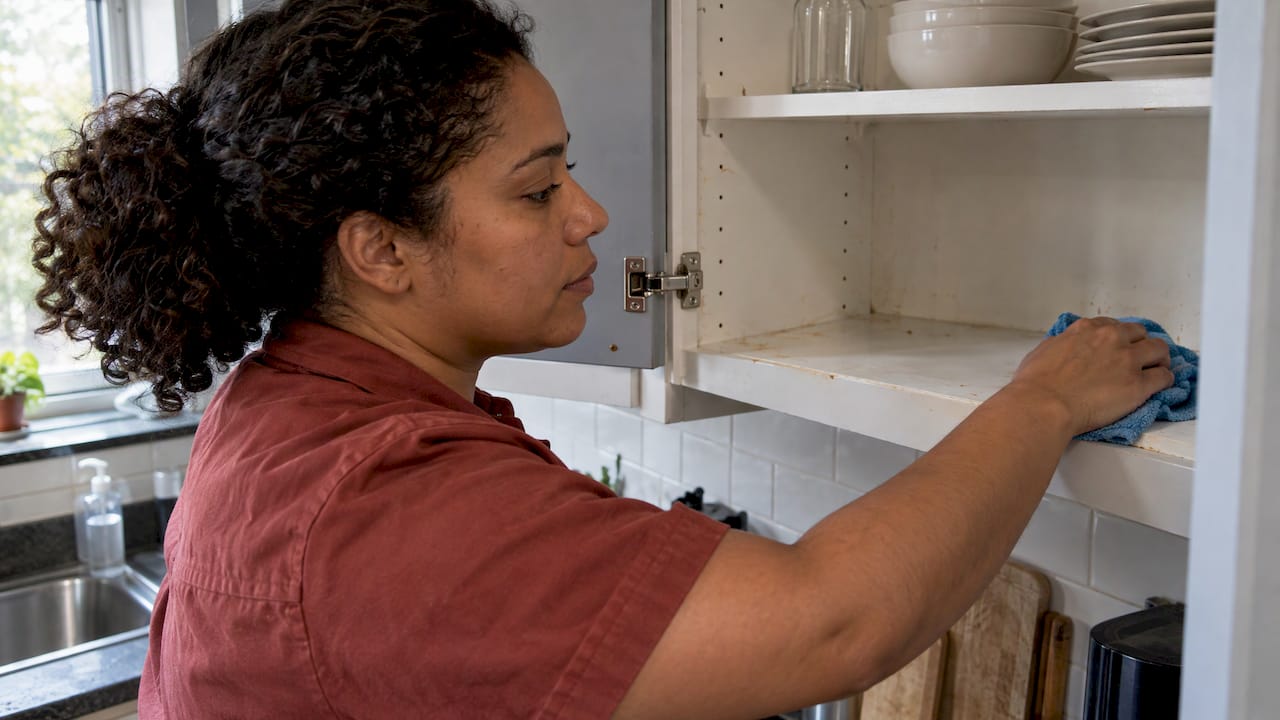
Cabinets deserve their own moment. Tenants open them first, and worn finishes or sticky shelves set the tone for the whole kitchen. If the cabinets themselves are tired, small cosmetic fixes can help, and these rental kitchen cabinet fixes that protect a deposit show what can be done without a renovation. A clean interior still has to come first.
Lighting is the other overlooked detail. Dusty globes and dead bulbs make a clean room look neglected, and if a fixture needs swapping, renter-friendly lighting upgrades are designed to leave no trace on the ceiling.
Rent ready clean, turnover clean or deep clean?
These terms overlap, and the right scope depends on the unit’s condition. As a working rule:
- Turnover clean: resets the unit for the next resident. Surfaces, floors, kitchen, bathrooms.
- Rent ready clean: a turnover clean performed after all repairs, with appliance interiors, cabinets, closets and disinfected touch points included.
- Deep clean: targets accumulated buildup such as grout discoloration, grease film, vent dust, baseboards, and fixtures that a standard turnover can skip.
A unit needs the deeper level when the previous tenancy was long, when pets or smoking were involved, when the property sat vacant, or when nobody has done detail work in a while. Our guides to what deep cleaning includes and deep clean versus regular clean help you decide, and why rental properties need deep cleans explains the reasoning in more depth.
For vacant homes with heavy buildup, see deep clean examples for vacant homes. If the property is a short-term rental rather than a long-term lease, the rhythm is different; our short-term rental cleaning checklist covers it.
When cleaning is not enough
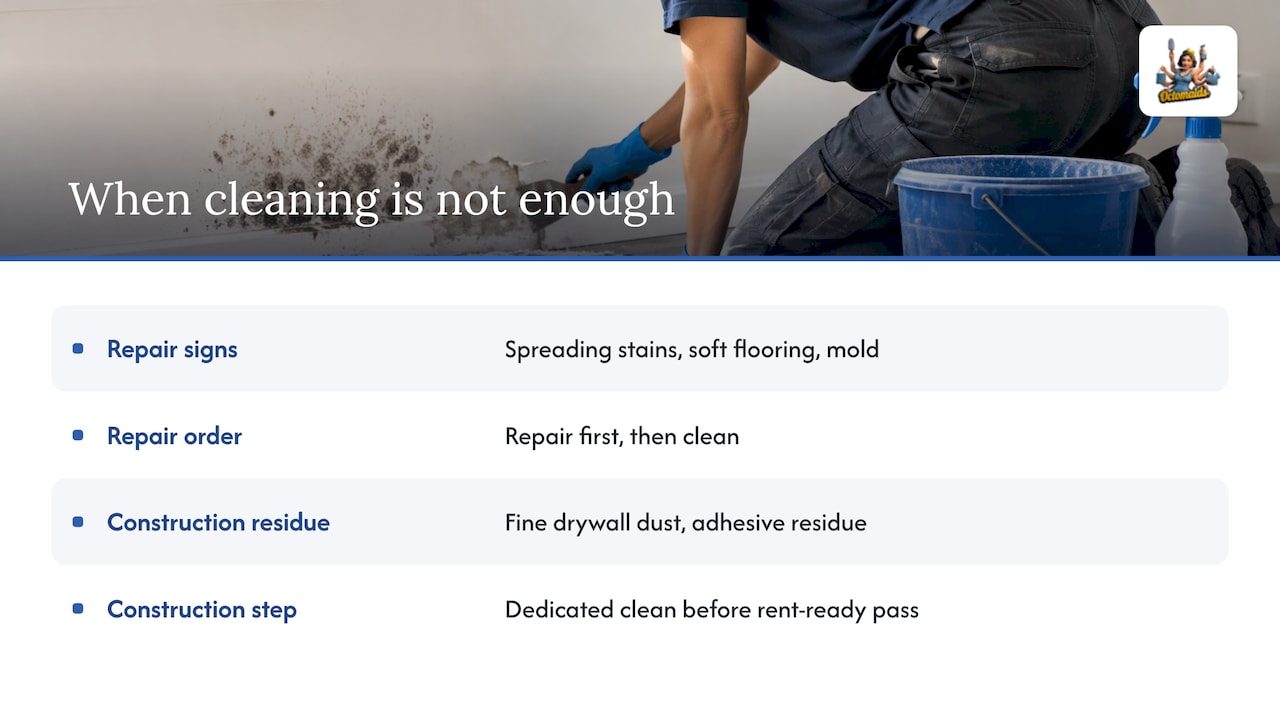
Some problems are repair problems, and cleaning cannot fix them. Water stains that keep spreading, soft flooring, mold behind a vanity, or damage beyond normal wear and tear all fall here. FindLaw notes that landlords may have a legal duty to fix damage beyond normal wear before a new tenant moves in. If you find these during your walk-through, schedule the repair first, then the clean. For questions about your obligations on habitability or deposits, a local landlord-tenant attorney or your state’s landlord-tenant resources are the right people to ask.
Finished construction or renovation work is a different category again. Fine drywall dust and adhesive residue call for a dedicated post-construction clean before the rent ready pass. We cover that on our services page.
How to confirm a unit is truly ready
A clean that nobody verifies is a clean you cannot prove. A simple routine protects you and the tenant:
- Photograph before. Pre-existing damage, left-behind items and any pest or mold evidence, so nothing surprises you later.
- Hand the cleaners a written scope. The checklist above works. Add any property-specific notes, such as a pet-stained bedroom or an older oven.
- Inspect after. Open every cabinet, oven, drawer and closet. Run your hand along baseboards and window tracks. Smell the unit with the windows closed.
- Photograph after. Dated photos of the cleaned condition, room by room.
- Invite the incoming tenant to a move-in walk-through. Sign off together on the condition, with the same checklist in hand.
This takes thirty minutes and removes most arguments about who left what.
Our perspective
Most vacancy delays we see are not caused by the big things. They come from a unit that is almost ready: a fridge gasket nobody wiped, a fan grille still gray, a bathroom that smells faintly of the last tenant. Prospective tenants notice, and property managers get the callback.
That is why we send the same dedicated team to a property, rather than whoever happens to be free. A team that has seen your unit knows where the last tenant left buildup, which closets stick, and which fixtures need extra time. Every one of our cleaners is background-checked, professionally trained and insured, and we stand behind the work with a satisfaction guarantee.
We are a family-owned company, not a franchise, and we have served Vancouver, WA and Portland, OR since 2006. We handle recurring homes, move-in and move-out cleans, short-term rentals and commercial spaces, so a turnover is one phone call rather than three vendors to coordinate. Our advice: book the clean for the day after your last trade finishes, hand us the checklist, and walk the unit with us afterward.
Steven
Get your rental rent ready with Octomaids
If you manage or own a rental in Clark County or the Portland metro, we can take the cleaning off your turnover list. Our team handles move-in and move-out cleans, one-time deep cleans, post-construction cleanups and short-term rental turnovers, and the same background-checked, insured crew returns each time.
Start with our move-in and move-out cleaning service, or browse everything we offer. If you host guests, our Airbnb and vacation rental cleaning covers fast turnovers between stays. You can also contact us through our site for a quote on your unit.
Keeping the unit rent ready between tenants
A unit stays rent ready when the tenancy itself is looked after. Recurring professional cleaning is common for owner-occupied homes, and landlords with vacant units can still schedule periodic visits. Our home cleaning frequency guide and guide to maintaining a clean home between visits are useful for talking to tenants about routine upkeep. Clean units also tend to earn better feedback; see how cleaning shapes rental reviews and ratings.
FAQ
What is the difference between rent ready cleaning and regular cleaning?
Regular cleaning maintains a lived-in home. Rent ready cleaning resets an empty unit after repairs and painting, and includes appliance interiors, cabinets, closets and disinfected high-touch surfaces. It is done last, so nothing gets dirty again before the next tenant arrives.
When should rent ready cleaning be scheduled?
After every other trade has finished. Painters, plumbers and flooring crews leave dust, debris and smudges, so cleaning earlier means cleaning twice. Book the cleaners to start right after the last contractor leaves.
How long does a rent ready clean take?
It depends on square footage, the number of bathrooms and how much buildup the previous tenancy left. A small, well-kept apartment takes far less time than a family house with pet damage. We scope each job individually, so reach out with the unit’s size and condition for an accurate estimate.
Should the tenant or the landlord do the final clean?
Tenants are usually expected to leave the unit clean, but the final presentation for the next tenant is the landlord’s responsibility. Many landlords hire a professional crew after repairs so the standard is consistent. Check your lease and your state’s landlord-tenant rules for what applies to your situation.
Sources
- Make Ready Cleaning: A Guide for Property Managers
- Apartment Make-Ready Cleaning Checklist
- When and How to Clean and Disinfect a Facility (CDC)
- Environmental Cleaning Resource (Washington State Department of Health)
- What Costs Can a Landlord Deduct From a Security Deposit (FindLaw)
- Rental Kitchen Cabinet Ideas
- Renter-Friendly Lighting
Recommended
- Rent Ready in 3–5 Days: Landlord Cleaning Checklist Between Tenants
- Move Out Cleaning Room by Room Guide for Renters
- Move Out Cleaning Checklist for Renters: Get Your Deposit Back
- Why Rental Properties Need Deep Cleans: 2026 Guide
About Octomaids
Octomaids is a locally operated professional cleaning company serving Vancouver, Clark County, and the surrounding Portland metro area. Since 2006, our cleaning teams have helped homeowners, renters, property managers, and businesses with recurring cleaning, deep cleaning, move-in/move-out cleaning, and commercial cleaning.
Our cleaning articles are reviewed to ensure the information reflects our real-world experience and professional cleaning practices.