


A time cost analysis for home cleaning is the practice of quantifying both the hours you spend cleaning and the financial value of that time, then comparing it against the direct cost of hiring a professional. Most homeowners focus only on the service invoice. They miss the bigger number: the value of their own time. When you run a full house cleaning budget analysis, professional service frequently wins on both counts. Typical DIY cleaning runs 18–22 hours per month, while a professional team completes the same work in 8–10 hours. A standard visit for a 3-bedroom home costs $140–$260, and a deep clean runs $220–$450.
How much time does home cleaning actually take?
Homeowners spend 18–22 hours monthly on cleaning tasks. That figure adds up to more than 200 hours per year for a mid-sized or larger home. Professional teams complete the same scope in 8–10 hours per month, saving you over 100 hours annually.
The gap comes from three factors: equipment, routine, and focus. Professionals arrive with commercial-grade tools and a standardized checklist. They do not stop to answer texts, switch laundry, or debate whether the baseboards really need attention today. A 3-bedroom home that takes a homeowner 4–6 hours to deep clean takes professionals 2–3 hours to complete at a higher standard.
Here is how cleaning time typically breaks down by home size for DIY:
| Home size | Weekly maintenance | Monthly deep clean | Annual total (est.) |
|---|---|---|---|
| Studio / 1-bedroom | 1–2 hrs | 3–4 hrs | 60–80 hrs |
| 2-bedroom | 2–3 hrs | 4–5 hrs | 90–120 hrs |
| 3-bedroom | 3–4 hrs | 5–6 hrs | 130–170 hrs |
| 4+ bedrooms | 4–6 hrs | 6–8 hrs | 180–240 hrs |
Seasonal tasks, such as window washing, refrigerator coils, and garage floors, add another 10–20 hours per year on top of these estimates.
Pro Tip: Track your actual cleaning time for one month before comparing it to a service quote. Most homeowners underestimate by 30–40% because they forget to count the time spent gathering supplies, moving furniture, and cleaning up after cleaning.
What are the typical costs of professional cleaning services?
Professional cleaning pricing follows three models: hourly rates ($25–$90 per hour), per square foot ($0.07–$0.15), and flat rates by home size. Flat rate pricing is the most common for residential work because it gives homeowners a predictable number before the cleaner arrives.
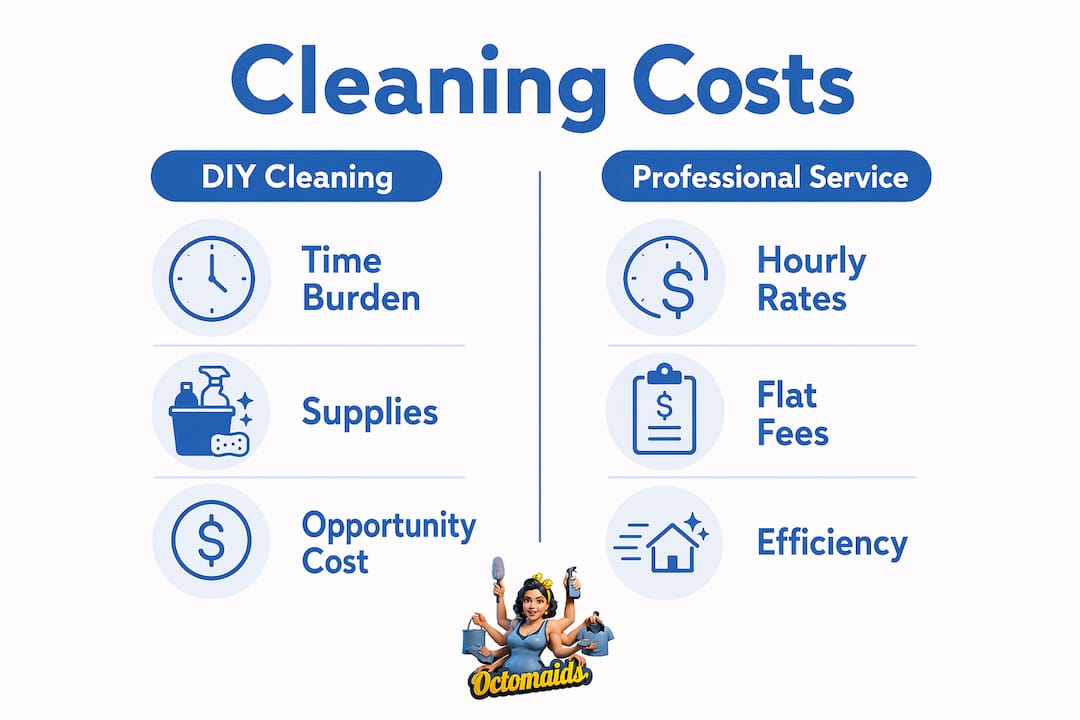
For a 3-bedroom home, a standard cleaning runs $140–$260 per visit. Deep cleans cost 50%–100% more, landing in the $220–$450 range. Move-out cleans typically fall at the top of that range or above, depending on condition. Recurring service plans generally carry a 15%–30% discount compared to one-time rates, which makes them the most cost-efficient option for homeowners who need regular maintenance.
Several factors push prices up or down:
- Pets: Pet hair and dander add time and effort, often adding $20–$40 per visit.
- Buildup: A home that has not been professionally cleaned in six months requires more labor than a home on a biweekly schedule.
- Location: Urban markets like Portland, OR tend to price higher than suburban or rural areas.
- Provider type: Franchise overhead leads to 30%–50% higher pricing than independent cleaners, who retain 85%–95% of fees and often deliver more personalized service.
Understanding how cleaning quotes work helps you read a proposal critically rather than just comparing bottom-line numbers. A lower quote from a franchise may still cost more than an independent cleaner’s higher quote once you factor in what is and is not included.
How do you calculate the opportunity cost of DIY cleaning?
Opportunity cost is the value of what you give up when you choose one activity over another. In cleaning decisions, it means asking: what would I do with those 20 hours per month if I were not scrubbing bathrooms? For households earning $75,000 or more per year, the hourly opportunity cost of cleaning time frequently exceeds the direct cost of hiring a professional.
The math is straightforward. Work through it in four steps:
- Calculate your hourly rate. Divide your annual household income by 2,080 working hours. A $75,000 income equals roughly $36 per hour.
- Estimate your annual cleaning hours. A 3-bedroom home at 18–22 hours per month equals roughly 156–264 hours per year of DIY time.
- Multiply hours by your hourly rate. At $36 per hour, 156 hours of cleaning time carries an opportunity cost of $5,616.
- Compare to service cost. Biweekly professional cleaning at $180 per visit runs approximately $4,320 per year. The math favors hiring out.
The calculation above only covers working time. It does not count recovery time, which is the mental and physical fatigue that follows a full day of cleaning. Homeowners often fail to include mental load and non-working time in their cost-benefit analysis. That skews the comparison in favor of DIY when the reality is the opposite.
Pro Tip: If you use your weekends to clean, your opportunity cost is not your work hourly rate. It is the value of rest, family time, or personal projects you are giving up. That number is harder to quantify but no less real.
The opportunity cost framework also explains why outsourcing house cleaning makes sense even for households that could technically afford the time. The question is not “Can I clean my own home?” The question is “Is this the best use of my time?”
How to build a cleaning budget that actually works
A residential cleaning time analysis is only useful if it leads to a decision. These steps turn the numbers into a practical plan.
- Start with your cleaning frequency. A cleaning frequency guide recommends weekly service for homes with pets or children, biweekly for most households, and monthly for smaller spaces or lower-traffic homes. Match frequency to your actual lifestyle, not an ideal.
- Use a written scope of work. Reputable cleaners provide a written scope before the first visit. This document defines exactly what is included, which prevents billing surprises and lets you compare quotes on equal terms.
- Request a trial clean. A single paid visit before committing to a recurring contract lets you evaluate quality, punctuality, and communication. It also gives the cleaner a chance to assess your home’s actual condition and price accordingly.
- Mix DIY and professional service strategically. Weekly light maintenance, such as wiping counters, vacuuming high-traffic areas, and managing clutter, keeps a home presentable between professional visits. This approach reduces the scope of each professional clean and can lower your per-visit cost.
- Factor in deep cleaning cycles. Most homes benefit from a professional deep clean two to four times per year even if they have regular maintenance service. Budget for these separately rather than treating them as a surprise expense.
Residential cleaning standards vary more than most homeowners expect. A provider who charges $30 less per visit but skips baseboards, ceiling fans, and interior appliances is not cheaper. They are incomplete.
Key Takeaways
Running a full time cost analysis on home cleaning consistently shows that professional service saves both time and money for most households once personal time value is included.
| Point | Details |
|---|---|
| DIY time burden | Homeowners spend 18–22 hours monthly cleaning; professionals complete the same work in 8–10 hours. |
| Professional pricing range | Standard 3-bedroom cleaning costs $140–$260; deep cleans run $220–$450 per visit. |
| Opportunity cost math | At $36/hr, 156 annual cleaning hours carry a $5,616 opportunity cost, often exceeding service fees. |
| Provider type matters | Independent cleaners typically offer better value than franchises due to 30%–50% lower overhead. |
| Trial cleans protect you | A single paid trial visit and a written scope prevent billing gaps before you commit to recurring service. |
What I’ve learned from watching homeowners get this math wrong
The most common mistake I see is treating cleaning as a zero-cost activity because no money changes hands. People think, “I cleaned it myself, so it was free.” But those four hours on a Saturday afternoon were not free. They came out of the only budget that cannot be replenished: your time.
The second mistake is comparing a professional quote to the cost of cleaning supplies and calling it a fair comparison. That is like comparing the cost of groceries to the cost of a restaurant meal and ignoring the two hours of cooking and cleanup. The full picture includes your time, your energy, and what you gave up to do it.
What I find genuinely useful is the opportunity cost calculation in step-by-step form. When homeowners actually write down their hourly rate and multiply it by their annual cleaning hours, the reaction is almost always surprise. The number is larger than they expected. That moment of clarity is what moves people from “I should probably hire someone” to “I am going to hire someone this week.”
The quality-of-life argument matters too, but it is harder to put in a spreadsheet. A clean home you did not have to clean yourself feels different. The mental load of managing a cleaning schedule, buying supplies, and doing the work yourself is real. Removing it has value that does not show up in any cost comparison but shows up clearly in how you feel on Sunday evening.
My advice: run the numbers honestly, include your time at a fair rate, and then request a written scope and a trial clean from any provider you are considering. That combination of financial clarity and service accountability is what separates a good cleaning decision from an expensive guess.
— Steven
Professional cleaning services from Octomaids
Octomaids has served homeowners and businesses in Vancouver, WA and Portland, OR since 2006. Our family-owned team brings the same trusted cleaners to every visit, which means consistent results and no relearning your home each time.
Whether you need recurring cleaning service on a weekly or biweekly schedule, a one-time deep clean, or move-in and move-out service, Octomaids provides transparent pricing and a clear scope of work before we start. Recurring plans carry meaningful discounts compared to one-time rates, making them the most cost-efficient path for most households. Browse our full range of residential and commercial services to find the plan that fits your home, your schedule, and your budget.
FAQ
How many hours per month does the average homeowner spend cleaning?
The average homeowner spends 18–22 hours per month on cleaning tasks. Professional teams complete the same scope in 8–10 hours, saving over 100 hours annually.
What does a professional cleaning service cost for a 3-bedroom home?
A standard professional cleaning for a 3-bedroom home costs $140–$260 per visit. Deep cleans run $220–$450, and recurring service plans typically reduce per-visit costs by 15%–30%.
Is hiring a cleaning service actually cheaper than doing it yourself?
For households earning $75,000 or more per year, the opportunity cost of DIY cleaning often exceeds the direct cost of professional service. At $36 per hour, 156 annual cleaning hours carry a $5,616 opportunity cost versus roughly $4,320 for biweekly professional service.
What is the difference between independent cleaners and franchise services?
Independent cleaners retain 85%–95% of their fees and typically offer more personalized service. Franchise overhead leads to 30%–50% higher pricing without a corresponding improvement in cleaning quality.
How do I protect myself before committing to a recurring cleaning contract?
Request a written scope of work and a paid trial clean before signing any recurring agreement. These two steps reveal service gaps and set clear expectations before you commit.