


OSHA requires restrooms be kept clean and sanitary under 29 CFR 1910.141, and CDC guidance calls for cleaning high-touch surfaces at least once daily. For a typical office, that translates into a practical baseline: a daily clean, plus additional checks as traffic increases.
TL;DR:
- Restrooms should be cleaned at least once daily with additional checks during high traffic or after reported issues, especially for high-touch surfaces.
- Proper record-keeping of cleaning logs with date, time, and initials helps prove compliance in inspections or audits.
- Cleaning, sanitizing, and disinfecting serve distinct purposes; cleaning removes soil, sanitizing reduces germs, and disinfecting targets illness or visible contamination.
- Response to biohazard spills requires a specific protocol, including securing the area, removing contamination, and using EPA-registered disinfectants with proper contact time.
- Consistent staff training, clear checklists, and thorough audits ensure restroom standards are reliably maintained and inspection-ready.
Table of Contents
- What OSHA 29 CFR 1910.141 requires from your facility
- Cleaning, sanitizing, and disinfecting are not the same job
- A daily restroom cleaning checklist that holds up to scrutiny
- Keeping cleaning staff safe with PPE and proper chemical handling
- Setting cleaning frequency by traffic, not just the clock
- Handling blood, fecal matter, and other biohazard incidents
- Adapting Octomaids’ checklist-driven workflows for your own team
- Where ISSA and GBAC STAR fit alongside OSHA and CDC
- Building an audit and quality control process that actually works
- Training staff so the standards actually get followed
- Cutting waste and chemical exposure without cutting corners
- Fixing odor, mold, and hard water stains before they become complaints
- What keeps a restroom inspection-ready, in one manager’s experience
- How Octomaids supports office and commercial restroom standards
- Sources
- FAQ
What OSHA 29 CFR 1910.141 requires from your facility
OSHA’s sanitation standard sets the legal floor for every workplace restroom, and it covers more than just cleanliness. The rule requires employers to provide toilet facilities that stay clean and sanitary, along with potable running water, soap or another cleansing agent, and a drying method such as towels or an air blower. Table J-1 in the standard defines minimum fixture counts scaled by employee headcount, and a 1998 OSHA interpretation clarifies that “provide” means employees need prompt, unrestricted access, not just a locked door somewhere down the hall.
A few points matter most for day-to-day compliance:
- Facilities must be separated by sex unless each restroom is a single-occupancy room that locks from the inside.
- Access cannot be delayed unreasonably; a sign-out system is fine only if it does not create real waiting time.
- Soap, water, and a drying method are not optional extras. Their absence is a standard violation on its own.
- Fixture counts scale with staff size, so a headcount change may mean your restroom count needs a second look.
Keep a simple maintenance log by each restroom door or in your facilities software. Date, time, and initials are enough to show an inspector that cleaning happened on schedule, and that record becomes your best evidence if a complaint ever turns into an audit.
Cleaning, sanitizing, and disinfecting are not the same job
These three words get used interchangeably by staff who have never had them explained, which is how restrooms end up over-disinfected in some spots and under-cleaned in others. Cleaning removes visible soil and organic matter with soap or detergent. Sanitizing reduces germs to a safer level. Disinfecting is effective only on surfaces that have been properly cleaned first, since leftover grime blocks the chemical from reaching what it is meant to kill.
CDC guidance treats routine cleaning as sufficient for most restroom situations, reserving disinfection for moments when someone is sick or a surface is visibly contaminated. That is a shift from the instinct to disinfect everything, every time.
Contact time, or dwell time, is a critical step often overlooked. An EPA-registered disinfectant only works if the surface stays visibly wet for the full time listed on the label. Wipe it dry early and the product never finishes killing what it is supposed to kill.
- Clean first, always. Disinfectant sprayed onto a soiled surface is wasted effort.
- Sanitizing sits between the two and suits everyday touchpoints like door handles.
- Disinfecting is the response to illness or visible contamination, not a daily default.
A daily restroom cleaning checklist that holds up to scrutiny
A checklist only works if it tells someone exactly what “done” looks like. Break the day into priority tasks, mid-shift checks, and periodic deep work, and give each one a clear finish line.
- Toilets and urinals: clean bowls and exteriors, disinfect seats and handles, and confirm no lingering odor or residue.
- Sinks and faucets: wipe basins, clean faucet handles, and dry surfaces so water spots do not build up.
- Mirrors: wipe streak-free, checking corners where splash marks collect.
- Dispensers: restock soap, toilet paper, and paper towels, and test that each unit actually dispenses.
- Trash: empty bins and replace liners rather than pushing waste down to make room.
- Floors: sweep, then spot mop around toilets and sinks where moisture collects.
- Odor control: check floor drains and vents, since odor is usually a symptom of something else, not a standalone problem.
For busier restrooms, add hourly or mid-shift rounds that hit the high-touch points: door handles, stall latches, faucet handles, and dispenser refills. Weekly or monthly tasks should cover grout and tile deep cleaning, drain maintenance, fixture descaling, and vent or grille cleaning, none of which fit into a five-minute daily pass.
Acceptance criteria keep the checklist honest: no visible soil, all dispensers functioning, no standing water, and no noticeable odor at entry. A supervisor who can walk in and check those four things in under a minute has a workable audit tool.
Pro Tip: Post the daily checklist inside the restroom door itself, not just in a binder at the front desk. Staff and visitors both notice when a task list is visible and current.
Keeping cleaning staff safe with PPE and proper chemical handling
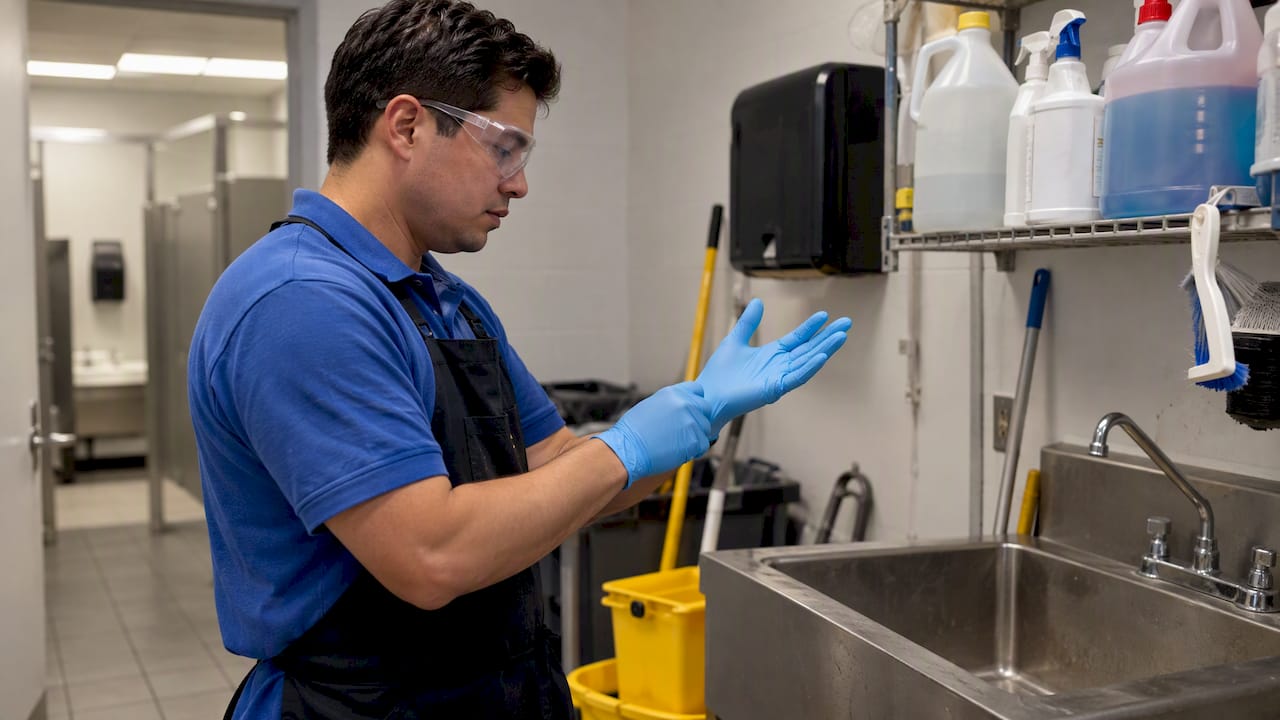
Protecting the people doing the cleaning is part of the standard, not an afterthought. Routine restroom cleaning calls for nitrile gloves and eye protection when splashing is likely, while any biohazard cleanup steps up to gloves, a gown, and face or eye protection, sometimes a mask depending on the exposure. Handwashing immediately after removing gloves is not optional in either case.
Before any product goes into use, check its Safety Data Sheet for required PPE, first-aid steps, and storage instructions, and confirm it is not being mixed with something incompatible. Diluted solutions need labels too, since an unmarked spray bottle is a hazard waiting to happen.
- Keep SDS binders or digital access points within reach of the supply closet, not locked in an office upstairs.
- Match PPE to the task: routine cleaning gloves are not the same tier as biohazard response gear.
- Ventilate the space when using stronger disinfectants, and favor less-irritating formulations where the label allows it, since fume buildup in a small restroom can trigger asthma symptoms in staff or visitors.
Setting cleaning frequency by traffic, not just the clock
A fixed schedule treats a rarely used single-occupancy restroom the same as one serving two hundred people a day, which wastes labor in one place and under-cleans in another. The better approach scales frequency to actual use.
- Low-traffic restrooms hold up fine on one full daily clean.
- Higher-traffic restrooms benefit from added midday checks as occupancy climbs, since more use means more opportunity for soil and depleted supplies.
- Visible soil, a reported illness, or a one-off event like an all-hands meeting are all valid triggers to escalate cleaning or add a disinfection pass.
- Porter rounds with a simple checklist, manual logs, or dispenser sensors all give supervisors a way to verify that checks actually happened rather than assuming they did.
None of these thresholds are regulatory requirements. They are operational guidance drawn from CDC’s risk-based cleaning framework, which favors reacting to real signals like traffic and illness over rigidly following a printed schedule.
Handling blood, fecal matter, and other biohazard incidents
A biohazard spill in a restroom is not a bigger version of a routine mess. It needs its own protocol, and staff should know it before they ever need it.
- Secure the area so no one else walks through it, and put on the appropriate PPE, gloves, gown, and eye or face protection.
- Remove gross contamination first using an absorbent material, since organic matter left in place will block any disinfectant from working.
- Clean the surface, then apply an EPA-registered disinfectant and keep it visibly wet for the full contact time on the label.
- Bag and dispose of waste according to local hazardous waste rules, wash hands thoroughly after removing PPE, and log the incident per facility policy.
Skipping the pre-clean step is the most common failure point. A disinfectant applied straight onto visible soil looks like a finished job but has not actually done the work it claims to.
Adapting Octomaids’ checklist-driven workflows for your own team
Checklists only pay off when they are actually used, which is why splitting tasks into daily and weekly tiers, with a short handover note between shifts, tends to outperform a single long list nobody reads in full. Dedicated teams who service the same site repeatedly build familiarity with dispenser par levels and trouble spots that rotating staff never develop.
- Set dispenser par levels so restocking happens on a fixed count, not just when someone notices an empty holder.
- Run a brief spot audit at shift change: three or four checkpoints, done consistently, beat an exhaustive list done rarely.
- Adapt a published office cleaning checklist into your own vendor SLA language so contractors are held to the same acceptance criteria your in-house team uses.
Where ISSA and GBAC STAR fit alongside OSHA and CDC
OSHA and CDC set the baseline, but two industry frameworks go further for organizations that want a documented, auditable cleaning program. ISSA’s Cleaning Industry Management Standard, known as CIMS, certifies that an organization’s cleaning operations meet defined criteria for quality systems, training, and management practices. It is less about any single restroom task and more about whether the whole cleaning operation runs on a repeatable, documented process.
GBAC STAR, developed by the Global Biorisk Advisory Council, focuses specifically on infectious disease prevention and outbreak preparedness in facilities. It asks for cleaning protocols, staff training, and response plans that go beyond routine maintenance into readiness for events like a norovirus outbreak moving through an office.
Neither framework is required by law the way OSHA’s sanitation standard is. They function as a ceiling above the regulatory floor, useful for facilities that want to demonstrate rigor to tenants, clients, or their own leadership. A facility manager does not need certification to borrow the underlying discipline: documented procedures, defined training, and a way to prove the program is actually followed rather than just written down. For most offices, adopting the habits these frameworks describe, without pursuing formal certification, delivers most of the benefit at a fraction of the administrative load.
Building an audit and quality control process that actually works
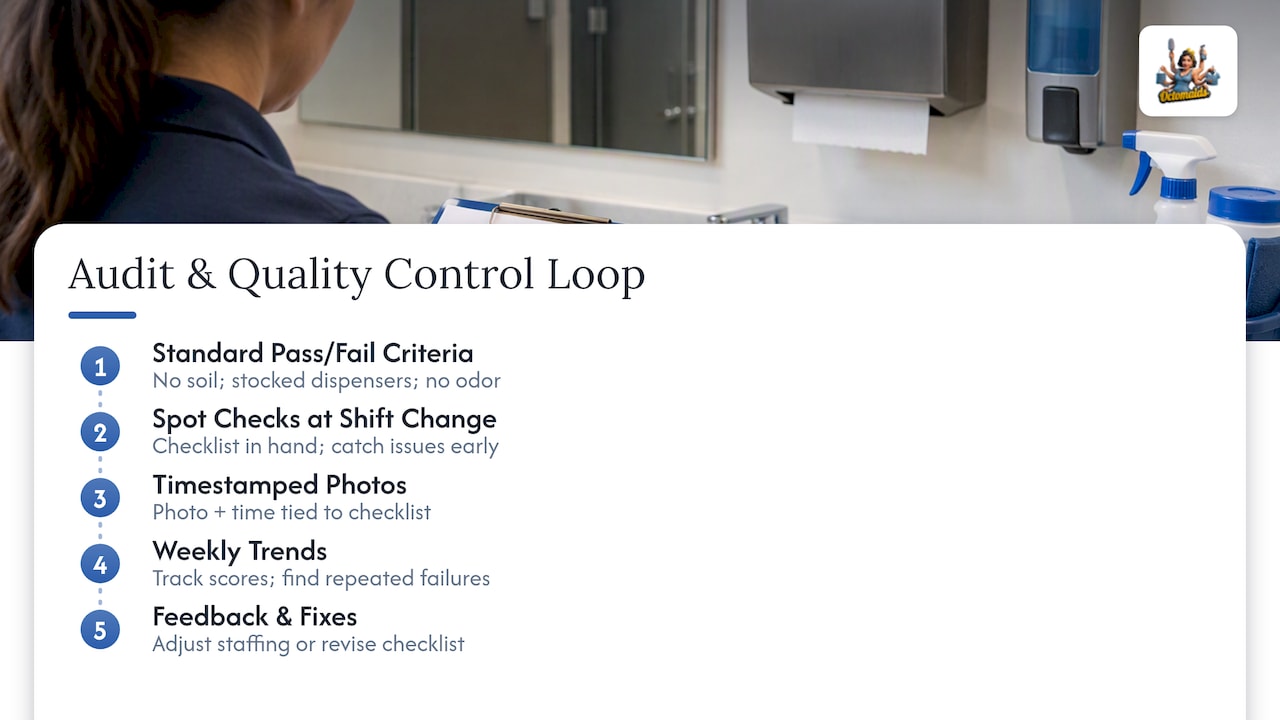
An audit process is only useful if it produces a consistent score, not a supervisor’s gut feeling on a given day. The simplest reliable method is a pass or fail checklist scored against the same acceptance criteria used in daily cleaning: no visible soil, stocked dispensers, no standing water, no persistent odor. Anything more complicated tends to break down once a non-technical reviewer has to apply it.
Spot checks work better woven into the existing rhythm than as a separate, occasional event. A supervisor walking a restroom at shift change, checklist in hand, catches problems while they are still small. Photographic documentation, timestamped and tied to the same checklist, adds a layer of proof that is hard to dispute later.
Trend the scores over weeks rather than reacting to any single bad day. A restroom that fails audit twice in a month points to a scheduling gap or a training issue, not bad luck. Feeding that pattern back into staffing or checklist revisions closes the loop between inspection and actual improvement, which is the part most programs skip.
Training staff so the standards actually get followed
A checklist is only as good as the person executing it, and restroom cleaning has enough nuance that a quick verbal explanation on day one rarely sticks. New staff need hands-on training covering the difference between cleaning and disinfecting, correct PPE use for both routine and biohazard scenarios, and how to read a product label for dilution ratios and contact times.
Competency is best confirmed through direct observation rather than a written quiz. A supervisor watching a new hire complete the full daily checklist once, correcting technique in real time, catches gaps that a training video alone will not.
Refresher training matters just as much as onboarding, particularly when a facility switches disinfectant products or updates its checklist. Staff who learned one product’s contact time can misapply it to a replacement product with a different requirement, which quietly undoes a compliance program that looked solid on paper.
Cutting waste and chemical exposure without cutting corners
Restroom cleaning generates a steady stream of chemical use and packaging waste, and a few adjustments reduce both without weakening the results. Concentrate-based cleaning systems, diluted on-site into reusable spray bottles, cut plastic waste compared to buying pre-mixed products in single-use containers.
Choosing less-irritating formulations where the label allows supports both sustainability goals and staff health, since lower-fume products reduce ventilation strain in small restroom spaces. Microfiber cloths, laundered and reused, replace a steady stream of disposable wipes for routine wiping tasks, though EPA-registered disinfectant application still needs to follow its specific label instructions regardless of the applicator.
Paper towel and toilet paper choices matter too. Recycled-content or FSC-certified paper products reduce environmental footprint without changing the restocking routine your checklist already covers. None of these swaps require abandoning EPA-registered disinfectants for illness response or biohazard cleanup. Sustainability and compliance are not in conflict here. The adjustments live in the routine cleaning layer, not the disinfection layer where label compliance has to come first.
Fixing odor, mold, and hard water stains before they become complaints
Odor is almost never a standalone problem. It is a signal that something else, a floor drain, a grout line, or a dispenser, needs attention. Chasing odor with air freshener treats the symptom and leaves the source to keep producing it.
Mold thrives on the moisture restrooms generate constantly, so ventilation matters as much as the cleaning product used on visible growth. Grout lines and caulk around fixtures are the most common hiding spots, and a weekly deep clean pass that specifically targets those areas prevents small growth from becoming a visible, complaint-generating problem.
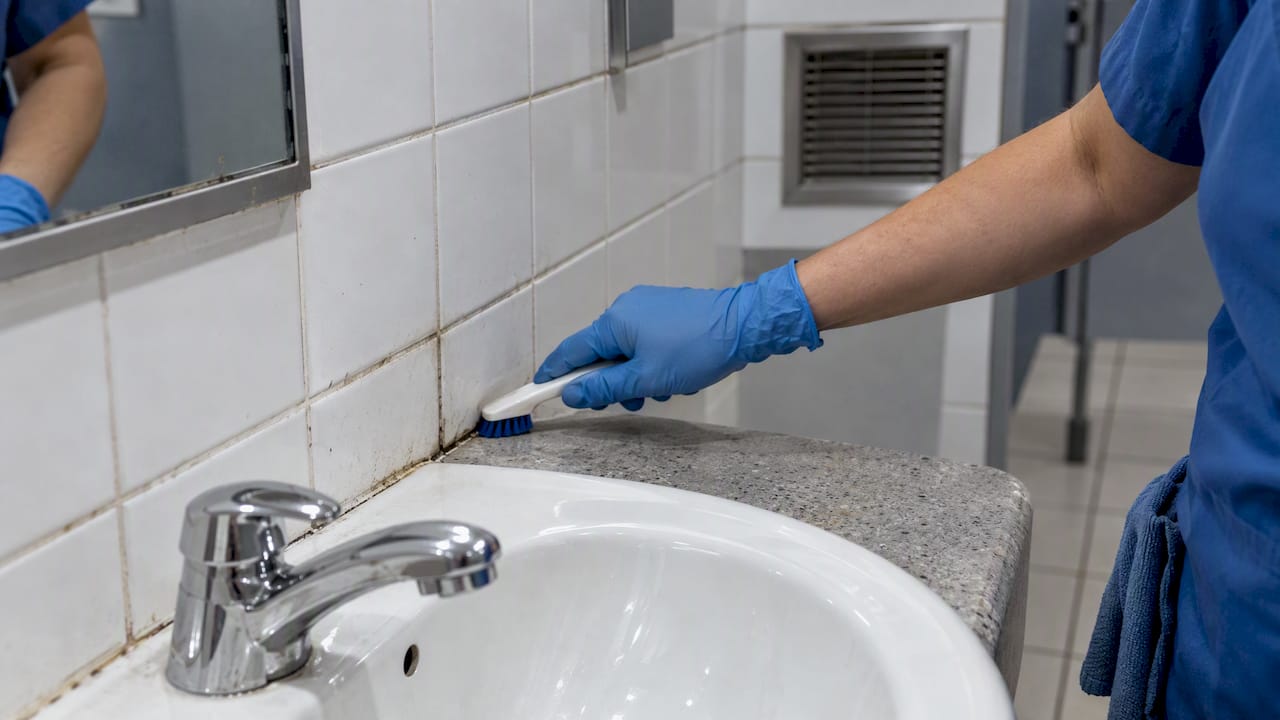
Hard water stains around faucets and in bowls respond to descaling treatments applied on a periodic basis rather than daily, since daily cleaning products are not usually formulated to dissolve mineral buildup. Catching these three issues at the weekly or monthly checklist tier, rather than waiting for a complaint, keeps the daily routine focused on what it does best and prevents the kind of visible neglect that erodes trust in a restroom faster than almost anything else.
What keeps a restroom inspection-ready, in one manager’s experience
Functional dispensers and a fast response to mid-shift problems prevent more complaints than any deep clean ever will. A short handover note and a two-minute spot check at shift change catch the small misses before they turn into a pattern.
— Steven
How Octomaids supports office and commercial restroom standards
Running a checklist is one thing. Having the same trained team show up and execute it the same way, visit after visit, is what actually keeps a restroom audit-ready between your own spot checks. Octomaids provides commercial and office cleaning with dedicated teams assigned to each site, so the person cleaning your restrooms this week is the same one who cleaned them last week and knows where the trouble spots are.
If you are comparing vendors, ask each one the same questions: how often do they check high-traffic restrooms, can they share a sample checklist, do they document which EPA-registered disinfectants they stock and follow label contact times, and what training and insurance coverage do their staff carry. A provider who answers all four clearly is worth a second look.
- Request a written cleaning frequency and checklist as part of any quote.
- Ask how the provider handles biohazard incidents and staff training on PPE.
- Confirm insurance and background-check practices before signing a contract.
Request a quote for office cleaning and ask for a sample checklist alongside it, so you know exactly what a visit includes before committing.
Sources
- 1910.141 – Sanitation. | Occupational Safety and Health Administration
- When and How to Clean and Disinfect a Facility | CDC
- Selected EPA-registered disinfectants | EPA
FAQ
What are the OSHA restroom cleaning requirements?
OSHA’s sanitation standard requires employers to provide toilet facilities that stay clean and sanitary, along with potable water, soap, and a drying method. It also sets minimum fixture counts and requires prompt, unrestricted access for employees.
How often should restrooms be cleaned in a workplace?
CDC guidance recommends cleaning high-touch restroom surfaces at least once daily, with more frequent attention for high-traffic areas. Offices typically run a full daily clean as the baseline and add midday checks as occupancy or reported issues rise.
What are the recommended guidelines for office cleanliness?
Office cleanliness guidelines combine OSHA’s fixture and sanitation requirements with CDC’s risk-based cleaning approach: clean daily, disinfect when someone is ill or a surface is visibly soiled, and always clean before disinfecting so the product can actually reach the surface. Documented checklists and simple pass or fail audits help managers verify the standard is being met consistently.
What are the 5 cleaning standards?
There is no single universally cited “5 cleaning standards” framework; definitions vary by industry and organization. A common approach groups the essentials as clean, sanitize, disinfect, ventilate, and document, reflecting the core actions covered by OSHA’s sanitation rule and CDC’s cleaning and disinfecting guidance.
Recommended
- 6 Steps to an Audit Ready Office Cleaning Checklist for Managers
- Managers: Audit Ready Office Kitchen Checklist for Passing Inspections
- Office Cleaning Supplies Managers Need: Zone Par Levels & EPA Signals
- Shared Workspace Sanitation Best Practices Managers Can Use Today
About Octomaids
Octomaids is a locally operated professional cleaning company serving Vancouver, Clark County, and the surrounding Portland metro area. Since 2006, our cleaning teams have helped homeowners, renters, property managers, and businesses with recurring cleaning, deep cleaning, move-in/move-out cleaning, and commercial cleaning.
Our cleaning articles are reviewed to ensure the information reflects our real-world experience and professional cleaning practices.