


An office move-out clean is the last job between your team and a clean handover: read the lease’s surrender clause, wait until furniture, files and IT equipment are out, then clean room by room (workstations, break room, restrooms, floors, glass, walls) and walk the space with your landlord’s standards in hand. This guide gives you that sequence, the checklist itself and the points where handovers usually go wrong.
TL;DR
- Read the lease’s surrender or move-out clause first. It, not a generic list, decides what “clean” means for your space.
- Clean after furniture, files, IT equipment and hauling are gone, so the space does not get dirty again before handoff.
- Work zone by zone: workstations, private offices, reception and conference rooms, break room, restrooms, floors, glass, walls and fixtures.
- Keep cleaning separate from repairs, hauling, patching and painting, and assign each to an owner.
- Hold your own walkthrough about a week before handover, with dated photos, so there are no surprises.
Table of Contents
- Start with the lease, not the mop
- Get the timing right
- What to gather before the cleaners arrive
- The room-by-room checklist
- What counts as cleaning, and what does not
- Check your work before the landlord does
- Common handover mistakes
- Perspective
- Let us handle the final clean
- FAQ
- Sources
Start with the lease, not the mop
The most common mistake in an office move-out is cleaning to a standard nobody agreed on. Commercial leases vary widely. Some ask only for the space to be returned “broom clean.” Others require professional carpet cleaning, window washing or receipts proving the work was done. Pull out the lease, any property manager instructions, the building’s move-out checklist, and any final walkthrough date before you schedule anything.
While you have those documents open, write down the building rules that affect the cleaners as much as your own staff: elevator reservations, loading dock schedules, trash and recycling rules, parking, and sign-in procedures. A crew that arrives to find the freight elevator booked for someone else loses hours you are paying for.
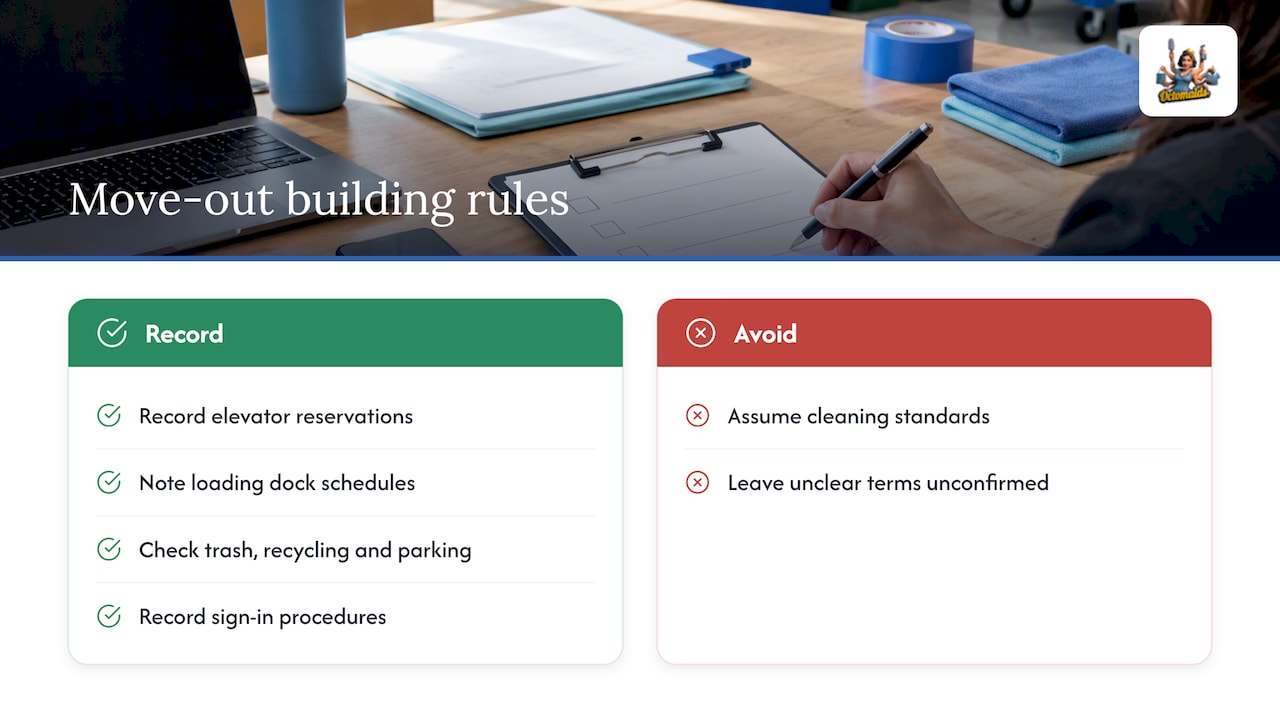
If any requirement is unclear, ask the property manager and get the answer in writing. Phrases like “ordinary wear and tear” are a frequent source of disputes. BOMA International, the commercial real estate association, suggests that landlords spell out surrender conditions in the lease, such as floor cleaning, wall restoration and testing of systems like HVAC, precisely to reduce disagreements at lease end. As a tenant, you benefit from the same clarity: ask what the landlord expects before you spend money.
If your move also involves clearing out bulky leftovers, a landlord’s written cleanout standards are a good model for what a handover-ready space looks like. This cleanout standards for units checklist shows how property owners think about lease terms, manager instructions and the final walkthrough.
Get the timing right
The order of trades matters more than the length of your checklist. Cleaning too early is the classic waste: movers, IT technicians and haulers track dirt back in, and you pay twice. The better plan is to start the final clean once furniture, employees, files and IT equipment are largely out, and after any hauling, cabling removal or repairs that could leave debris.
A workable sequence looks like this:
- Weeks ahead: Review the lease, set a budget and timeline, and tell managers and staff what is expected of them.
- Before the move: Declutter desks, shred or archive records, and decide who is responsible for disposing of equipment, supplies and furniture.
- Move day and after: Movers, IT and hauling finish. Anything the building must repair or patch is done.
- Final clean: Crew cleans the empty space top to bottom.
- Pre-handover walkthrough: You inspect, photograph and fix leftovers.
- Handover: Keys, access cards and codes go back to the property manager.
The U.S. Forest Service’s office cleanup handbook is written for federal offices but the logic transfers to any business: start early, build a timeline and budget, brief managers and staff, name who handles disposal of records, software and supplies, coordinate safety and security, and arrange hauling for heavy or awkward items and for recycled and discarded material.
What to gather before the cleaners arrive
A cleaning company can only quote and plan accurately if you give it the facts. Pull this together in one short document:
- The floor plan or suite size, and the floor types (carpet, tile, vinyl, hardwood)
- Photos of stains, damage and any leftover items
- Confirmation that water and power will stay on through the clean
- Access details: keys, access cards or security codes, elevator and loading dock rules, parking, and sign-in procedures
- Any restricted rooms or areas that must not be disturbed
- The date of the final walkthrough or the first showing for the incoming tenant
- Who is paying for the clean
Guidance from Diamond Certified, a business rating organization, points the same way: the team needs access to every area in scope, and building security should be told about after-hours access and the schedule. Also clear space under and behind furniture that remains in scope, and walk the office beforehand so nothing about the condition surprises the crew.
Take dated photos of the space as it stands before the last items leave. Those images help you separate marks and damage that were already there from anything that happened during your tenancy.
The room-by-room checklist
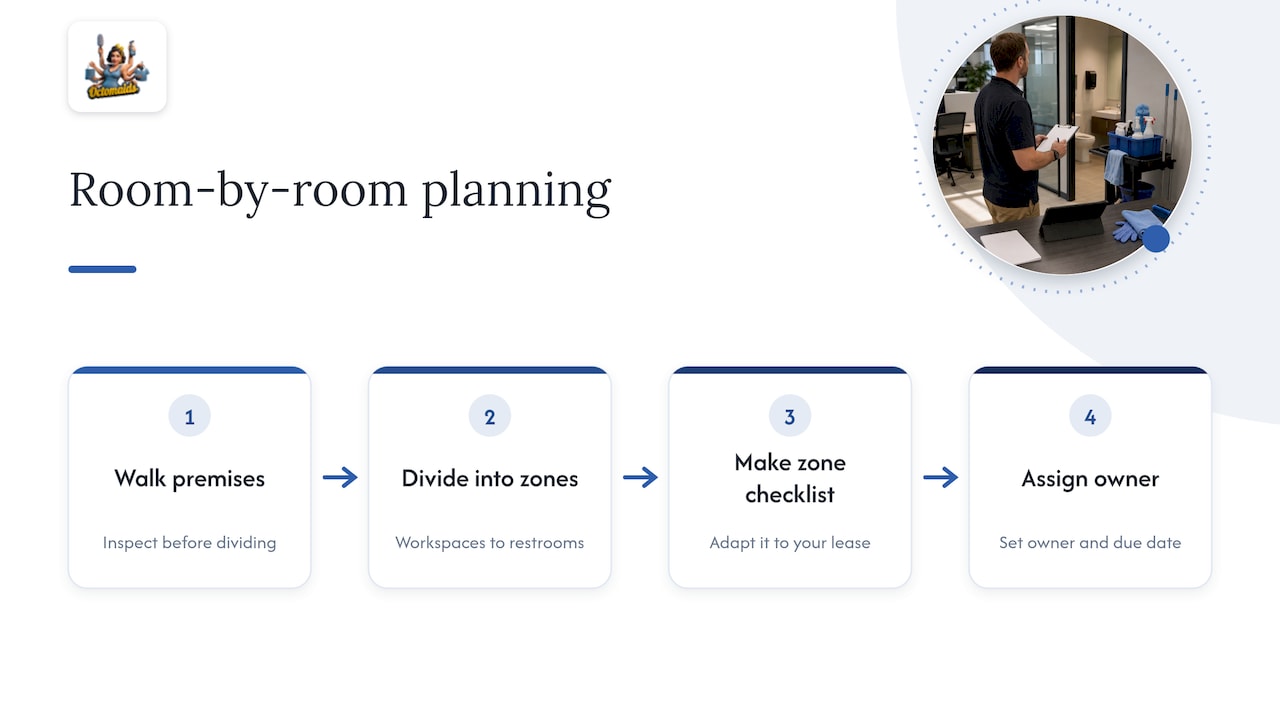
Walk the premises first and divide them into zones: workspaces, private offices, reception, conference rooms, break rooms and restrooms. Turn your notes into the list below, and assign each zone an owner and a due date. Adapt it to your own lease.
Workstations, cubicles and private offices
- Remove all personal items, paper, cables and supplies from desks, drawers and cabinets
- Dust and disinfect desktops, shelves, ledges, filing cabinet tops and partition tops
- Wipe desk drawers inside and out if the furniture stays
- Clean phones, light switches, door handles and door frames
- Vacuum under and behind where furniture stood, and check for tape residue and cable marks on floors
- Empty all trash cans and recycling bins, and remove liners
Reception, conference rooms and common areas
- Wipe the front desk counter and surrounding high-touch points
- Clean glass partitions, display cases and the entry door, including interior touch points
- Remove scuff marks and adhesive residue from walls, such as tape or mount marks
- Dust window sills, ledges, blinds and the tops of door frames
- Clean interior door tracks and thresholds
- Wipe whiteboards, tables and built-in credenzas that stay with the space
If you are moving into a new office as well, our guide to office move-in cleaning covers what to book and when on the other end.
Break room and kitchen
- Empty the refrigerator, throw out all food, and wash shelves and drawers; leave doors propped open or the unit unplugged if the landlord prefers it
- Clean microwave interiors and exteriors
- Degrease the stovetop, and clean the oven if there is one
- Wipe cabinet fronts, inside the cabinets and drawers, and countertops
- Scrub and disinfect the sink and faucet, and clean the coffee station, water dispenser and dishwasher filters if they are part of the space
- Take out trash and recycling, and wipe the bins
For a deeper look at the standards a kitchen should meet, see our office kitchen cleaning checklist.
Restrooms
- Descale and disinfect toilets, urinals, sinks and faucets
- Clean mirrors, dispensers and partitions
- Wipe walls, doors and stall latches
- Mop floors and clean drains
- Remove all trash and sanitary bins, and take out any supplies you own
Restrooms are where an inspector’s eyes land fast. Leave them in the best shape of any room.
Floors
- Vacuum carpets thoroughly, then check your lease: it may call for professional hot-water extraction or steam cleaning, sometimes with a receipt
- Sweep and mop hard floors, paying attention to corners, thresholds and the edges along baseboards
- Check lease language about stripping and refinishing hard floors, which is a specialist job
- Spot-treat stains and note any that remain, with a photo, so you can explain them at walkthrough
Under federal workplace safety rules, OSHA standard 29 CFR 1910.22 requires employers to keep workplaces, passageways and walking-working surfaces clean, orderly and sanitary, and the surfaces free of hazards such as spills. While your crew is still in the building, that is a practical reason to mop up spills right away and keep paths clear of debris and equipment.
Windows and glass
- Clean interior windows and glass doors, removing smudges and stains
- Wipe frames, tracks and sills
- Clean glass office walls and partitions on both sides
- Check the lease for exterior window washing, which may need to be done by a professional with proper equipment
Walls, vents and fixtures
- Remove scuffs and adhesive residue from walls
- Dust ceiling vents and return grilles, and wipe light fixtures and diffusers
- Take down nails, hooks and mounting hardware, and note holes for the property manager
- Wipe baseboards, door frames and light switch plates
A note on the boundary: patching holes and painting are maintenance, not cleaning. Many cleaning scopes also do not include hauling away furniture and equipment. Decide in advance who handles each, so no task is orphaned a day before handover.
What counts as cleaning, and what does not
It helps to give every task a category before you hire anyone. A quick split:
| Task | Usually cleaning? | Who typically handles it |
|---|---|---|
| Wiping surfaces, mopping, vacuuming | Yes | Cleaning crew |
| Carpet extraction, glass, restroom restoration | Yes, specialized | Cleaning crew or specialist |
| Removing furniture, e-waste, junk | No | Movers or hauler |
| Removing cabling, IT equipment | No | IT vendor |
| Patching walls, painting, repairs | No | Maintenance or contractor |
| Post-construction dust after buildout removal | Specialized cleaning | Cleaning crew with the right scope |
End-of-lease cleaning can go beyond a normal janitorial visit. Depending on the lease, it might include deep cleaning, carpet extraction, appliance cleaning and restroom restoration. If your lease sets a higher bar than “broom clean,” confirm it in writing before you set the budget.
Check your work before the landlord does
About a week before the surrender date, do a pre-inspection of your own. That leaves time to fix issues while vendors and building access are still available.
- Reread the clause with the checklist beside it.
- Inspect each room against the agreed condition, not against what you think looks good.
- Record exceptions with photos: any stain that did not come out, any mark that predates your tenancy, any item left behind by the building.
- Track each open item with an owner, a due date and a simple acceptance test (for example, “carpet in conference room has no visible stains”).
- Reconcile the open list before handover, and keep a copy for your records.
BOMA also recommends that landlords schedule inspections at one year, six months, three months and one month before lease expiration, so that repairs get found early. If your landlord does this, use those inspection notes as part of your plan rather than waiting for the final one.
When the day arrives, return all keys, cards and codes, and ask for written confirmation that the handover is complete.
Common handover mistakes
- Cleaning before the trades finish. Dust and footprints come back with the movers.
- Assuming “clean” is a single standard. It is whatever the lease and the building say it is.
- Forgetting access. Crews cannot clean what they cannot reach. Rooms, closets and server rooms need keys or codes.
- Leaving supplies and equipment. Old cleaning products, paper and appliances left behind count against you.
- Skipping the written record. Without dated photos, a dispute over a stain becomes your word against the landlord’s.
If your team or a vendor handles cleaning products on site, make sure they follow product labels and safety data sheets, and report any incident. This non-toxic cleaning supplies starter kit is a helpful overview of what to look for when choosing supplies.
Perspective
We have cleaned homes and businesses across Vancouver, WA and the Portland metro since 2006, and the pattern at move-out is always the same: the space is never the problem, the plan is. Offices that go smoothly settle three things early. They know exactly what the lease requires, they clean after the last box leaves, and they give one team the whole job.
That last point is why we send the same dedicated, background-checked, insured team for every visit rather than whoever happens to be free. A crew that has seen your space can tell the difference between a mark that was there before and one that needs attention. At a handover, that familiarity saves time and prevents arguments.
Our advice is to treat the final clean as a project with a scope, not a rush job on the last evening. Give your cleaners access, a photo set and the lease language, and let them do what they are trained for.
Steven
Let us handle the final clean
If you would rather not coordinate this yourself, our team provides commercial and office cleaning for businesses in Clark County, WA and the Portland metro. We are a family-owned company, not a franchise, and every visit is staffed by trained, background-checked and insured cleaners. Tell us your suite size, floor types and handover date, and we will talk through what your lease requires and plan the clean around your move.
For ongoing upkeep in your new space, our office cleaning checklist for managers and office deep cleaning checklist are good places to start. When you are ready, you can see all our commercial services or reach us through our home page.
FAQ
What does office move-out cleaning usually include?
It usually covers workstations and private offices, the break room, restrooms, floors, glass, walls, vents and fixtures, plus trash removal. Depending on your lease, it can also include carpet extraction, hard floor refinishing and appliance cleaning. Hauling, patching and painting are generally separate trades.
When should I schedule the final clean?
After furniture, files, IT equipment and hauling are out, and before the final walkthrough. Leave a few days of buffer so you can correct anything the pre-inspection finds. Cleaning earlier usually means the space gets dirty again before handoff.
Is a “broom clean” office the same as a deep clean?
No. Broom clean generally means free of debris and swept, while many leases ask for a deeper professional standard. Check the surrender clause, and if it is vague, ask the property manager to confirm the standard in writing.
Who pays for end-of-lease office cleaning?
That depends on the lease. Most commonly the tenant is responsible for returning the space to the stated condition, but the lease and any negotiated terms decide. Read the clause, and confirm with your property manager before you book.
Sources
- Move Handbook: Office Cleanup, U.S. Forest Service
- How to Prepare for a Commercial Office Cleaning, Diamond Certified
- Avoiding Disputes Over the Condition of Properties Upon Surrender, BOMA International
- 29 CFR 1910.22 General requirements, OSHA
- Cleanout Standards for Units: A Landlord’s Checklist
- A Budget-Friendly Starter Kit for Safe, Non-Toxic Family Cleaning
Recommended
- Move Out Cleaning Room by Room Guide for Renters
- Areas to Clean Before Moving Out: Deposit Checklist
- Move Out Cleaning Checklist for Renters: Get Your Deposit Back
- Office Move-In Cleaning: What to Book and When
About Octomaids
Octomaids is a locally operated professional cleaning company serving Vancouver, Clark County, and the surrounding Portland metro area. Since 2006, our cleaning teams have helped homeowners, renters, property managers, and businesses with recurring cleaning, deep cleaning, move-in/move-out cleaning, and commercial cleaning.
Our cleaning articles are reviewed to ensure the information reflects our real-world experience and professional cleaning practices.