


Office move-in cleaning is a one-time, top-to-bottom clean of an empty commercial space before your furniture, equipment and staff arrive. Book it about a month ahead, schedule it after contractors finish and before the movers show up, and make sure it covers high-touch surfaces, floors, restrooms, the breakroom, glass and vent covers. Done in that order, your team walks into a space that is ready to work in, not one that still carries the previous tenant’s dust or a construction crew’s debris.
This guide is for office managers, business owners and property managers in Vancouver, WA and the Portland metro area. It explains what the service includes, how to time it, what to ask a cleaning company, and how to keep the product choices safe for the people who will breathe the air afterward.
TL;DR
- Contract the cleaning at least a month before move-in so the crew can review the site and coordinate access with building management, as office move planning guides recommend.
- Schedule the clean after construction, painting and repairs, and before furniture, boxes and IT equipment come in. Cleaning around furniture is slower and misses the spots that matter most.
- A proper scope covers high-touch surfaces, restrooms, floors, the breakroom, interior glass and HVAC vent covers, tailored to how your team will actually use the space.
- Ask about products and safety paperwork up front: low-VOC cleaners, EPA-registered disinfectants used per label, and Safety Data Sheets on site.
- Octomaids serves Vancouver, WA and Portland, OR with the same dedicated team each visit, so the crew that learns your building is the crew that returns.
Table of Contents
- Why a move-in clean is more than cosmetic
- When to book and how the timeline works
- What a thorough office move-in clean includes
- Choosing products that are safe to breathe
- What to ask a cleaning company before you sign
- Tailor the clean to how your team will use the space
- Our perspective on office move-in cleaning
- Cleaning your new office with Octomaids
- A simple pre-clean checklist for you
- FAQ
- Sources
Why a move-in clean is more than cosmetic
Most office managers treat the pre-move clean as a finishing touch. The reason to treat it as more than that is simple: the day your staff arrive, everything in the space becomes shared. Door handles, light switches, faucets, elevator buttons and breakroom appliances all get touched by dozens of people within hours.
Industry guidance from ISSA, the cleaning industry association, frames cleaning as part of managing a healthy building rather than as decoration. Its Clean Standard for institutional and commercial facilities applies to office buildings, retail stores, hotels and similar spaces, and it stresses that a cleaning program should reflect how a facility is used. A ten-person design studio with a client lobby has different needs from a call center running two shifts.
The EPA makes a related point about air. Its guidance on biological contaminants and indoor air quality names source control as the first strategy: remove the dust, debris and moisture problems that let contaminants build up, rather than trying to mask them later. An empty office is the easiest time to do that, because nothing is in the way.
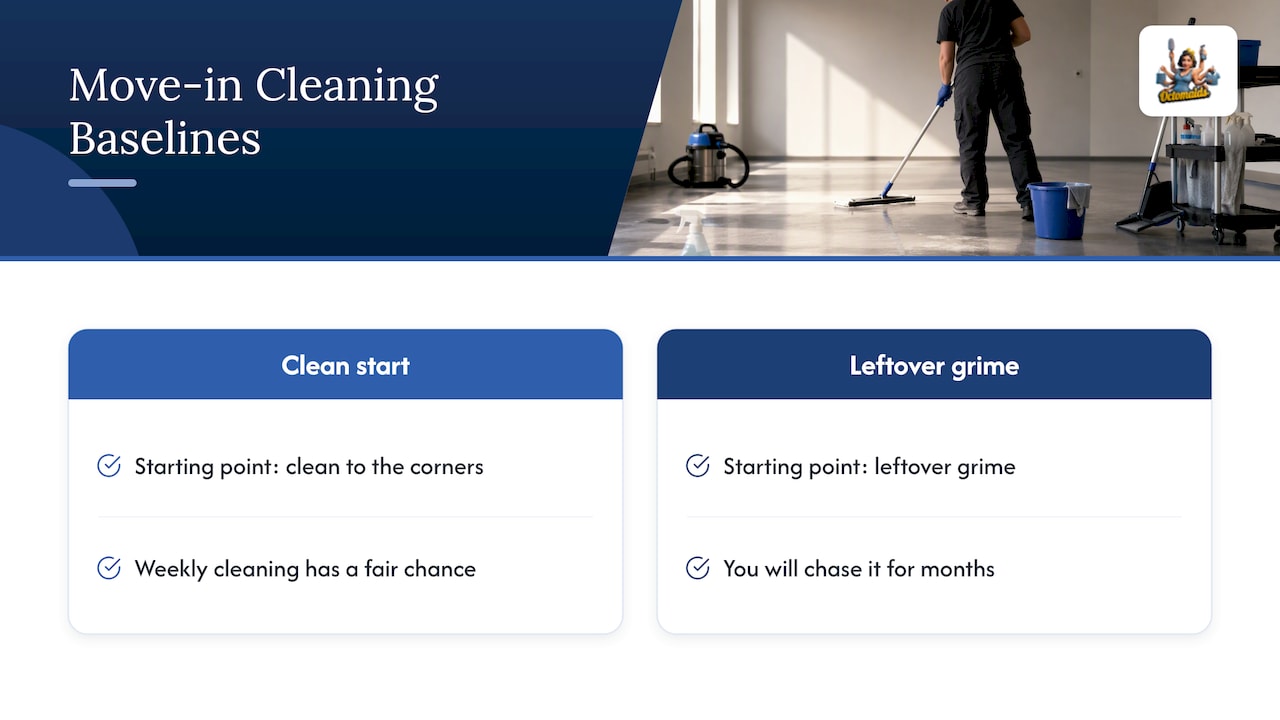
Think of it as setting the baseline. If you start with a space that is clean to the corners, ordinary weekly cleaning has a fair chance of keeping it that way. If you start with leftover grime, you will chase it for months.
When to book and how the timeline works
The planning guides we see for commercial relocations put cleaning on the calendar early. A suggested office move planning guide recommends contracting cleaning services about a month before move-in. The reason is practical: the cleaning company needs to review site-specific requirements and coordinate access with building management before crews and equipment arrive.
Here is a sequence that works for most small and mid-size offices:
- Four or more weeks out: Request a walkthrough and a written scope. Confirm building rules such as freight elevator reservations, loading dock hours, certificates of insurance and any after-hours access policy.
- Two to three weeks out: Lock in the cleaning date relative to the construction or tenant improvement schedule. Ask the contractor for a firm finish date and build in a buffer day.
- Final walkthrough with the contractor: Punch-list items such as touch-up paint, caulking and ceiling tile repairs need to be done before the crew arrives, or they will leave fresh dust behind.
- Cleaning day, two to three days before movers: Leave a gap so you can fix anything the crew flags and so floors and surfaces are fully dry when furniture arrives.
- Move day: Carpet runners and protective film for floors are a good idea. A clean floor is the first thing movers damage.
If your move involves a lot of renovation, a separate post-construction clean may be needed first, followed by the move-in clean as a final detail pass. We cover both, and we explain how the two differ when you call.
If you are also coordinating packing, storage and logistics, a move management checklist from a San Antonio organizing and relocation firm is a useful reference for sequencing the non-cleaning tasks around your clean date.
What a thorough office move-in clean includes
No two offices are identical, but a solid scope usually has these parts. A commercial cleaning checklist published through IFMA’s engagement platform describes professional programs as covering high-touch surfaces, restrooms, trash removal, floor care and breakroom maintenance. A move-in clean takes those and goes deeper, since the space is empty.
| Area | What to expect |
|---|---|
| High-touch surfaces | Door handles, light switches, push plates, railings, elevator panels, thermostat covers, cleaned and disinfected where appropriate |
| Restrooms | Toilets, urinals, sinks, partitions, mirrors, dispensers and floors scrubbed; fixtures descaled; trash removed |
| Breakroom and kitchen | Inside and outside of cabinets, drawers, sinks, countertops, and the inside of any appliances that stay |
| Floors | Hard floors vacuumed, mopped and, if needed, scrubbed; carpet vacuumed and spot treated; baseboards and corners detailed |
| Glass | Interior windows, glass doors, sidelights and conference room partitions |
| Walls, doors and trim | Spot cleaning of scuffs, dust on ledges, door frames and window sills |
| Ceiling and air | HVAC vent covers and return grilles wiped, light fixtures dusted, high dust removed before floors are done |
| Storage and closets | Shelving, supply rooms, server or utility closets (exterior surfaces only unless the client directs otherwise) |
The order matters as much as the list. Professional crews work from high to low and from back to front: ceiling vents and light fixtures first, then walls and surfaces, then floors last, finishing at the exit. Reversing that means re-cleaning floors after dust falls.
Details that separate a surface clean from a deep clean
The ISSA standard goes beyond visible appearance. It points to high-touch surfaces, HVAC vent covers and even the underside of furniture as part of a deeper commercial clean, and some facilities verify results with ATP testing, which measures organic residue on a surface with a handheld meter. Few small offices need lab-style verification, but the idea is useful: a surface can look clean and still hold residue. Ask your provider how they check their own work, whether that is a walkthrough with you, a photo report, or a punch list.
If the previous tenant left furniture behind, plan for it. Cleaning companies generally are not junk haulers, and anything left in place has to be moved or removed before the floors can be finished.
Choosing products that are safe to breathe
A freshly cleaned office should not smell like a chemical aisle. The EPA’s page on identifying greener cleaning products is the best starting point for both managers and cleaners, and its advice leans toward lower-VOC formulas. VOCs are volatile organic compounds, chemicals that evaporate into indoor air and can irritate eyes, noses and throats.
Three practical rules follow from the EPA’s guidance:
- More is not better. Harsh disinfectants on surfaces that do not need them can add VOCs and irritate occupants. Use the strongest products only where they matter, such as restrooms and high-touch points.
- Check for registration. An antimicrobial product that makes disinfecting claims must be registered with the EPA. Look for an EPA Reg. No. on the label, and use the product exactly as the label directs.
- Respect dwell time. A disinfectant works only if the surface stays visibly wet for the contact time printed on the label. Spraying and wiping right away, which happens a lot on rushed move-in days, can leave pathogens behind. Ask your cleaner how they handle this, and check the label for the number.
Source control, meaning physically removing dust, debris and allergens, does most of the work. Disinfectants are the finishing step for the surfaces people touch most.
What to ask a cleaning company before you sign
A short list of questions screens out most problems. Several come straight from federal workplace safety rules, which also protect you as the business owner.
- Do you provide Safety Data Sheets for everything you bring on site? OSHA’s guide for protecting workers who use cleaning chemicals explains that cleaning products can irritate skin, cause burns or release harmful vapors, and that employers must train workers on the hazards under the Hazard Communication Standard (29 CFR 1910.1200). A professional company has SDS binders and trained staff, and can show you both.
- Are your cleaners insured and background-checked? You are giving a crew access to an empty office, sometimes with keys or alarm codes. Ask for a certificate of insurance, and give building management a copy if they require one.
- Will the same crew come every time? For a one-time clean this matters less, but if you will hire recurring cleaning after the move, continuity pays off. A crew that knows your layout and your rules works faster and better.
- What is the written scope? Rooms, tasks, products and what is excluded. Vague scopes lead to disputes.
- How do you price? Square footage, hours, condition of the space and the number of restrooms all affect cost. Ask for a quote after a walkthrough, not before.
- What happens if something is missed? Ask about the re-clean policy and how quickly they respond.
If you want a primer on the vocabulary, our guide to janitorial versus commercial cleaning walks facility managers through six questions that apply here too.
Make the space safe for the crew
Good work depends on good conditions. OSHA notes that housekeeping and cleaning staff face ergonomic hazards such as awkward positions and pushing heavy carts, which can lead to strains and sprains. You can help by keeping pathways clear, making sure lights are on in every area, and giving the crew access to water and power. It is also the quickest way to get the quality you are paying for.
Tailor the clean to how your team will use the space
A generic checklist wastes money in some rooms and shortchanges others. Before the walkthrough, write down how the space will be used:
- Open-plan offices need careful floor care and attention to shared desks, phones and keyboards once they are installed. The move-in clean covers the surfaces and flooring beneath them.
- Client-facing spaces such as lobbies, reception areas and conference rooms deserve extra attention to glass, entry mats and door hardware, because first impressions form there.
- Shared kitchens carry the most food-safety exposure. Make sure refrigerators, microwaves, dishwashers and coffee stations are cleaned inside and out.
- Medical, dental or lab-adjacent offices may need different disinfection standards. Tell your provider early.
- Executive and private offices often need less floor wear attention and more detail on furniture-adjacent surfaces after installation.
The point from industry standards is consistent: programs should be tailored to traffic patterns and occupancy, not copied from a template. If you hire for recurring service afterward, the move-in clean also gives your provider a clear picture of what the space looks like at its best, which is a useful benchmark.
Our perspective on office move-in cleaning
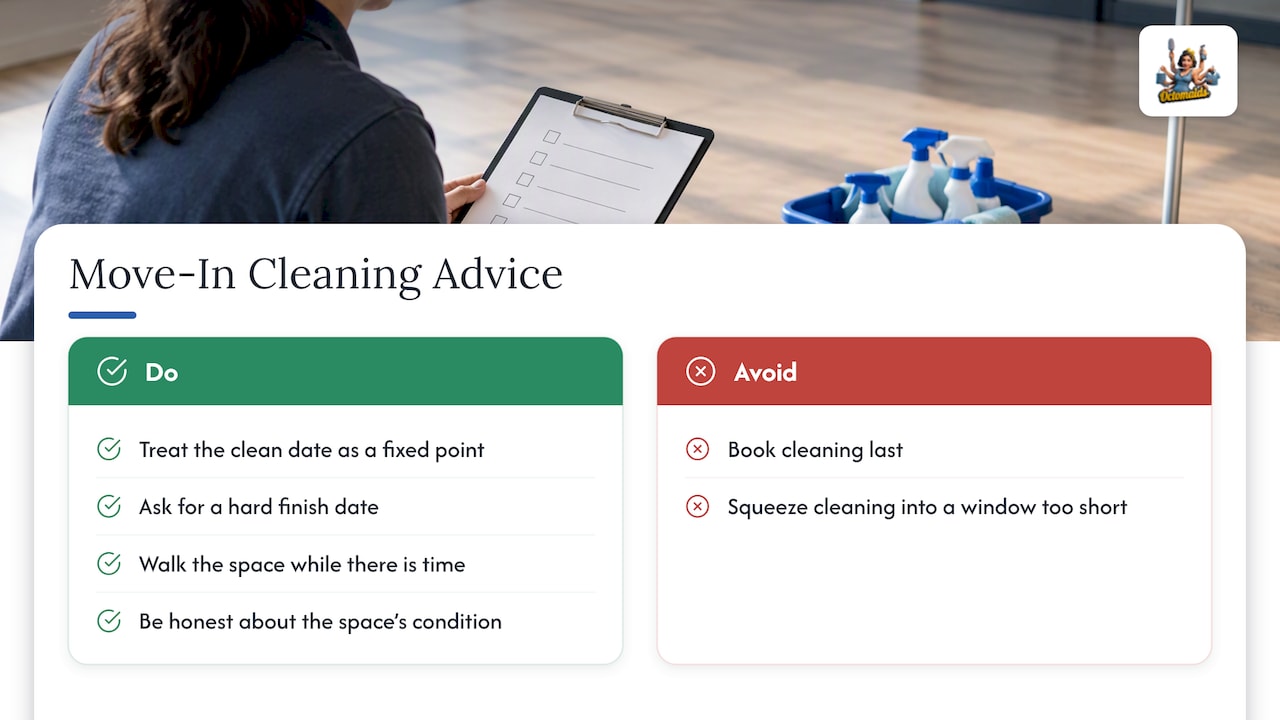
We have cleaned homes and businesses across Clark County and the Portland metro since 2006, and the pattern we see with office moves is almost always the same. People book cleaning last. The lease is signed, the contractor runs two days over, the movers are scheduled, and cleaning gets squeezed into a window that is too short. The result is a rushed job in a space that was never really empty.
Our advice is to treat the clean date as a fixed point in the timeline, not a leftover. Ask your contractor for a hard finish date, and have us walk the space while there is still time to adjust. A walkthrough a few weeks out tells us about floor types, restroom counts, glass, kitchen equipment and building access rules, and it lets us send the right-sized team with the right supplies.
The second thing we would stress is continuity. We are family-owned, not a franchise, and we assign the same dedicated team rather than rotating random staff. For an office, that means the people who did the move-in clean can be the people who keep the space in shape afterward, because they already know where the quirks are. If you want to understand why that matters, we wrote about the benefits of the same cleaner every time.
Finally, be honest about the condition of the space. If the previous tenant left it rough, or if drywall dust is everywhere, tell us. We would rather quote the real job than discover it on the day.
— Steven
Cleaning your new office with Octomaids
We provide commercial and office cleaning, post-construction cleaning, janitorial services and move-in cleaning for businesses and homeowners in Vancouver, WA and the Portland, OR metro area. Our staff are background-checked, professionally trained and insured, and our work is satisfaction guaranteed. We do not publish flat prices for office work, because the right quote depends on the size and condition of your space, so the best next step is a walkthrough.
See our commercial and office cleaning services to learn how we work, or start from our move-in and move-out cleaning page if you are also relocating your household. When the office is up and running, we can set up recurring service so the space stays at the standard you started with.
If you are moving a home as well as an office, our guide to how professional cleaning reduces moving stress and our explanation of why move-in cleaning matters for a new home may help.
A simple pre-clean checklist for you
You can make the cleaning crew’s time more productive with a few steps on your side:
- Confirm the construction or repair finish date in writing.
- Arrange building access, parking, elevator reservations and alarm codes.
- Make sure water, electricity and lighting work in every room.
- Remove debris, packaging and leftover materials the contractor is responsible for.
- Mark any areas that are off-limits, such as server rooms or secured storage.
- Tell the cleaner about delicate surfaces: stone, specialty flooring, glass partitions or finishes with manufacturer care instructions.
- Decide in advance who will do the walkthrough with the crew lead, and set aside 15 to 20 minutes for it.
FAQ
What should be included in an office move-in clean?
At minimum: high-touch surfaces, restrooms, breakroom and kitchen, floors, interior glass and HVAC vent covers, plus dust removal from ledges, fixtures and baseboards. Industry checklists group these under high-touch, restroom, floor care and breakroom work. Ask for the scope in writing and adjust it to how your team will use the space.
How far ahead should I book office move-in cleaning?
About a month before move-in is the guideline in office move planning materials, which gives the cleaning company time to review the site and coordinate with building management. If your timeline is shorter, call anyway and ask what is possible. Just expect fewer date options.
Is a move-in clean different from regular office cleaning?
Yes. Regular janitorial service maintains a space that is already in use, usually with a fixed task list at a set frequency. A move-in clean is a single, detail-heavy pass on an empty space, including areas that are hard to reach once furniture is in, such as vents, corners, baseboards and the inside of cabinets.
Do I need disinfectants for the whole office?
No. The EPA’s guidance favors removing dust and debris first and limiting disinfectants to high-touch areas, since unnecessary harsh products can add VOCs and irritate occupants. Where disinfectants are used, they should be EPA-registered and left wet for the dwell time on the label.
Can Octomaids clean offices in both Vancouver and Portland?
Yes. We serve Vancouver, WA, the wider Clark County area and the Portland, OR metro. Contact us with your address and move date, and we will arrange a walkthrough and a quote.
Sources
- Suggested Office Move Planning Guide
- Commercial Cleaning Checklist for Professional Office Facilities (IFMA)
- Clean Standard: Institutional and Commercial (ISSA)
- Biological Contaminants and Indoor Air Quality (EPA)
- Identifying Greener Cleaning Products (EPA)
- Protecting Workers Who Use Cleaning Chemicals (OSHA)
- Work-related Musculoskeletal Disorders, Housekeeping (OSHA)
- Move Management Checklist
Recommended
- Move-In Cleaning Cost: What to Expect and Budget For
- Types of Move-In Cleaning Services for Your New Home
- How Professional Cleaning Speeds Up Your Move
- Why Move-In Cleaning Is Essential for Your New Home
About Octomaids
Octomaids is a locally operated professional cleaning company serving Vancouver, Clark County, and the surrounding Portland metro area. Since 2006, our cleaning teams have helped homeowners, renters, property managers, and businesses with recurring cleaning, deep cleaning, move-in/move-out cleaning, and commercial cleaning.
Our cleaning articles are reviewed to ensure the information reflects our real-world experience and professional cleaning practices.