


An office hygiene policy is a short written document that says what “clean” means in your workplace, who is responsible for each task, how often it happens and how you check it. The strongest policies cover seven areas: roles, schedules, emergency response, approved products, hand hygiene and protective equipment, training, and monitoring. They hand the daily cleaning to a dependable, trained team, so the policy is followed on an ordinary Tuesday and not only after an outbreak. If you manage an office in Clark County, WA or the Portland metro area, that is the kind of routine our commercial team at Octomaids builds with office managers.
Key Takeaways
- A policy states what must be done. Procedures and checklists state how. You need both, and the policy is the shorter of the two.
- Cover seven areas: roles, schedule, emergency plan, approved products, personal hygiene and PPE, training, and auditing.
- Frequently touched surfaces need cleaning at least daily, and more often in busy areas, according to occupational health guidance.
- Make hand hygiene easy: soap, a way to dry hands, sanitizer with at least 60% alcohol, and reminders where people actually stand.
- A policy only works when someone is named to carry it out and someone checks the result. A consistent cleaning team makes both simpler.
Table of Contents
- What an office hygiene policy actually is
- The seven areas every policy should cover
- Cleaning, sanitizing and disinfecting: define the terms once
- Set frequencies for shared areas and workstations
- Personal hygiene: make the right habit the easy one
- Sick-day rules that people will follow
- Raising a hygiene concern without embarrassment
- Choose and use products safely
- Train people, then check the work
- Why a consistent team makes the policy real
- Our approach to office hygiene
- A perspective from our team
- Frequently asked questions
- Sources
What an office hygiene policy actually is
People use “hygiene policy” and “cleanliness policy” interchangeably. Both mean the same thing in practice: a formal set of rules that defines how an organization keeps its workplace clean and safe, including the tasks, how often they happen, who does them and the standard they must meet. A cleaning and sanitation policy glossary entry describes the usual contents: the difference between routine cleaning and disinfection, schedules and checklists, assigned roles, verification, supplies, training, signage and what to do in an outbreak.
A useful way to keep the document tidy comes from Cleveland Clinic’s employer solutions team. In its guide to cleaning and disinfection programs, policies explain what should be done, while procedures explain how. Your policy can therefore stay at one or two pages. The detailed room-by-room work belongs in checklists that sit underneath it.
Policy, procedure and checklist
| Document | Answers | Example |
|---|---|---|
| Policy | What and who | “Shared kitchen surfaces are cleaned and disinfected daily by the cleaning team.” |
| Procedure | How | Which product, how long it stays wet, what gloves to wear |
| Checklist | Was it done | A signed daily or weekly list per zone |
If you want ready-made lists for the lower layer, our office cleaning checklist and zone-by-zone inspection checklist are built for managers who need records they can show.
The seven areas every policy should cover
Cleveland Clinic’s guide says a robust program’s policies should address seven areas. They make a sound skeleton for any office, from a six-person studio to a multi-floor suite.
- Roles and responsibilities. Name who cleans, who supervises and who employees report problems to. A clearly defined structure for reporting concerns is part of the guidance.
- Cleaning and disinfection schedule. Daily, weekly and monthly tasks by zone.
- Emergency plan and required cleaning. What changes if someone reports an infectious illness or a spill.
- Approved products, supplies and equipment. A short list, so no one improvises with whatever is under the sink.
- PPE and hand hygiene expectations. Gloves for the people handling chemicals, hand washing for everyone.
- Education and training. Cleaning staff and employees both.
- Monitoring and auditing. Someone checks the work against the standard.
Write one short paragraph or a few bullets for each. A policy that runs ten pages tends not to get read, and a policy no one reads does not change behavior.
Cleaning, sanitizing and disinfecting: define the terms once
Most confusion in office policies comes from treating three different jobs as one. Cleaning removes dirt and debris. Disinfecting uses a chemical to kill germs on a surface. Your policy should say which surfaces get which treatment and how often. The CDC’s guidance, When and How to Clean and Disinfect a Facility, updated in April 2024, covers the definitions and the safe way to do each step.
For a manager, the practical rule is simple. Everything gets cleaned on schedule. High-touch and shared surfaces, plus restrooms and kitchen counters, also get disinfected. Our guide to office cleaning versus disinfection walks through how to turn the CDC language into your own task list.
Set frequencies for shared areas and workstations
The schedule is the heart of the policy, and it is where vague wording hurts most. “Clean regularly” means something different to everyone who reads it.
Two sources help you set numbers:
- The AIHA/COSH Network’s guidance for custodians, published in August 2020, says frequently touched surfaces should be cleaned at least daily and more often if possible. In high-volume areas hourly cleaning and disinfecting may be needed, and in lower-volume areas two or three times per shift.
- New York State’s Department of Health requires facilities to have procedures and supplies for routine cleaning, disinfection and hand hygiene, and to identify frequently touched surfaces, shared equipment and workstations. That is a New York rule, but the method of listing your own touch points applies anywhere.
A sample frequency table
Use this as a starting point and adjust it to your headcount and foot traffic.
| Area | Minimum in the policy | Notes |
|---|---|---|
| Door handles, light switches, elevator buttons | Daily, more often at peak times | Busiest touch points in the building |
| Shared desks and hot-desk stations | Daily, and between users where practical | See why shared desks need regular disinfection |
| Restrooms | Daily, with restocking | Our restroom standards list seven daily tasks |
| Kitchen and break room | Daily surfaces, appliance cleaning weekly | An office kitchen checklist keeps this audit-ready |
| Conference rooms | After heavy use, and daily for touch points | Tables, remotes, chair arms |
| Floors and trash | Per cleaning visit | Set by traffic |
| Deep cleaning | Quarterly or as you decide | See the office deep cleaning checklist |
Our high-touch surfaces guide explains what to clean, how often and how, and it is worth pairing with your policy. For the broader routines that keep open-plan spaces in order, see these shared workspace sanitation practices.
Personal hygiene: make the right habit the easy one
The personal hygiene part of the policy is about the environment you provide, not about policing individuals. The CDC’s page on hand hygiene at work sets out what good looks like:
- Wash hands with soap and water for at least 20 seconds, then dry them.
- Use an alcohol-based hand sanitizer with at least 60% alcohol when soap and water are not readily available.
- Increase access to sinks, and provide soap, water and a way to dry hands.
- Place sanitizer dispensers near frequently touched surfaces.
- Put visual reminders in bathrooms and kitchen areas.
- Provide tissues and no-touch trash cans, and clean frequently touched surfaces regularly.
Early CDC workplace guidance from February 2020 also suggests providing disposable wipes so staff can wipe down commonly used surfaces such as keyboards and desks before each use, and posting reminders at the entrance about staying home when sick, cough and sneeze etiquette and hand hygiene.
Translate this into three lines of policy: what supplies the company provides, where they are placed and who restocks them. Restocking is an easy job to forget, so assign it by name. Our office cleaning supplies list shows par levels by zone so dispensers do not run empty.
Sick-day rules that people will follow
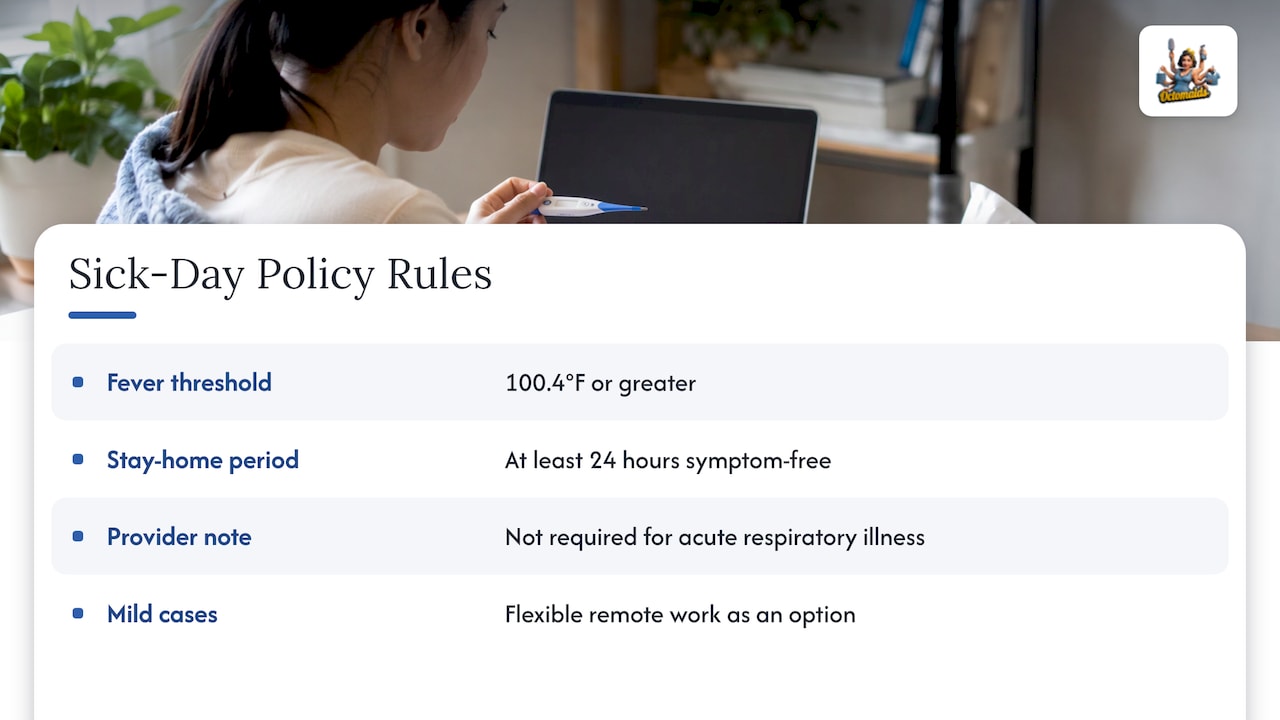
A hygiene policy that ignores illness is incomplete, because staff who come in sick undo much of what cleaning achieves. The same CDC guidance recommends that employers encourage sick employees to stay home until they have been free of fever (100.4°F or greater), signs of fever and other symptoms for at least 24 hours without fever-reducing or other symptom-altering medicines. It also advises that employers not require a healthcare provider’s note for employees sick with acute respiratory illness. That February 2020 guidance was written for a specific outbreak, so check current CDC and your state’s health department advice before you fix numbers in your own policy.
Keep the wording supportive: say what you ask of people and what you offer in return, such as flexible remote work for mild cases. Your HR lead or an employment attorney should confirm how this fits sick leave law in your state. Washington and Oregon both have paid sick leave requirements, so confirm details with the state labor agency.
Raising a hygiene concern without embarrassment
Policies usually fail at the human moment: a coworker’s lingering odor, a fridge nobody cleans, a desk that attracts complaints. Decide the route in advance:
- Facility concerns (dirty restrooms, empty dispensers, overflowing bins) go to a named person or a shared inbox, and the cleaning team receives them the same day.
- Personal hygiene concerns go to the employee’s manager or HR, never to a group chat. The conversation is private, factual and kind, and it is held the same way for everyone.
- Medical or cultural factors can be involved, so a manager listens first and involves HR before drawing conclusions.
Write that routing into the policy in two sentences. When the path is clear, people stop complaining sideways and start reporting.
Choose and use products safely
Safety belongs in the policy because chemicals harm people when they are misused. Keep these points, all drawn from official or professional guidance:
- Read the label. The CDC advises confirming a product can be used on the surface, improving air circulation by opening doors and windows or adjusting HVAC, and wearing the protective equipment recommended in Section 8 of the product’s Safety Data Sheet.
- Use registered products and follow the contact time. The AIHA/COSH guidance says to use products with EPA-approved emerging viral pathogens claims and to follow the manufacturer’s instructions on concentration, application method and contact time (how long the surface must stay wet).
- Know the EPA list. A University of Idaho extension publication explains that EPA’s List N gives product names, registration numbers and contact times, and says homemade substances are illegal, ineffective and unsafe for controlling viruses and bacteria.
- Bleach rules. The CDC’s facility guidance says diluted household bleach can be used where appropriate for the surface, with a sodium hypochlorite concentration of 5% to 6% and at least one minute on the surface. Never mix bleach with ammonia or any other cleanser.
- Ventilation and technique. OSHA’s environmental services guidance calls for proper ventilation during cleaning and says to avoid dry sweeping or high-pressure water streams that could re-aerosolize infectious particles.
Keep the approved product list short, and keep the Safety Data Sheets where the cleaning team can reach them.
Train people, then check the work
CDC and OSHA guidance on cleaning and disinfecting your facility says employers should develop worker-protection policies and train all cleaning staff on site before they begin tasks. Training should cover when and which PPE to use, how to put it on, use and remove it, and how to dispose of it, plus the hazards of cleaning chemicals under OSHA’s Hazard Communication standard (29 CFR 1910.1200).
Then verify. The AIHA/COSH guidance calls quality control critical: supervisors confirm procedures are followed, visually inspect that surfaces are clean and free of dust and debris, and use checklists to record that work was done as described in the standard operating procedure.
A workable audit rhythm for a small office:
- Daily: the cleaner signs the zone checklist.
- Weekly: the office manager walks the restrooms, kitchen and conference rooms.
- Monthly or quarterly: review the checklist records, restock levels and any complaints, then update the policy.
Why a consistent team makes the policy real
A policy written on paper still depends on the person holding the spray bottle. When the cleaners rotate constantly, each new person has to learn your touch points, your product list and your priorities. A familiar team already knows them.
That is the model we run at Octomaids: one dedicated, background-checked, trained and insured team assigned to your site, not a rotating crew. Your policy then describes a routine the same people carry out each visit.
Our approach to office hygiene
Here is how we would put your policy into practice in Vancouver or Portland.
Commercial and office cleaning is part of what Octomaids does, alongside janitorial services and post-construction cleaning, for businesses throughout Clark County and the Portland metro area. Since 2006 we have been a family-owned, locally operated company, and our dedicated teams are background-checked, professionally trained and insured. Share your draft policy and your floor plan, and the work in your schedule can be matched to the zones and frequencies you wrote.

If you are also planning a move, our office move-out cleaning checklist covers the room-by-room work, and the Commercial Cleaning page explains how to choose a reliable janitorial provider in our area.
A perspective from our team
In our experience, the offices with the best hygiene are not the ones with the longest policy. They are the ones where everyone knows who cleans what, and the same faces show up to do it.
We write our approach around three ideas. First, put the standard on paper in plain words, so a new employee and a new cleaner read the same thing. Second, keep the team consistent. When the same people clean your office each visit, they learn the hot spots: the break room fridge handle, the shared printer, the conference room remote. Third, make quality visible with a signed checklist, so no one has to guess whether the work happened.
A policy is calm, practical and fair. It protects the people who work in the space, and it spares managers from awkward conversations about shared spaces. We built Octomaids as a family-owned, local company so that the people who clean your office feel like part of your routine, not strangers passing through.
Steven
Frequently asked questions
How long should an office hygiene policy be?
One to two pages for the policy itself is enough. Cover the seven areas in short paragraphs, then attach checklists for the detailed tasks. Longer documents are harder to enforce and rarely get read.
Who should own the policy?
Name one person, usually the office or facility manager, as the owner. That person assigns tasks, receives reports and schedules the audits. HR joins for the personal hygiene and sick-day parts, and your cleaning provider carries out the scheduled work.
How often should shared surfaces be disinfected?
Occupational health guidance from the AIHA/COSH Network says frequently touched surfaces should be cleaned at least daily and more often if possible. High-volume areas may need hourly attention. Set the numbers by zone based on how many people use each one.
How do I address a coworker’s personal hygiene?
Have a private, factual and kind conversation through the manager or HR, and handle every case the same way. Listen first, because health or other circumstances may be involved. Your policy should name the route so no one has to improvise.
Do I need to review the policy?
Yes. Review it at least once a year and after any outbreak, move, renovation or change in headcount. Update the schedule and product list when the office changes.
Sources
- Cleaning and Sanitation Policy
- Six Building Blocks of a Robust Cleaning and Disinfection Program, Cleveland Clinic
- When and How to Clean and Disinfect a Facility, CDC
- Effective and Safe Practices, Guidance for Custodians, AIHA/COSH Network
- Cleaning Facilities, New York State Department of Health
- About Hand Hygiene at Work, CDC
- Plan and Respond to Coronavirus Disease 2019, CDC
- Using Disinfectants, Sanitizers, and Cleaners Safely, University of Idaho Extension
- Cleaning and Disinfecting Your Facility, CDC
- Control and Prevention: Environmental Services Workers, OSHA
Recommended
- Shared Workspace Sanitation Best Practices Managers Can Use Today
- 7 Daily Tasks to Meet Office Restroom Cleaning Standards for Managers
- How to Create an Office Cleaning Schedule That Works
- Office Cleaning Inspection Checklist: Zone-by-Zone Guide
About Octomaids
Octomaids is a locally operated professional cleaning company serving Vancouver, Clark County, and the surrounding Portland metro area. Since 2006, our cleaning teams have helped homeowners, renters, property managers, and businesses with recurring cleaning, deep cleaning, move-in/move-out cleaning, and commercial cleaning.
Our cleaning articles are reviewed to ensure the information reflects our real-world experience and professional cleaning practices.