


If you manage more than a couple of listings or turn over more than roughly 300 pounds of laundry a week, a linen service for Airbnb almost always beats doing it in-house. If you run a low-turnover property, washing sheets yourself or paying for wash-only pickup usually costs less. The choice comes down to three models — in-house wash, outsourced wash-only, and full linen rental — and each trades cost against time, control, and storage space.
TL;DR:
- Linen rental is generally more cost-effective and practical for properties managing five or more units or exceeding 300 pounds of weekly laundry.
- Outsourcing linen wash costs between $0.50 and $1.00 per pound, with bulk rates closer to $0.75, translating to roughly $7.50 to $15 for a two-bedroom turnover.
- Turnaround times of 24 to 48 hours are typical, but larger inventories require a par system of three sets per bed and proper buffer stock to avoid delays.
- Vendors should provide clear, written service level agreements, transparent pricing, and proof of insurance before signing a contract.
- Coordinating linen deliveries with cleaning schedules and managing stain treatment efficiently can prevent guest experience issues and costly delays.
Table of Contents
- What Does a Linen Service for Airbnb Actually Do?
- Ownership vs. Rental vs. Hybrid: How to Choose by Scale
- What Does a Linen Service for Airbnb Cost?
- Turnaround Times and Par Levels That Prevent Delays
- How Do You Vet a Linen Service Before Signing?
- Practical Tactics: Stain Triage and Knowing When to Scale
- Octomaids’ View: Where Linen Coordination Meets Cleaning
- Book Turnover Cleaning That Works With Your Linen Flow
- Sources
- FAQ
What Does a Linen Service for Airbnb Actually Do?
A linen service, sometimes called linen supply or linen rental, handles the sheets, pillowcases, duvet covers, towels, and other textiles your guests touch every stay. Some providers simply launder linens you already own; others rent you their own inventory and replace items as they wear out, so you never own a single pillowcase.
The three models break down like this:
- Wash-only: You own the linens; the vendor picks up dirty sets, washes and presses them, and returns them, usually within 24 to 48 hours.
- Linen rental: The vendor owns the inventory. You pay per turnover or per set, and worn items get swapped out automatically.
- Hybrid: You keep signature or branded pieces in-house and rent commodity items like white towels and basic sheets.
Most providers quote a standard turnaround window and deliver linens folded, bagged, or shelf-ready, matching the presentation guests expect from a hotel.
Ownership vs. Rental vs. Hybrid: How to Choose by Scale
Portfolio size decides this faster than personal preference does. A single property with a handful of monthly turnovers rarely justifies a rental contract. Operators managing five or more units, or moving past roughly 300 pounds of laundry weekly, tend to hit bottlenecks that outsourcing solves outright.
- One property, under 10 turnovers/month: Wash in-house or use wash-only pickup.
- Two to four properties: Wash-only outsourcing usually wins; storage and folding labor start eating into margins.
- Five-plus properties or multiple locations: Linen rental removes storage and replacement headaches entirely, since centralizing inventory across scattered units is harder than managing one central rack.
Ownership gives you full control over fabric quality but ties up cash in inventory and closet space. Rental frees up storage and shifts replacement risk to the vendor, but you pay a premium for that convenience, and outsourcing adds per-turnover cost even as it improves consistency.
Pro Tip: Run the math on time, not just dollars. If folding and hauling linens costs you or your cleaner more than an hour per turnover, that hour is worth more than the per-pound fee you’re trying to avoid.
What Does a Linen Service for Airbnb Cost?
Pricing generally falls into three structures, and vendors rarely volunteer which one benefits you most, so ask directly.
- Per pound: Commercial laundries and hotel-grade wholesalers charge as little as $0.75 per pound in bulk, with typical retail ranges running $0.50 to $1.00 per pound depending on market and add-ons.
- Per set: Flat fee per bed set or towel bundle, common with linen rental programs.
- Subscription: A flat monthly rate covering a fixed number of turnovers, popular with hosts who want predictable budgeting.
Industry pricing guides put typical outsourced laundry costs between $0.50 and $1.00 per pound, with bulk hotel-style contracts dropping closer to $0.75 per pound.
For a two-bedroom turnover at roughly 15 pounds of linens, that’s roughly $7.50 to $15 per cleaning under per-pound pricing. A three-bedroom unit running 25 pounds could land between $12.50 and $25. Add-on fees for stain treatment, rush service, or same-day pickup may increase costs, so ask vendors to itemize those before comparing quotes.
Turnaround Times and Par Levels That Prevent Delays
Turnaround windows and par counts are what separate a smooth turnover from a guest standing on your porch waiting for clean sheets. Most linen vendors commit to a 24 to 48 hour turnaround, which works fine for scheduled turnovers but leaves no room for same-day emergencies unless you’ve built in buffer stock.
The standard par formula: Par = (Turnovers per week × Recovery days) + Buffer. A property doing 10 turnovers a week with a 3-day recovery cycle needs roughly 30 sets plus a 10-set buffer, or 40 total sets in rotation.
- Keep three sets per bed in circulation: one in use, one in wash, one spare.
- Stock two towel sets per guest, plus one spare set for the property.
- Label linens by property and rotate on a first-in, first-out basis to catch wear before it reaches a guest’s bed.
- Sync delivery windows with your cleaner’s arrival time; a mismatched schedule forces cleaners to wait or hunt for missing linens, which quietly inflates labor costs.
- Use a digital par tracker like Turno to flag low counts before they cause a stock-out.
Pro Tip: Build your buffer stock around your worst week, not your average week. One late delivery during a holiday weekend can cost you a booking’s worth of reviews.
How Do You Vet a Linen Service Before Signing?
Ask every candidate vendor the same set of questions, and score their answers against a simple checklist.
- Does the SLA guarantee 24 to 48 hour turnaround in writing, or is it a verbal estimate?
- Is pricing itemized by pound, set, or turnover, with add-on fees disclosed upfront?
- What’s the replacement or repair policy for stained or torn linens?
- Can they send fabric samples before you commit to a contract?
- Do they carry insurance covering lost or damaged inventory?
- Do they provide photo evidence or quality-control logs per delivery?
- Will they coordinate directly with your cleaning team’s schedule?
| Vendor Trait | What a Strong Answer Sounds Like |
|---|---|
| SLA clarity | Written 24 to 48 hour guarantee with penalty for missed windows |
| Pricing transparency | Itemized per-pound or per-set rate, no hidden rush fees |
| Damage policy | Clear replacement threshold and cost-sharing terms |
| Insurance | Proof of liability coverage for lost or damaged textiles |
| QC process | Photo or checklist documentation per batch |
A vendor who hedges on turnaround time or refuses to itemize pricing is a red flag worth walking away from. So is one who can’t explain how they’ll coordinate delivery with your cleaner’s arrival window.
Practical Tactics: Stain Triage and Knowing When to Scale
Treat stains within two hours of checkout for the best removal odds. Enzyme pre-treats work best on biological stains; oxygen bleach handles color-safe sanitizing without degrading fabric over repeated washes, based on operational guidance for high-turnover laundry. Document stains with a photo before bagging linens, so your provider isn’t guessing what happened.

The hybrid strategy solves a real tension: keep branded or signature pieces, like a logo throw or a distinctive duvet cover, in-house so your listing photos stay consistent, while renting commodity whites that guests never notice or remember. That split cuts inventory carrying costs without sacrificing the details that make a listing feel curated.
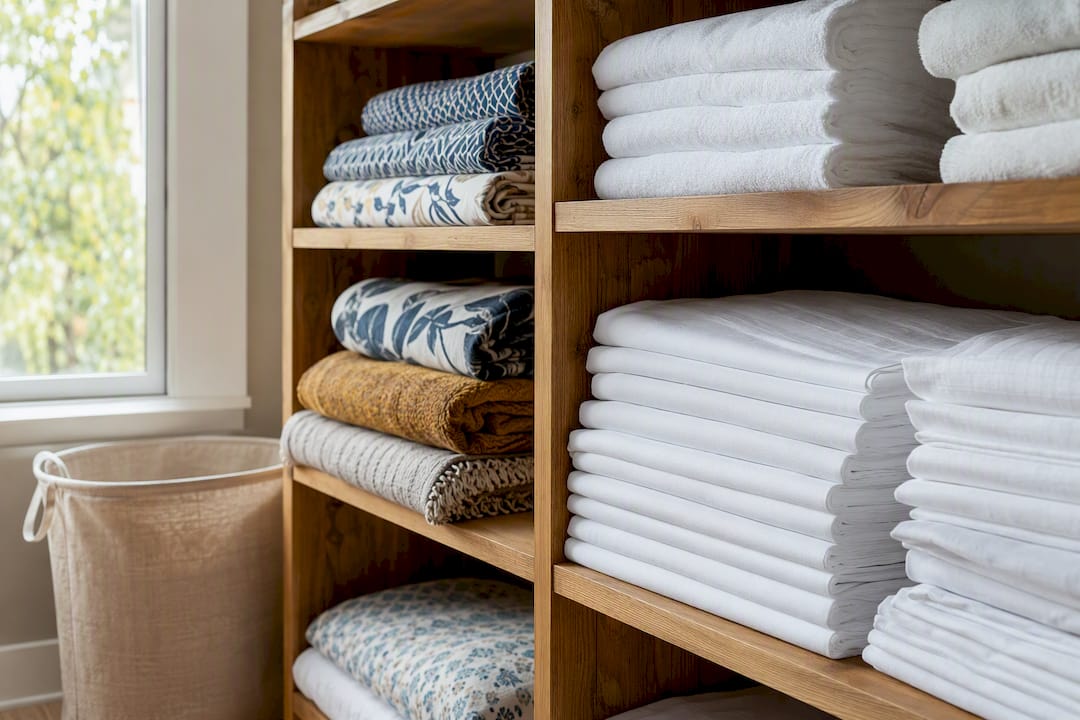
Pro Tip: If you’re spending more than two hours a week on laundry logistics across your portfolio, that’s your signal to price out a wash-only vendor, even before you hit the 300-pound threshold.
Octomaids’ View: Where Linen Coordination Meets Cleaning
Our teams have experience handling short-term rental turnovers where linens and cleaning have to sync perfectly. A cleaner should hand off used linens in a labeled bag and receive a matching clean set before starting the reset, not mid-clean. We’ve organized same-day rescues when a delivery ran late, pulling from buffer stock to keep a check-in on schedule. Our advice: set delivery windows at least an hour before your cleaner arrives, never on top of it.
— Steven
Book Turnover Cleaning That Works With Your Linen Flow
Coordinating a linen vendor is only half the turnover equation. The other half is a cleaning team that shows up on time, handles the linen handoff correctly, and flags shortages before your next guest notices. Professional cleaning teams can cover recurring and same-day short-term rental turnovers, working directly with your par system and delivery windows instead of around them.
Getting started is straightforward: request a quote through our cleaning services page, tell us your typical turnover windows, and share your linen inventory or par counts so we can build cleaning schedules around delivery timing rather than guessing at it. If a vendor runs late or a guest checks out early, having a cleaning partner who already understands your linen flow is what keeps a five-star review from turning into a one-star scramble.
Sources
For deeper detail on par formulas and inventory counts, the Rent Responsibly linen guide breaks down set-by-set planning. For scaling thresholds and in-house versus outsourced math, see the STR Specialist comparison.
- What is a Linen Service for Vacation Rentals? — Lodgify encyclopedia
- Airbnb laundry without bottlenecks: in-house vs outsourced — STR Specialist
- Should you handle laundry onsite or outsource it? — BNBStartup
- What is Linen Service? — Hostaway glossary
FAQ
What Does Linen Service Include?
A typical linen service for Airbnb covers pickup of used sheets, towels, and pillowcases, industrial washing and pressing, and delivery of clean, folded sets, often within a 24 to 48 hour window, with some vendors also handling stain treatment and torn-item replacement.
What Are the Linen Requirements for an Airbnb?
There’s no universal legal requirement, but most hosts follow a par system of three sets per bed and two towel sets per guest plus a spare, which keeps a property stocked through wash cycles without stock-outs.
How Much Does It Cost to Pay Someone to Clean an Airbnb’s Linens?
Outsourced laundry typically runs $0.50 to $1.00 per pound, with bulk commercial rates closer to $0.75 per pound; a two-bedroom turnover at roughly 15 pounds lands around $7.50 to $15 before add-on fees.
Should I Choose Ownership, Wash-Only, or Linen Rental?
Choose ownership or wash-only for a single low-turnover property, and switch to linen rental once you’re managing five or more properties or crossing roughly 300 pounds of laundry a week, since rental removes storage and replacement burdens that scale poorly on your own.
Recommended
- Why STR Cleaning Differs from Residential: 2026 Guide
- High-Traffic Rental Areas to Deep Clean: A Room-by-Room Guide
- Short Term Rental Cleaning Checklist: Host’s Guide
- Why Rental Properties Need Deep Cleans: 2026 Guide
About Octomaids
Octomaids is a locally operated professional cleaning company serving Vancouver, Clark County, and the surrounding Portland metro area. Since 2006, our cleaning teams have helped homeowners, renters, property managers, and businesses with recurring cleaning, deep cleaning, move-in/move-out cleaning, and commercial cleaning.
Our cleaning articles are reviewed to ensure the information reflects our real-world experience and professional cleaning practices.