


High-touch surfaces and restrooms need daily attention, while everything else should be scheduled by actual use, visible condition, and audit results rather than habit. That principle comes straight from CDC facility guidance, OSHA’s sanitation expectations, and the workloading math that ISSA has refined for decades. Frequency follows exposure and verification, not the calendar.
TL;DR:
- Restrooms and high-touch public areas require daily cleaning, especially during peak times, with the frequency adjusted based on inspection results and occupancy.
- Task frequencies should be driven by exposure risk, with condition-based triggers and documentation to meet OSHA standards and avoid rigid schedules.
- Routine cleaning should be supported by a workloading approach, converting weekly tasks into annual labor hours, and adjusted through ongoing KPI tracking like inspections and complaint rates.
- Preventative and maintenance work, such as carpet extraction or floor refinishing, must be tied to condition triggers rather than fixed calendars for optimal timing.
- Regular audits, surface testing, and monitoring supply usage are essential to refine cleaning frequencies and ensure the schedule aligns with actual building usage.
Table of Contents
- Cleaning frequency by area and facility type
- Task-tier frequencies: daily, weekly, monthly, and project work
- How to set frequency: risk rules, condition overrides, and ISSA workloading
- Metrics and tools for optimizing frequency
- Octomaids resources and practical templates
- Operator perspective: common mistakes and how to evolve a mature program
- How Octomaids supports janitorial schedule design
- FAQ
- Sources
Cleaning frequency by area and facility type
Every facility has zones that demand daily discipline and zones that can run on a lighter cadence. The starting point is foot traffic and touchpoint density, then you adjust based on what inspections actually show.
Restrooms sit at the top of the list. The CDC notes that restroom fixtures count among the high-touch items that typically need cleaning at least once a day, and busier facilities often need more than one pass, especially around lunch hours or shift changes. Lobbies and other public-facing areas follow close behind: door handles, elevator buttons, and reception counters absorb constant contact from people who don’t work in the building, which raises both soil load and liability if someone notices grime first thing.
Private offices and cubicles can usually run on a lighter schedule than shared spaces, since fewer hands touch the same surfaces. Kitchens and break rooms are a different story. Food contact surfaces, trash receptacles, and shared appliances need daily cleaning at minimum, and sanitizing contact surfaces should follow your written food safety policy rather than guesswork. Gyms and locker rooms push frequency even higher because sweat, moisture, and shared equipment create conditions that dirty up fast and stay that way without intervention.
A quick reference for starting frequencies by space:
- Restrooms: at least daily, more often during peak occupancy or high headcount periods.
- Lobbies and entryways: multiple touchpoint wipe-downs daily given public exposure.
- Private offices: daily to a few times weekly depending on shared use.
- Kitchens and break rooms: daily surface and waste cleaning, with sanitizing per food safety policy.
- Gyms and locker rooms: multiple daily passes on equipment and wet surfaces.
Schools and retail spaces blend several of these categories at once. A school hallway behaves like a lobby, a cafeteria behaves like a break room, and a retail checkout counter sees nearly as much contact as a restroom door handle. Map each space to its closest equivalent, then let the first few weeks of inspection scores confirm whether you guessed right.
Task-tier frequencies: daily, weekly, monthly, and project work
Turning a facility into a working checklist means breaking tasks into tiers that your team can execute without re-reading a policy manual every morning. Here’s how that breakdown typically looks in practice.
- Daily tasks: wipe high-touch surfaces (door handles, light switches, shared equipment), empty all trash and recycling, clean and restock restrooms, and spot-mop entryways and spill zones.
- Weekly tasks: vacuum all carpeted areas fully, dust horizontal surfaces and furniture, clean glass partitions and interior windows, and replenish paper and soap supplies in bulk rather than just topping off.
- Monthly tasks: deep dust vents, baseboards, and light fixtures, clean HVAC grilles and return vents, and spot-treat upholstery and fabric chairs that show wear.
- Project work: triggered by condition or warranty cycles rather than the calendar, covering carpet extraction, floor stripping and refinishing, and window washing on multi-story exteriors.
Daily tasks are the ones that protect health and first impressions, so they get no slack. Weekly tasks maintain the baseline so daily work doesn’t fall behind. Monthly tasks catch what accumulates slowly, dust in vents, grime on fixtures, wear that’s easy to miss day to day. Project work is the category most facilities get wrong, either waiting too long because nothing looks urgent, or scheduling it on a fixed interval that ignores actual carpet wear or floor finish breakdown. Tie project triggers to inspection scores and manufacturer warranty terms instead of a generic once-a-year rule.
How to set frequency: risk rules, condition overrides, and ISSA workloading
Setting a defensible schedule starts with a task list, not a calendar. Walk the facility, list every recurring task, and assign an initial frequency based on traffic and touchpoint risk. From there, ISSA’s workloading method turns that list into a labor plan: convert each task’s weekly frequency into annual occurrences, then multiply by the time each task takes to get annual labor hours.
The math is simple once you see it. A task performed five days a week occurs 260 times a year, so if that task takes ten minutes, you’re looking at roughly 43 hours of annual labor for that single line item. Repeat across every task on the list and you get a labor total that can be priced, staffed, and defended in a contract negotiation rather than estimated by gut feeling.
- List every task with its assigned frequency and estimated time per occurrence.
- Convert weekly or monthly frequencies into annual occurrences before calculating labor.
- Use building-specific time studies where possible, since published production rates are indicative only and vary by layout and equipment.
- Document every condition-based override (a spill, overflowing waste, a reported illness) separately from the standing schedule.
OSHA’s sanitation standard doesn’t prescribe a fixed interval for janitorial work. Instead, it requires that workplaces stay clean and that waste gets removed as often as necessary, with food-waste receptacles emptied at least each working day unless they go unused. That means a calendar alone doesn’t satisfy the OSHA sanitation requirement; you need documentation showing that condition-based triggers get addressed when they happen, not on the next scheduled visit.
Pro Tip: Keep a simple override log next to your standing schedule. When you adjust a frequency because of a spill, complaint, or inspection failure, note the date, the trigger, and the corrective action. That log becomes your evidence during an audit or a contract renewal.
Metrics and tools for optimizing frequency
A schedule built once and never revisited drifts out of sync with how the building actually gets used. Data-driven cleaning treats frequency as something you test and adjust, not something you set and forget.
The KPIs worth tracking are the ones that tell you whether a space is clean enough between visits, not just whether the task got checked off:
- Inspection scores from routine walkthroughs or third-party audits.
- Complaint and rework rates, which flag spaces where frequency is too low.
- Foot traffic and restroom usage counts, often available from access control systems or simple tally sheets.
- Supply usage rates, which reveal actual occupancy better than a posted capacity number.
- Time logs, showing whether tasks are taking longer or shorter than the workloading estimate assumed.
For spaces where verification matters most, ATP testing or surface sampling can confirm whether a cleaning process is actually working, not just whether someone wiped the counter. Restroom sensors and janitorial software that logs visit times add another layer of objective data. The simplest way to optimize is to change one frequency at a time: drop a task from five days a week to three, then watch inspection scores and complaints over the following month before deciding whether the change sticks.
Octomaids resources and practical templates
We’ve put together manager-ready checklists that translate these guidelines into daily routines, including our office restroom cleaning standards and a companion kitchen checklist for break room contact surfaces.
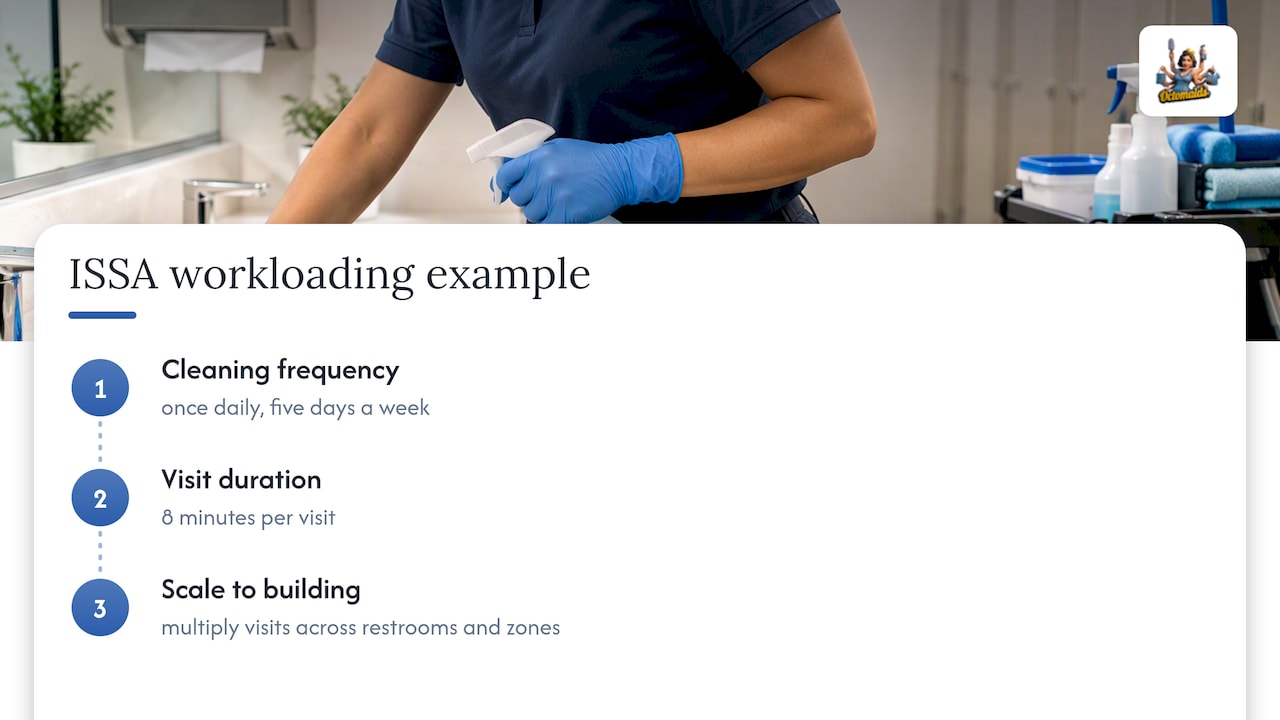
Here’s a workloading example using the ISSA method: a restroom cleaned once daily, five days a week, totals numerous annual occurrences. At eight minutes per visit, that represents a considerable amount of annual labor for one restroom. Multiply that across every restroom and high-touch zone in a building and you get a labor estimate that holds up in a contract conversation instead of a rough guess.
Operator perspective: common mistakes and how to evolve a mature program
The biggest mistake we see is treating a janitorial schedule as fixed once it’s written. Restrooms and high-traffic zones need condition triggers layered on top of the baseline, not just a repeating calendar entry. Cleaning and disinfection are also different controls: disinfection belongs in response to confirmed risk, not as a daily default. The facilities that improve fastest run small, single-variable experiments and pair every change with an audit.
— Steven
How Octomaids supports janitorial schedule design
We design recurring janitorial schedules around the same risk-based logic covered here: daily attention where exposure is highest, documented overrides when conditions call for it, and the same trained team on every visit so nothing gets missed between inspections. Our commercial cleaning and office cleaning services in Vancouver, WA and the Portland, OR metro area include checklist-based delivery built for audit follow-up, not guesswork.
- We assign a trained team to your facility for every visit.
- We build schedules around actual traffic patterns and inspection results, not a generic template.
- We offer cleaning services available on request for offices of any size.
If you manage a facility in our service area and want a schedule built around these guidelines, request a commercial cleaning quote and we’ll walk the space with you before proposing a frequency plan.
FAQ
How frequently should food contact surfaces be cleaned and sanitized?
Food contact surfaces should be cleaned daily at minimum, with sanitizing frequency set by your written food safety policy rather than a generic rule. High-use kitchen counters and shared appliances typically need attention after each use or at set intervals throughout the day.
What information should be included in a cleaning schedule?
A complete schedule lists every task, its assigned frequency, the person or team responsible, and the expected time per occurrence, following the ISSA workloading approach. It should also include a space for documenting condition-based overrides separately from the standing routine.
What is the 5-5-5 rule for cleaning?
There’s no single, widely recognized industry standard called the no fixed numeric “rule” in commercial janitorial guidance from CDC, OSHA, or ISSA. If you’ve seen it referenced elsewhere, treat it as an informal shorthand rather than a governing standard, and build your schedule from documented frequency guidelines instead.
What determines the frequency of cleaning?
Frequency is set by exposure, specifically foot traffic, touchpoint risk, and surface material, combined with observed condition from audits and inspections. OSHA’s sanitation standard reinforces this by requiring waste removal and clean conditions “as often as necessary” rather than on a fixed interval.
Sources
- When and How to Clean and Disinfect a Facility | CDC
- 1910.141 – Sanitation. | Occupational Safety and Health Administration
- Workloading: Finding the Right Balance – ISSA
Recommended
- 7 Daily Tasks to Meet Office Restroom Cleaning Standards for Managers
- Facility Manager: Turn CDC Rules into Office Cleaning vs Disinfection
- Shared Workspace Sanitation Best Practices Managers Can Use Today
- 7 Elements Facility Managers Need in an RFP Ready Janitorial Scope
About Octomaids
Octomaids is a locally operated professional cleaning company serving Vancouver, Clark County, and the surrounding Portland metro area. Since 2006, our cleaning teams have helped homeowners, renters, property managers, and businesses with recurring cleaning, deep cleaning, move-in/move-out cleaning, and commercial cleaning.
Our cleaning articles are reviewed to ensure the information reflects our real-world experience and professional cleaning practices.