


The best hypoallergenic cleaning products are fragrance-free, dye-free and low in irritants, and they come from brands that back the claim with a certification or a published ingredient list. The word “hypoallergenic” on its own tells you very little. What protects a sensitive household is the full routine: gentle products, a HEPA vacuum, hot-washed bedding and good timing. Below we compare real options with current U.S. prices, show you how to read a label, and explain how to cut pet dander and dust without making symptoms worse.
TL;DR
- Look for “Free & Clear” or fragrance-free wording, then verify it with a third-party certification such as EPA Safer Choice or EWG Verified, because “natural” and “hypoallergenic” are not guarantees.
- For most surfaces, warm water and soap, baking soda and diluted vinegar do the job with fewer irritants than a cabinet full of sprays.
- Dust and pet dander are often a bigger trigger than the cleaner itself: use a HEPA vacuum, wash bedding weekly in hot water and clean when the allergic person is out.
- Laundry detergent, carpet formula and all-purpose spray are the three places where switching to a fragrance-free product pays off most.
- If you hire help, ask which products will be used and who will be doing the work before the first visit.
Table of Contents
- Why a cleaning product can cause the very symptoms you are trying to prevent
- How to read a label when “hypoallergenic” is not enough
- Hypoallergenic cleaning products compared
- The simplest option: warm water, soap, baking soda and vinegar
- Cleaning for allergens, not just for looks
- Our perspective: the product matters, but the routine matters more
- When it makes sense to hand it off
- What to avoid
- FAQ
- Sources
Why a cleaning product can cause the very symptoms you are trying to prevent
Most people think of dust, pollen and pet hair as the enemies. Cleaning supplies can join that list. The American Lung Association explains that VOCs and other chemicals released by cleaning supplies can contribute to allergic reactions. VOCs are volatile organic compounds, gases that evaporate from a product into the air you breathe. That is the sharp smell you notice when you open a bottle.
The same organization advises choosing products with no or reduced amounts of VOCs, fragrances and irritants, and keeping cleaning products in well-ventilated areas. Think of fragrance as subconscious noise for your airways: the lemon or lavender scent signals “clean” to your nose, but it is an added ingredient your body may have to process. The Cleaning Institute, the trade association for the cleaning products industry, makes a similar point: a fragrance-free option can remove a potential irritant without sacrificing cleaning power.
This does not mean you should stop cleaning. Dust, dander and mold are real triggers, and a clean home is a healthier one. It means choosing the right tools and using them in the right order.
How to read a label when “hypoallergenic” is not enough
A brand can print “hypoallergenic” or “natural” on a bottle with little to back it up. EWG, a nonprofit that rates household products, notes that the word “natural” on a cleaner is unregulated and can mean anything or nothing at all. We treat “hypoallergenic” with the same caution: it is a starting point for your search, not the end of it.
Here is the checklist we would use in your kitchen.
- Look for “Free & Clear.” This wording generally means no added dyes or perfumes. EWG’s label guide recommends it, but also warns that some products may contain a scent to mask odors. If the label is unclear, check EWG’s guide or call the manufacturer.
- Look for a certification. The EPA’s Safer Choice program certifies products that contain safer ingredients for human health and the environment, and its product search includes a fragrance-free filter.
- Check the standard behind the badge. EWG Verified cleaning products must keep to pH ranges between 2 and 11.5 to protect against skin and eye irritation, and its Fragrance-Free certification requires confirmation that no materials impart a scent.
- Do not assume the ingredient list is complete. The American Lung Association points out that manufacturers are not legally obligated to list all ingredients in consumer products. A brand that publishes full ingredients voluntarily is giving you more to work with.
- Test first. Try a new product in a small amount, on one surface, with a window open, before you commit to the whole house.
Hypoallergenic cleaning products compared
The table covers products with official or brand pages we could verify. Prices are as listed on each brand’s own page and change often, so confirm at checkout.
| Product | Best for | What the maker says | Listed price |
|---|---|---|---|
| Tide Free & Gentle liquid | Laundry, baby clothes, bedding | Free of dyes and perfumes, recommended by the NEA and NPF | See Tide’s shop |
| Seventh Generation Free & Clear liquid | Laundry in standard and HE machines | No dyes, optical brighteners or fragrances; tested for skin irritation and sensitization | See brand page |
| Seventh Generation Free & Clear packs | Laundry without measuring | EPA Safer Choice certified, fragrance- and dye-free, 45- and 64-count sizes | See brand page |
| ATTITUDE Sensitive Skin All-Purpose Cleaner | Kitchen and bathroom surfaces | Hypoallergenic, fragrance-free, degreasing | See listing |
| Aunt Fannie’s All-Purpose Cleaning Spray | Everyday surfaces | Dermatologist tested and hypoallergenic | $11.99 |
| AspenClean bathroom and kitchen cleaners | Bathrooms, kitchens | Natural spray and concentrate line | $11.99 bathroom, $13.99 kitchen |
| BISSELL Revolution PET OXY Deep Clean Free & Clear | Carpets in homes with pets | 60-ounce formula for upright carpet cleaners | $20.99 |
Laundry: the easiest switch
Bedding, towels and pajamas sit against your skin and your face for hours, so detergent residue matters here more than anywhere else. Tide describes Free & Gentle as a concentrated, hypoallergenic line that works in HE and non-HE machines and comes as liquid, powder and laundry pacs. Tide’s liquid is also marketed for baby clothing and for properly functioning septic systems when used in normal recommended amounts.
Seventh Generation’s Free & Clear liquid is made with plant-based ingredients, is USDA Certified Biobased Product 97% and comes in 45, 90 and 135 fl oz sizes. Its packs are 94% USDA Certified Biobased, with one pack recommended for a medium load and two for a large or heavily soiled load. Either brand is a reasonable pick; the better choice is the one your skin tolerates and your washer rinses cleanly.
All-purpose sprays and bathroom cleaners
For daily wipe-downs, a fragrance-free all-purpose spray covers most needs. ATTITUDE’s cleaner is described as hypoallergenic and fragrance-free with degreasing power, which suits kitchen counters and stovetops. Aunt Fannie’s and AspenClean are priced around $12 to $14 per bottle on their own sites, which is typical for the category. Compare per-ounce cost if you buy concentrates, since a small bottle of concentrate can make several spray bottles.
One caution: a fragrance-free label does not make a product harmless to every person. Someone with asthma or very reactive skin should still test a small amount, ventilate and, if symptoms persist, talk to an allergist.
Carpet formula for pet households
Carpets hold dander the way a sponge holds water. BISSELL’s Free & Clear formula is built for upright carpet cleaners and sells for $20.99 for 60 ounces on the brand’s page. Rental or owned machines are only part of the picture, though. A HEPA-filter vacuum between deep cleanings does more of the daily work, which we cover below.
The simplest option: warm water, soap, baking soda and vinegar
Before you buy anything, consider what the American Lung Association says plainly: warm water and soap often will do the trick. Baking soda is good for scrubbing, and vinegar mixed with water can clean glass.
A basic fragrance-free kit might look like this:
- A mild liquid dish soap in warm water for counters, cabinet fronts and most hard surfaces
- Baking soda as a gentle scrub for sinks and tubs
- Diluted vinegar and water for glass and mirrors
- Clean microfiber cloths, which trap dust instead of pushing it into the air
Never mix cleaning products with each other, and do not combine vinegar with bleach. When you use any product, open a window or run the exhaust fan.
Cleaning for allergens, not just for looks
The product is half the story. A fragrance-free spray used with a feather duster will still throw dust into the air. Here is what the major allergy organizations recommend.
Dust and pet dander
The American Academy of Allergy, Asthma and Immunology (AAAAI) recommends that people with allergies use a vacuum with a HEPA filter or double-layered bag and vacuum carpets often to control pet allergens. It also recommends washing bedding weekly in hot water and keeping pets out of bedrooms.
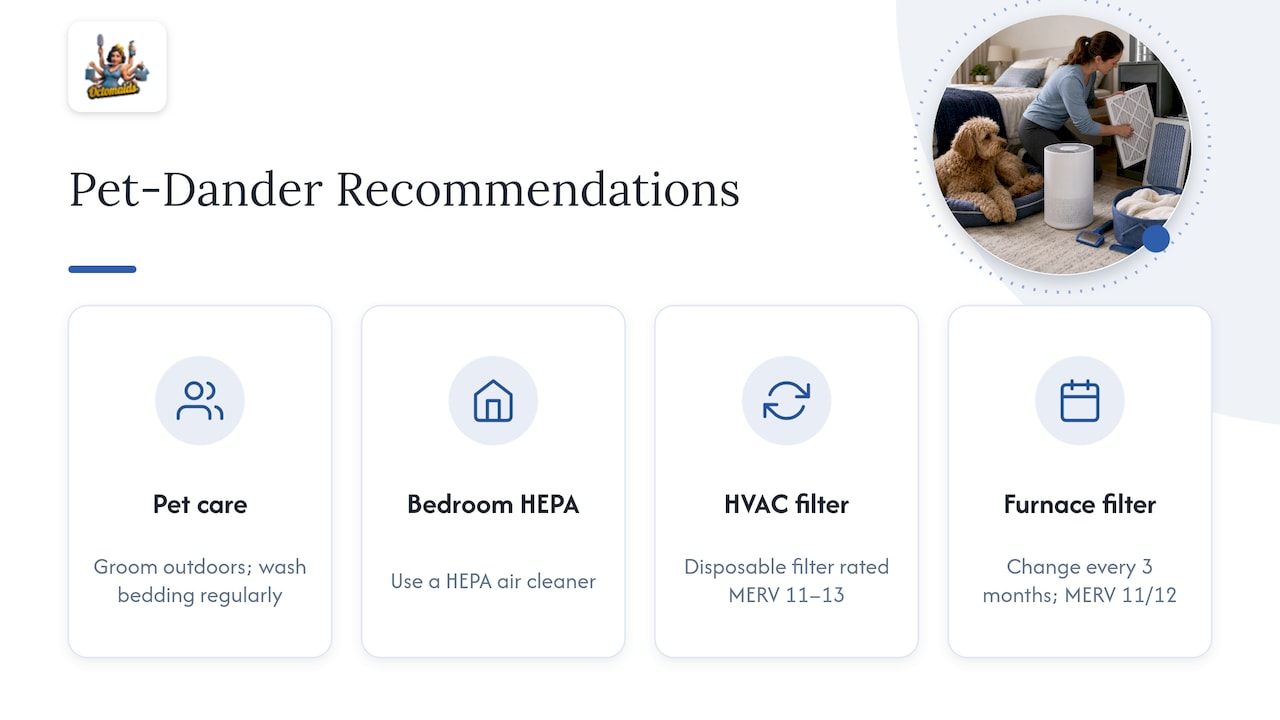
The American College of Allergy, Asthma and Immunology (ACAAI) adds that you can reduce dander by grooming pets outside, washing pet bedding regularly and installing a disposable HVAC filter rated MERV 11 to 13. It recommends a HEPA air cleaner in the allergic person’s bedroom, since a HEPA-filter purifier can remove airborne pet dander. For furnace filters, ACAAI suggests changing them every three months and choosing a MERV rating of 11 or 12.
We go deeper on why filtration matters in our guide to HEPA vacuum benefits, and on dander and hair specifically in our pet hair cleaning approach.
Timing matters more than most people think
Dust does not vanish when you finish wiping. ACAAI notes it can take more than two hours for dust to settle after thorough cleaning, and recommends cleaning when the allergic person is away if possible. Schedule vacuuming for a morning when the person with allergies is at work or school, and let the room settle before they come back to it.
A weekly routine that works
- Strip and wash bedding in hot water.
- Dust high to low with a damp microfiber cloth.
- Vacuum upholstery, rugs and carpet with a HEPA-filter vacuum, then hard floors.
- Wipe kitchen and bathroom surfaces with a fragrance-free cleaner or soap and water.
- Empty the vacuum outdoors if it is bagless, and replace filters on schedule.
For how often each task should happen, our cleaning frequency guide breaks it down room by room.
Our perspective: the product matters, but the routine matters more
We have cleaned homes in Vancouver, WA and Portland, OR since 2006, and allergy questions come up constantly: from parents of kids with asthma, from pet owners, from seniors who are sensitive to strong scents. Our view is that no single bottle fixes an allergy-prone home. Residue left behind by a heavy product, dust pushed from shelf to floor, and a vacuum that exhausts fine particles back into the room do more damage than most people expect.
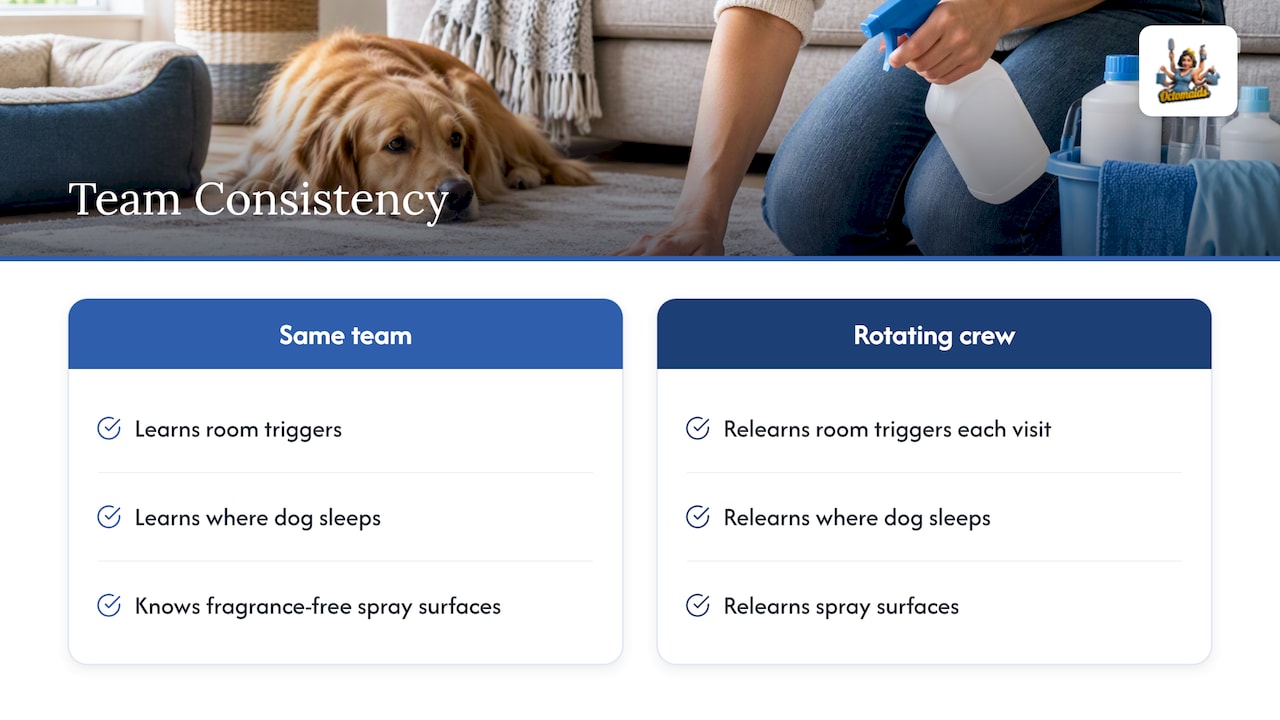
That is why consistency matters to us. When the same dedicated team comes each visit, they learn which room triggers sneezing, where the dog sleeps, and which surfaces get the fragrance-free spray. A rotating crew has to relearn all of that every time. Our staff are background-checked, trained and insured, and we back our work with a satisfaction guarantee.
We also think label claims deserve skepticism, ours included. If you are choosing a service, ask what will be used in your home and why. We have written about how to verify an eco-friendly cleaning service’s claims, and about the benefits of green cleaning for homes and offices. For homes with animals, our pet-friendly cleaning approach explains how we handle products around pets.
— Steven
When it makes sense to hand it off
Cleaning for allergies is physical, repetitive work, and some of it is exactly what a sensitive person should not be doing. Stirring up dust while vacuuming, scrubbing a moldy shower grout or hauling bedding every week can set off the symptoms you are trying to avoid.
If that sounds like your household, our recurring home cleaning puts the same team in your home weekly, bi-weekly or monthly, so the routine above happens on schedule. If you are starting from a dusty baseline, a one-time deep clean resets the house first, and recurring visits keep it there. We publish no flat rate because homes differ in size and condition, so request a quote and tell us about any sensitivities up front. Ask about product preferences when you book.
Moving into a new place is another good moment to start fresh, and our move-in and move-out cleaning removes the previous occupants’ dust and dander before your boxes arrive. After a remodel, fine construction dust is its own problem, covered in our post-renovation dust protocol.
What to avoid
- Products that rely on strong scents to signal clean. Air fresheners, scented sprays and heavily perfumed detergents add irritants without adding cleaning power.
- “Natural” as a selling point alone. As EWG notes, the term is unregulated.
- Cleaning while the allergic person is in the room. Dust is still airborne for hours afterward.
- Dry dusting. A dry cloth or feather duster moves allergens around. Use damp microfiber.
- Skipping ventilation. Even a gentle product releases something into the air. Crack a window.
- Overbuying. One fragrance-free all-purpose cleaner, a glass cleaner or vinegar mix, and a good detergent cover most homes.
FAQ
Can you have an allergic reaction to cleaning products?
Yes. VOCs and other chemicals released by cleaning supplies can contribute to allergic reactions, according to the American Lung Association. Choose products with reduced VOCs and fragrances, ventilate while you clean, and consider simple options like warm water and soap. If you get hives, wheezing or persistent breathing trouble, see an allergist or your doctor.
Is fragrance-free the same as unscented?
Not always. Some products labeled unscented may contain a masking scent to cover odors, which is why EWG recommends checking its guide or calling the manufacturer. A product labeled fragrance-free, ideally backed by a certification like EWG’s Fragrance-Free or EPA Safer Choice’s fragrance-free listing, is the safer bet.
How do I remove pet dander from my house?
Vacuum often with a HEPA-filter vacuum, wash pet bedding and your own bedding regularly, groom pets outside and keep them out of bedrooms. Add a HEPA air purifier in the allergic person’s bedroom and use a MERV 11 to 13 furnace filter. These steps come from ACAAI and AAAAI guidance.
Are hypoallergenic laundry detergents worth it?
For most sensitive households, yes. Bedding and clothing stay against your skin for hours, so dye- and fragrance-free detergents remove a common irritant. Tide Free & Gentle and Seventh Generation Free & Clear are two widely sold examples, but test one on a few loads before replacing everything.
When should I clean if someone in the house has allergies?
When the allergic person is away. ACAAI says dust can take more than two hours to settle after thorough cleaning, so give the house time before they return.
Sources
- American Lung Association: Cleaning Supplies and Household Chemicals
- The Cleaning Institute: Scented or Fragrance-Free Cleaning Products
- EWG’s Guide to Healthy Cleaning: Decoding Labels
- EPA: Identifying Greener Cleaning Products
- EWG Verified Cleaning Products Criteria 2026
- Tide Free & Gentle Liquid Laundry Detergent
- Tide Free & Gentle collection
- Seventh Generation Free & Clear liquid
- Seventh Generation Free & Clear packs
- ATTITUDE Sensitive Skin All-Purpose Cleaner
- Aunt Fannie’s All-Purpose Cleaning Spray
- AspenClean natural cleaners
- BISSELL Revolution PET OXY Deep Clean Free & Clear
- AAAAI: Managing Indoor Allergen Culprits
- ACAAI: Air Filter
- ACAAI: Double Duty Spring Cleaning
- ACAAI: Dust Allergy
Recommended
- Pet-Friendly House Cleaning: The Safe, Non-Toxic Approach
- Book Truly Fragrance Free Cleaning in 48 Hours With Octomaids
About Octomaids
Octomaids is a locally operated professional cleaning company serving Vancouver, Clark County, and the surrounding Portland metro area. Since 2006, our cleaning teams have helped homeowners, renters, property managers, and businesses with recurring cleaning, deep cleaning, move-in/move-out cleaning, and commercial cleaning.
Our cleaning articles are reviewed to ensure the information reflects our real-world experience and professional cleaning practices.