


High-touch surfaces are the objects your hands meet again and again: doorknobs, light switches, faucet handles, remotes, phones, desks and countertops. Because they pass germs from hand to hand, the CDC says they are more likely to spread germs than a wall or a ceiling. For most homes and offices, cleaning them regularly with soap and water does most of the work. Disinfecting is the extra step for specific situations. This guide gives you the list, the rhythm and the method.
TL;DR
- High-touch surfaces are the ones many hands touch every day: handles, switches, faucets, remotes, phones, desks, counters and shared fixtures.
- Clean them regularly and after visitors. Disinfect when someone has been ill or when a surface has met raw meat juices.
- Always clean with soap or detergent first. Soil blocks disinfectant from reaching germs.
- Follow the label for contact time and ventilation, never mix chemicals, and follow the manufacturer’s instructions for electronics.
- A recurring cleaning schedule makes the routine automatic at home and in the office.
Table of Contents
- What counts as a high-touch surface
- The high-touch surfaces list for your home
- The high-touch list for offices and shared spaces
- How often to clean high-touch surfaces
- Cleaning, sanitizing and disinfecting: what each one does
- How to clean and disinfect high-touch surfaces step by step
- Common mistakes with high-touch cleaning
- Building a routine you can keep
- Our perspective
- Let a dedicated team keep the routine going
- FAQ
- Sources
What counts as a high-touch surface
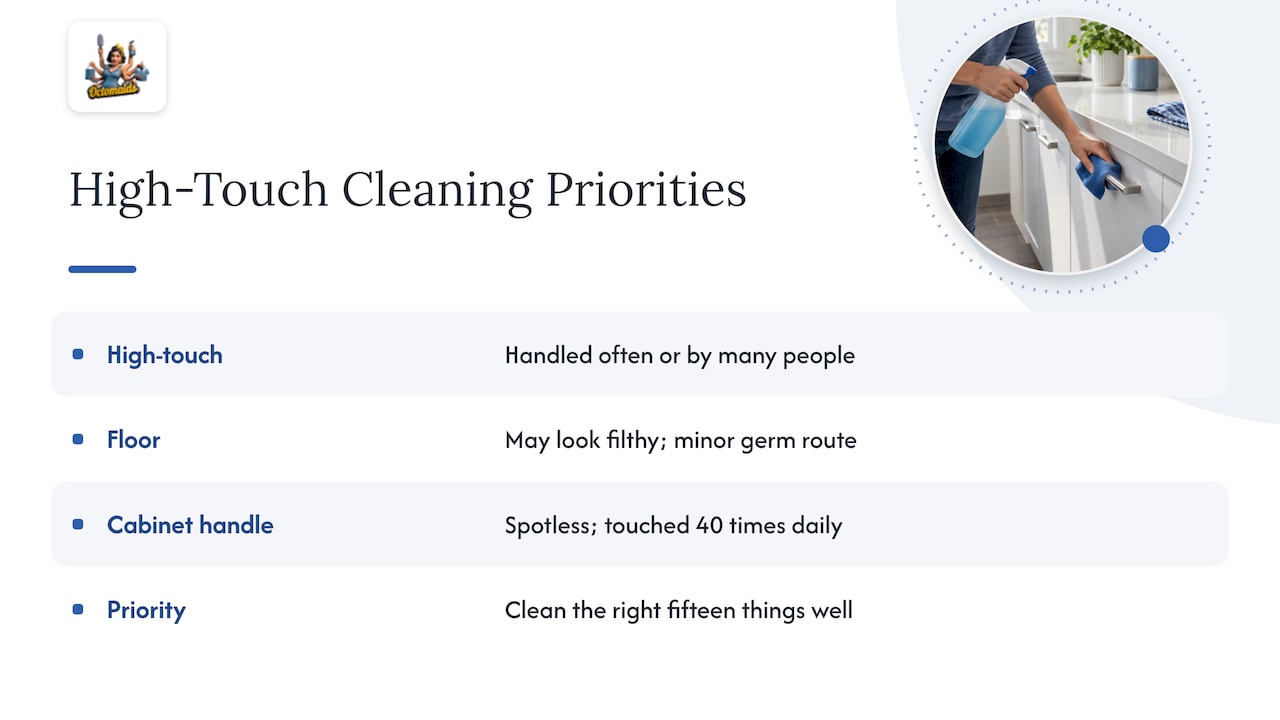
A surface is high-touch when it is handled often, by many people, or by one person with many things on their hands. The CDC’s facility guidance gives examples such as pens, counters, shopping carts, door handles, stair rails, elevator buttons, touchpads, restroom fixtures and desks. At home the same logic applies on a smaller scale. Your front door handle is touched by every person who comes and goes. Your bathroom faucet is touched right after you use the toilet and right before you wash.
The reason to focus on these spots is efficiency. A floor can look filthy and still be a minor route for germs. A kitchen cabinet handle can look spotless and be touched forty times a day. Cleaning the right fifteen things well does more for a household’s health than wiping every flat surface in sight.
The high-touch surfaces list for your home
The CDC’s home guidance names light switches, doorknobs, countertops, certain toys, phones, tablets, touch screens, keyboards and remote controls. Its household guidance document extends the list to tables, hard-backed chairs, handles, desks, toilets, sinks and faucets. Here is how that looks room by room.
Entryway and shared areas
- Front and back door handles, deadbolts and the garage entry door
- Light switches and thermostat
- Stair rails and banisters
- Key bowls, hooks and the top of the shoe bench
- Remote controls, game controllers and tablets
Kitchen
- Refrigerator, oven and microwave handles
- Cabinet and drawer pulls
- Faucet handle and sink edges
- Countertops and the table
- Coffee maker buttons, toaster lever and other small appliance controls
- Trash can lid or pedal
The kitchen has one special rule. After raw meat, poultry or their juices touch a surface, the CDC recommends cleaning counters with hot, soapy water and then sanitizing the contaminated surfaces, including the sink.
Bathrooms
The American Cleaning Institute lists toilet seats and flush handles, sink and faucet controls, counters, door handles and light switches as priority bathroom surfaces. Add the towel bar, the shower door handle and the toothbrush holder, which collect a surprising amount of daily contact.
Bedrooms and the home office
- Door handles and light switches
- Nightstand surfaces and lamp switches
- Phone, tablet, keyboard, mouse and desk
- Chair arms and hard-backed chair surfaces
For bedding, the same American Cleaning Institute guidance suggests laundering sheets at least every other week. After illness it recommends disinfecting frequently touched surfaces and laundering clothes and bedding.
Items people forget
Few people think of the dog leash handle, the car door handle and steering wheel, backpack straps, the garage door opener, reusable grocery bag handles or the laundry room machine dials. Phones are the classic miss: they travel to every room, including the bathroom, and then rest on the kitchen table.
If you want the surrounding picture of a whole-home reset, our deep clean house checklist for every room covers the surfaces that sit just outside this high-touch list.
The high-touch list for offices and shared spaces
In an office, the number of people multiplies the risk. One door handle can be touched by an entire floor. The CDC facility guidance points to counters, door handles, stair rails, elevator buttons, touchpads, restroom fixtures and desks. In practice an office checklist should add:
- Entrance door handles and push plates
- Elevator and access-badge reader buttons
- Breakroom refrigerator and microwave handles, coffee machine buttons and the shared sink faucet
- Conference table surfaces, chair arms, remote controls and room touch panels
- Copier and printer touchscreens
- Shared keyboards, phones and hot-desk surfaces
- Restroom door handles, flush levers, faucets, soap dispensers and paper towel dispensers
Restrooms deserve their own rhythm, since they combine the most contact with the most risk. Our guide to the daily tasks that meet office restroom cleaning standards breaks that routine down for managers.
How often to clean high-touch surfaces
There is no single number that fits every building, but the official guidance gives a clear framework.
At home. The CDC says high-touch surfaces such as light switches, doorknobs and countertops should be cleaned regularly and after visitors. Other surfaces can wait until they are visibly dirty or as needed. The American Cleaning Institute recommends warm water and soap for routine cleaning, with a disinfectant used periodically on frequently touched surfaces.
At work. The CDC’s facility guidance is similar: clean high-touch surfaces regularly, clean other surfaces when visibly dirty, and disinfect areas where people have obviously been ill. It adds that high-traffic areas may justify more frequent cleaning or added disinfection.
When someone is sick. Older CDC household guidance, written for illness at home, advised that common-area high-touch surfaces be cleaned and disinfected daily. It said a bedroom or bathroom used by the ill person could be cleaned as needed to reduce unnecessary contact, and that a shared bathroom should be cleaned and disinfected after each use by the ill person when possible.
Here is a practical rhythm built on that framework:
| Setting | Surfaces | Suggested rhythm |
|---|---|---|
| Home, everyday | Switches, handles, remotes, faucets, counters | Wipe with soap and water several times a week, and after visitors |
| Home, after illness | Same surfaces plus bathroom fixtures | Clean, then disinfect, daily until recovery |
| Home, after raw meat | Counters, sink, cutting areas | Clean with hot soapy water, then sanitize, right away |
| Small office | Door handles, breakroom, restrooms | At least daily, with the busiest points more often |
| Busy shared space | Entrances, elevators, restroom fixtures | Several times through the day |
The rhythm column is our practical translation of the guidance, not a rule from one agency. Adjust it to how many people share the space.
For a fuller view of how frequency fits into a whole-home plan, see our home cleaning frequency guide.
Cleaning, sanitizing and disinfecting: what each one does
These three words get used as if they were the same. They are not.
- Cleaning uses water, soap or detergent and some scrubbing to remove most germs, dirt and impurities. The CDC says cleaning alone removes most types of harmful germs and lowers infection risk.
- Sanitizing reduces germs to levels considered safe.
- Disinfecting uses stronger chemicals to kill most germs that remain after cleaning.
The American Cleaning Institute adds that disinfecting inactivates pathogens including bacteria, viruses and fungi, and that for viruses such as SARS-CoV-2 you should choose products registered by the EPA for that use.
Think of it as sweeping before you mop. Soap and water lift the film of oil, food residue and dust that germs hide in. Disinfectant then has a clear path to what is left. That is why, in most situations, regular cleaning is enough, and disinfecting is reserved for places where people have obviously been ill.
If you manage a workplace and want that distinction translated into a task list, our office disinfection vs. cleaning guide for facility managers walks through it.
How to clean and disinfect high-touch surfaces step by step
- Wash your hands and gather supplies. The University of Connecticut’s Healthy Homes guide starts here, and it also advises protecting skin and eyes with gloves and, where the label calls for it, eye protection.
- Clean first. Use soap or detergent and water to remove visible dirt. The CDC notes that soil can stop a disinfectant from reaching germs effectively.
- Pick the right product. Use an EPA-registered disinfectant labeled for the germ and the surface. Not every disinfectant works on every germ or every material.
- Follow the label. It tells you the dilution, ventilation, protective equipment and contact time. The UConn guide describes contact time as commonly lasting 3 to 10 minutes, but your product’s label is the final word. The surface must stay visibly wet for the full time.
- Let it dry or rinse as directed. Food-contact surfaces such as counters and tables often need a rinse. The label will say.
- Finish with your hands. Wash them again, and launder or dispose of cloths properly.
Two rules matter more than the rest. Never mix cleaning chemicals, and do not rely on fogging or wide-area spraying. The Washington State Department of Health says fogging, fumigation and wide-area spraying are not effective substitutes for surface cleaning and disinfection, and may be hazardous.
Electronics and soft surfaces
Phones, tablets, touch screens, keyboards and remotes should be cleaned according to the manufacturer’s instructions. The CDC suggests considering a wipeable cover so the device can be cleaned without worry. Do not spray liquid directly onto a device.
Soft surfaces such as upholstery, curtains and rugs are less of a priority, but the CDC’s home guidance says to use an appropriate soap- or detergent-based cleaner, launder items where possible at the warmest appropriate setting and dry them completely. Vacuum carpets and rugs, and dispose of the dirt safely.
Protecting finishes
Repeated wiping can dull wood, cloud stainless steel, and wear the coating off some brass handles. Microfiber cloths, mild dish soap and warm water are gentle for daily use, and an all-purpose cleaner works where the label lists the surface as safe. Save the disinfectant for when the situation calls for it, and test any new product on a hidden corner first.
Common mistakes with high-touch cleaning
- Skipping the cleaning step. Spraying disinfectant over a greasy handle mostly wastes product.
- Wiping too quickly. If the surface dries in thirty seconds, the contact time was not met.
- Using the same cloth everywhere. A cloth that cleaned the bathroom faucet should never touch the kitchen counter. Use color-coded cloths or fresh ones for each area.
- Forgetting the cleaning tools. Dirty sponges and cloths spread what they pick up. Launder cloths on a warm cycle and replace sponges often.
- Cleaning in a set order that ignores the traffic. Start with the cleanest areas and end with restrooms and floors.
- Treating a single deep clean as a lasting fix. Contact keeps happening. The surfaces are touched again within minutes, so rhythm matters more than intensity.
Building a routine you can keep
Most households do not fail at knowing what to clean. They fail at repeating it. A routine works best when it is short and attached to something you already do.
- Daily, two minutes: wipe kitchen counters, the faucet and the fridge handle after dinner.
- Several times a week, ten minutes: switches, doorknobs, remotes, bathroom fixtures.
- Weekly: phones, keyboards, desk surfaces, towel bars, trash can lids, bedding changes as needed.
- After guests or illness: clean, then disinfect, the surfaces they touched.
Our guide on how to maintain a clean home between visits and the recurring cleaning schedule examples for busy homes show how to split those tasks between you and a cleaning team.
Our perspective
We have cleaned homes and offices around Vancouver, WA and Portland, OR since 2006, and the pattern is always the same. The surfaces people worry about are rarely the ones they forget. Nobody forgets the toilet. They forget the light switch beside it, the cabinet pull above the stove and the handle of the fridge.
What helps most is consistency, and consistency is easier when the same people clean your space each visit. A dedicated team learns where your household’s touch points are: the entry door your kids use, the home office desk, the breakroom microwave that everyone shares. They notice when something has changed. That is the practical value of a team that knows your space, and it is why we assign the same cleaners rather than sending someone new each time.
Our approach is simple. Clean thoroughly and regularly, pay attention to the surfaces hands actually touch, and leave the space ready for people to live and work in. Our staff are background-checked, professionally trained and insured, and our service is satisfaction guaranteed.
Steven
Let a dedicated team keep the routine going
If the list above sounds like one more thing on a full week, that is a common reaction, and it is what we are here for. Octomaids is a family-owned cleaning company serving Vancouver, WA, Portland, OR and the surrounding area. Our recurring home cleaning puts the same team in your home on a weekly, bi-weekly or monthly schedule, so the regular upkeep of your kitchen, bathrooms and living areas is handled.
Starting from a heavier baseline? A one-time deep cleaning resets the home first. For workplaces, rentals and construction cleanup, see our full list of residential and commercial services, and visit octomaids.com to request a quote.
FAQ
Is cleaning enough, or do I need to disinfect high-touch surfaces?
In most situations, regular cleaning with soap or detergent and water is enough, according to the CDC, because it removes most types of harmful germs. Disinfect where people have obviously been ill, or when a product label or situation calls for it. Always clean first so the disinfectant can work.
How often should I clean doorknobs and light switches at home?
The CDC says to clean high-touch home surfaces such as light switches, doorknobs and countertops regularly and after visitors. For many households that means a quick wipe a few times a week. Increase the frequency during illness, when you should clean and disinfect daily.
How do I clean my phone and keyboard without damaging them?
Follow the manufacturer’s instructions, which the CDC and the American Cleaning Institute both recommend for electronics. Never spray liquid straight onto the device. A wipeable cover makes routine cleaning simpler.
Can I use fogging or spray the whole room instead?
No. Washington State’s Department of Health says fogging, fumigation and wide-area spraying are not effective substitutes for cleaning and disinfecting surfaces, and they may be hazardous. Wipe the individual surfaces instead.
How long should a disinfectant stay on the surface?
That depends on the product. The University of Connecticut’s guide says contact times commonly run from 3 to 10 minutes, but the label on your disinfectant sets the exact time. Keep the surface wet for that whole period.
Sources
- CDC: When and How to Clean and Disinfect a Facility
- CDC: When and How to Clean and Disinfect Your Home
- CDC: Cleaning and Disinfection for Households (illness guidance)
- CDC: Cleaning and Disinfection for Households
- American Cleaning Institute: Levels of Cleaning for Better Health
- American Cleaning Institute: Quaternary Ammonium Compounds FAQ
- Washington State Department of Health: Public Spaces, Safe Cleaning and Disinfecting
- University of Connecticut Healthy Homes: Cleaning and Disinfecting High Touch Surfaces
Recommended
- Home Cleaning Frequency Guide for a Healthier Home
- How to Maintain a Clean Home Between Visits
- Deep Clean vs Regular Clean: A Homeowner’s Guide
- Home Cleaning Best Practices for a Spotless Home
About Octomaids
Octomaids is a locally operated professional cleaning company serving Vancouver, Clark County, and the surrounding Portland metro area. Since 2006, our cleaning teams have helped homeowners, renters, property managers, and businesses with recurring cleaning, deep cleaning, move-in/move-out cleaning, and commercial cleaning.
Our cleaning articles are reviewed to ensure the information reflects our real-world experience and professional cleaning practices.