


The safe way to clean wildfire ash is to keep it wet, keep it out of the air and keep your lungs covered. Wet-wipe hard surfaces, wet-mop floors, wear a fitted N95 or better, and never sweep dry or use a leaf blower. Ash from burned buildings is a different matter. Oregon regulators treat it as possibly containing asbestos, so it belongs with licensed professionals, not with a broom. This guide covers both situations for homes and businesses in the Portland and Vancouver, WA area, and where a professional deep clean fits once the hazardous part is handled.
Key Takeaways
- Ash that drifts in from a distant forest fire is an irritant you can usually clean with wet methods and a respirator. Ash and debris from burned structures should be presumed to contain asbestos.
- Never dry sweep, dust dry, use a leaf blower or pressure wash. Mist, wipe, mop and bag.
- Older adults, pregnant women, children and anyone with heart or lung disease should stay out of ash cleanup entirely.
- Metro’s Central Transfer Station in Portland does not accept wildfire ash or burned materials, so check disposal rules before you haul anything.
- Once the ash itself is dealt with, a thorough deep clean removes the fine dust and film that lingers on surfaces and belongings.
Table of Contents
- First, Work Out Which Kind of Ash You Have
- Who Should Not Do the Cleanup
- The Gear That Actually Protects You
- How to Clean Smoke-Borne Ash Without Spreading It
- Air Filters, HVAC and Lingering Smoke Smell
- When the Ash Came From a Building
- Where the Ash Goes: Disposal in the Portland Area
- Burned Trees and Yard Debris
- After the Hazard Is Handled: The Deep Clean
- Our Perspective
- FAQ
- Sources
First, Work Out Which Kind of Ash You Have
Not all ash is equal, and the first decision in any cleanup is which category you are in.
Smoke-borne ash. This is the gray or white flake that settles on cars, patios and windowsills when a fire burns miles away. Multnomah County says a noticeable smoke smell in your home likely means some level of smoke damage, and suggests wiping a surface with a clean glove and a wet wipe to see whether soot or ash comes off. The county also says to consider professional cleaning depending on how thick the dust is. It explains that visible ash pieces are large enough for your nose and throat to stop them before the lungs, but circulating ash can still irritate skin, nose and throat and trigger asthma, and it may carry traces of metals and cancer-causing chemicals.
Ash from burned structures. This is the ash and debris left where a building burned, whether a home, a warehouse or a garage. Oregon’s Department of Environmental Quality (DEQ) says to either have an accredited inspector survey for asbestos or presume that all debris and ash contain asbestos. Asbestos is a mineral fiber once common in building materials. DEQ calls it a known carcinogen with no known safe level of exposure, and strongly recommends a licensed abatement contractor for any abatement work.
Portland saw this distinction play out when the Centennial Mills warehouse burned. The city published guidance for neighbors on safely handling debris that landed on their property: gently soak it, wear the best mask available, pick it up with gloves and a damp paper towel, double-bag it and wash afterward. The guidance rules out sweeping, vacuuming and power washing.
A simple rule follows. If the ash on your property came from a building, treat it as hazardous. If it blew in as ordinary smoke fallout, follow the wet-cleaning steps below.
Who Should Not Do the Cleanup
The US EPA says people with heart or lung disease, older adults and pregnant women should not take part in ash cleanup. Washington’s Department of Health adds infants, children and people over 65 to the list of those who should stay away from ash, and avoid cleanup as much as possible. The CDC says children should not do any cleanup work.
If that describes you or someone in your household, hand the job to someone else. Senior homeowners and busy professionals often prefer this anyway. If you have a heart or lung condition and are unsure whether any exposure is safe, ask your doctor before you spend time in a dusty space.
The Gear That Actually Protects You
The wrong mask is the most common mistake. The EPA recommends a snug-fitting NIOSH-approved N95 or P100 respirator with two straps, and says surgical masks and single-strap dust masks will not protect your lungs. Oregon DEQ also says cloth masks and bandanas are ineffective.
For general ash, Oregon DEQ and the CDC describe the same kit:
- A properly fitted N95 respirator
- Heavy-duty or disposable rubber gloves
- Long sleeves, long pants, closed shoes and socks, or disposable coveralls if possible
- Goggles
The CDC adds that you should wash ash off skin, eyes or mouth as soon as possible.
If asbestos is known or suspected, the bar rises. CDC/NIOSH says to wear a NIOSH-approved elastomeric half-mask respirator or higher with a particulate filter, because filtering facepiece respirators do not provide adequate protection against asbestos dusts. Washington’s Department of Health likewise says an N95 will not adequately protect against asbestos. That is the practical line between a weekend cleanup and a job for a licensed abatement contractor.
Two more hazards to know about, both from CDC/NIOSH. Avoid ash from wooden decks, fences and retaining walls pressure-treated with chromated copper arsenate (CCA), which may contain lethal amounts of arsenic. Also avoid burned items that may contain hazardous chemicals, such as cleaning products, paint and solvent containers. Watch for electrical hazards, unstable surfaces and sharp objects, and leave immediately if you suspect gases are present.
How to Clean Smoke-Borne Ash Without Spreading It
The principle behind every official guide is the same: ash is a fine powder, and dry cleaning turns it into airborne dust. Keep everything damp.
- Prepare the space. Put on your respirator, gloves and eye protection. Keep children and pets away until the ash or dust is cleaned, as Oregon DEQ advises. Washington’s guide says not to open windows until outdoor cleanup is done and outdoor air quality has improved. The EPA says that when conditions allow, you can open windows and doors and use fans to exhaust contaminants outdoors while you clean.
- Start outdoors. Gently dampen outdoor ash, with no pressure washer. Oregon DEQ says to use a HEPA-filter vacuum outdoors. The EPA says never to use a leaf blower.
- Work top to bottom indoors. Pasadena, California public health guidance recommends a top-to-bottom approach with wet methods, so that dust falling from shelves lands on surfaces you have not yet cleaned. Soap and water are adequate; harsh chemical cleaners are not needed.
- Use a damp cloth on surfaces, a wet mop on floors. The EPA says to mist hard surfaces before sweeping, follow with wet mopping, and use a damp cloth on lightly dusted areas.
- Vacuum only with a HEPA filter. CDC/NIOSH warns that shop vacuums blow fine particles out of the exhaust. Oregon DEQ says no vacuuming without a high-efficiency HEPA filter. If you only have a typical vacuum, the EPA says to wear a respirator, air out the space and use an air cleaner or HVAC filter.
- Deal with soft items. Linens, curtains and carpets are porous and hold fine particles. Pasadena’s guidance says to wash or dispose of them.
- Wash up. Rinse ash off skin and eyes, and launder your clothes separately.
A worked example: you come home to a gray film on a Vancouver deck and across your kitchen window ledge after a smoky weekend. You put on an N95 and gloves, mist the deck lightly, collect the damp ash with paper towels and bag it. Indoors, you wipe the ledge with a damp cloth, mop the floor and replace your furnace filter. Nothing is swept, nothing is blown, and the dust never gets airborne.
Air Filters, HVAC and Lingering Smoke Smell
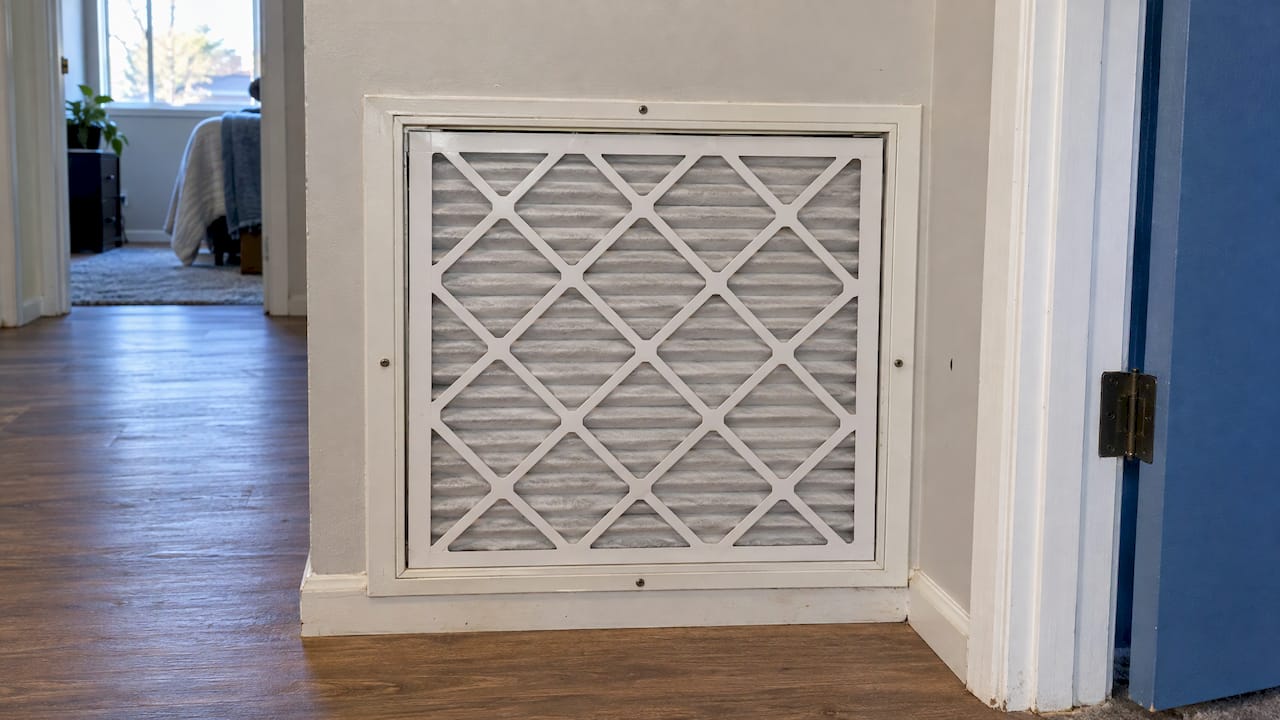
Ash settles on surfaces, but the finest particles and the odor travel through your air. The EPA says that if your HVAC system is safe to use, run it with a high-efficiency filter and use an air cleaner for lingering fine particles. Washington’s Department of Health says to replace HVAC filters monthly until the smoke smell in your home is gone.
Pasadena’s guidance is more specific: use a filter rated MERV 13 or higher, as high as your system can accommodate. MERV is a rating of how fine a particle a filter catches. Seal any gaps around the filter with foam or tape, and run the fan on recirculation as often as possible. Oregon DEQ adds that a HEPA air purifier should be sized for the room where you use it.
Smoke odor is not just surface dust. Pasadena public health explains that it is a mix of particles and gases, including benzene and formaldehyde, that fade over weeks to months. Cleaning, fresh-air ventilation and HEPA-plus-carbon air purifiers can speed that along, so plan to keep purifiers running for a while.
When the Ash Came From a Building
If ash and debris came from a burned structure, stop and treat it as a hazardous waste project. Oregon DEQ’s guidance for owners who consider doing it themselves says self-directed debris removal can cost as much as $75,000, and that the agency strongly urges owners not to remove hazardous materials and debris themselves. It strongly recommends a DEQ-licensed asbestos abatement contractor.
Before any work starts, DEQ says to contact your insurance provider to learn reimbursement requirements. Keep disposal receipts, lab reports, site maps and photos, since counties, insurers and landfills may ask for copies. This is a step the law and your insurer put in the hands of specific authorities and licensed firms, so make those calls first.
In Washington, the Department of Health’s After a Fire guide is the place to start for the same hazards. If you are unsure whether your situation counts as hazardous, call your local waste authority or the health department before you touch anything. The EPA suggests checking with local authorities for recommendations on selecting reputable specialists if cleanup is not safe or feasible for you.
Where the Ash Goes: Disposal in the Portland Area
For ordinary smoke-borne ash, the EPA says collected ash may go in regular trash, stored in plastic bags or other containers so it cannot be stirred up. Washington’s Department of Health says to double-bag all ash and debris, including the disposable coveralls and gloves you used, in sealed plastic trash bags. Check with your local disposal site for its rules. Do not wash ash into storm drains.
Burned structure debris is different. Metro’s Central Transfer Station at 6161 NW 61st Ave. in Portland does not accept burned materials or wildfire ash, nor asbestos-containing material. Customers who dump unaccepted items may be fined or face asbestos testing and removal costs that can exceed $3,000. WM Northwest says its Oregon transfer stations are not accepting wildfire debris and advises against self-hauling because of potential asbestos or other hazardous material.
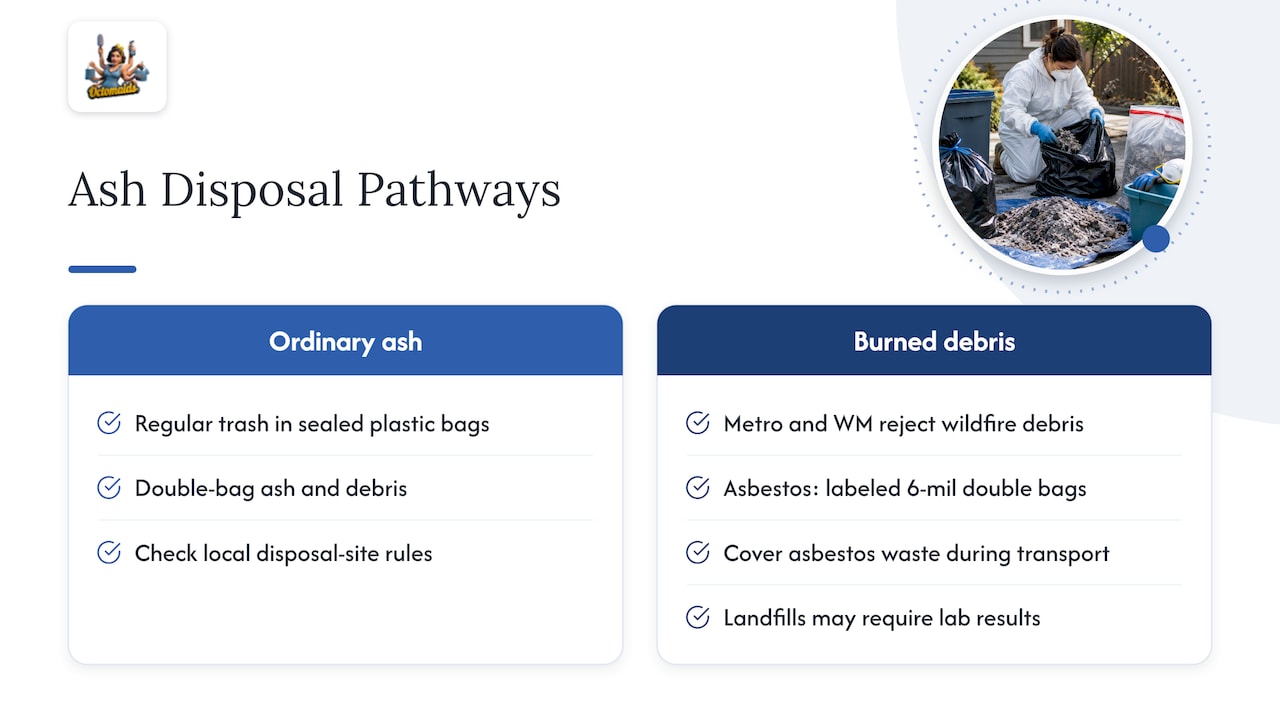
If your debris is confirmed or presumed to contain asbestos, DEQ says the waste must be double-bagged in 6-mil plastic sheeting, labeled as asbestos, and covered during transport. Many landfills also require lab results before they accept it.
Burned Trees and Yard Debris
Wildfire fallout often leaves a yard with scorched limbs and trees that are damaged or unstable. Stay away from unstable surfaces and falling hazards, and remember the CCA warning above for treated wood. For burned or damaged trees, tree services and land restoration cover the removal and restoration work that sits outside house cleaning.
After the Hazard Is Handled: The Deep Clean
Here is where a professional house cleaning comes in. Once hazardous ash has been dealt with by the right authorities and licensed firms, or once the fallout was only smoke-borne dust, a home still holds fine film in places you rarely reach: baseboards, vent covers, window tracks, the tops of cabinets and the insides of closets. Wiping these by hand takes hours, and it is exactly the kind of job the people who should avoid ash exposure need to hand off.
A room-by-room deep clean is built for this reach. Our guide to what deep cleaning includes lists the surfaces covered. If you are weighing the work, what a deep clean costs in Portland is published on our site.
For homes, we offer one-time deep cleaning. For rental owners and offices, our commercial and short-term rental cleaning services cover turnovers and workplaces. Tell us about your situation when you call, so we can talk through what fits your home.

And if you want smoke season to stay manageable, recurring home cleaning keeps dust from building up between wildfire events. You can also reach us through our Portland house cleaning page.
Our Perspective
Cleaning after wildfire smoke comes down to one idea: fine particles behave like a liquid’s opposite. Disturb them dry and they go everywhere, keep them damp and they stay put. Every public health agency in this guide lands on that same principle, and it is the one we build our cleaning habits around.
We have served Vancouver, WA and Portland, OR since 2006 as a family-owned team, not a franchise. What our customers tell us they value most is knowing who is in their home: we send the same dedicated team every visit, and our staff are background-checked, professionally trained and insured. When someone is already stressed about smoke, ash and what it left behind, that consistency matters.
Our view is simple. Let the authorities and licensed abatement contractors handle anything from burned structures. Then let a careful, consistent team handle the home itself, so you, your parents or anyone with sensitive lungs never has to stand in a dusty room with a rag. We back our services with a satisfaction guarantee, and we would be glad to talk through your home.
Steven
FAQ
Can I vacuum wildfire ash?
Only with a HEPA-filter vacuum. CDC/NIOSH warns that shop vacuums blow particles out through the exhaust, and Oregon DEQ says not to vacuum without a high-efficiency HEPA filter. With an ordinary vacuum, the EPA says to wear a respirator, ventilate the space and use an air cleaner or HVAC filter.
Can I pressure wash ash off my patio or siding?
No. Oregon DEQ says to gently dampen outdoor ash without a pressure washer, and Portland’s debris guidance says not to power wash. Also avoid washing ash into storm drains, as the EPA advises.
Is a regular dust mask enough?
No. The EPA says surgical masks and one-strap dust masks will not protect your lungs. Use a snug-fitting NIOSH-approved N95 or P100 with two straps. If asbestos is possible, Washington’s Department of Health says an N95 will not adequately protect you.
How long should I keep changing my furnace filter?
Washington’s Department of Health says to replace HVAC filters monthly until the smoke smell is gone. Pasadena’s public health guidance goes further and suggests replacing filters monthly for up to a year after the surrounding area is cleaned, or sooner if they clog.
Where can I throw away the ash?
Ordinary smoke-borne ash can go in the regular trash, double-bagged, according to the EPA and Washington’s Department of Health. Metro’s Central Transfer Station in Portland does not take wildfire ash or burned materials, so call your local waste authority before hauling any burned debris.
Sources
- Wildfire smoke and your health, Multnomah County
- Protect Yourself from Ash, US EPA
- How to Safely Clean Up After a Fire, Oregon DEQ
- Safely dispose of debris, City of Portland
- After a Fire: Clean up Guide, Washington State Department of Health
- Safety Guidelines: After a Wildfire, CDC
- Hazards During Wildland Fire Cleanup, CDC/NIOSH
- Cleaning Guidance for Ash, Soot, and Smoke After a Wildfire, City of Pasadena
- Information for residential property owners opting out of cleanup, Oregon DEQ
- Metro Central Transfer Station, Metro
- WM Hillsboro Landfill and Tualatin Valley Waste Recovery, WM Northwest
- Tree services and land restoration
Recommended
About Octomaids
Octomaids is a locally operated professional cleaning company serving Vancouver, Clark County, and the surrounding Portland metro area. Since 2006, our cleaning teams have helped homeowners, renters, property managers, and businesses with recurring cleaning, deep cleaning, move-in/move-out cleaning, and commercial cleaning.
Our cleaning articles are reviewed to ensure the information reflects our real-world experience and professional cleaning practices.