



Professional cleaners define cleaning priorities in busy homes as the targeted focus on kitchens, bathrooms, and high-traffic zones that deliver the greatest hygiene and visual impact per minute spent. Understanding what areas cleaners prioritize in busy homes is the single most useful thing a homeowner can do to stop wasting time on low-return tasks. The 80/20 rule drives every decision a skilled cleaner makes: 20% of cleaning tasks produce 80% of perceived cleanliness. Knowing which 20% those are changes everything about how you approach your household routine.
Which key areas do professional cleaners focus on first in busy homes?
Kitchens and bathrooms are the mandatory first stops in any professional cleaning routine. From an infectious disease standpoint, kitchens rank higher than bathrooms as a hygiene priority because of raw food exposure and constant hand contact. That surprises most homeowners, who assume the bathroom is the dirtiest room. The reality is that bacteria spread fastest where food handling happens.
Professional cleaners allocate roughly 20–30 minutes per major room, tackling clutter first, then dry dusting, then wet cleaning, and finishing with floors. This sequence prevents dust from resettling on surfaces you just wiped. Bathrooms get similar structured attention, with product dwell time built in so disinfectants can work while the cleaner moves to another task.
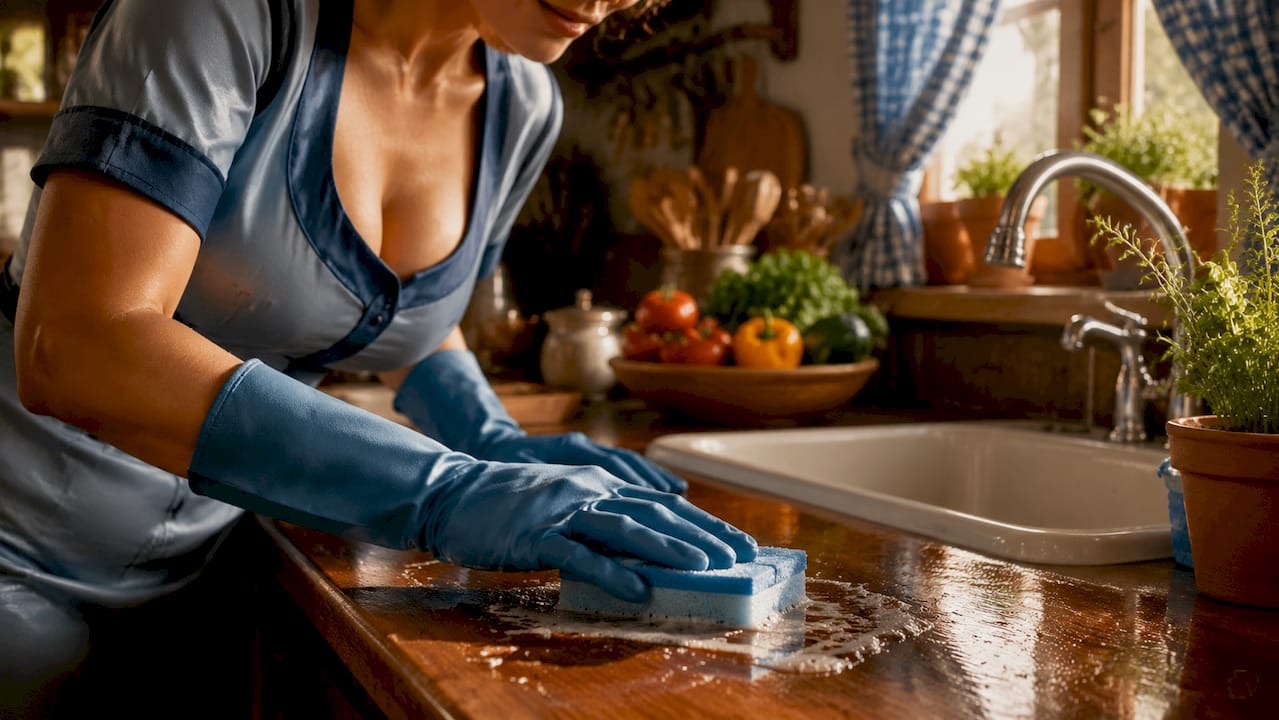
Entryways and hallways come third. Dirt tracked in through the front door spreads to every room it touches. Stopping it at the source protects carpets, grout, and hard floors throughout the rest of the home.
Pro Tip: Focus your first five minutes on high-touch surfaces: faucet handles, light switches, cabinet pulls, and countertops. These spots transfer bacteria faster than any other surface in the home.
Primary zone task breakdown
Kitchen (20–30 minutes):
- Wipe and disinfect countertops and backsplash
- Clean sink and faucet handles
- Wipe refrigerator handle and exterior
- Clean stovetop and microwave exterior
- Sweep and mop floor
Bathroom (15–20 minutes):
- Disinfect toilet, seat, and base
- Scrub sink and faucet
- Wipe mirror and light switch
- Clean tub or shower walls
- Mop floor
Entryway and hallway (5–10 minutes):
- Sweep or vacuum floor
- Wipe door handles and light switches
- Clear and organize shoe area
- Dust any shelving or console surfaces
How do professional cleaners apply the 80/20 rule to clean busy homes effectively?
The 80/20 rule, applied to residential cleaning, means that clutter clearing, wiping high-touch surfaces, and vacuuming high-traffic floors account for most of what guests and family members actually notice. Polishing baseboards or scrubbing grout lines are real tasks, but they contribute very little to how clean a home feels on any given day. Professionals know this and spend their time accordingly.
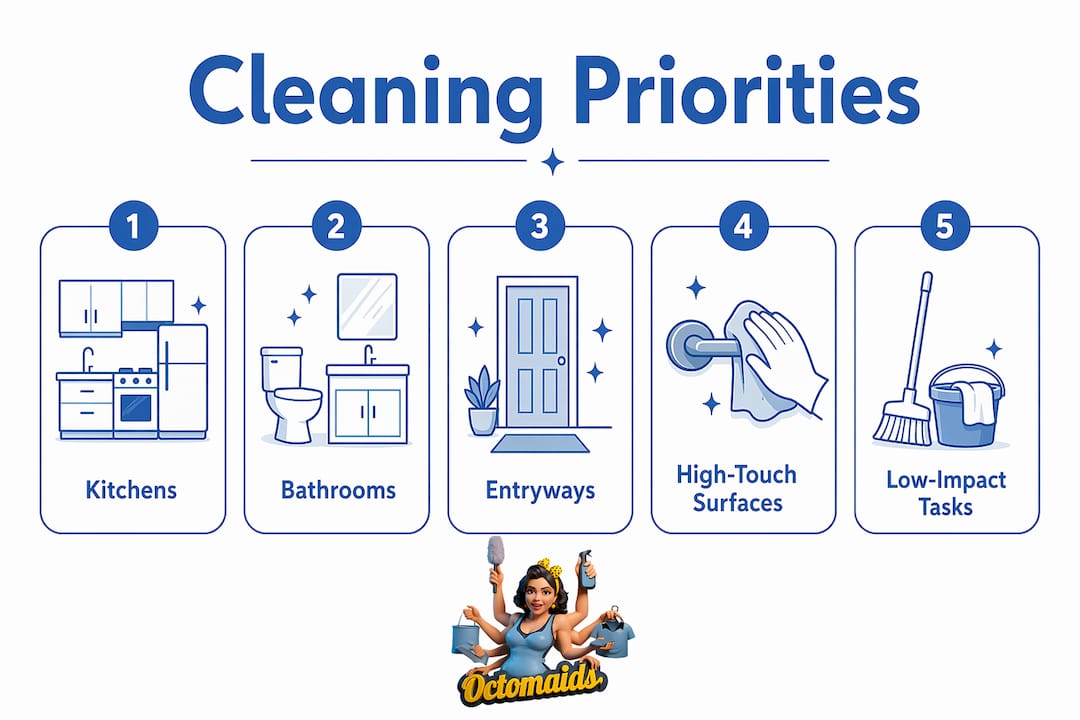
The practical split looks like this: high-impact tasks take priority every visit, while low-impact tasks rotate on a monthly or seasonal schedule. This keeps the home consistently presentable without burning through time on diminishing returns.
| Task | Impact level | Frequency |
|---|---|---|
| Wipe kitchen counters and sink | High | Daily |
| Vacuum main living areas | High | 2–3 times per week |
| Disinfect bathroom surfaces | High | Weekly |
| Clear clutter from default zones | High | Daily |
| Clean baseboards | Low | Monthly |
| Scrub grout lines | Low | Quarterly |
| Wash windows | Low | Seasonally |
| Polish furniture | Low | Monthly |
Household type shapes which tasks move up the priority list. Pet owners need to vacuum more frequently because hair and dander accumulate fast. Homes with young children require more frequent disinfection of low surfaces and toys. Allergy sufferers benefit from prioritizing dusting and HVAC filter changes over visual tasks like window cleaning.
Pro Tip: Write your personal high-impact task list on a sticky note and keep it visible. When time is short, work only from that list. You will cover the 20% that matters most every single time.
What cleaning sequences and routines do professionals recommend for busy households?
The top-to-bottom, room-by-room sequence is the foundation of professional cleaning efficiency. This order reduces cleaning time by 25% because dust and debris fall downward. Cleaning ceilings, shelves, and counters before floors means you only sweep or mop once. Reversing this order means cleaning the floor twice.
Professionals divide tasks into daily and weekly categories to prevent any single session from becoming unmanageable.
Daily non-negotiables (10–15 minutes total):
- Clear clutter from default tidy zones (entryway, kitchen counter, main table)
- Wipe kitchen counters and stovetop
- Rinse sink and wipe faucet
- Do a quick bathroom wipe-down
- Sweep or spot-vacuum the main living area
- Put away anything left out from the day
Weekly deep-focus areas:
- Full bathroom scrub including tub and toilet base
- Vacuum all rooms including under furniture edges
- Mop hard floors
- Change bed sheets
- Wipe appliance exteriors
- Dust ceiling fans and light fixtures
Establishing default tidy zones is one of the most underrated strategies in household management. A default tidy zone is a surface or area that always gets cleared before you go to bed. The kitchen counter, the entryway table, and the main living room surface are the three most common choices. When these stay clear, the entire home feels more ordered, even if other areas are not perfect.
One task that professionals consistently flag as overlooked: changing the furnace filter. This 60-second task improves indoor air quality and reduces how quickly dust resettles on every surface you just cleaned. Skipping it means your cleaning efforts work against a constant stream of recirculated particles.
Pro Tip: Set a 10-minute timer and clean only until it goes off. This technique, sometimes called a “micro-clean,” prevents the mental resistance that comes from open-ended cleaning sessions. Consistency beats intensity every time.
You can also explore a weekly cleaning routine guide to build a schedule that fits your specific household size and lifestyle.
Which areas are commonly missed in busy homes and how do professionals address them?
Busy schedules create predictable blind spots. The areas that get skipped most often are the ones that require moving something first: under furniture, behind appliances, and inside HVAC vents. These spots accumulate dust, allergens, and debris at a steady rate, even when the rest of the home looks clean.
Neglecting these zones has real consequences. Dust under beds and sofas circulates every time someone walks through the room. Dirty HVAC filters push allergens back into the air. Grime behind the refrigerator and stove creates conditions where bacteria and pests thrive. The professional approach to indoor air quality treats filter changes and vent cleaning as non-negotiable, not optional extras.
The good news is that most of these tasks do not require much time. They just require a schedule. Professionals integrate them on a rotating basis so nothing goes more than a few weeks without attention.
High-value tasks that busy homeowners most often skip:
- Vacuuming under beds, sofas, and chairs
- Wiping the top of the refrigerator
- Cleaning behind and under the stove
- Replacing or cleaning the HVAC furnace filter
- Wiping light switch plates and door frames
- Cleaning the inside of the microwave
- Dusting ceiling fan blades
- Scrubbing the bathroom exhaust fan cover
Pro Tip: Attach one “hidden zone” task to something you already do weekly. For example, every time you change bed sheets, vacuum under the bed. Pairing new habits with existing ones makes them stick without requiring extra mental effort.
For a full breakdown of how often each area needs attention, the home cleaning frequency guide from Octomaids covers every room in practical detail.
How can busy homeowners adapt professional cleaning priorities to their own routines?
The most effective house cleaning strategies are the ones you will actually follow. Professional priorities give you a framework, but your household’s specific needs shape the final plan. A home with two dogs and three kids has different top priorities than a two-person household with no pets.
Start by auditing your home for your personal vital 20%. Walk through each room and identify the three surfaces or areas that, when clean, make the whole room feel better. Those are your non-negotiables. Everything else can wait or rotate.
Micro-habits outperform marathon cleans for busy homeowners. A 15-minute daily reset prevents the kind of buildup that turns into a two-hour Saturday project. The goal is to keep the home at a functional baseline, not to achieve a showroom finish every day.
Practical ways to adapt professional priorities to your schedule:
- Identify your three default tidy zones and clear them every night
- Keep cleaning supplies in each bathroom so wiping takes seconds, not a trip to the supply closet
- Assign one “deep focus” area per week instead of trying to deep clean everything at once
- Use a simple checklist posted somewhere visible to track rotating tasks
- Accept that an 80% clean home is a healthy, realistic goal
Embracing an 80% clean home is not lowering your standards. It is protecting your energy so you can maintain consistency over time. Perfection leads to burnout. Consistency leads to a home that always feels livable.
When certain tasks consistently fall off your list, that is a signal worth paying attention to. Some cleaning jobs are genuinely better delegated to professionals, especially deep cleaning tasks that require time, equipment, or expertise most homeowners do not have on hand. You can also learn more about professional cleaning methods that translate well into everyday home routines.
Key takeaways
Professional cleaners in busy homes focus on the 20% of tasks, primarily kitchens, bathrooms, high-touch surfaces, and default tidy zones, that produce 80% of visible cleanliness results.
| Point | Details |
|---|---|
| Kitchen is the top hygiene priority | Raw food exposure makes kitchen surfaces higher-risk than bathrooms; disinfect daily. |
| 80/20 rule guides every decision | Focus on clutter clearing, high-touch surfaces, and vacuuming before any other task. |
| Top-to-bottom sequence saves time | Cleaning from high surfaces to floors reduces cleaning time by 25% by avoiding rework. |
| Default tidy zones anchor daily order | Clearing three key surfaces each night prevents clutter from spreading through the home. |
| Overlooked tasks compound over time | HVAC filter changes and under-furniture vacuuming protect air quality and reduce dust buildup. |
What I have learned after years of watching how people actually clean
After working with hundreds of homeowners across Vancouver, WA and Portland, OR, the pattern I see most often is not laziness. It is misplaced effort. Homeowners spend real time on tasks that feel productive but do not move the needle: reorganizing a closet while the kitchen sink sits dirty, or polishing furniture while the bathroom goes another week without a scrub.
The shift that makes the biggest difference is simple. Stop cleaning what bothers you visually and start cleaning what matters hygienically and structurally. Your eye is drawn to clutter, but bacteria do not care about clutter. They thrive on faucet handles and cutting boards.
The homeowners I have seen manage their homes best are not the ones who clean the most. They are the ones who clean the right things consistently. They have a short list, they protect it, and they do not let perfect become the enemy of done. A home that is reliably 80% clean every day is a healthier, calmer place to live than one that swings between spotless and chaotic.
My honest advice: spend one week tracking where you actually spend your cleaning time. You will probably find that 60% of your effort goes to tasks in the bottom half of the impact table. Redirect that time to your kitchen, your bathrooms, and your default zones. The difference will be noticeable within days.
— Steven
Professional cleaning for busy homes in Vancouver and Portland
Octomaids has served busy homeowners in Clark County, WA and the Portland Metro area since 2006. Our family-owned team focuses on the high-impact areas that matter most: kitchens, bathrooms, high-touch surfaces, and the zones that keep your home feeling ordered between visits.
Whether you need a recurring cleaning service to maintain your priority zones week after week, or a one-time deep clean to reset your home, Octomaids sends the same trusted cleaners every visit. You can also explore our full range of residential and commercial services to find the right fit for your household. We handle the 20% that makes 80% of the difference, so you do not have to.
FAQ
What areas do professional cleaners prioritize first?
Professional cleaners prioritize kitchens, bathrooms, and entryways first because these zones carry the highest hygiene risk and have the greatest impact on overall home cleanliness. High-touch surfaces like faucet handles, countertops, and light switches are the first targets within each area.
How does the 80/20 rule apply to house cleaning?
The 80/20 rule means that 20% of cleaning tasks, specifically clutter clearing, wiping high-touch surfaces, and vacuuming high-traffic floors, produce 80% of perceived cleanliness. Focusing on these tasks first gives busy homeowners the most return for their time.
How long should cleaning each major room take?
Professional cleaners allocate roughly 20–30 minutes per major room, following a top-to-bottom, dry-before-wet sequence that prevents rework and reduces total cleaning time by 25%.
What are the most commonly missed cleaning tasks in busy homes?
The most overlooked tasks include vacuuming under furniture, cleaning behind appliances, and changing the HVAC furnace filter. The furnace filter change takes about 60 seconds and significantly reduces dust and allergen buildup throughout the home.
Is it realistic to maintain a clean home without professional help?
A functional, healthy home is achievable with daily 10–15 minute resets focused on default tidy zones and high-touch surfaces. For deep cleaning tasks or when schedules get tight, periodic professional cleaning fills the gaps without requiring a full-time commitment.