


How to organize your home for easy cleaning
The fastest way to cut your cleaning time is not to clean faster. It’s to organize so that cleaning almost takes care of itself. When every item in your home has a logical, designated place, you stop cleaning around clutter and start moving through rooms with purpose. That shift alone can turn a two-hour Saturday scrub session into a 20-minute daily reset.
Organizing for easy cleaning means building systems that match how you actually live, not how a magazine says you should. The goal is to reduce friction: the right choice (putting something away) becomes the easiest choice. Here’s the foundation to build from:
- Create activity zones. Group items by where and how you use them. Cooking tools near the stove, charging cables near the couch, cleaning supplies under each sink. When zones are clear, you never have to decide where things go.
- Give every item a home. Clutter is almost always the result of items that have no assigned place. A designated home for items removes the daily decision of where to put things and makes tidying faster and more automatic.
- Use drop zones strategically. A small tray or basket near the front door for keys, wallets, and mail prevents these items from migrating to every flat surface in the house.
- Contain countertop items on trays. When you need to wipe a counter, lifting one tray takes two seconds. Clearing a dozen loose items takes two minutes.
- Declutter before you organize. Containers and bins solve nothing if they’re full of things you don’t use. Reduce first, then contain.
- Keep cleaning supplies accessible. A caddy stocked with your go-to products means you grab it and go, rather than hunting through cabinets before you even start.
The relationship between organization and cleaning is direct: less stuff in the wrong place means less to move, less to dust around, and less visual noise pulling your attention. Homes that are easy to clean are not necessarily spotless. They’re set up so that keeping them clean requires minimal conscious effort.
How to build a weekly cleaning and organizing schedule that actually sticks
Most cleaning routines fail not because people lack motivation, but because the decisions are left open every single day. A structured schedule removes that burden. When Monday always means bathrooms and Wednesday always means floors, you stop negotiating with yourself about what needs doing.
The Clean Mama cleaning schedule offers a practical model built around daily tasks layered with one weekly focus per day. It works because the decisions are already made before the week begins.
Daily tasks (roughly 20 minutes):
- Make the beds first thing.
- Do a quick sweep or vacuum in high-traffic areas.
- Wipe kitchen counters every evening, bathroom counters when you’re in there.
- Do one load of laundry from start to finish.
- Do a general clutter sweep, returning items to their zones.
Weekly schedule by day:
- Monday: Clean bathrooms.
- Tuesday: Dust surfaces, furniture, and light fixtures.
- Wednesday: Vacuum all floors.
- Thursday: Wash floors.
- Friday: Catch-all day for anything missed, plus one rotating task.
- Saturday: Launder sheets and towels.
- Sunday: Rest. Daily tasks only.
Rotating tasks, things like wiping down appliances, cleaning baseboards, or vacuuming under furniture, get two slots per week on Friday. That way they cycle through the month without ever feeling like a major project.
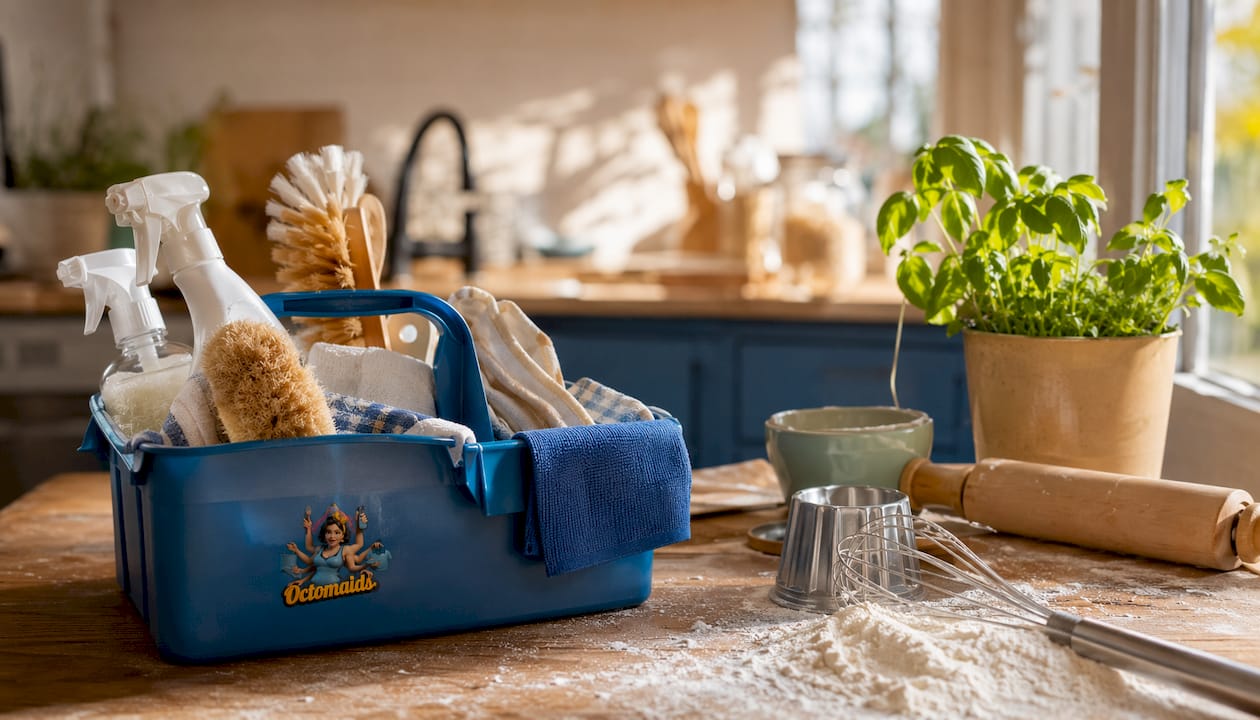
Pro Tip: Before you start any cleaning session, gather all your supplies into a single caddy. Cleaning top-down and carrying everything with you eliminates the wasted trips back to the supply closet that quietly double your cleaning time.
Balancing this schedule with a real life means accepting that some weeks will be incomplete. The structure is not a standard to meet perfectly. It’s a default that keeps your home from falling behind, so you’re never starting from scratch.
Decluttering principles that make home organization genuinely easier
Decluttering is not a one-weekend project. It’s an ongoing practice, and the homes that stay cleanest are the ones where the owners have internalized a few simple rules for deciding what stays and what goes.
The core problem with decluttering is decision fatigue. When you stand in front of a closet full of things and have to evaluate each item from scratch, you exhaust your mental energy before the job is half done. The fix is to have a plan before you start: decide in advance whether each category of item will be donated, sold, recycled, or discarded. That pre-decision collapses dozens of micro-choices into one.
A few principles that hold up in practice:
- The 5-5-5 rule. Each day, identify 5 items to toss, 5 to donate, and 5 to return to their proper place. It takes under 10 minutes and prevents clutter from accumulating invisibly over weeks.
- Usage-based sorting. If you haven’t used something recently and don’t have a specific upcoming use for it, it’s a candidate for removal. Keeping items “just in case” is the single biggest driver of storage overflow.
- Act immediately on decluttered items. Whatever goes in the donation bag goes to the car that same day. Whatever goes in the trash leaves the house before you can second-guess it.
- Work room by room, area by area. Don’t try to declutter the whole house at once. Start with the kitchen spice drawer or the bathroom cabinet under the sink.
Pro Tip: Short, focused sessions of 10–15 minutes on one small area build momentum far better than marathon weekend projects. Set a timer, work until it goes off, and stop. The progress compounds.
The psychological payoff of decluttering is real. Every item you remove is one fewer thing to clean around, store, or move when you’re wiping down a surface. A decluttered room is not just tidier. It’s physically faster to clean.
Daily habits that keep your home clean with minimal effort
Sustainable cleanliness is built on small, repeatable actions, not occasional heroic cleaning sessions. The homes that stay consistently tidy are the ones where the people living in them have a handful of non-negotiable daily habits baked into their routines.
- Reset high-traffic areas every evening. The kitchen counter, the entryway, and the living room floor are the three spots that, if cleared nightly, make the whole house feel under control. A five-minute nightly reset clears the counter, loads the dishwasher, and returns obvious items to their zones.
- Handle items once. When you bring something in the door, put it where it belongs immediately. Mail goes in the tray. Shoes go on the rack. Bags go on the hook. The habit of “I’ll deal with it later” is how flat surfaces disappear under clutter.
- Wipe as you go in the kitchen. Wiping the stovetop after cooking takes 30 seconds. Scrubbing baked-on residue the next day takes 10 minutes. The math is obvious, but the habit has to be deliberate.
- Involve everyone in the household. Assign each person responsibility for their own zone or basket. The simpler the system, the easier it is for kids and partners to participate without reminders.
- Do one load of laundry daily. Laundry piles are one of the most common sources of bedroom clutter. One load per day, folded and put away before bed, keeps the pile from becoming a mountain.
These habits do something important beyond keeping surfaces clean: they reduce the need for deep cleaning. When counters are wiped daily, grease doesn’t build up. When floors are swept regularly, grit doesn’t grind into the finish. The cleaning frequency guide from Octomaids breaks down exactly how often each area of the home needs attention to stay genuinely clean, not just presentable.
What behavioral science tells us about staying organized long-term
Organization is not a personality trait. It’s a system design problem. The homes that stay clean and tidy are not occupied by naturally tidy people. They’re set up so that the path of least resistance leads to order, not chaos.
The concept behind this is sometimes called “friction reduction.” When organizing workflows match existing habits, like placing a mail tray exactly where you drop mail when you walk in, the system maintains itself without willpower. You’re not fighting your natural behavior. You’re redirecting it.
Decision fatigue is the other key factor. Every small choice you make during the day draws from the same mental reserve. When your home is organized so that items have obvious homes, you eliminate dozens of micro-decisions from your daily routine. That preserved mental energy shows up as less resistance to tidying, less procrastination on cleaning, and a generally calmer experience of being home.
A few practical applications of these insights:
- Identify your frustration points. Where does clutter consistently accumulate? That spot is telling you something: there’s a missing system, not a character flaw. Build the system around the behavior.
- Use open containers for high-frequency items. Lidded bins add one step to the “put away” process. For things you use daily, open bins or trays make the right action the fastest action.
- Build reset points, not cleaning sessions. A reset point is a small pause where you return things to neutral: the entryway tray, the mail sorter, the kitchen counter. These micro-resets prevent the slow creep of clutter that eventually requires a full cleaning day.
- Add one maintenance habit at a time. Trying to overhaul every system at once leads to exhaustion and abandonment. Build one system, use it for two weeks, then add the next.
- Predictable cleaning rhythms prevent reactive cleaning. When you clean on a consistent, predictable schedule, you clean before things get bad, not after. That shift alone reduces the total time spent cleaning each week.
The organizing systems that last are the quiet ones. They don’t require motivation or reminders. They just make the easiest choice also the tidiest one.
Room-by-room organization strategies for easier cleaning
Every room in your home has its own clutter patterns and its own cleaning demands. Organizing each space with those specific demands in mind is what separates a home that’s easy to clean from one that just looks organized.
Kitchen
Kitchen counters become clutter magnets when items don’t have assigned homes. The fix is zone-based storage: cooking tools near the stove, prep items near the cutting board, containers near where you pack lunches. Apply what’s sometimes called the 5/7 Rule: if you don’t use something at least five days a week, it doesn’t earn permanent counter space. Clear counters are the single biggest factor in how fast a kitchen can be wiped down.
Bathrooms
Bathroom clutter is almost always a product problem, too many half-used bottles and “just in case” backups. Pare down to what you actually use, then group daily essentials in a small tray or bin so they can be lifted as a unit when you wipe the counter. Under-sink storage works best with clear bins labeled by category: first aid, backup supplies, cleaning products. Countertops kept clear dramatically cut down on toothpaste splatter and soap scum buildup around loose items.
Bedrooms
The bedroom’s biggest cleaning obstacle is usually the floor: clothes that didn’t make it to the hamper, shoes that didn’t make it to the rack. A hamper placed exactly where clothes come off (not across the room) solves most of it. For closets, the American Cleaning Institute recommends a full clear-out periodically: remove everything, wipe shelves, then sort into keep, donate, and discard before returning items. That process keeps closets from becoming the catch-all that eventually spills into the room.
Living room
Living rooms host too many activities to stay naturally tidy. The solution is containment by activity: a basket for remotes and chargers, a bin for kids’ toys, a tray for books and magazines. When each activity has a home base, the evening reset becomes a matter of returning items to their containers rather than deciding where everything goes.
Entryway
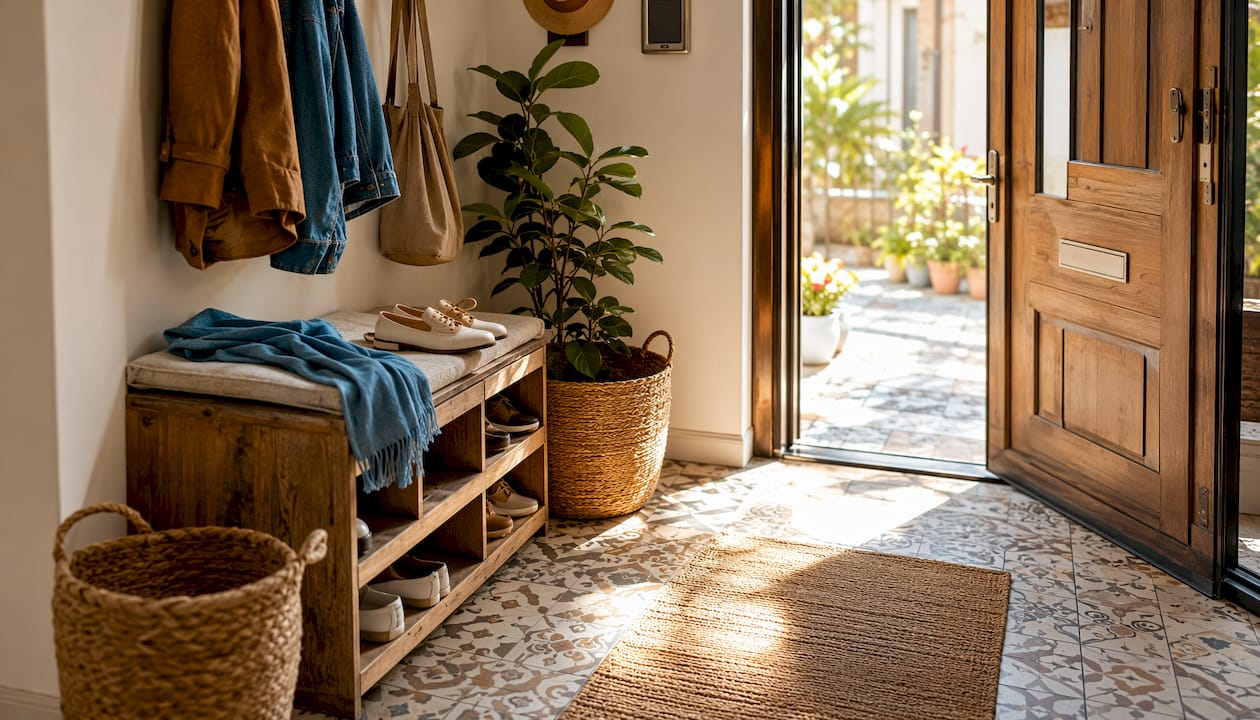
The entryway is where the whole home’s organization either holds or collapses. A functional entryway needs three things: a place for shoes, a spot for bags and coats, and a small landing area for keys and mail. A vertical mail sorter processes paper before it piles up. When the entryway works, everything that enters the house has a path to where it belongs.
Storage solutions that reduce dust and dirt buildup
How you store things directly affects how much dust accumulates and how hard surfaces are to clean. Open shelving looks appealing but collects dust on every surface and every item. Closed storage, whether cabinets, drawers, or lidded bins, keeps items protected and reduces the number of surfaces that need wiping.
A few storage choices that pay off in cleaning time:
- Clear bins with labels. You can see what’s inside without opening them, which means less rummaging and less disruption to organized spaces. In closets and under sinks, clear bins keep categories visible and accessible.
- Vertical storage. Pegboards, wall-mounted hooks, and shelving keep items off the floor and counters. Floors and counters that are clear of items are dramatically faster to clean.
- Trays as micro-zones. A tray on a bathroom counter or kitchen island groups loose items so they can be moved as a unit during cleaning. This is one of the highest-return organizing moves for cleaning ease.
- Limit open shelving in dusty areas. Bookshelves, open pantry shelves, and display shelves in living areas require regular dusting of both the shelf and every item on it. Consolidating to fewer open surfaces reduces that load.
- Store seasonal items in labeled bins in deep storage. Rotating seasonal items out of prime storage keeps everyday spaces clear and reduces the clutter that makes cleaning awkward.
The principle connecting all of these is surface reduction. Every horizontal surface that’s clear of items is a surface you can wipe in one pass. Every item stored behind a door or in a bin is an item that doesn’t need dusting. Organizing with that lens changes how you think about storage choices.
For a deeper look at how professional cleaners approach these spaces, Octomaids has a practical breakdown of what professional cleaners do differently that’s worth reading alongside your own organizing efforts.
Choosing furniture and materials that are easy to clean
The surfaces and furniture you live with either work with your cleaning routine or against it. Choosing materials with cleaning ease in mind is one of the most durable time-saving decisions you can make for your home.
Flooring is the biggest factor. Smooth, hard floors like hardwood, luxury vinyl plank, or tile are far faster to clean than carpet. Carpet traps dust, pet hair, allergens, and spills in ways that require significantly more effort to address. If carpet is already in place, low-pile options are easier to vacuum and less likely to trap debris than thick, plush styles.
Upholstery matters more than most people realize. Tight-weave fabrics and leather or faux-leather surfaces wipe clean quickly. Loose-weave textiles, velvet, and heavily textured fabrics trap pet hair and dust and require more frequent, more intensive cleaning. Slipcovers on sofas and chairs offer a practical middle ground: they protect the furniture and can be machine-washed.
Countertops vary widely in maintenance demands. Quartz is non-porous and resists staining without sealing. Natural stone like marble requires periodic sealing and is more vulnerable to acidic spills. Laminate is affordable and easy to wipe but can be damaged by heat. For busy kitchens, quartz or a sealed solid surface tends to be the lowest-maintenance choice.
Furniture with legs is consistently easier to clean under than furniture that sits flush to the floor. Sofas, beds, and storage units raised on legs allow a vacuum or mop to pass underneath without moving the piece. Furniture that sits on the floor creates a perimeter where dust and debris accumulate invisibly.
Matte finishes on walls and cabinetry hide fingerprints and smudges better than high-gloss finishes, which show every mark. In high-traffic areas like hallways and kitchens, a satin or eggshell paint finish offers a balance: it’s washable without showing every touch.
When you’re ready to bring in professional support for the deeper work, Octomaids offers recurring cleaning services for homeowners throughout Vancouver, WA and the Portland Metro area. Our team works with the systems you’ve built to keep your home consistently clean between your own maintenance routines.
Key Takeaways
Organizing your home for easy cleaning means building simple, friction-reducing systems where every item has a logical home, daily habits replace reactive cleaning, and storage choices actively minimize dust and mess.
| Point | Details |
|---|---|
| Every item needs a home | Assigning a specific place to each item removes daily decisions and makes tidying automatic. |
| Daily habits beat deep cleaning | A five-minute nightly reset and one daily laundry load prevent the buildup that requires major cleaning sessions. |
| Declutter before organizing | Containers and bins only work when they hold things you actually use; reduce first, then contain. |
| Match systems to real behavior | Place storage where items naturally land, not where they “should” go, to reduce friction and maintain order. |
| Material choices affect cleaning time | Hard floors, tight-weave upholstery, and furniture on legs are consistently faster to clean than their alternatives. |
FAQ
What is the 5-5-5 rule for decluttering?
The 5-5-5 rule means identifying five items to toss, five to donate, and five to return to their proper place each day. This daily practice takes under 10 minutes and prevents clutter from accumulating gradually over time.
How do you clean and organize your house quickly?
Start by picking up clutter and staging items to return to their zones, then clean top-to-bottom in each room, carrying all supplies in a single caddy. Prioritizing the kitchen and bathrooms first gives you the biggest visible return in the shortest time.
What is the 80/20 rule for house cleaning?
Focusing your daily cleaning effort on kitchen counters, bathroom sinks, entryway floors, and high-traffic living areas keeps the home looking clean with far less total time spent.
What are the 4 C’s of decluttering?
The 4 C’s is not a single standardized framework, but a common version covers: Clear (remove everything from the space), Categorize (group like items together), Cut (remove what you don’t use or love), and Contain (store what remains in appropriate bins or zones). The sequence matters because organizing before decluttering just means neatly storing things you don’t need.