
The fastest way to organize a cleaning supplies closet is an 8-step system built around the 5-Zone Utility Closet Rule: Edit → Group → Clean → Zone → Contain → Label → Inventory → Maintain. Daily items go at eye level, hazardous chemicals stay low, backups live up high, tall tools stand on the floor, and small items mount on the door so you can grab what you need and restock in under two minutes.
TL;DR — pin this to your closet door:
- Empty the closet completely before you do anything else
- Discard expired products; donate anything unused for six months
- Keep a moderate number of daily items in a portable caddy at eye level
- Store heavy or hazardous chemicals on the low shelf, secured
- Move backup stock to the upper shelf (one-step rule: never stack more than one item deep)
- Mount tools on the floor or wall; use the door for small flat storage
- Record every item in one spreadsheet or app — never rely on memory
Pro Tip: Set a timer and know that many overwhelming closets take under an hour to sort once everything is pulled out and laid on the floor.
Table of Contents
- What to gather before you organize your cleaning closet
- Step-by-step workflow to organize cleaning supplies
- The 5-Zone Utility Closet layout explained
- Safe storage and disposal of hazardous cleaning products
- A simple inventory system that actually gets used
- Janitorial closet best practices for businesses
- How long does it take and what does it cost?
- Key Takeaways
- Why a tidy closet changes how well you clean
- Octomaids handles the cleaning when you’d rather not
- Useful sources and further reading
- FAQ
What to gather before you organize your cleaning closet
Starting without the right supplies on hand is the single fastest way to abandon a project halfway through. Pull these together before you touch the closet.
Containers and storage:
- Clear stackable bins in two sizes (large for bulk, small for sponges and brushes)
- A shallow portable caddy for daily grab-and-go items
- Lidded bins or small plastic trays for chemical storage (secondary containment)
- Over-the-door organizer or tension rod for spray bottles
Safety and sorting:
- Nitrile gloves and safety goggles if you’re handling old or unknown chemicals
- One trash bag and one donate box, placed outside the closet before you start
- Paper towels and an all-purpose cleaner to wipe shelves once they’re empty
Labeling and inventory:
- A label maker, or painter’s tape and a permanent marker
- A smartphone (for a Google Sheets template) or a printed inventory sheet
- A clipboard to hang inside the door once the system is live
Pro Tip: Recruit one helper for the sorting phase. Two people cut the decision time on “keep or toss” in half and keep the energy up through the purge.
Step-by-step workflow to organize cleaning supplies
Follow these eight steps in order. Skipping the first one — editing — is why most organizing attempts fail within a month.
- Edit. Pull everything out. Discard products that are expired, nearly empty, or haven’t been touched in six months. Professional organizers call this the mandatory first step: you cannot organize a junk cabinet into a functional one.
- Group. Sort what remains into task categories: bathroom, kitchen, glass, floor care, paper goods, PPE. Then sort each category by frequency: daily, weekly, bulk/backup.
- Clean. Wipe every shelf and the floor of the closet before anything goes back. Check for old drips or residue that could contaminate new containers.
- Zone. Assign each group to its zone using the 5-Zone layout (detailed in the next section). Do this on paper or mentally before moving a single item back in.
- Contain. Place each group in a clear bin so the contents are visible at a glance. Use a portable caddy for the 8–12 items you reach for every single day.
- Label. Mark every bin and bottle with its category. For diluted solutions, add the dilution ratio. For bulk items, add the date opened.
- Inventory. Record each item: name, location, quantity on hand, and par level. A simple spreadsheet takes about 15 minutes to build and prevents every future emergency run.
- Maintain. Two-minute weekly reset, monthly quick count, quarterly purge. The system only holds if maintenance is scheduled, not improvised.
The 5-Zone Utility Closet layout explained
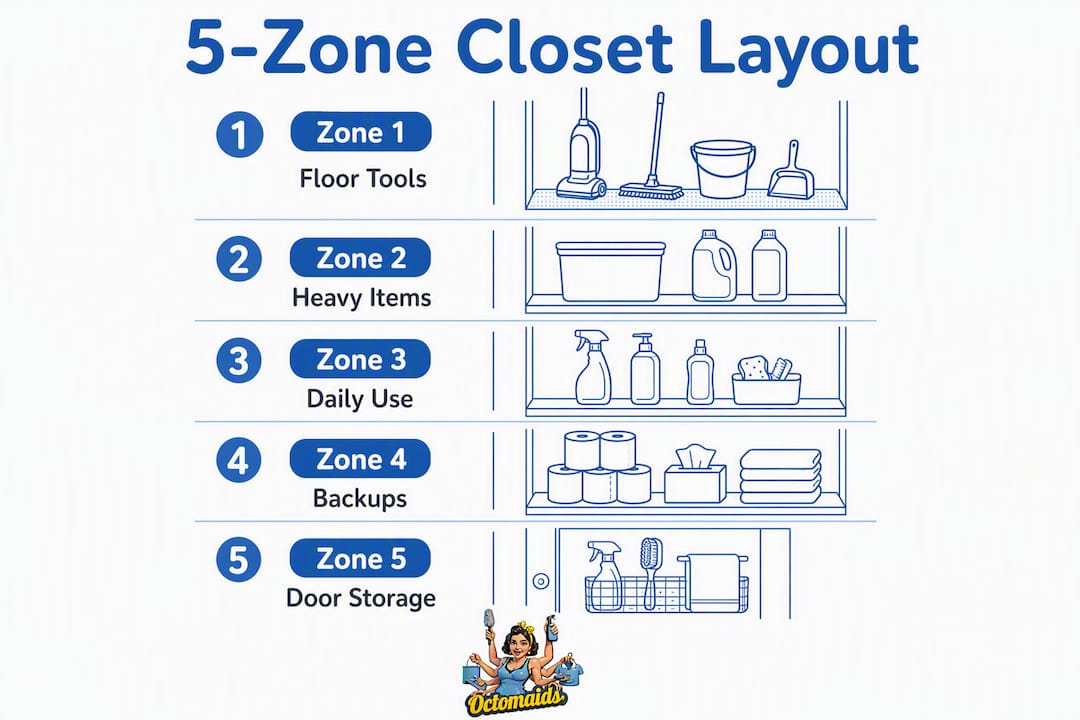
The 5-Zone Utility Closet Rule divides your closet from floor to ceiling so every item has a permanent, logical home. Here is exactly what belongs where.
Zone 1 — Floor: Tall tools only. Vacuums, mop buckets, brooms, and mops stand here. Mount brooms and mops on a spring-loaded wall holder to keep them upright and free up floor space for the vacuum.
Zone 2 — Low shelf: Heavy and hazardous items. Bulk chemical refills, large containers of bleach or ammonia-based cleaners, and anything with a warning label lives here. Storing these low reduces the risk of a spill from overhead and keeps them away from children who might climb. Use a lidded bin or a small plastic tray underneath open containers to catch drips.
Zone 3 — Eye level: Your daily grab items. All-purpose cleaner, microfiber cloths, disinfecting wipes, and your portable caddy all live here. This is the zone you open most often, so keep it lean: only active, in-use products. Deep cabinets at this level become black holes fast — apply the one-step rule and never stack items more than one layer deep. A lazy Susan or pull-out bin fixes reach problems immediately.
Zone 4 — Upper shelf: Backups and specialty products used less than once a month. One backup per product is enough. If reaching the upper shelf requires a step stool, that friction is intentional — it keeps you from overstocking.
Zone 5 — Door and walls: Small flat storage. A tension rod near the top of the door lets spray bottles hang by their triggers, reclaiming shelf space entirely. Add binder clips for gloves, a pencil holder for scrub brushes, and a clipboard for your inventory checklist.
| Zone | Location | What goes here | Container type |
|---|---|---|---|
| 1 | Floor | Vacuums, mops, brooms | Wall-mounted tool holder |
| 2 | Low shelf | Bulk chemicals, large refills | Lidded bin + drip tray |
| 3 | Eye level | Daily items, caddy | Clear open-top bin, caddy |
| 4 | Upper shelf | Backups, specialty products | Clear stackable tote |
| 5 | Door/walls | Spray bottles, gloves, brushes | Tension rod, hooks, pencil holder |
If you’re considering a full shelving overhaul rather than just reorganizing what you have, custom closet solutions can make the 5-Zone layout permanent and far easier to maintain.
Safe storage and disposal of hazardous cleaning products
Cleaning chemicals are among the most commonly mishandled household items. A few non-negotiable rules keep your home or business safe.
Storage checklist:
- Keep every product in its original container with the label intact
- Never store bleach and ammonia-based cleaners on the same shelf — mixing their vapors is dangerous
- Store flammable products away from heat sources, open flames, and hot pipes
- Use a locked or lidded bin if children or pets have access to the closet
- Keep the closet dry and temperature-controlled; heat accelerates chemical breakdown
Disposal and Safety Data Sheets (SDS): An SDS is a standardized document that lists a product’s hazards, safe handling instructions, and disposal requirements. For household products, the U.S. Consumer Product Safety Commission recommends checking the product label for disposal guidance; many municipalities offer hazardous waste drop-off days for items like old solvents or concentrated disinfectants. Never pour concentrated chemicals down the drain without checking the label first.
For janitorial operations: Label every diluted solution with its ratio and the date mixed. Keep a spill kit and PPE accessible on the same shelf as your chemical storage.
Pro Tip: Place a small plastic tray under any open container on the low shelf. A single drip caught by a tray takes five seconds to wipe; a drip that soaks into a shelf takes twenty minutes and a scraper.
A simple inventory system that actually gets used
Head-based inventory — keeping stock levels in memory — causes emergency runs, duplicate purchases, and the quiet frustration of running out of paper towels mid-clean. One digital source of truth fixes all three.
Three low-friction options:
- Google Sheets + Form: Free, shareable, and filterable. A formula flags any item below par level in red. Works well for households and small businesses with one or two sites.
- Simple inventory app: Apps like Sortly offer a free tier with barcode scanning. Better for businesses managing multiple product SKUs.
- Printed binder: No tech required. Works for households that prefer paper. Pair it with a clipboard on the closet door.
Sample inventory fields:
| Field | Purpose |
|---|---|
| Item name | What it is |
| Location | Which zone/shelf |
| Unit size | Oz, rolls, count |
| Quantity on hand | Current stock |
| Par level | Minimum before reorder |
| Reorder trigger | “If qty ≤ par, add to list” |
| Last updated | Date of last count |
A free spreadsheet template with these fields is available to download and adapt immediately. Google Sheets workflows can also automate low-stock alerts with a simple formula, removing the need to remember reorder points at all.
Pro Tip: Do your weekly count during the two-minute reset. Walk the closet, glance at quantities, and update the sheet on your phone before you close the door. The whole process takes under three minutes once the system is set up.
Janitorial closet best practices for businesses
For office managers and small janitorial operations, a disorganized supply room costs real time across every shift. The fix is standardization, not more storage.
- Standardize the layout across all sites. When every location uses the same 5-Zone arrangement and the same label format, any cleaner can find supplies immediately, even at an unfamiliar site.
- Assign roles clearly. A site lead handles the weekly physical count and flags low stock. A central manager handles bulk reordering and adjusts par levels monthly based on actual usage.
- Set site-specific par levels. A high-traffic office burns through paper towels and disinfectant wipes far faster than a small retail space. Par levels should reflect actual consumption, not a generic default.
- Reconcile monthly. Compare physical counts against usage logs to catch shrinkage, waste, or a product that’s consistently running low before it becomes a problem.
Pro Tip: Keep a small emergency kit on-site: one spare mop head, a small bottle of disinfectant, and two extra microfiber cloths. Log every time the kit is used. If it’s being used regularly, that item needs a higher par level in the main inventory.
How long does it take and what does it cost?
| Scenario | Time estimate | DIY cost | Pro service |
|---|---|---|---|
| Small closet | 30–60 min | — | Included in a one-time deep clean |
| Standard utility closet | 60–120 min | — | — |
| Multi-site business room | 2–4 hours per site | — | Custom quote; often bundled with janitorial setup |
DIY costs cover clear bins, a portable caddy, a label maker or tape, and basic wall hardware. Safety equipment (gloves, goggles) and mounting hardware add a small amount on top.
Hiring a professional makes the most sense when the closet hasn’t been touched in years, when hazardous materials need proper disposal, or when you simply don’t have two hours to spend on it. Pairing a closet organization session with a one-time deep clean is often the most efficient use of that appointment.
Pro Tip: For busy homeowners and managers, the real cost of a disorganized closet is time lost on every single cleaning visit. A one-time investment of two hours or a professional session pays back quickly.
Key Takeaways
A well-organized cleaning closet runs on one principle: every item has a fixed zone, a label, and a par level so you never search, guess, or overbuy.
| Point | Details |
|---|---|
| Edit before organizing | Discard expired and unused products first; organizing clutter just hides it. |
| Use the 5-Zone layout | Floor for tools, low shelf for hazards, eye level for daily items, upper shelf for backups, door for small storage. |
| Keep a single inventory source | One spreadsheet or app with par levels prevents emergency runs and duplicate purchases. |
| Maintain weekly | A two-minute weekly reset and monthly count keeps the system from reverting to chaos. |
| Octomaids can help | For homeowners and businesses in Vancouver, WA and Portland, OR, Octomaids offers one-time deep cleans and janitorial services that include supply organization support. |
Why a tidy closet changes how well you clean
There’s something our team notices on nearly every job: the homes and offices where cleaning goes smoothly are the ones where supplies are already organized. Not perfectly styled — just logical. Everything in a known place, a caddy ready to grab, and no ten-minute search for the right product before the work even starts.
From a professional standpoint, an organized closet isn’t about aesthetics. It’s about removing friction from a task most people already find tedious. When the all-purpose cleaner is always at eye level and the backup bottle is always on the upper shelf, the mental load of cleaning drops noticeably. You stop making decisions mid-task and start moving through rooms with a rhythm.
The inventory piece is where I see the biggest gap in both homes and small businesses. Most people run on memory until they run out of something at the worst possible moment. A simple spreadsheet with par levels takes 15 minutes to build and eliminates that problem permanently. It’s one of the lowest-effort, highest-return changes you can make to how your household or business operates.
Octomaids handles the cleaning when you’d rather not
If your closet hasn’t been touched in years, or you’re managing a commercial space with multiple supply rooms, the organizing session itself can feel like a full project before any actual cleaning happens. That’s exactly when it makes sense to hand it off.
Octomaids has served homeowners and businesses across Vancouver, WA and Portland, OR since 2006. Our background-checked teams handle one-time deep cleans, recurring residential service, and commercial janitorial work for offices and small businesses throughout Clark County and the Portland Metro area. For businesses specifically, our janitorial teams arrive with organized supply kits and can help establish the kind of consistent closet setup described in this article. You get the same trusted cleaners every visit, which means the system stays consistent.
Ready to skip the project entirely? Book a cleaning service with Octomaids and let our team handle the hard part.
Useful sources and further reading
- 5-Zone Utility Closet Rule — Home Organize Hacks: primary source for the zone-by-zone layout used throughout this article.
- Caddy + centralized storage system — Refresh Routine: supports the portable caddy recommendation and daily item selection.
- Edit-first principle — The Strategist / NYMag: professional organizer guidance on purging before organizing, plus the one-step rule.
- Digital inventory best practice — Janitorial Manager: janitorial-grade guidance on avoiding head-based inventory and setting par levels.
- Free inventory spreadsheet template — Spreadsheet Daddy: downloadable template with SKU, par level, and expiration fields.
- Google Sheets inventory workflow — Simular.ai: step-by-step setup for automated low-stock alerts.
- Safe chemical storage guidance — The Spruce: practical rules for temperature, separation, and child safety.
- Tension rod and door storage hacks — Better Homes & Gardens: vertical space solutions for spray bottles, gloves, and small tools.
FAQ
What is the 5-Zone Utility Closet Rule?
The 5-Zone Utility Closet Rule divides a cleaning closet from floor to ceiling: Zone 1 (floor) for tall tools, Zone 2 (low shelf) for heavy or hazardous items, Zone 3 (eye level) for daily grab items, Zone 4 (upper shelf) for backups, and Zone 5 (door/walls) for small flat storage like spray bottles and gloves.
How long does it take to organize a cleaning supplies closet?
A small closet takes 30–60 minutes; a standard utility closet typically takes 60–120 minutes. Multi-site business supply rooms run 2–4 hours per location.
What should I keep in my portable cleaning caddy?
Limit the caddy to 8–12 daily-use items: all-purpose cleaner, disinfectant, glass cleaner, microfiber cloths, and a scrub brush. Everything else stays in its assigned zone in the closet.
How do I prevent running out of cleaning supplies?
Set a par level for each product and record it in a spreadsheet or app. The rule is simple: if the quantity on hand drops to or below the par level, add it to the reorder list immediately rather than waiting until it runs out.
When should I hire a professional instead of doing it myself?
Hire a professional when the closet hasn’t been organized in years, when hazardous materials need proper disposal, or when you’re managing a commercial space with multiple supply rooms. Octomaids offers one-time deep cleans and janitorial services for homeowners and businesses in Vancouver, WA and Portland, OR.

