


A complete office cleaning checklist runs on three layers: nightly high-touch disinfection, weekly detail work, and monthly deep maintenance across restrooms, breakrooms, reception, and workstations. Add documented SOPs, an SDS binder, PPE, and disinfectant dwell times, and you have a system, not just a list. The sections below break each layer into a route sheet you can hand to staff or a vendor tomorrow.
TL;DR:
- Regular cleaning should follow a strict nightly sequence, starting with restocking supplies and ending with a final walk-through to verify all tasks are complete.
- Weekly and monthly tasks include detailed dusting, deep-cleaning fixtures, inspecting HVAC filters, and addressing high surfaces to prevent office fatigue.
- Restroom cleaning requires careful order, distinct disinfectants for fixtures, and constant trash removal, not just when containers are full.
- PPE, SDS access, and color-coded cloths are essential to maintain safety, prevent cross-contamination, and ensure compliance with OSHA and EPA standards.
- Using documented SOPs and regular audits transforms cleaning from a routine into a verifiable quality system, whether done in-house or through a professional service.
Table of Contents
- Daily Office Cleaning Checklist: The Nightly Route
- Weekly and Monthly Tasks That Keep the Building Aging Well
- What Belongs in Each Room’s Cleaning Checklist?
- Supplies, PPE, and the Safety Rules Most Checklists Skip
- How to Turn a Checklist Into a Verifiable System
- How Octomaids Builds and Tests These Checklists
- Handling Biohazard and Medical Waste in an Office Setting
- A Publisher’s Take on What Actually Improves Compliance
- Octomaids Handles the Checklist So You Don’t Have To
- Where to Verify the Standards Behind This Checklist
- Sources
- FAQ
Daily Office Cleaning Checklist: The Nightly Route
The order matters more than most managers realize. Clean top to bottom and stock before you disinfect, or you’ll drag contamination from one surface to the next. A crew that empties trash last, after wiping desks, is just redistributing dust they already stirred up.
Here’s the sequence that avoids that problem:
- Restock first. Walk through with paper towels, soap, and liners before touching a single surface. You need supplies in hand, not a second trip halfway through.
- Disinfect high-touch points. Door handles, light switches, elevator buttons, shared phones, and conference room tables get wiped with an EPA-registered disinfectant, applied wet and left to sit for its full contact time.
- Service restrooms. Fixtures, mirrors, and floors, in that order, so drips land where you’re about to clean anyway.
- Reset the breakroom. Wipe counters, sanitize the sink, empty and rinse coffee equipment drip trays, and pull anything past its expiration from the shared fridge.
- Finish with floors. Vacuum carpet, dry mop hard surfaces, and spot mop entryways last, since that’s where the day’s dirt concentrates.
- Do a final walk. Check trash bins are liner-fresh, lights are off in unused rooms, and doors are secured.
A one-line nightly log, cleaner initials, time in and out, and any flagged issue, turns this from a hopeful routine into something you can actually verify a week later.
Pro Tip: Give each cleaner a laminated route card with the sequence numbered. It cuts wasted steps and keeps a rotating night crew from skipping the restock step when they’re rushed.
Weekly and Monthly Tasks That Keep the Building Aging Well
Daily tasks handle what people touch. Weekly and monthly tasks handle what accumulates when nobody’s looking, and that’s usually where offices start to feel tired even when the desks are clean.
Weekly work should include:
- Detailed dusting of shelves, picture frames, and vents
- Vacuuming upholstered chairs and fabric partitions
- Interior glass and partition cleaning
- Baseboard wipe-down along main walkways
- A full breakroom fridge purge, not just a surface wipe
- Rotating restroom disinfectant products to prevent buildup on fixtures
Monthly work should include:
- HVAC filter inspection, with replacement on whatever cadence your unit and occupancy demand
- High-dusting above eye level: light fixtures, ceiling vents, cabinet tops
- Carpet spot extraction in high-traffic zones like the front entry and copier area
- A deep restroom and appliance clean, including behind and under fixtures where routine service doesn’t reach
Occupancy should drive frequency, not the calendar alone. A 40-person open floor with a shared kitchen needs weekly tasks done twice as often as a 10-person satellite office. For a full breakdown of what qualifies as deep versus routine work, a room-by-room deep cleaning guide is worth reviewing before you set cadence.
What Belongs in Each Room’s Cleaning Checklist?
A generic “clean the office” instruction fails because every room has a different risk profile. Restrooms need disinfection; reception needs polish; workstations need care around electronics. Treat each zone as its own checklist.
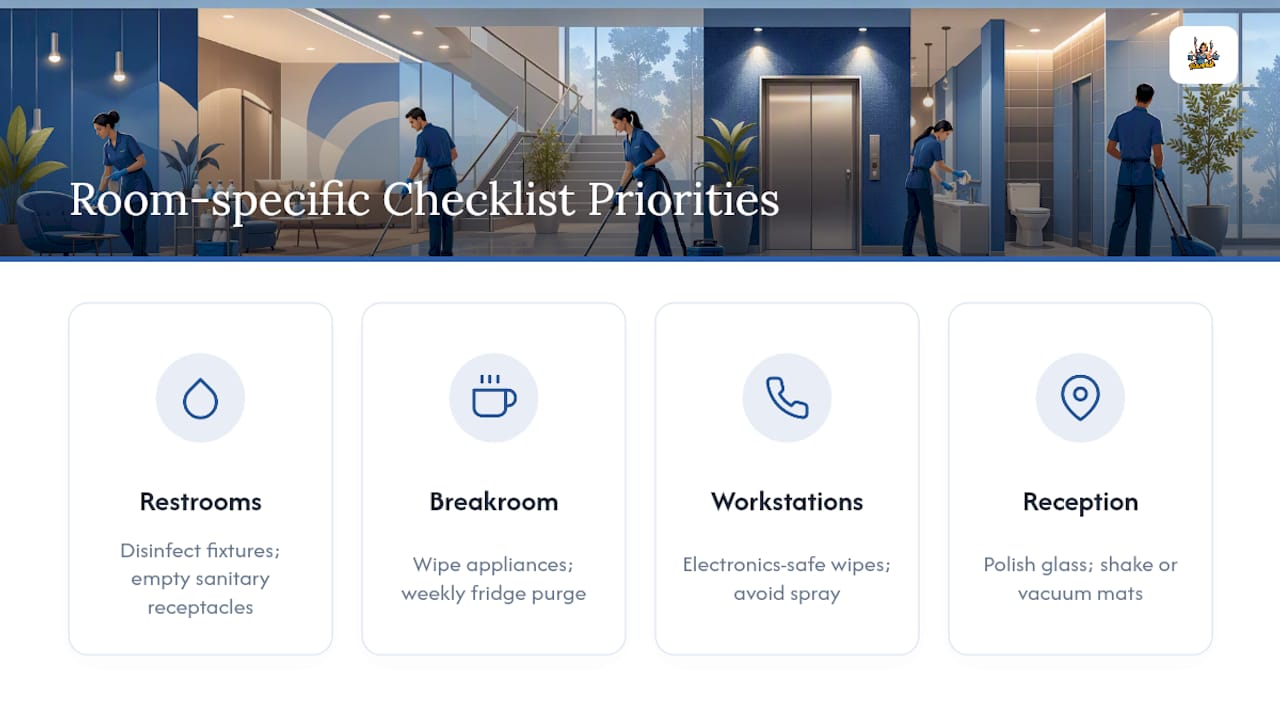
Restrooms follow a strict order: stock supplies, dust from the top down, disinfect fixtures, then mop. Sanitary receptacles get emptied and lined every visit, not just when full, and the disinfectant used on toilet and urinal surfaces should differ from general-purpose cleaners since cleaning, sanitizing, and disinfecting are distinct steps with different chemical requirements.
Break room and kitchen tasks include wiping appliance exteriors (microwave, coffee maker, fridge handles), sanitizing sinks and counters after every use spike, and running a scheduled fridge purge, typically weekly, so forgotten lunches don’t become a food-safety problem.
Workstations and conference rooms need electronics-safe methods: disinfectant wipes rated for screens, never spray-and-wipe near keyboards, and cable-safe dusting that doesn’t yank cords loose. Shared devices, phones, tablets, badge readers, get disinfected daily since multiple hands touch them.
Reception and entry is the first impression, so glass gets polished streak-free, doormats are shaken out or vacuumed to cut tracked-in grit, and the checklist should flag anything visually off, scuffed walls, dead plants, before a visitor notices it first.
Supplies, PPE, and the Safety Rules Most Checklists Skip
A checklist is only as good as what’s behind it. Employers are required to maintain sanitary facilities and follow Hazard Communication rules under OSHA’s standard, which means every chemical on-site needs a corresponding Safety Data Sheet, and staff need training on how to read one.
By the numbers: Serious OSHA violations can carry penalties up to $16,550 per incident as of January 2026, a cost that makes an SDS binder and basic PPE training cheap insurance by comparison.
Beyond compliance, a few equipment choices genuinely change outcomes:
- Color-coded microfiber cloths (one color for restrooms, another for kitchens) prevent cross-contamination between zones.
- HEPA-filter vacuums cut down on recirculated dust, which matters for indoor air quality in carpeted offices.
- Disinfectant dwell time isn’t optional. Products need to stay wet on a surface for the contact time listed on the EPA label, often several minutes, or they don’t work as claimed.
How to Turn a Checklist Into a Verifiable System
A checklist taped to a supply closet door doesn’t survive staff turnover. Written SOPs do. Break each zone into its own SOP with assigned frequency, then fold those into your scope-of-work document if you’re contracting the work out.
- Write zone-by-zone SOPs specifying task, frequency, and product used.
- Log nightly. A simple sheet with initials, time, and flagged issues is enough.
- Walk through weekly. Compare the space against the SOP, not against memory.
- Track a completion-rate KPI. Even a rough percentage catches drift before it becomes a pattern.
ISSA’s CIMS standard frames this well: a written quality plan with documented performance measures is what separates real quality management from box-checking. If you’re hiring a vendor, ask for exactly that, plus onsite SDS access and periodic supervisor visits, before signing anything. If you’d rather build the schedule yourself first, this guide to creating an office cleaning schedule walks through the frequency math.
Pro Tip: Ask any vendor for a sample audit log before you sign. If they can’t produce one, they’re probably not running one.
How Octomaids Builds and Tests These Checklists
Octomaids has served Vancouver, WA and Portland, OR since 2006, running commercial janitorial alongside residential work. Steven, who helped shape the checklists behind our recurring and office cleaning services, built these routines from real vendor SOPs, not theory. Want to see one applied to your space? Request a sample checklist or a walkthrough.
Handling Biohazard and Medical Waste in an Office Setting
Most offices never touch true biohazard waste, but it happens more than managers expect: a break room injury, a spill of bodily fluid, or a medical device left in a shared bin. General janitorial staff should not handle these without specific training, since standard SOPs and disinfectants aren’t built for that category of risk.
The baseline rule is separation. Any waste contaminated with blood or bodily fluid needs its own labeled, leak-resistant container, kept apart from regular trash and recycling, and disposed of through a licensed medical waste hauler rather than the standard trash pickup. Cleaning staff handling a spill should use disposable gloves at minimum, and ideally a face shield if there’s splash risk, then dispose of the cleaning materials in the same segregated container.
Offices with on-site health services, a nurse’s station, an on-site clinic, or even a first-aid room with sharps, have a higher bar. Sharps need a rigid, puncture-resistant container, never a standard trash bag, and staff should know who on the property is authorized to seal and remove it.
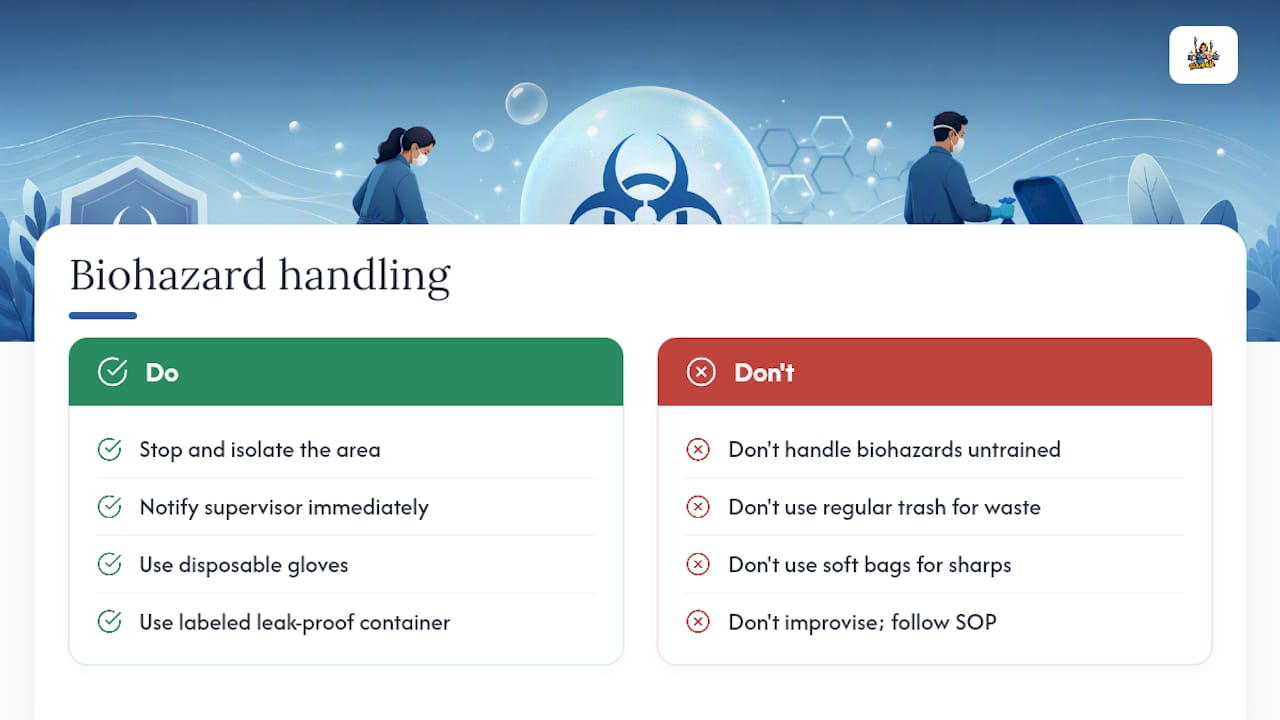
Write this into your SOP explicitly rather than assuming common sense will cover it. A cleaner who encounters an unexpected biohazard needs a clear instruction: stop, isolate the area, and notify a supervisor, rather than improvising with whatever’s in the cleaning cart. That single line in a written procedure prevents the kind of exposure incident that turns into a real liability problem.
A Publisher’s Take on What Actually Improves Compliance
A short end-of-shift photo log, paired with a light weekly audit, beats strict punitive checks. Training and recognition build consistency faster than fear does.
— Steven
Octomaids Handles the Checklist So You Don’t Have To
If building and auditing this system in-house sounds like more oversight than your week has room for, that’s exactly the gap Octomaids fills. Octomaids runs recurring commercial janitorial service with documented SOPs and the same dedicated team assigned to your office every visit, so you’re not re-training a new crew on your restroom sequence every month.
That consistency is the real advantage over building an internal program from scratch: no hiring, no SDS binder to assemble yourself, no audit log to design. Serving Vancouver, WA and the Portland metro area, Octomaids can walk your space, map it against a checklist like the one above, and hand you a fixed quote. Visit the office cleaning services page to request a sample checklist and get a quote for your building.
Where to Verify the Standards Behind This Checklist
For employer obligations and SDS rules, check OSHA’s sanitation standard. For dwell times, consult EPA’s disinfectant guidance. For quality-management frameworks, review ISSA’s CIMS standard. For infection-control context, see WHO’s cleaning guidance.
Sources
- OSHA — Restrooms and sanitation
- ISSA — Cleaning Industry Management Standard (CIMS)
- WHO — Cleaning and disinfecting surfaces in non-health-care settings
FAQ
What Is the Checklist for Cleanliness of Offices?
A complete office cleaning checklist covers daily high-touch disinfection and trash removal, weekly detail work like dusting and upholstery vacuuming, and monthly deep tasks like HVAC filter checks and carpet extraction, organized zone by zone.
How Do You Professionally Clean an Office?
Professional cleaning follows a fixed sequence: restock supplies, disinfect top to bottom, service restrooms and breakrooms, then finish with floors, all logged and audited against a written SOP rather than done from memory.
What Is the 20 Minute Rule in Cleaning?
The concept of allotting a specific amount of time to each zone or task during a shift helps keep a route on schedule; it’s a scheduling habit rather than a formal cleaning standard.
What Is Expected of an Office Cleaner?
An office cleaner is expected to follow documented task sequences, use PPE and chemicals correctly per their Safety Data Sheet training, disinfect high-touch surfaces daily, and log completed work for audit.
How Often Should an Office Restroom Be Cleaned?
Office restrooms need disinfection at least once daily in most offices, with higher-traffic buildings requiring midday touch-ups on top of the nightly deep service.
Recommended
- How to Create an Office Cleaning Schedule That Works
- Shared Workspace Sanitation Best Practices Managers Can Use Today
About Octomaids
Octomaids is a locally operated professional cleaning company serving Vancouver, Clark County, and the surrounding Portland metro area. Since 2006, our cleaning teams have helped homeowners, renters, property managers, and businesses with recurring cleaning, deep cleaning, move-in/move-out cleaning, and commercial cleaning.
Our cleaning articles are reviewed to ensure the information reflects our real-world experience and professional cleaning practices.