



Maintaining a clean home when you work long hours is achievable. The key is replacing sporadic deep cleans with a structured system built on daily micro-tasks, a rotating weekly schedule, and smart automation. Busy professionals and families who maintain home cleanliness consistently do so not by working harder, but by working within realistic time limits. This guide breaks down exactly how to build that system, reduce mental load, and keep your home functional without sacrificing rest.
How to keep home clean with long hours using a daily reset
The foundation of any effective cleaning system for busy people is the daily reset routine. Experts recommend a 15–20 minute daily reset that covers kitchen surfaces, one laundry cycle, and a 5-minute clutter pickup. That short window is enough to prevent mess from compounding overnight into something that takes an entire weekend to fix.
The concept behind this is called the “Minimum Viable Clean.” Think of it as the lowest acceptable standard of tidiness that keeps your home functional and your stress manageable. You are not aiming for a showroom. You are aiming for a home that does not feel like a burden when you walk through the door after a 10-hour shift.

A timer is your best ally here. Using a timer for your reset session creates urgency and stops tasks from expanding beyond their allotted time. Without a timer, a quick wipe-down of the kitchen can drift into reorganizing the pantry. With one, you stay focused and finish on schedule.
Pro Tip: Stack your reset routine onto an existing habit. Start the dishwasher right after dinner, toss laundry in while your coffee brews in the morning, and do your clutter pickup during a phone call. Habit stacking removes the decision of when to clean.
Here is a sample daily reset broken into timed tasks:
| Task | Estimated Time |
|---|---|
| Wipe kitchen counters and stovetop | 5 minutes |
| Load or switch laundry | 3 minutes |
| Clutter pickup (living room, entryway) | 5 minutes |
| Quick bathroom wipe (sink and toilet) | 4 minutes |
| Sweep or spot-vacuum high-traffic floor | 3 minutes |
Keep your cleaning tools visible and within reach. A spray bottle on the counter and a microfiber cloth on the sink edge remove the friction of getting started. When the tools are already out, you are far more likely to use them.
How to organize a weekly cleaning schedule that fits a busy lifestyle
A rotating weekly schedule is the single most effective way to avoid the dreaded Saturday marathon clean. The principle is simple: assign one or two specific tasks to each weekday, limit each session to 20–30 minutes, and rotate through the full home over seven days. Nothing gets neglected, and nothing becomes overwhelming.
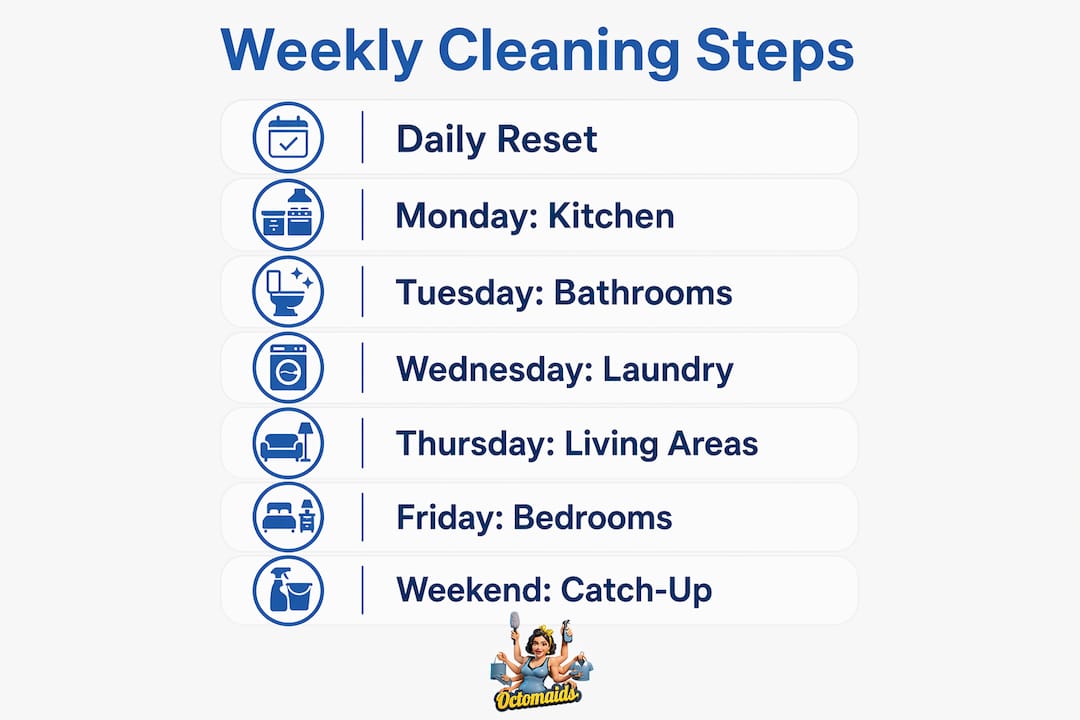
Cleaning schedules with assigned days eliminate daily decision fatigue. When you already know that Wednesday is floors and Thursday is bathrooms, you do not spend mental energy deciding what to clean. That conserved energy matters enormously after a long workday.
A practical weekly rotation looks like this:
- Monday: Bathrooms (toilet, sink, mirror, floor)
- Tuesday: Dusting (shelves, ceiling fans, baseboards)
- Wednesday: Floors (vacuum and mop)
- Thursday: Kitchen deep clean (appliances, inside microwave, sink)
- Friday: Laundry and linen change
- Saturday: Catch-up or optional (30 minutes maximum)
- Sunday: Rest. No cleaning.
The flexibility built into this system matters as much as the structure. If you miss Thursday’s kitchen clean, move it to Saturday’s catch-up slot. Working parents benefit most from systems designed to flex with household chaos rather than collapse under it. Rigid perfection is the enemy of consistency.
Limiting weekend cleaning to 30–45 minutes maximum is a non-negotiable boundary worth protecting. When weekends feel like unpaid cleaning shifts, motivation collapses by the following week. The goal is a predictable rhythm that you can sustain for months, not a burst of effort that burns out in three weeks.
Pro Tip: Write your weekly schedule on a whiteboard or sticky note inside a cabinet door. Seeing it daily keeps the habit visible without making your home feel like an office.
What tools and automation strategies save time for busy households
The right tools cut cleaning time dramatically. Robot vacuums reclaim up to 60 minutes per week by running scheduled floor cleaning while you rest, cook, or sleep. That is an hour of manual labor eliminated without any active effort on your part.
Cordless vacuums are equally valuable for spot cleaning. They remove the friction of pulling out a full-size vacuum for a small mess, which means you actually clean the mess instead of walking past it. Pre-mixed cleaning sprays in labeled bottles under every sink serve the same purpose: zero setup time means zero excuses.
The spray-and-walk-away technique is a professional shortcut worth adopting immediately. Spray your bathroom surfaces or stovetop, let the cleaner sit for 3–5 minutes while you do another quick task, then return and wipe. The chemical does the scrubbing work for you. This approach cuts physical effort significantly and works especially well on soap scum and grease.
Here is a quick list of tools that deliver the highest return for busy households:
- Robot vacuum: Scheduled daily floor cleaning with zero manual effort
- Cordless vacuum: Instant spot cleaning without setup time
- Pre-mixed spray bottles: One per bathroom and kitchen, always loaded and ready
- Microfiber cloths: Faster and more effective than paper towels on most surfaces
- Timed dishwasher: Set to run overnight so dishes are clean by morning
Pro Tip: Place a small caddy with your most-used cleaning supplies in each bathroom. Carrying supplies room to room wastes time and reduces the chance you will clean on impulse.
You can also explore weekly tasks worth automating to identify which chores in your specific home are the best candidates for a hands-off approach.
What mindset shifts help you maintain cleanliness with limited time
The biggest obstacle to keeping a tidy home is not time. It is the belief that cleaning must be done perfectly or not at all. That all-or-nothing thinking leads directly to the marathon weekend cleanup, which is exactly what you are trying to avoid.
Daily 10–20 minute micro-sessions are less draining and more effective than infrequent long sessions. The stress reduction alone justifies the habit. A home that is consistently “good enough” feels far better to live in than one that swings between spotless and chaotic.
“The goal is not a perfect home. The goal is a home that supports your life. A functional, reasonably tidy space reduces background stress, improves focus, and makes rest feel like actual rest.”
Resting 20 minutes after work before starting any chores significantly improves willpower and task performance. Post-work decision fatigue is real. Jumping straight from your commute into cleaning produces slower, lower-quality results than taking a short recovery window first.
Catch-all bins are a practical tool for managing the psychological barrier of a messy surface. Catch-all bins placed in high-traffic areas temporarily contain clutter without requiring you to sort and put everything away immediately. You clear the bin once a week during your scheduled reset. Surfaces stay clear, and the mental weight of visible mess stays low.
A few mindset rules worth keeping:
- Delegate tasks. Shared household responsibility is not optional when both adults work full time.
- Declutter regularly. Fewer objects mean fewer things to clean around.
- Avoid the “I’ll do it all this weekend” trap. That weekend never feels as free as you imagined.
- Accept that some weeks will be messier than others. The system absorbs that variation.
Key Takeaways
A consistent daily reset of 15–20 minutes, combined with a rotating weekly schedule and targeted automation, is the most effective system for keeping a home clean with long working hours.
| Point | Details |
|---|---|
| Daily reset routine | A 15–20 minute daily session covering kitchen, laundry, and clutter prevents mess from compounding. |
| Rotating weekly schedule | Assigning one task per weekday in 20–30 minute sessions eliminates decision fatigue and weekend overload. |
| Automation tools | Robot vacuums and cordless vacuums reclaim significant weekly time with zero active cleaning effort. |
| Minimum Viable Clean | Accepting a functional rather than perfect standard reduces stress and sustains long-term consistency. |
| Post-work rest window | A 20-minute recovery break before cleaning improves willpower and produces better results. |
What I’ve learned after years of watching busy households struggle with this
I have seen the same pattern repeat itself more times than I can count. A household runs fine for two weeks on a new cleaning schedule, then one brutal work week hits, the system falls apart, and the guilt spiral begins. The person does not need a better schedule. They need permission to lower the bar temporarily without abandoning the system entirely.
The households that maintain the cleanest homes are not the ones with the most time. They are the ones with the most consistent habits, even if those habits are small. A 10-minute reset done six days a week beats a three-hour Saturday clean every single time, both for cleanliness outcomes and for mental health.
My honest recommendation: start with just the daily kitchen reset for two weeks. Nothing else. Once that feels automatic, add one weekly task. Build the system slowly and it will hold. Try to implement everything at once and it collapses under its own weight.
Professional help is not a luxury or an admission of failure. For many busy professionals and families, integrating professional cleaning into their routine is simply the most rational use of their limited time. Outsourcing the deep work frees you to maintain the surface work, and that combination is genuinely sustainable.
— Steven
When your schedule needs professional backup
Some weeks, the system cannot keep up. A project deadline, a sick child, or back-to-back travel can leave a home in a state that no 20-minute reset will fix. That is exactly where Octomaids steps in.
Octomaids has served homeowners and businesses across Vancouver, WA and Portland, OR since 2006. Whether you need a recurring cleaning plan to maintain your home between your own efforts, or a one-time reset after a difficult stretch, the same trusted team shows up every visit. Explore the full range of residential and commercial cleaning services to find the option that fits your schedule and your home. Letting professionals handle the deep work is not giving up on your system. It is protecting it.
FAQ
What is the minimum daily cleaning time for a busy professional?
Experts recommend a 15–20 minute daily reset covering kitchen surfaces, one laundry cycle, and a quick clutter pickup. That window is enough to prevent mess from building into a larger problem.
How does a weekly rotating schedule prevent weekend cleaning overload?
Assigning specific tasks to each weekday in 20–30 minute sessions distributes the workload evenly across the week. By Saturday, the home is already maintained and no marathon session is needed.
What is the “Minimum Viable Clean” concept?
The Minimum Viable Clean is a practical baseline that prioritizes functionality over perfection. It reduces mental load by setting a realistic standard that keeps a home livable without requiring exhaustive effort after long workdays.
Should I clean immediately after getting home from work?
A 20-minute rest period after work improves willpower and task performance before cleaning. Jumping straight into chores after a long day produces slower, lower-quality results than taking a short recovery break first.
When does it make sense to hire a professional cleaning service?
Professional cleaning makes sense when your personal system cannot keep up with your schedule, or when deep cleaning tasks exceed what daily and weekly routines can address. Octomaids offers both recurring and one-time services for households across Clark County, WA and the Portland Metro area.